
Rigid flex pcb rules
1. Minimum bend radius:
The minimum bend radius for a rigid-flex PCB is typically 10 times the thickness of the thinnest layer in the stackup.
2. Trace width and spacing:
The trace width and spacing should be designed to ensure that the PCB can withstand the stresses of bending without breaking or cracking.
3. Hole size and placement:
The hole size and placement should be carefully considered to ensure that they do not interfere with the flexing of the PCB.
4. Copper weight:
The copper weight should be chosen to ensure that the PCB can withstand the stresses of bending without cracking or breaking.
5. Layer stackup:
The layer stackup should be carefully designed to ensure that the rigid and flexible layers are properly aligned and that there is sufficient space for the flexing of the PCB.
6. Solder mask:
The solder mask should be designed to ensure that it does not interfere with the flexing of the PCB.
7. Component placement:
The placement of components should be carefully considered to ensure that they do not interfere with the flexing of the PCB.
8. Testing:
Rigorous testing should be performed to ensure that the PCB can withstand the stresses of bending and that it meets all electrical and mechanical requirements.
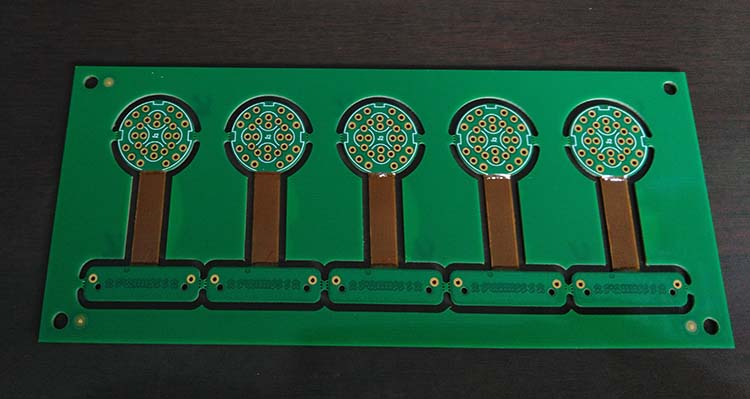
rigid and flex pcb
Rigid PCB (Printed Circuit Board) is a type of PCB that is made of a solid material, such as fiberglass or FR4.
It is inflexible and cannot be bent or twisted. Rigid PCBs are commonly used in electronic devices that require a stable and sturdy platform for the components to be mounted on.
Flex PCB, on the other hand, is a type of PCB that is designed to be flexible and can be bent or twisted to fit into tight spaces or conform to a certain shape.
Flex PCBs are made of a thin and flexible material, such as polyimide, which allows them to bend and twist without breaking.
They are commonly used in electronic devices that require a compact and lightweight design, such as smartphones and wearable devices.
Both rigid and flex PCBs have their own advantages and disadvantages,
and the choice between the two depends on the specific requirements of the electronic device being designed.
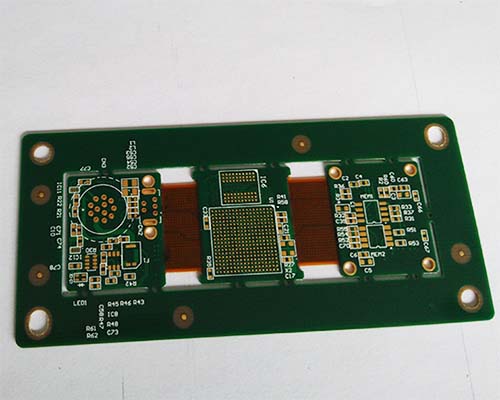
rigid flex pcb definition
Rigid-flex PCBs (Printed Circuit Boards) are a hybrid type of PCB that combines the features of both rigid and flexible PCBs.
They are designed to have both rigid and flexible areas,
allowing them to bend and twist without breaking while still providing a stable and sturdy platform for the components to be mounted on.
Rigid-flex PCBs are typically made of multiple layers of flexible and rigid materials that are laminated together to form a single board.
The flexible areas are made of a thin and flexible material, such as polyimide,
while the rigid areas are made of a solid material, such as fiberglass or FR4.
Rigid-flex PCBs are commonly used in electronic devices that require a compact and lightweight design,
such as medical devices, aerospace and defense equipment, and portable electronics.
They offer a number of advantages over traditional rigid or flexible PCBs,
including reduced size and weight, improved reliability, and increased durability.
How to define soft and hard board
Soft board refers to a type of board made of soft materials such as foam, cork, or rubber.
Soft boards are typically used for insulation, cushioning, or as a base for artwork.
Hard board, on the other hand, refers to a type of board made of hard materials such as wood fibers,
particleboard, or MDF (medium-density fiberboard). Hard boards are typically used for construction, furniture making, or as a base for painting.
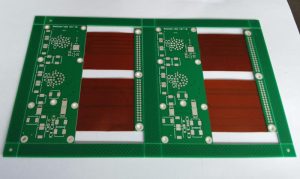
rigid flex pcb eagle
Rigid-flex PCBs are a combination of both rigid and flexible PCBs, allowing for a more compact and versatile design.
Eagle PCB design software is a popular choice for designing rigid-flex PCBs due to its user-friendly interface and extensive library of components.
To design a rigid-flex PCB in Eagle, you will need to follow these steps:
1. Create a new project in Eagle and select the appropriate board size and layer stackup.
2. Draw the rigid sections of the board using the standard Eagle tools for drawing traces and adding components.
3. Define the flexible sections of the board by creating cutouts in the rigid sections and adding flexible connectors.
4. Define the routing rules for the flexible sections of the board, including minimum trace width and spacing, and maximum bend radius.
5. Use the Eagle autorouter to automatically route the traces in the rigid sections of the board, and manually route the traces in the flexible sections.
6. Add any necessary vias and through-holes to connect the rigid and flexible sections of the board.
7. Verify the design using the Eagle Design Rule Check (DRC) tool to ensure that the board meets all electrical and mechanical requirements.
8. Generate the Gerber files and send them to a PCB manufacturer for fabrication.
It is important to note that designing a rigid-flex PCB requires a thorough understanding of both rigid and flexible PCB design principles,
as well as the mechanical requirements of the final product.
It is recommended to consult with an experienced PCB designer or manufacturer before attempting to design a rigid-flex PCB.