
Skip to content
Andwin Circuits
  • Home
  • ProductsExpand
    • HDI multilayer PCB
    • Rigid Flex PCB
    • Flex pcb
    • Special PCBExpand
      • High Frequency PCBExpand
        • Rogers RO4350B PCB
        • Rogers RO4003 pcb
        • Rogers RO3003 PCB
        • Rogers 5880 PCB
        • DICLAD 527 PCB
        • Taconic TLX series
        • Taconic TLX-8 RF PCB
        • Taconic TLX-9 RF PCB
      • High speed pcbExpand
        • Megtron 6 High Speed PCB
        • TU-872 SLK Sp High Speed
      • High TG PCBExpand
        • SHENGYI SH260 PCB
        • ISOLA 370HR PCB
        • ISOLA IS410 PCB
        • ISOLA IS420 PCB
      • Heavy copper PCB
      • Copper coin pcb
      • Copper inlay PCB
    • Metal Core PCBExpand
      • Copper core pcb
      • Aluminum PCB
      • 2 Layers Aluminum PCB
      • Direct thermal MCPCB
      • 2 Layers Direct Thermal
    • Ceramic PCBExpand
      • DPC ceramic PCB
      • DBC ceramic PCB
      • Thick film Ceramic PCB
      • Al2O3 Alumina PCB
      • AIN ALN ceramic PCB
      • IGBT Ceramic PCB
  • ServiceExpand
    • PCB Assembly
    • Quick turn PCB assembly
    • PCBA conformal coating
  • IndustryExpand
    • Telecommunication
    • IoT and Wireless
    • Industrial Control
    • Thermal management
    • Power and Energy
    • IC test board
    • Automative
    • Medical
  • CapabilityExpand
    • Rigid PCB
    • Rigid flex PCB
    • Metal core PCB
    • PCB Assembly
  • TechnologyExpand
    • Blogs
    • Via in pad
    • PCB E-test
    • PCB stack up
    • MCPCB panelization
    • Controlled impedance PCB
  • AboutExpand
    • About us
    • Certification
    • Factory Tour
  • Contact
Andwin Circuits
Home / Blogs / Handmade PCB Soldering: A Comprehensive Guide to DIY Circuit Board Assembly

Handmade PCB Soldering: A Comprehensive Guide to DIY Circuit Board Assembly

ByGrace May 24, 2025May 22, 2025

Introduction

Printed Circuit Boards (PCBs) are the backbone of modern electronics, providing a reliable platform for mounting and interconnecting electronic components. While automated machines dominate mass production, hand-soldering PCBs remains a valuable skill for hobbyists, engineers, and small-scale manufacturers. This guide explores the step-by-step process of hand-soldering a PCB, covering essential tools, techniques, and best practices.

1. Tools and Materials Required

Before starting, gather the necessary tools and materials:

1.1 Soldering Equipment

  • Soldering Iron (25W–60W, adjustable temperature preferred)
  • Solder Wire (Lead-based 60/40 or lead-free, 0.5mm–1mm thickness)
  • Flux (Liquid or paste, improves solder flow)
  • Soldering Stand & Sponge (For cleaning the iron tip)
  • Desoldering Tools (Solder wick, desoldering pump for corrections)

1.2 PCB and Components

  • Blank PCB (Single-sided or double-sided, pre-etched)
  • Electronic Components (Resistors, capacitors, ICs, connectors, etc.)
  • PCB Holder or Clamp (Stabilizes the board during soldering)

1.3 Safety & Auxiliary Tools

  • Safety Glasses (Protects eyes from solder splashes)
  • Tweezers (For handling small components)
  • Magnifying Glass or Microscope (For inspecting solder joints)
  • Isopropyl Alcohol & Brush (Cleaning flux residues)
Contact us for PCB quote now |

2. Preparing the PCB and Components

2.1 PCB Inspection

  • Check for manufacturing defects (scratches, incomplete etching).
  • Ensure all holes are properly drilled.

2.2 Component Organization

  • Arrange components by type and value for easy access.
  • Bend component leads (for through-hole parts) to fit PCB holes.

2.3 Applying Flux (Optional but Recommended)

  • Apply a thin layer of flux on PCB pads to improve solder adhesion.

3. Step-by-Step Soldering Process

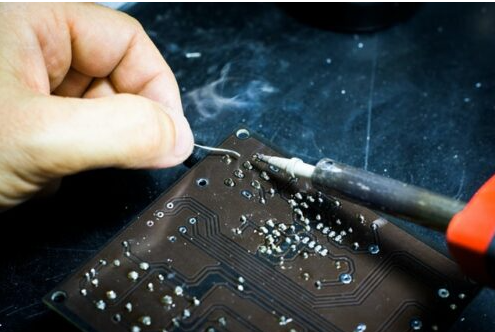
3.1 Soldering Through-Hole Components (THT)

  1. Insert the Component – Place the component leads through the PCB holes.
  2. Bend Leads Slightly – To hold the component in place.
  3. Heat the Pad & Lead – Touch the soldering iron to both the pad and lead for 1–3 seconds.
  4. Apply Solder – Feed solder wire into the joint until it melts and forms a smooth fillet.
  5. Remove Iron & Inspect – A good joint should be shiny and cone-shaped.

3.2 Soldering Surface-Mount Components (SMD)

  1. Apply Solder Paste (Optional) – For reflow-like hand soldering.
  2. Place the Component – Use tweezers to position SMD parts.
  3. Tack One Pad – Solder one pad to hold the component.
  4. Solder Remaining Pads – Reflow solder on other pads.
  5. Check for Bridges – Use flux and desoldering wick to fix shorts.

3.3 Soldering Integrated Circuits (ICs)

  • For DIP ICs: Solder diagonally opposite pins first to prevent misalignment.
  • For SMD ICs: Use drag soldering (applying solder along pins while dragging the iron).
Contact us for PCB quote now |

4. Post-Soldering Steps

4.1 Inspection & Testing

  • Visual Check: Look for cold joints, bridges, or insufficient solder.
  • Continuity Test: Use a multimeter to verify connections.

4.2 Cleaning the PCB

  • Remove flux residues with isopropyl alcohol and a brush.

4.3 Troubleshooting Common Issues

  • Cold Joints: Reheat and add flux if the joint is dull or cracked.
  • Solder Bridges: Use desoldering wick to remove excess solder.
  • Lifted Pads: Repair with jumper wires if traces are damaged.

5. Best Practices for Reliable Hand-Soldering

  • Temperature Control: Keep the iron at 300–350°C (lead-based) or 350–400°C (lead-free).
  • Avoid Overheating: Prolonged heat can damage components or PCB.
  • Use Quality Solder: Cheap solder can cause poor joints.
  • Work in a Well-Ventilated Area: Solder fumes can be harmful.

Conclusion

Hand-soldering PCBs is a fundamental skill for electronics enthusiasts and professionals. With the right tools, techniques, and patience, anyone can assemble high-quality circuit boards at home. Whether working on prototypes, repairs, or custom projects, mastering manual soldering ensures flexibility and precision in electronic fabrication.

By following this guide, beginners can avoid common mistakes and achieve clean, reliable solder joints, paving the way for successful DIY electronics projects.

Contact us for PCB quote now |
Post Tags: #aluminum clad pcb#aluminum core pcb#aluminum pcb#Handmade PCB Soldering:

Post navigation

Previous Previous
The Significance of Copper Pour in PCB Design
NextContinue
How to Solve Impedance Discontinuity in PCB Design

Search

Search

Products

  • HDI Multilayer PCB
  • Rigid Flex PCB
  • Flex pcb
  • High Frequency PCB
  • High speed pcb
  • Heavy copper PCB
  • Metal Core PCB
  • Ceramic PCB

Address

Andwin Circuits Co.,Limited
Email: sales@andwinpcb.com
Tel: +86 755 2832 9394
Fax:+86 755 2992  6717
ADD:1-2F-1217,HouDeQun Industrial park,
NanTing RD NO.56,ShaJing,BaoAn,Shenzhen 518104,GuangDong,China

Products

  • HDI Multilayer PCB
  • Rigid Flex PCB
  • Flex pcb
  • High Frequency PCB
  • High speed pcb
  • Heavy copper PCB
  • Metal Core PCB
  • Ceramic PCB

Technology

  • Blogs
  • Via in pad
  • PCB E-test
  • PCB stack up
  • Metal core PCB panelization
  • Controlled impedance PCB

CERTIFICATION

Certification >>


Copyright© 2003 - 2026 Andwin | All Rights Reserved | Powered by Andwin

Scroll to top
  • Home
  • Products
    • HDI multilayer PCB
    • Rigid Flex PCB
    • Flex pcb
    • Special PCB
      • High Frequency PCB
        • Rogers RO4350B PCB
        • Rogers RO4003 pcb
        • Rogers RO3003 PCB
        • Rogers 5880 PCB
        • DICLAD 527 PCB
        • Taconic TLX series
        • Taconic TLX-8 RF PCB
        • Taconic TLX-9 RF PCB
      • High speed pcb
        • Megtron 6 High Speed PCB
        • TU-872 SLK Sp High Speed
      • High TG PCB
        • SHENGYI SH260 PCB
        • ISOLA 370HR PCB
        • ISOLA IS410 PCB
        • ISOLA IS420 PCB
      • Heavy copper PCB
      • Copper coin pcb
      • Copper inlay PCB
    • Metal Core PCB
      • Copper core pcb
      • Aluminum PCB
      • 2 Layers Aluminum PCB
      • Direct thermal MCPCB
      • 2 Layers Direct Thermal
    • Ceramic PCB
      • DPC ceramic PCB
      • DBC ceramic PCB
      • Thick film Ceramic PCB
      • Al2O3 Alumina PCB
      • AIN ALN ceramic PCB
      • IGBT Ceramic PCB
  • Service
    • PCB Assembly
    • Quick turn PCB assembly
    • PCBA conformal coating
  • Industry
    • Telecommunication
    • IoT and Wireless
    • Industrial Control
    • Thermal management
    • Power and Energy
    • IC test board
    • Automative
    • Medical
  • Capability
    • Rigid PCB
    • Rigid flex PCB
    • Metal core PCB
    • PCB Assembly
  • Technology
    • Blogs
    • Via in pad
    • PCB E-test
    • PCB stack up
    • MCPCB panelization
    • Controlled impedance PCB
  • About
    • About us
    • Certification
    • Factory Tour
  • Contact
Search