
A Brief Analysis of the Advantages and Disadvantages of PCB Copper Plating Technology
As an important part of PCB design, copper plating, whether it is the domestic Qingyuefeng PCB design software or some foreign Protel and PowerPCB, all provide intelligent copper plating functions. So how to do copper plating well? I will share some of my ideas with you, hoping to benefit my peers.
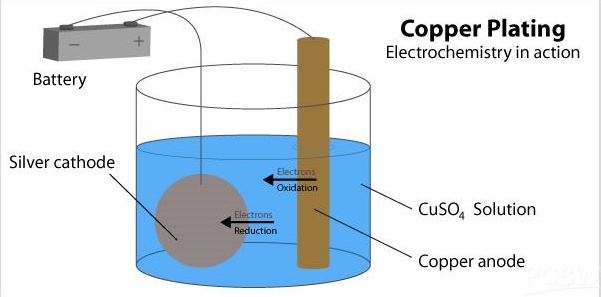
The so-called copper plating is to use the idle space on the PCB as the reference surface and then fill it with solid copper.
These copper areas are also called copper pouring. The significance of copper plating is to reduce the impedance of the ground line and improve the anti-interference ability; reduce the voltage drop and improve the power supply efficiency; connected to the ground line, it can also reduce the loop area. In order to make the PCB as deformable as possible during welding, most PCB manufacturers will also require PCB designers to fill the open area of the PCB with copper or grid-shaped ground lines. If the copper plating is not handled properly, it will be more gain than loss. Is copper plating “more advantages than disadvantages” or “more disadvantages than advantages”?
As we all know, under high frequency conditions, the distributed capacitance of the wiring on the printed circuit board will play a role.
When the length is greater than 1/20 of the corresponding wavelength of the noise frequency, an antenna effect will be generated, and the noise will be emitted outward through the wiring. If there is a poorly grounded copper foil in the PCB, the copper foil will become a tool for propagating noise. Therefore, in high-frequency circuits, do not think that connecting a certain part of the ground wire to the ground is the “ground wire”. It is necessary to punch holes in the wiring with a spacing less than λ/20 to “well ground” with the ground plane of the multilayer board. If the copper foil is properly processed, the copper foil not only has the dual function of increasing the current, but also shielding interference.
There are generally two basic ways of copper foil, namely large-area copper foil and grid copper foil.
People often ask whether large-area copper foil or grid copper foil is better. It is not easy to generalize. Why? Large-area copper foil has the dual functions of increasing current and shielding, but large-area copper foil may cause the board to warp or even bubble during wave soldering. Therefore, for large-area copper plating, several grooves are usually opened to alleviate the blistering of copper foil. The main function of pure grid copper plating is shielding, and the effect of increasing current is reduced. From the perspective of heat dissipation, the grid has advantages (it reduces the heating surface of copper) and plays a certain role in electromagnetic shielding. However, it should be pointed out that the grid is composed of traces in staggered directions. We know that for the circuit, the width of the trace has a corresponding “electrical length” for the operating frequency of the circuit board (the actual size is divided by the digital frequency corresponding to the operating frequency, which can be obtained by referring to relevant books). When the operating frequency is not very high, the effect of the grid line may not be very obvious. Once the electrical length matches the operating frequency, it will be very bad. You will find that the circuit cannot work properly at all, and signals that interfere with the operation of the system are emitted everywhere. So for colleagues who use grids, my suggestion is to choose according to the working conditions of the designed circuit board, and don’t stick to one thing. Therefore, high-frequency circuits with high requirements for anti-interference use grids, and low-frequency circuits with large current circuits often use complete copper plating.
Having said so much, in order to achieve the expected effect of copper plating, what issues should we pay attention to in copper plating:
- If there are many grounds on the PCB, such as SGND, AGND, GND, etc., it is necessary to use the most important “ground” as a reference for independent copper coating according to the different positions on the PCB board. It goes without saying that the digital ground and analog ground are separately coated with copper. At the same time, before coating copper, first thicken the corresponding power connection: 5.0V, 3.3V, etc., so that multiple deformable structures of different shapes are formed.
- For single-point connection of different grounds, the method is to connect through 0 ohm resistors or magnetic beads or inductors;
- Copper coating near the crystal oscillator. The crystal oscillator in the circuit is a high-frequency emission source. The method is to coat copper around the crystal oscillator and then ground the shell of the crystal oscillator separately.
- If you think the island (dead zone) problem is very large, it will not take much effort to define a ground via and add it in.
- When starting to wire, the ground wire should be treated equally. When routing, the ground wire should be routed well. It cannot be relied on to eliminate the ground pin that is not connected by adding vias after copper coating. This effect is very bad.
- It is best not to have sharp corners on the board (<=180 degrees), because from the perspective of electromagnetics, this constitutes a transmitting antenna! For other things, there will always be an impact, but it is just a matter of size. I recommend using the edge line of the arc.
- Do not apply copper to the empty area of the wiring in the middle layer of the multilayer board. Because it is difficult to make this copper “well grounded”
- The metal inside the equipment, such as metal heat sinks, metal reinforcement strips, etc., must be “well grounded”.
- The heat dissipation metal block of the three-terminal regulator must be well grounded. The ground isolation belt near the crystal oscillator must be well grounded. In short: If the grounding problem of copper on the PCB is handled well, it will definitely be “more beneficial than harmful”. It can reduce the return area of the signal line and reduce the electromagnetic interference of the signal to the outside.