
Carbon Fiber Fabrication: Techniques, Applications, and Future Trends
Abstract
Carbon fiber is a high-performance material renowned for its exceptional strength-to-weight ratio, stiffness, and corrosion resistance. Its fabrication involves complex processes that transform precursor materials into high-strength fibers. This article explores the manufacturing techniques of carbon fiber, including precursor selection, stabilization, carbonization, and surface treatment. Additionally, it examines key applications in aerospace, automotive, sports equipment, and renewable energy. Finally, emerging trends such as sustainable production methods and additive manufacturing are discussed.
1. Introduction
Carbon fiber has revolutionized industries requiring lightweight yet strong materials. Composed of over 90% carbon atoms arranged in crystalline structures, carbon fiber offers superior mechanical properties compared to metals like steel and aluminum. The fabrication process is critical in determining the fiber’s final characteristics, including tensile strength, modulus, and thermal stability.
This article provides a comprehensive overview of carbon fiber fabrication, covering:
- Precursor materials
- Stabilization and carbonization processes
- Surface treatment and sizing
- Applications across industries
- Future advancements
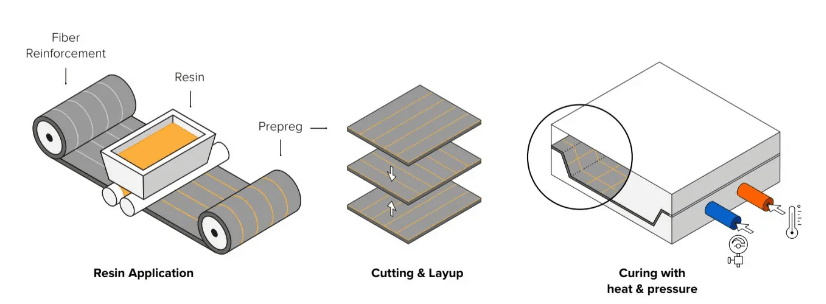
2. Carbon Fiber Fabrication Process
2.1 Precursor Materials
The first step in carbon fiber production involves selecting a precursor material, which serves as the foundation for the fiber. The most common precursors include:
- Polyacrylonitrile (PAN): The dominant precursor (~90% of production) due to its high carbon yield and superior mechanical properties.
- Pitch-based precursors: Derived from petroleum or coal tar, these fibers exhibit high thermal conductivity but lower tensile strength.
- Rayon: An early precursor with limited use today due to low carbon yield (~20-30%).
PAN remains the preferred choice for high-performance applications, while pitch-based fibers are used in specialized thermal applications.
2.2 Stabilization (Oxidation)
Before carbonization, PAN fibers undergo stabilization, where they are heated in air at 200–300°C. This process:
- Converts the linear polymer structure into a thermally stable ladder structure.
- Introduces oxygen molecules to prevent melting during high-temperature treatment.
- Requires precise temperature control to avoid fiber damage.
Stabilization is a slow, energy-intensive step that significantly impacts the final fiber quality.
2.3 Carbonization
After stabilization, fibers are carbonized in an inert atmosphere (nitrogen or argon) at temperatures between 700°C and 1500°C. During this stage:
- Non-carbon elements (hydrogen, oxygen, nitrogen) are removed as volatile gases.
- Carbon atoms form tightly bonded crystalline structures.
- The fiber shrinks in diameter and gains higher tensile strength.
High-modulus fibers undergo further treatment at up to 3000°C (graphitization), enhancing alignment of carbon layers for increased stiffness.
2.4 Surface Treatment and Sizing
To improve adhesion in composite materials, carbon fibers undergo:
- Oxidative surface treatment: Introduces functional groups (e.g., carboxyl, hydroxyl) for better resin bonding.
- Sizing: A protective polymer coating is applied to reduce handling damage and enhance compatibility with matrix materials (e.g., epoxy, polyester).
3. Applications of Carbon Fiber
3.1 Aerospace
Carbon fiber composites are widely used in aircraft and spacecraft due to their lightweight and high strength. Applications include:
- Fuselage and wing structures (e.g., Boeing 787 Dreamliner)
- Satellite components
- UAVs (drones)
3.2 Automotive
The automotive industry employs carbon fiber to reduce vehicle weight and improve fuel efficiency. Examples include:
- High-performance cars (e.g., BMW i3, Lamborghini Aventador)
- Electric vehicle battery enclosures
- Racing components (Formula 1)
3.3 Sports and Recreation
Carbon fiber’s stiffness and lightweight properties make it ideal for:
- Bicycle frames
- Tennis rackets
- Golf clubs
- Fishing rods
3.4 Renewable Energy
Wind turbine blades and hydrogen storage tanks increasingly use carbon fiber for durability and weight reduction.
4. Future Trends in Carbon Fiber Fabrication
4.1 Sustainable Production
Researchers are exploring bio-based precursors (e.g., lignin) to reduce reliance on petroleum-derived PAN. Recycling methods for carbon fiber composites are also gaining attention.
4.2 Additive Manufacturing
3D printing with carbon fiber-reinforced polymers enables complex geometries for customized applications.
4.3 Cost Reduction
Efforts to lower production costs include optimizing stabilization techniques and developing alternative precursors.
5. Conclusion
Carbon fiber fabrication is a sophisticated process that transforms precursor materials into high-performance fibers. While PAN-based carbon fiber dominates the market, advancements in sustainable precursors and manufacturing techniques promise to expand its applications. As industries continue to prioritize lightweight and durable materials, carbon fiber will remain a cornerstone of modern engineering.