
Skip to content
Andwin Circuits
  • Home
  • ProductsExpand
    • HDI multilayer PCB
    • Rigid Flex PCB
    • Flex pcb
    • Special PCBExpand
      • High Frequency PCBExpand
        • Rogers RO4350B PCB
        • Rogers RO4003 pcb
        • Rogers RO3003 PCB
        • Rogers 5880 PCB
        • DICLAD 527 PCB
        • Taconic TLX series
        • Taconic TLX-8 RF PCB
        • Taconic TLX-9 RF PCB
      • High speed pcbExpand
        • Megtron 6 High Speed PCB
        • TU-872 SLK Sp High Speed
      • High TG PCBExpand
        • SHENGYI SH260 PCB
        • ISOLA 370HR PCB
        • ISOLA IS410 PCB
        • ISOLA IS420 PCB
      • Heavy copper PCB
      • Copper coin pcb
      • Copper inlay PCB
    • Metal Core PCBExpand
      • Copper core pcb
      • Aluminum PCB
      • 2 Layers Aluminum PCB
      • Direct thermal MCPCB
      • 2 Layers Direct Thermal
    • Ceramic PCBExpand
      • DPC ceramic PCB
      • DBC ceramic PCB
      • Thick film Ceramic PCB
      • Al2O3 Alumina PCB
      • AIN ALN ceramic PCB
      • IGBT Ceramic PCB
  • ServiceExpand
    • PCB Assembly
    • Quick turn PCB assembly
    • PCBA conformal coating
  • IndustryExpand
    • Telecommunication
    • IoT and Wireless
    • Industrial Control
    • Thermal management
    • Power and Energy
    • IC test board
    • Automative
    • Medical
  • CapabilityExpand
    • Rigid PCB
    • Rigid flex PCB
    • Metal core PCB
    • PCB Assembly
  • TechnologyExpand
    • Blogs
    • Via in pad
    • PCB E-test
    • PCB stack up
    • MCPCB panelization
    • Controlled impedance PCB
  • AboutExpand
    • About us
    • Certification
    • Factory Tour
  • Contact
Andwin Circuits
Home / Disadvantages of the traditional four-layer stackup of PCBs

Disadvantages of the traditional four-layer stackup of PCBs

ByGrace June 27, 2024June 27, 2024

If the interlayer capacitance is not large enough, the electric field will be distributed over a relatively large area of ​​the board, so that the interlayer impedance is reduced and the return current can flow back to the top layer.

In this case, the field generated by this signal may interfere with the field of the signal that changes layers nearby.

This is not what we want at all. Unfortunately, on a 0.062-inch 4-layer board, the distance between the layers is far (at least 0.020 inches, as shown in Figures 1 and 2), and the interlayer capacitance is small.

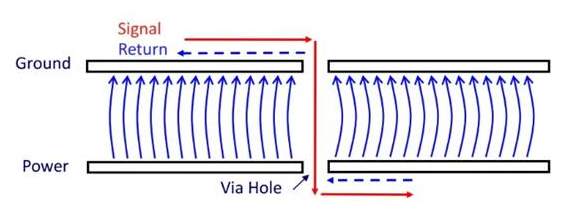
The first problem of the stackup in Figures 1 and 2 occurs when the trace changes from layer 1 to layer 4 or vice versa. As shown in Figure 3.
Contact us for PCB quote now |

The figure shows that when the signal trace goes from layer 1 to layer 4 (red line), the return current must also change planes (blue line). If the frequency of the signal is high enough and the planes are close together, the return current can flow through the inter-layer capacitance that exists between the ground and power planes. However, the lack of a direct conductive connection for the return current causes a break in the return path, which we can imagine as impedance between the planes (see Figure 4).
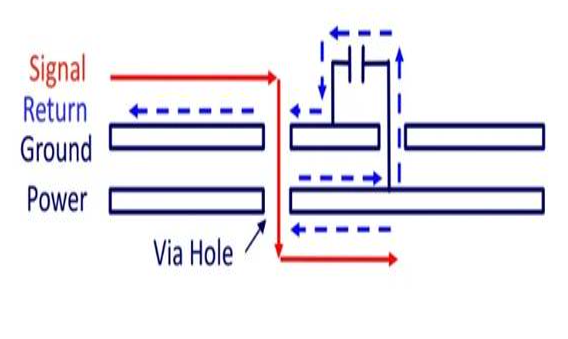
Figure 4. Image courtesy of Electromagnetic Compatibility Engineering.

If the inter-layer capacitance is not large enough, the electric field will be distributed over a relatively large area of ​​the board, so that the inter-layer impedance is reduced and the return current can flow back to the top layer. In this case, the field generated by this signal may interfere with the field of the nearby signal that changed layers. This is not what we want at all. Unfortunately, on a 0.062-inch 4-layer board, the distance between the layers is far (at least 0.020 inches, as shown in Figures 1 and 2), and the inter-layer capacitance is small. Therefore, the above-mentioned electric field interference occurs. This may not cause signal integrity problems, but it will definitely generate more EMI. This is why we avoid changing layers when using the stackup shown in Figures 1 and 2, especially for high-frequency signals such as clocks.
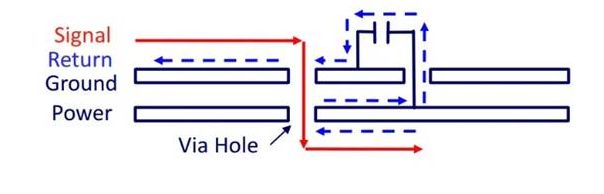
It is common practice to add a decoupling capacitor near the transition via to reduce the impedance experienced by the return current (see Figure 5). However, this decoupling capacitor is ineffective for very high frequency signals due to its low self-resonant frequency. For AC signals above 200-300 MHz, we cannot rely on decoupling capacitors to create a low impedance return path. Therefore, we need a decoupling capacitor (for below 200-300 MHz) and a relatively large inter-board capacitance for higher frequencies.
Contact us for PCB quote now |

The above problems can be avoided by not changing the layers of critical signals. However, the small inter-board capacitance of the four-layer board leads to another serious problem: power delivery.

Clocking digital ICs usually requires large transient power currents. As the rise/fall time of IC outputs decreases, we need to provide energy at a higher rate. To provide a charge source, we usually place decoupling capacitors very close to each logic IC.

However, there is a problem: when we exceed the self-resonant frequency, the decoupling capacitor cannot effectively store and transfer energy, because at these frequencies, the capacitor will act like an inductor.

Since most of today’s ICs have fast rise/fall times (about 500 ps), we need an additional decoupling structure with a self-resonant frequency higher than that of the decoupling capacitor. The interlayer capacitance of the circuit board can be an effective decoupling structure, provided that the layers are close enough to each other to provide sufficient capacitance.

Therefore, in addition to the commonly used decoupling capacitors, we prefer to adopt closely spaced power and ground layers to provide transient power to digital ICs.

Please note that due to the common circuit board manufacturing process, we usually do not have a thin insulator between the second and third layers of the four-layer board. The cost of a four-layer board with a thin insulator between layers 2 and 3 can be much higher than a traditional four-layer board.

Post Tags: #4 layer board#pcb#pcb design

Post navigation

Previous Previous
The difference between HDI board and through-hole PCB
NextContinue
Tips for replacing ICs to make PCB design more perfect

Search

Search

Products

  • HDI Multilayer PCB
  • Rigid Flex PCB
  • Flex pcb
  • High Frequency PCB
  • High speed pcb
  • Heavy copper PCB
  • Metal Core PCB
  • Ceramic PCB

Address

Andwin Circuits Co.,Limited
Email: sales@andwinpcb.com
Tel: +86 755 2832 9394
Fax:+86 755 2992  6717
ADD:1-2F-1217,HouDeQun Industrial park,
NanTing RD NO.56,ShaJing,BaoAn,Shenzhen 518104,GuangDong,China

Products

  • HDI Multilayer PCB
  • Rigid Flex PCB
  • Flex pcb
  • High Frequency PCB
  • High speed pcb
  • Heavy copper PCB
  • Metal Core PCB
  • Ceramic PCB

Technology

  • Blogs
  • Via in pad
  • PCB E-test
  • PCB stack up
  • Metal core PCB panelization
  • Controlled impedance PCB

CERTIFICATION

Certification >>


Copyright© 2003 - 2026 Andwin | All Rights Reserved | Powered by Andwin

Scroll to top
  • Home
  • Products
    • HDI multilayer PCB
    • Rigid Flex PCB
    • Flex pcb
    • Special PCB
      • High Frequency PCB
        • Rogers RO4350B PCB
        • Rogers RO4003 pcb
        • Rogers RO3003 PCB
        • Rogers 5880 PCB
        • DICLAD 527 PCB
        • Taconic TLX series
        • Taconic TLX-8 RF PCB
        • Taconic TLX-9 RF PCB
      • High speed pcb
        • Megtron 6 High Speed PCB
        • TU-872 SLK Sp High Speed
      • High TG PCB
        • SHENGYI SH260 PCB
        • ISOLA 370HR PCB
        • ISOLA IS410 PCB
        • ISOLA IS420 PCB
      • Heavy copper PCB
      • Copper coin pcb
      • Copper inlay PCB
    • Metal Core PCB
      • Copper core pcb
      • Aluminum PCB
      • 2 Layers Aluminum PCB
      • Direct thermal MCPCB
      • 2 Layers Direct Thermal
    • Ceramic PCB
      • DPC ceramic PCB
      • DBC ceramic PCB
      • Thick film Ceramic PCB
      • Al2O3 Alumina PCB
      • AIN ALN ceramic PCB
      • IGBT Ceramic PCB
  • Service
    • PCB Assembly
    • Quick turn PCB assembly
    • PCBA conformal coating
  • Industry
    • Telecommunication
    • IoT and Wireless
    • Industrial Control
    • Thermal management
    • Power and Energy
    • IC test board
    • Automative
    • Medical
  • Capability
    • Rigid PCB
    • Rigid flex PCB
    • Metal core PCB
    • PCB Assembly
  • Technology
    • Blogs
    • Via in pad
    • PCB E-test
    • PCB stack up
    • MCPCB panelization
    • Controlled impedance PCB
  • About
    • About us
    • Certification
    • Factory Tour
  • Contact
Search