
How to avoid ICD failure in PCB production?
ICD failure, i.e. Inner connection defects, is also called inner layer interconnection defect. For PCB manufacturers, ICD problems are difficult to effectively intercept in the electrical testing process, and often flow to the downstream or even the client. During the SMT mounting process, the PCB board undergoes the impact of high-temperature processes such as lead-free reflow IR, wave soldering, and some manual soldering or rework, resulting in inner layer interconnection failure and open circuit. At this time, the PCB board has been assembled, which will cause great quality risks.
The following briefly explains the influence mechanism of ICD failure from the two aspects of drilling quality and degumming process, and summarizes the detection and analysis experience of such problems.
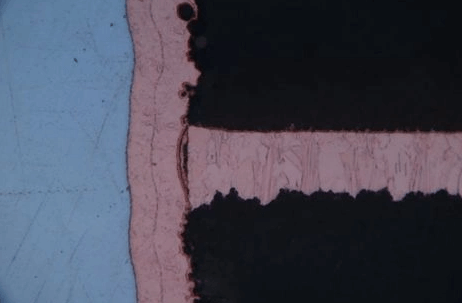
The influence of drilling quality on ICD
Taking the processing of high-frequency and high-speed materials as an example, the substrate of high-frequency and high-speed boards has the characteristics of low Dk and low Df, its polarity is small, the material activity is low, and it is difficult to remove the glue residue, which further increases the influence of residual glue in the hole on PTH electroplating. Some high-frequency boards have a lot of resin fillers in the dielectric layer, and their physical properties are relatively hard, which causes great wear on the drill bit of the drill, large hole wall roughness, and a lot of high-temperature gel when the drill bit rubs. Therefore, in cases where the hole wall is rough and the nail head is abnormal, the degumming solution may not circulate well, resulting in poor degumming effect, and failure to completely remove the residual glue residue on the hole wall, resulting in ICD failure at the connection between the inner hole copper and the hole wall. Some boards also have a soft substrate and a low softening point. The high temperature generated during the drilling process can easily soften the drill cuttings and cause them to adhere to agglomerate, resulting in poor chip removal during drilling and intermittent extrusion and chip removal. The drill cuttings are easily squeezed and adhered to the hole wall, which greatly increases the difficulty of degumming in the later process, and there is a risk of residual glue in the hole, which may eventually lead to ICD problems.
For rigid-flex printed circuit boards (FPCs), the insulating medium of flexible materials is polyimide (PI), etc. The mechanical processing performance of these materials is relatively poor, and the deformation during processing is large, which is easy to cause nail heads, leaving stress at the location of the inner layer interconnection. Therefore, in this case, the impact of drilling residue on the interconnection reliability of the hole copper and the inner layer copper layer will be more prominent, and ultimately cause the inner layer interconnection to crack and open circuit when the product is subjected to high temperature shock during the welding process.

1 Case background
The impact of incomplete glue removal on ICD
Take the FR-4 board of ordinary epoxy resin system as an example. In the process of chemical glue removal, the chemical bonds such as C-O and C-H contained in the high molecular epoxy resin glue remaining on the hole wall after drilling can be oxidized and decomposed by KMnO4 to generate corresponding inorganic substances such as carbon dioxide and water, and then can be completely removed after washing or degreasing. When abnormal conditions such as KMnO4 concentration being lower than the control limit occur, the base copper layer on the inner wall of the hole may have residual resin glue, which cannot be effectively removed after degumming, water washing, degreasing and other processes. During electroplating, the base copper layer and the electroplated copper have poor bonding in the area with glue. After thermal stress treatment, the residual glue area is “pulled” by thermal stress and micro cracks appear.
For high-frequency materials, the dielectric layer and the drill bit of the drill are more severely worn, and the friction of the drill bit causes excessive gel. Therefore, the degumming process of high-frequency boards needs more attention. Some products even use a combination of “plasma degumming + chemical degumming” to ensure that the residual glue on the hole wall is completely removed to prevent the residual glue residue from causing poor bonding between the inner copper ring and the electroplated hole copper, thereby causing ICD failure.