
Key Advantages of Flexible PCBs: Weight Reduction, Space Savings & Beyond
Modern electronics are shrinking at an unprecedented pace. From foldable smartphones to compact wearables, engineers face mounting pressure to design smaller, lighter, and more reliable devices. Enter flexible printed circuit boards (flex PCBs)—a transformative technology that’s redefining what’s possible in electronic design.
Unlike traditional rigid PCBs, flexible circuits can bend, twist, and fold while maintaining electrical performance. This unique capability unlocks benefits that go far beyond simple flexibility. In this comprehensive guide, we’ll explore the primary advantages of flex PCBs and why they’re becoming the preferred choice for cutting-edge electronics in 2026.
What Are Flexible PCBs?
Flexible printed circuit boards are electronic circuits fabricated on flexible plastic substrates, typically polyimide or polyester films. Unlike rigid FR-4 boards, flex PCBs can be bent, folded, or rolled without damaging the circuitry.
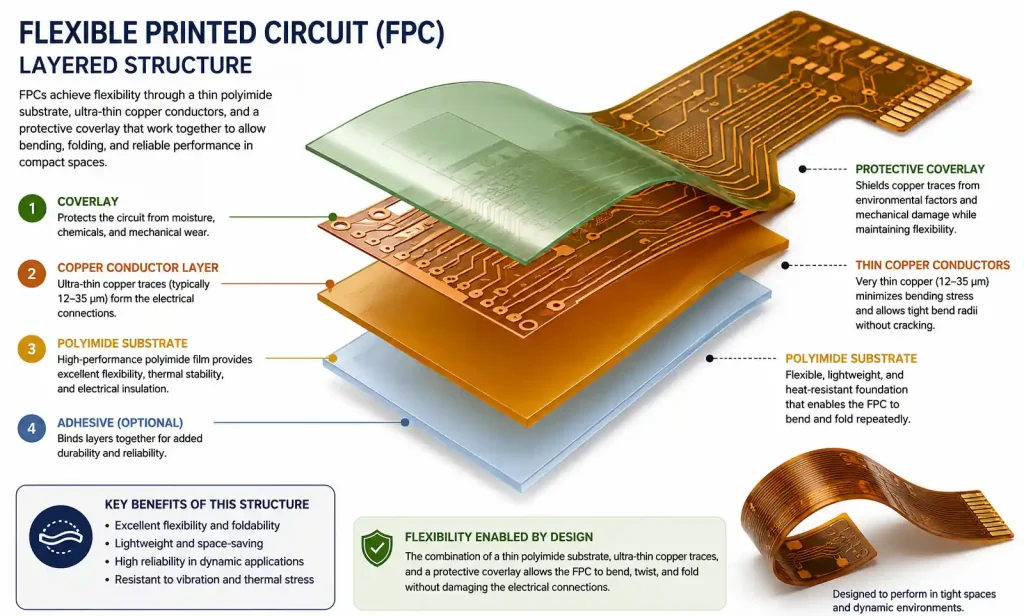
These circuits range from simple single-layer designs to complex multilayer configurations. They can be used as standalone flexible circuits or combined with rigid sections to create rigid-flex hybrid boards, offering the best of both worlds.
The core material—usually polyimide—provides excellent electrical properties, chemical resistance, and temperature stability, making flex PCBs suitable for demanding applications in aerospace, medical devices, and consumer electronics.
Advantage 1: Dramatic Weight Reduction
Weight is a critical factor in modern electronics, particularly for portable, wearable, and aerospace applications. Flexible PCBs deliver remarkable weight savings compared to traditional rigid boards.
The Numbers Behind Weight Reduction
Recent industry data shows impressive weight reductions:
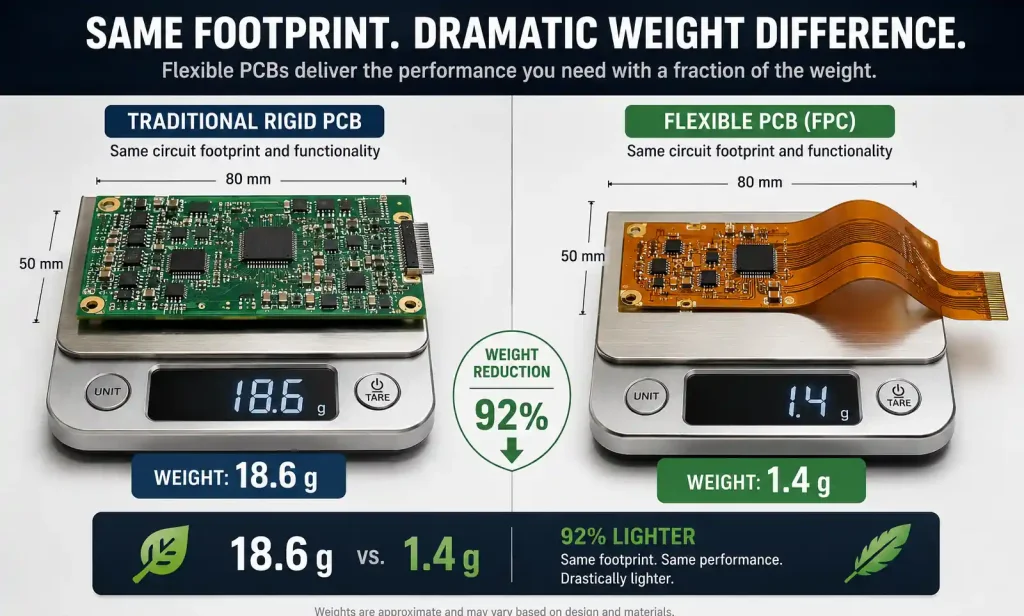
- 50-75% lighter than equivalent rigid PCB solutions
- Some applications achieve 70-90% weight reduction
- A 100cm² 2-layer flex PCB weighs approximately 14.8g compared to 29.6g for rigid PCB—a 50% reduction
Why Flex PCBs Are Lighter
The weight advantage comes from several factors:
Thinner materials: Polyimide substrates are significantly thinner than FR-4 rigid boards. Where rigid PCBs typically use 1.6mm thick boards, flex circuits can be as thin as 0.05mm.
Elimination of connectors: Flex circuits replace heavy wire harnesses and bulky connectors, removing unnecessary weight from the assembly.
Reduced copper usage: Advanced manufacturing techniques allow for thinner copper traces while maintaining electrical performance.
Real-World Impact
For portable devices like drones, wearables, and handheld medical equipment, every gram matters. A lighter PCB means:
- Extended battery life (less weight to carry)
- Improved device portability
- Enhanced user comfort for wearables
- Better fuel efficiency in aerospace applications
- Reduced shipping costs for manufacturers
Advantage 2: Significant Space Savings
In an era where devices are expected to do more while occupying less space, flexible PCBs offer substantial space-saving advantages.
Quantifying Space Efficiency
Industry research indicates:
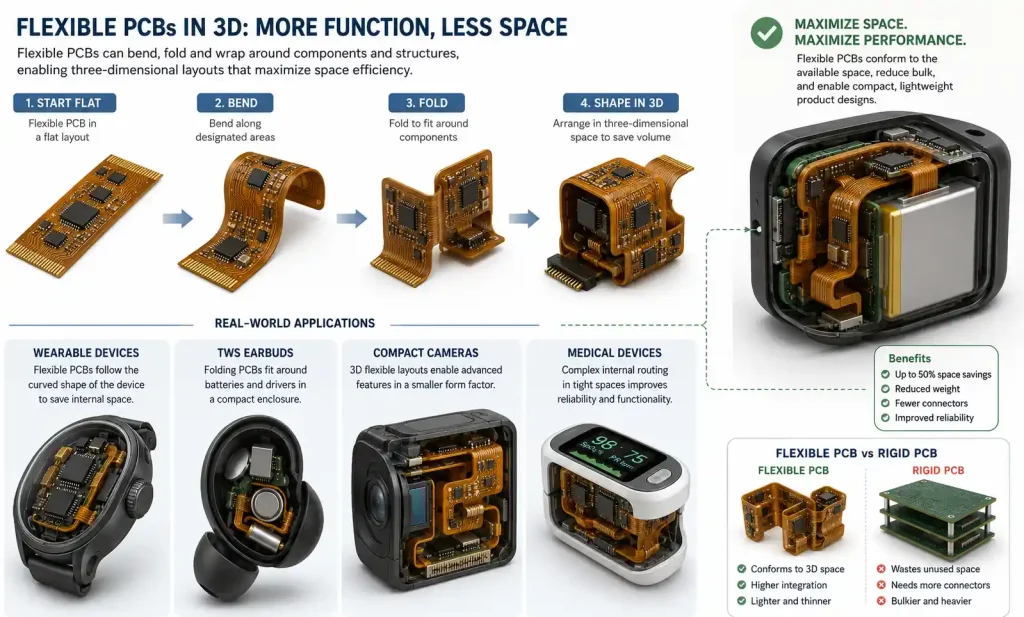
- Up to 60% space savings compared to rigid PCB assemblies
- 3D packaging geometries that are physically impossible with rigid boards
- Elimination of bulky connectors that consume valuable PCB real estate
How Flex PCBs Save Space
3D design capabilities: Flexible circuits can be folded, stacked, or wrapped around components, utilizing three-dimensional space efficiently. This allows designers to place circuits behind displays, around batteries, or within curved housings.
Connector elimination: By replacing separate rigid boards connected with cables and connectors, flex circuits create seamless assemblies that occupy far less volume.
Component integration: Flexible substrates allow components to be placed on both sides and in configurations impossible with rigid boards, maximizing space utilization.
Design Freedom in Compact Packages
The ability to bend and fold flex PCBs opens new possibilities for compact product design:
- Circuits can wrap around cylindrical batteries
- Electronics fit into curved or irregular enclosures
- Multiple circuit sections connect without bulky wire harnesses
- Displays and touchscreens integrate with underlying electronics seamlessly
This spatial efficiency is crucial for modern smartphones, smartwatches, hearing aids, and other devices where every millimeter counts.
Advantage 3: Enhanced Design Freedom
Flexible PCBs liberate engineers from the geometric constraints of rigid boards, enabling innovative product designs previously deemed impossible.
Three-Dimensional Design Possibilities
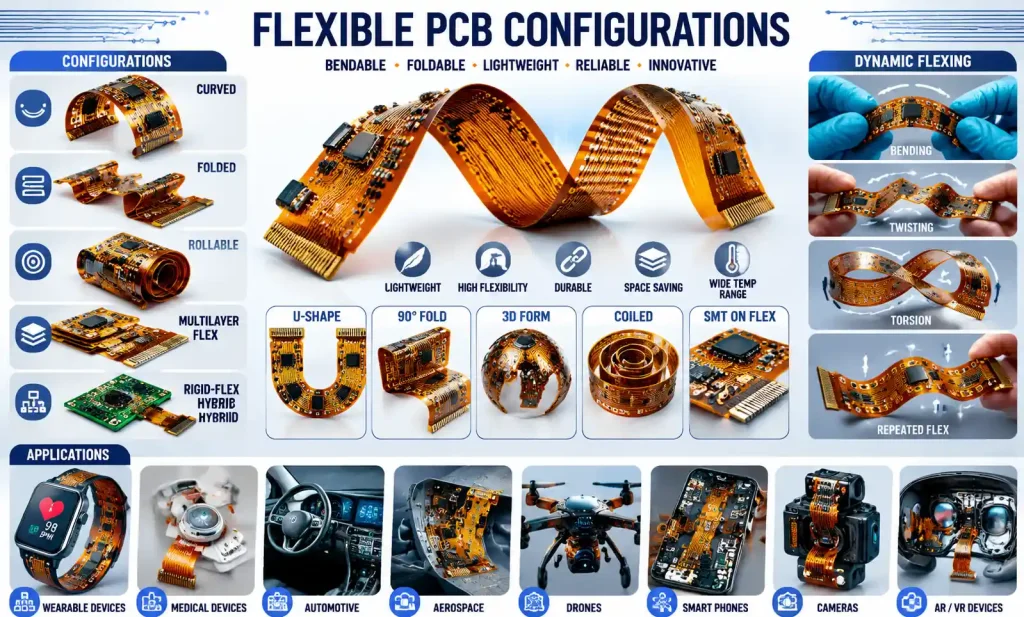
Traditional rigid PCBs confine designers to flat, two-dimensional layouts. Flex circuits break this limitation:
Complex geometries: Circuits can conform to curved surfaces, wrap around components, or fold through multiple planes.
Dynamic flexing: Some applications require circuits to flex repeatedly during operation—like laptop hinges, flip phones, or articulated robotic joints. Flex PCBs handle this movement gracefully.
Miniaturization: The ability to fold circuits into compact 3D configurations enables unprecedented device miniaturization.
Precision Manufacturing
Modern flex PCB manufacturing achieves:
- 0.05mm trace precision for high-density interconnects
- Fine-pitch component mounting for miniaturized designs
- Precise impedance control for high-speed signals
Streamlined Product Aesthetics
Flexible circuits enable cleaner, more elegant product designs:
- No visible cable bundles cluttering the interior
- Seamless integration between subsystems
- Thinner overall product profiles
- Curved or contoured device shapes
This design freedom is why flex PCBs have become essential in premium consumer electronics, where aesthetics and functionality must coexist.
Advantage 4: Superior Reliability and Durability
Contrary to what the name might suggest, flexible PCBs often outlast their rigid counterparts in demanding applications.
Mechanical Reliability
Vibration resistance: With fewer solder joints and interconnections, flex circuits have fewer potential failure points when subjected to vibration—critical for automotive and aerospace applications.
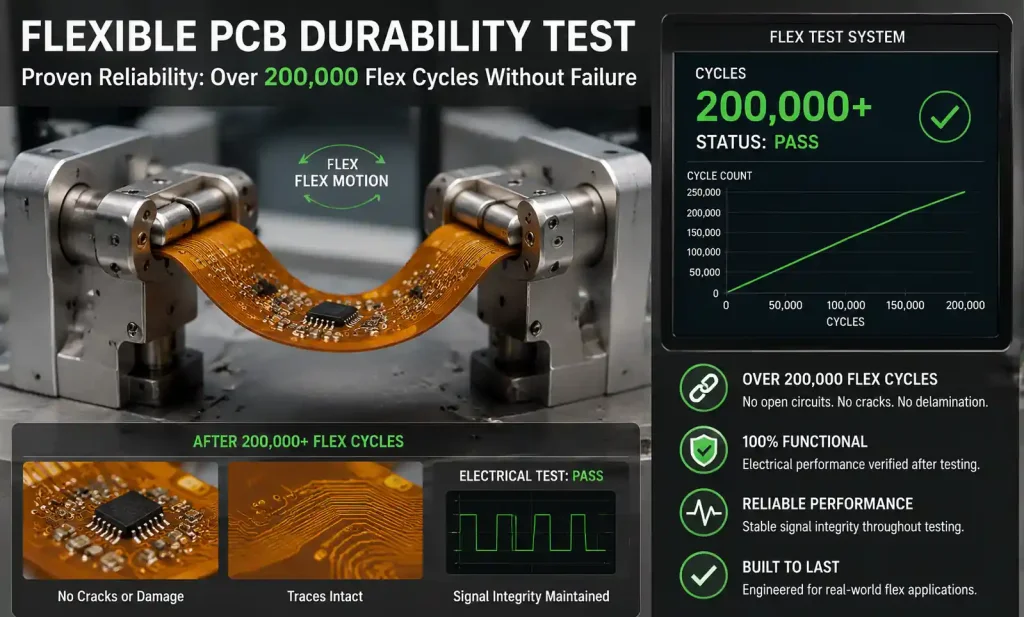
Flex cycle endurance: Quality flex PCBs routinely exceed 200,000 dynamic flexing cycles, making them ideal for applications with repeated movement like printer heads, disk drives, and medical instruments.
Shock absorption: The flexible substrate naturally absorbs mechanical shocks that might crack rigid boards.
Electrical Reliability
Consistent impedance: Flexible substrates maintain more consistent dielectric properties across temperature ranges than rigid boards.
Fewer interconnections: By eliminating connectors and cables, flex circuits reduce potential points of electrical failure.
EMI performance: Properly designed flex circuits can provide excellent electromagnetic interference shielding in compact assemblies.
Environmental Resilience
High-quality polyimide-based flex PCBs withstand:
- Temperature extremes (-200°C to +400°C for polyimide)
- Chemical exposure (oils, solvents, cleaning agents)
- Humidity and moisture
- Radiation exposure (aerospace applications)
This durability makes flex PCBs particularly valuable in harsh environments like automotive engine compartments, medical sterilization equipment, and aerospace applications.
Advantage 5: Reduced Assembly Complexity
Flexible PCBs can significantly streamline manufacturing and assembly processes, reducing costs and improving product quality.
Fewer Components and Connections
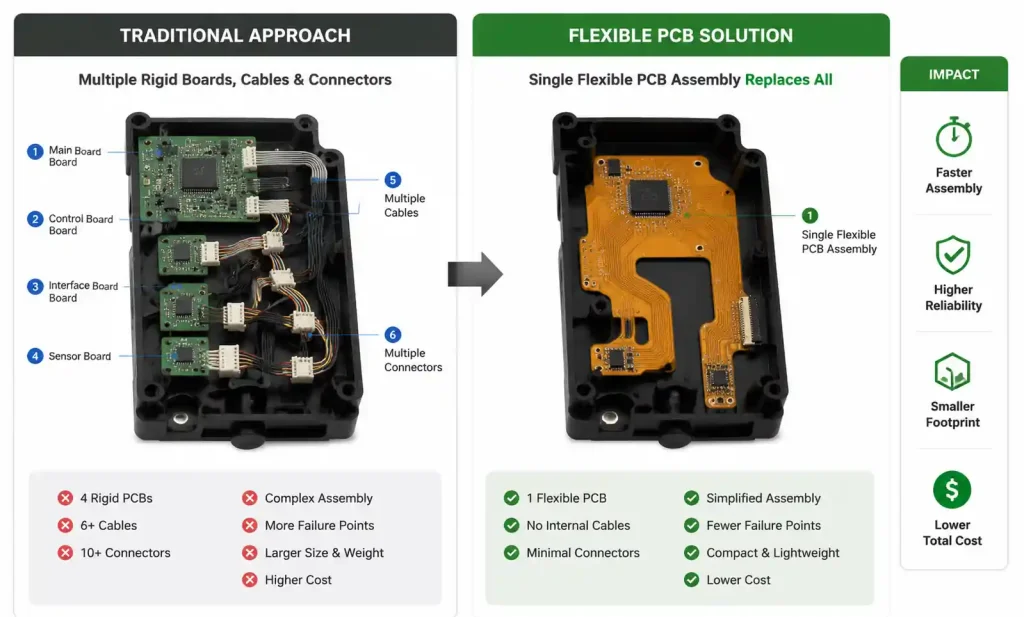
Integrated assemblies: A single flex circuit can replace multiple rigid boards, cables, and connectors—simplifying the bill of materials.
Reduced hand assembly: Fewer connectors mean less manual assembly work, reducing labor costs and human error potential.
Lower component count: Eliminating connectors and cables removes dozens of parts from complex assemblies.
Manufacturing Efficiency
Faster assembly: Fewer discrete components translate to faster production line throughput.
Improved yields: Eliminating solder joints and connectors reduces potential defect points.
Simplified testing: Integrated flex assemblies often require fewer test points and simpler validation procedures.
Cost Implications
While flex PCBs themselves may have higher per-unit costs than rigid boards, total assembly costs often decrease due to:
- Reduced component count
- Lower assembly labor
- Fewer quality control steps
- Decreased rework and warranty issues
For high-volume production, these savings can offset the higher circuit cost, resulting in lower overall product costs.
Advantage 6: Better Thermal Management
Thermal management is increasingly critical as electronics become more powerful and compact. Flexible PCBs offer several thermal advantages.
Heat Dissipation Properties
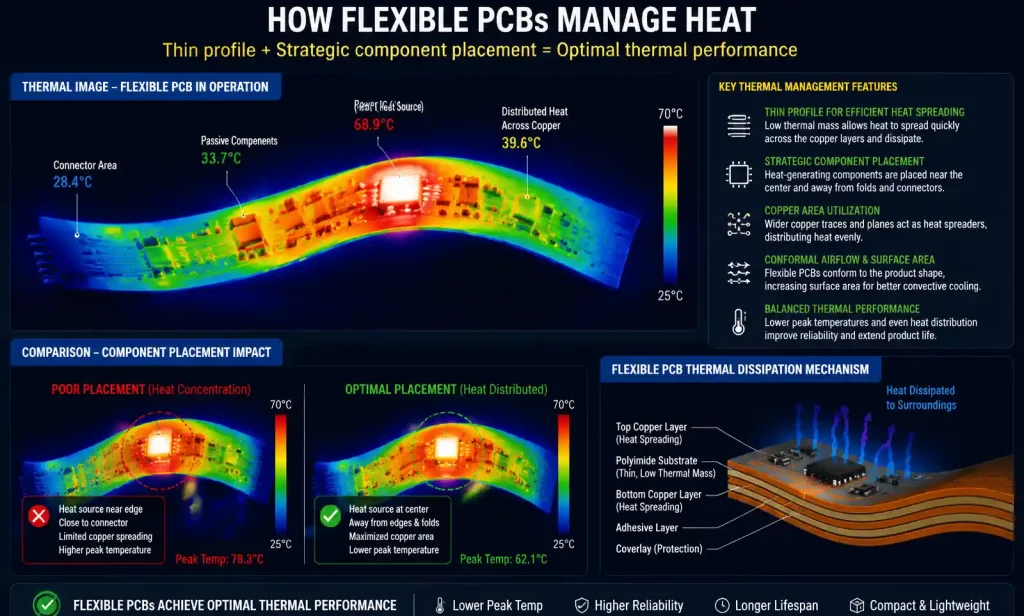
Thin profiles: The minimal thickness of flex circuits allows heat to escape more readily than thick rigid boards.
Thermal conductivity: Polyimide substrates, while not as thermally conductive as metal-core PCBs, can incorporate copper or aluminum stiffeners for enhanced heat spreading.
Strategic component placement: The 3D design freedom of flex circuits allows heat-generating components to be positioned for optimal thermal performance.
Active Thermal Solutions
Flex circuits can integrate with advanced cooling solutions:
- Conformal designs that wrap around heat sinks
- Direct contact with metal chassis for heat sinking
- Integration with thermal interface materials
- Strategic placement away from temperature-sensitive components
Temperature Stability
High-quality flex PCB materials maintain stable electrical properties across wide temperature ranges, ensuring consistent performance in both extreme cold and high-heat environments.
Applications Driving Flex PCB Adoption
The unique advantages of flexible PCBs make them indispensable across numerous industries and applications.
Consumer Electronics
- Smartphones: Connecting displays, cameras, and batteries in ultra-thin profiles
- Wearables: Smartwatches, fitness trackers, and health monitors benefit from lightweight, flexible circuits
- Laptops and tablets: Hinge connections and touchpad assemblies
- Wireless earbuds: Miniature flex circuits enable compact designs
Medical Devices
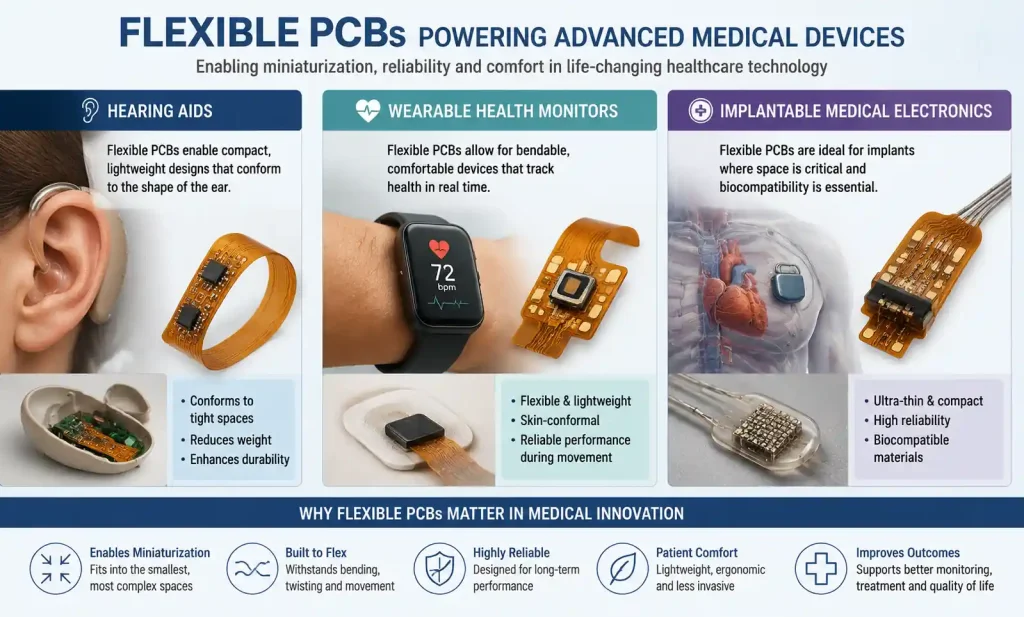
- Implantables: Pacemakers and neural stimulators use biocompatible flex circuits
- Diagnostic equipment: Portable ultrasound and monitoring devices
- Surgical instruments: Minimally invasive tools with embedded sensors
- Hearing aids: Ultra-miniaturized circuits in small form factors
Automotive and Aerospace
- Automotive dashboards: Instrument clusters and infotainment systems
- Sensor networks: Distributed sensing for autonomous vehicles
- Satellite systems: Weight-critical aerospace applications
- Aircraft avionics: Reliable operation in extreme conditions
Industrial and IoT
- Industrial sensors: Harsh environment monitoring
- Robotics: Articulated joints and moving assemblies
- Smart home devices: Compact, aesthetically pleasing electronics
- IoT edge devices: Battery-powered sensors requiring minimal weight and space
The versatility of flex PCBs continues to expand as designers discover new applications leveraging their unique properties.
Considerations and Trade-offs
While flexible PCBs offer numerous advantages, they’re not always the optimal solution. Understanding the trade-offs helps engineers make informed decisions.
Cost Considerations
Higher per-unit costs: Flex PCB manufacturing is generally more expensive than rigid boards, particularly for low volumes.
Tooling expenses: Custom designs require specialized tooling that increases upfront costs.
ROI timeline: Cost benefits from reduced assembly complexity may only materialize at higher production volumes.
Design Constraints
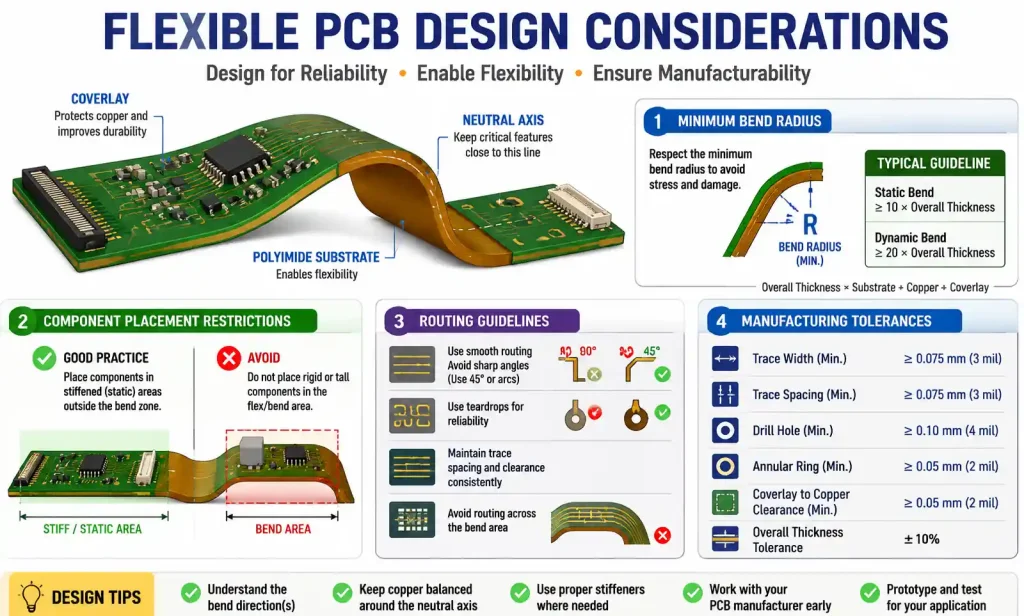
Component limitations: Not all components are suitable for flex PCB mounting, particularly heavy or high-pin-count packages.
Manufacturing complexity: Designing for manufacturability requires specialized knowledge and careful adherence to design rules.
Bending radius limitations: Excessive bending can damage traces; designers must respect minimum bend radius specifications.
When to Choose Rigid PCBs
Rigid PCBs remain the better choice when:
- Design is flat with no space constraints
- Cost is the primary driver and volumes are low
- Heavy components require rigid mounting
- Thermal management demands metal-core substrates
- Standard interconnections are sufficient
Rigid-Flex Hybrid Solutions
For many applications, rigid-flex boards offer an optimal compromise, combining rigid sections for component mounting with flexible interconnections where needed.
The Future of Flexible PCBs
As electronics continue evolving toward smaller, smarter, and more integrated devices, flexible PCB technology advances to meet emerging demands.
Technology Trends
Stretchable circuits: Next-generation flex PCBs that can stretch as well as bend, opening possibilities for truly conformable electronics.
Higher density: Advanced manufacturing techniques enable finer traces and smaller vias, supporting more complex circuits in smaller spaces.
Integrated components: Embedding passive components directly into flex substrates for even greater miniaturization.
Sustainable materials: Development of environmentally friendly substrates and manufacturing processes.
Emerging Applications
- Foldable displays: The backbone of folding smartphones and tablets
- Electronic textiles: Circuits integrated into clothing and fabrics
- Biomedical sensors: Advanced health monitoring with skin-conformable electronics
- Automotive interiors: Seamless integration of controls and displays into vehicle surfaces
Market Growth
Industry analysts project continued strong growth in the flex PCB market, driven by:
- Expanding wearable and IoT device markets
- 5G and wireless communication infrastructure
- Electric vehicle production ramp-up
- Advanced medical device development
As manufacturing techniques mature and costs decrease, flexible PCBs will become accessible to an even broader range of applications.
Conclusion
Flexible PCBs represent a paradigm shift in electronic design, offering compelling advantages that extend far beyond simple flexibility. The ability to reduce weight by up to 75% and save up to 60% in space makes flex circuits indispensable for modern electronics.
Beyond these headline benefits, flex PCBs deliver enhanced design freedom, superior reliability, simplified assembly, and effective thermal management. These advantages explain why flexible circuits have become essential in applications ranging from consumer smartphones to aerospace systems.
While cost and design complexity considerations remain, the total value proposition—particularly for space-constrained, weight-sensitive, or high-reliability applications—often favors flexible over rigid solutions.
As technology continues advancing toward smaller, smarter, and more integrated devices, flexible PCB technology will play an increasingly central role in bringing innovative electronic products to market. For engineers and designers working on next-generation electronics, understanding and leveraging the advantages of flex PCBs isn’t just beneficial—it’s essential.