
Methods for Cleaning Flux Residues from PCB Boards
Introduction
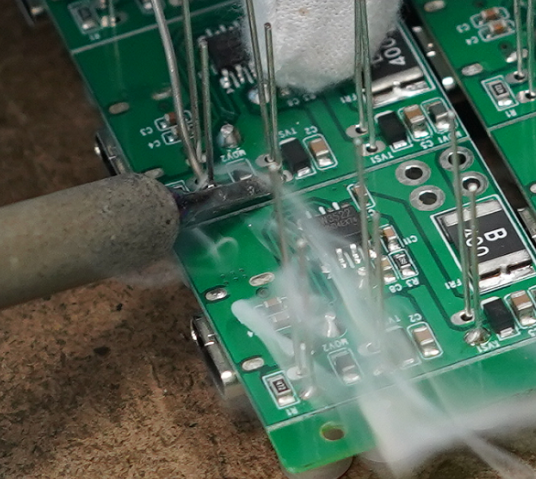
Printed Circuit Boards (PCBs) are essential components in modern electronics, and the soldering process is crucial for assembling components onto them. During soldering, flux is used to remove oxides, improve wetting, and ensure reliable solder joints. However, flux residues left on PCBs can cause corrosion, electrical leakage, and reduced performance if not properly cleaned.
This article explores various flux cleaning methods, including solvent-based cleaning, water-based cleaning, semi-aqueous cleaning, and newer environmentally friendly techniques. We will discuss their advantages, limitations, and best practices for effective PCB cleaning.
1. Why Clean Flux Residues from PCBs?
Flux residues can be classified into three main types:
- Rosin-based flux (moderately active, leaves sticky residues)
- Water-soluble flux (highly active, requires cleaning)
- No-clean flux (low residue, but may still need cleaning in high-reliability applications)
If not removed, flux residues can:
✔ Cause electrical short circuits due to ionic contamination.
✔ Lead to corrosion over time, especially with halide-containing fluxes.
✔ Affect signal integrity in high-frequency circuits.
✔ Reduce adhesion of conformal coatings.
Thus, selecting the right cleaning method is critical for PCB reliability.
2. Common PCB Flux Cleaning Methods
2.1 Solvent-Based Cleaning
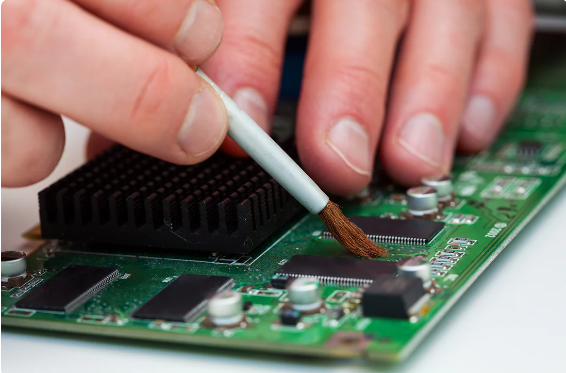
Solvent cleaning uses organic solvents to dissolve and remove flux residues. Common solvents include:
- Isopropyl Alcohol (IPA) – Effective for rosin and no-clean fluxes.
- Acetone – Stronger solvent but may damage some plastics.
- Hydrofluorocarbons (HFCs) & Hydrofluoroethers (HFEs) – Low toxicity, fast evaporation.
Process:
- Immersion or Spray Cleaning – PCBs are dipped or sprayed with solvent.
- Ultrasonic Cleaning (optional) – Enhances cleaning efficiency for stubborn residues.
- Rinsing & Drying – Residual solvent is evaporated or blown off.
Pros:
✔ Fast evaporation, no water spots.
✔ Effective for rosin-based fluxes.
Cons:
✖ Some solvents are flammable or toxic.
✖ Not ideal for water-soluble fluxes.
2.2 Water-Based Cleaning
Water-based cleaning is suitable for water-soluble fluxes and involves:
- Deionized (DI) water – Prevents mineral deposits.
- Saponifiers (alkaline additives) – Helps break down rosin flux.
Process:
- Pre-rinse – Removes loose contaminants.
- Main Wash – Heated DI water with saponifiers (if needed).
- Final Rinse – Ensures no detergent residues remain.
- Drying – Hot air or IR drying.
Pros:
✔ Environmentally friendly (no VOCs).
✔ Effective for water-soluble and some rosin fluxes.
Cons:
✖ Requires proper wastewater treatment.
✖ Longer drying time compared to solvents.
2.3 Semi-Aqueous Cleaning
Semi-aqueous cleaning combines solvent and water rinsing. Common steps:
- Solvent Pre-Clean – Removes bulk flux.
- Water Rinse – Eliminates remaining residues.
- Drying – Ensures no moisture remains.
Pros:
✔ Balances effectiveness and environmental impact.
✔ Works for both rosin and synthetic fluxes.
Cons:
✖ More complex process than pure solvent or water cleaning.
2.4 No-Clean Flux & Minimal Cleaning
Some modern fluxes are labeled “no-clean,” meaning they leave minimal residues that do not require cleaning in most applications. However, in high-reliability electronics (medical, aerospace), even no-clean residues may need removal.
Methods:
- Low-residue flux selection – Reduces cleaning needs.
- Localized cleaning – Only cleaning critical areas.
Pros:
✔ Saves time and cost in less critical applications.
Cons:
✖ May still require cleaning in harsh environments.
2.5 Advanced Cleaning Techniques
A) Plasma Cleaning
- Uses ionized gas to break down organic residues.
- Ideal for high-precision PCBs (e.g., medical devices).
B) CO₂ Snow Cleaning
- Blasts dry ice particles to remove contaminants.
- Non-abrasive and residue-free.
C) Ultrasonic & Megasonic Cleaning
- Uses high-frequency sound waves for deep cleaning.
- Effective for complex PCB geometries.
3. Choosing the Right Cleaning Method
| Factor | Best Method |
|---|---|
| Rosin Flux | Solvent or semi-aqueous cleaning |
| Water-Soluble Flux | Water-based cleaning |
| No-Clean Flux | Minimal or selective cleaning |
| High Reliability | Plasma or CO₂ cleaning |
| Environmentally Friendly | Water-based or semi-aqueous |
4. Best Practices for PCB Flux Cleaning
- Test Compatibility – Ensure cleaning agents don’t damage components.
- Optimize Process Parameters – Temperature, pressure, and exposure time.
- Inspect After Cleaning – Use ion contamination testers or visual inspection.
- Proper Waste Disposal – Follow environmental regulations for solvents.
5. Conclusion
Cleaning flux residues from PCBs is crucial for long-term reliability and performance. The choice of cleaning method depends on the flux type, PCB complexity, and environmental considerations. While solvent cleaning remains popular for its speed, water-based and advanced techniques (plasma, CO₂) are gaining traction due to stricter environmental regulations.
By selecting the appropriate cleaning method and following best practices, manufacturers can ensure high-quality, contamination-free PCBs for various applications.