
Skip to content
Andwin Circuits
  • Home
  • ProductsExpand
    • HDI multilayer PCB
    • Rigid Flex PCB
    • Flex pcb
    • Special PCBExpand
      • High Frequency PCBExpand
        • Rogers RO4350B PCB
        • Rogers RO4003 pcb
        • Rogers RO3003 PCB
        • Rogers 5880 PCB
        • DICLAD 527 PCB
        • Taconic TLX series
        • Taconic TLX-8 RF PCB
        • Taconic TLX-9 RF PCB
      • High speed pcbExpand
        • Megtron 6 High Speed PCB
        • TU-872 SLK Sp High Speed
      • High TG PCBExpand
        • SHENGYI SH260 PCB
        • ISOLA 370HR PCB
        • ISOLA IS410 PCB
        • ISOLA IS420 PCB
      • Heavy copper PCB
      • Copper coin pcb
      • Copper inlay PCB
    • Metal Core PCBExpand
      • Copper core pcb
      • Aluminum PCB
      • 2 Layers Aluminum PCB
      • Direct thermal MCPCB
      • 2 Layers Direct Thermal
    • Ceramic PCBExpand
      • DPC ceramic PCB
      • DBC ceramic PCB
      • Thick film Ceramic PCB
      • Al2O3 Alumina PCB
      • AIN ALN ceramic PCB
      • IGBT Ceramic PCB
  • ServiceExpand
    • PCB Assembly
    • Quick turn PCB assembly
    • PCBA conformal coating
  • IndustryExpand
    • Telecommunication
    • IoT and Wireless
    • Industrial Control
    • Thermal management
    • Power and Energy
    • IC test board
    • Automative
    • Medical
  • CapabilityExpand
    • Rigid PCB
    • Rigid flex PCB
    • Metal core PCB
    • PCB Assembly
  • TechnologyExpand
    • Blogs
    • Via in pad
    • PCB E-test
    • PCB stack up
    • MCPCB panelization
    • Controlled impedance PCB
  • AboutExpand
    • About us
    • Certification
    • Factory Tour
  • Contact
Andwin Circuits
Home / PCB signal line layout

PCB signal line layout

ByGrace July 7, 2025March 31, 2026

Before starting the circuit design of the PCB, find out the key signals based on relevant knowledge and analyze those key signals. For example, in this application note, for the most critical signals, such as clock signals, switch signals and other switching signals, one or more of the following measures can be adopted.

1. Line termination

According to [5], circuit designers can choose many different termination technologies. For long lines, line termination can avoid emission, and for short lines, line termination can avoid ringing, so it is necessary. Most of them are terminal termination and source termination. For example, terminal termination minimizes the rise time, so it is suitable for speed optimization. Source end serial termination can reduce the current of the signal track, so it can better reduce radiation.

The series termination resistor must be as close to the signal driver (source) as possible. It can be optimized to match the transmission line impedance or form a low-pass filter with the load capacitor. The transmission line impedance should match the sum of the driving impedances and the resistor value should be equal to the transmission line impedance. In order to achieve EME optimization, the current on the signal line and the harmonics of the signal frequency should be minimized. Therefore, it is desirable to obtain a resistor as large as the timing and functional constraints allow.

2.Transmission lines on PCBs

The most common transmission lines used on PCBs are striplines or microstrip lines. In [5], complex and accurate formulas for calculating impedance, delay, etc. are available. As shown in Figure 5-11, Figures 1 and 2 are examples of microstrip lines; Figure 3 is an example of stripline. It is worth noting that when calculating striplines or microstrip lines, the parameters are assumed to be on an infinite ground. Since this is not a true ground plane, the signal line is at least 5 times the larger of the line width and line spacing. Another reason for implementing this measure is to implement a guard ring so that routing can be done at the edge of the board.

When implementing stripline or microstrip, confirm that the above assumptions are met during the PCB design process. Any local crosstalk from other lines can affect the characteristics of the stripline or microstrip and may cause unintentional high radiation. In addition, the power plane is not suitable as a reference plane for stripline or microstrip.
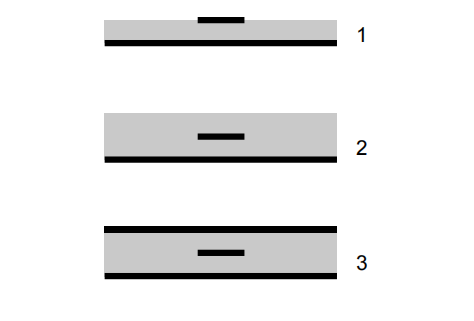
For the stackup, the distance between all layers of the PCB should be carefully considered and defined. The distance to the ground and the thickness of the material will affect the characteristics of the trace. Further, the signal radiation on the ground is proportional to the distance from the signal on the ground to the ground. Therefore, any critical signal on the ground should not be more than 0.2mm away from the ground, and the clock frequency above 30MHz should not be more than 0.1mm away from the ground. The clock frequency above 50MHz should be treated as a stripline instead.

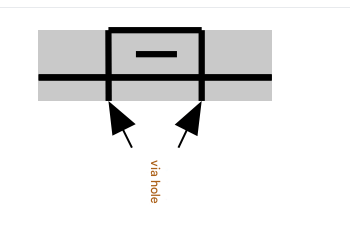
If there are only a few strip lines, it is possible to avoid using a second ground plane because it can be replaced by a ground line. For this purpose, the clock signal should be routed on a layer close to the ground, and a wider ground line should be placed on top of the clock signal on the next layer. This ground line is connected to both sides of the clock signal every 5-10 mm. Figure 5-12 gives an example of a 4-layer board.
Contact us for PCB quote now |

Post Tags: #aluminum clad pcb#aluminum core pcb#aluminum pcb#pab design#pcb signal

Post navigation

Previous Previous
How to divide large current and small current on PCB board
NextContinue
About PCB heating circuit design

Search

Search

Products

  • HDI Multilayer PCB
  • Rigid Flex PCB
  • Flex pcb
  • High Frequency PCB
  • High speed pcb
  • Heavy copper PCB
  • Metal Core PCB
  • Ceramic PCB

Address

Andwin Circuits Co.,Limited
Email: sales@andwinpcb.com
Tel: +86 755 2832 9394
Fax:+86 755 2992  6717
ADD:1-2F-1217,HouDeQun Industrial park,
NanTing RD NO.56,ShaJing,BaoAn,Shenzhen 518104,GuangDong,China

Products

  • HDI Multilayer PCB
  • Rigid Flex PCB
  • Flex pcb
  • High Frequency PCB
  • High speed pcb
  • Heavy copper PCB
  • Metal Core PCB
  • Ceramic PCB

Technology

  • Blogs
  • Via in pad
  • PCB E-test
  • PCB stack up
  • Metal core PCB panelization
  • Controlled impedance PCB

CERTIFICATION

Certification >>


Copyright© 2003 - 2026 Andwin | All Rights Reserved | Powered by Andwin

Scroll to top
  • Home
  • Products
    • HDI multilayer PCB
    • Rigid Flex PCB
    • Flex pcb
    • Special PCB
      • High Frequency PCB
        • Rogers RO4350B PCB
        • Rogers RO4003 pcb
        • Rogers RO3003 PCB
        • Rogers 5880 PCB
        • DICLAD 527 PCB
        • Taconic TLX series
        • Taconic TLX-8 RF PCB
        • Taconic TLX-9 RF PCB
      • High speed pcb
        • Megtron 6 High Speed PCB
        • TU-872 SLK Sp High Speed
      • High TG PCB
        • SHENGYI SH260 PCB
        • ISOLA 370HR PCB
        • ISOLA IS410 PCB
        • ISOLA IS420 PCB
      • Heavy copper PCB
      • Copper coin pcb
      • Copper inlay PCB
    • Metal Core PCB
      • Copper core pcb
      • Aluminum PCB
      • 2 Layers Aluminum PCB
      • Direct thermal MCPCB
      • 2 Layers Direct Thermal
    • Ceramic PCB
      • DPC ceramic PCB
      • DBC ceramic PCB
      • Thick film Ceramic PCB
      • Al2O3 Alumina PCB
      • AIN ALN ceramic PCB
      • IGBT Ceramic PCB
  • Service
    • PCB Assembly
    • Quick turn PCB assembly
    • PCBA conformal coating
  • Industry
    • Telecommunication
    • IoT and Wireless
    • Industrial Control
    • Thermal management
    • Power and Energy
    • IC test board
    • Automative
    • Medical
  • Capability
    • Rigid PCB
    • Rigid flex PCB
    • Metal core PCB
    • PCB Assembly
  • Technology
    • Blogs
    • Via in pad
    • PCB E-test
    • PCB stack up
    • MCPCB panelization
    • Controlled impedance PCB
  • About
    • About us
    • Certification
    • Factory Tour
  • Contact
Search