
PCB Stiffener: Purpose, Materials, and Applications in Modern Electronics
Introduction
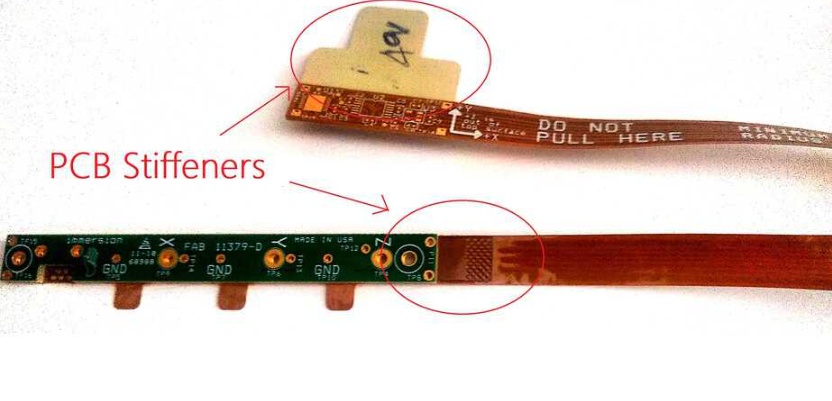
Printed Circuit Boards (PCBs) are the backbone of modern electronics, providing mechanical support and electrical connections for components. However, certain PCB designs—particularly flexible PCBs (flex circuits) and rigid-flex PCBs—require additional reinforcement to prevent bending, warping, or damage during assembly and operation. This is where PCB stiffeners come into play.
A PCB stiffener is a rigid or semi-rigid material attached to a flexible PCB to provide structural support, enhance durability, and improve component placement. Stiffeners are crucial in applications where flex circuits undergo mechanical stress or require a stable mounting surface for connectors, chips, or other components.
This article explores the purpose, materials, types, manufacturing processes, and applications of PCB stiffeners in modern electronics.
1. Purpose of PCB Stiffeners
Stiffeners serve several key functions in PCB design:
1.1 Mechanical Reinforcement
Flexible PCBs are designed to bend, but certain areas (such as where connectors or heavy components are mounted) need rigidity to prevent cracking or delamination. Stiffeners reinforce these sections, ensuring mechanical stability.
1.2 Improved Component Mounting
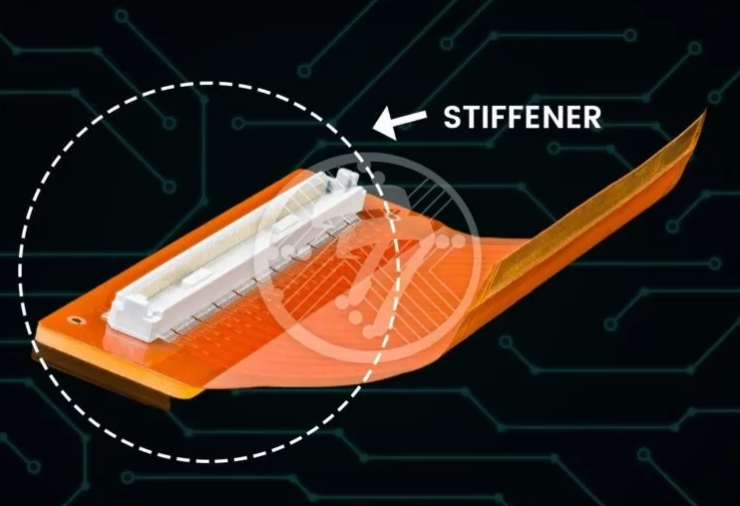
Surface-mounted devices (SMDs), ball grid arrays (BGAs), and connectors require a flat, rigid surface for proper soldering. Stiffeners provide this stability, preventing misalignment during reflow soldering.
1.3 Prevention of Flex Circuit Damage
Repeated bending or vibration can weaken flex circuits over time. Stiffeners minimize stress in critical areas, extending the PCB’s lifespan.
1.4 Enhanced Heat Dissipation
Some stiffeners, such as those made of metal, can act as heat spreaders, improving thermal management in high-power applications.
1.5 Easier Handling During Assembly
Flex circuits can be difficult to handle during manufacturing. Stiffeners make them easier to position in pick-and-place machines and wave soldering processes.
2. Common Materials Used for PCB Stiffeners
The choice of stiffener material depends on factors like rigidity, thermal properties, weight, and cost. The most common materials include:
2.1 FR4 (Glass Epoxy)
- Pros: Cost-effective, widely available, compatible with PCB manufacturing.
- Cons: Heavier than polyimide, less flexible.
- Applications: Standard rigid-flex PCBs, connector reinforcement.
2.2 Polyimide (PI)
- Pros: Lightweight, excellent thermal stability, matches flex PCB material.
- Cons: More expensive than FR4.
- Applications: High-temperature applications, aerospace, medical devices.
2.3 Aluminum
- Pros: Excellent heat dissipation, lightweight, durable.
- Cons: Conducts electricity (requires insulation), higher cost.
- Applications: LED PCBs, power electronics, RF shielding.
2.4 Stainless Steel
- Pros: Extremely rigid, corrosion-resistant, EMI shielding.
- Cons: Heavy, expensive.
- Applications: Military, industrial, harsh environments.
2.5 PET (Polyester)
- Pros: Low cost, lightweight, good for thin stiffeners.
- Cons: Lower thermal resistance.
- Applications: Consumer electronics, simple flex PCB support.
3. Types of PCB Stiffeners
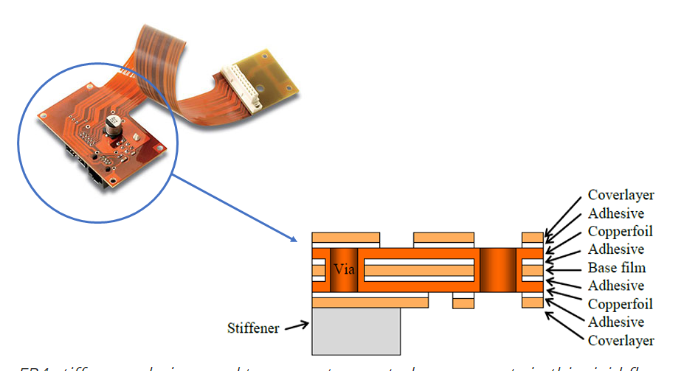
Stiffeners can be categorized based on their attachment method and location:
3.1 Adhesive-Based Stiffeners
- Pre-coated with pressure-sensitive adhesive (PSA) or thermal-bonding adhesive.
- Easy to apply but may weaken under high heat.
3.2 Laminated Stiffeners
- Bonded using heat and pressure during PCB fabrication.
- Provides a permanent, robust attachment.
3.3 Removable Stiffeners
- Used temporarily during assembly and then peeled off.
- Common in prototyping.
3.4 Localized vs. Full-Length Stiffeners
- Localized: Reinforces only specific areas (e.g., connector zones).
- Full-length: Covers the entire length of the flex section for maximum rigidity.
4. Manufacturing and Attachment Processes
The process of adding stiffeners to a PCB involves several steps:
4.1 Cutting the Stiffener Material
- Stiffeners are laser-cut or die-cut to match the PCB’s shape.
4.2 Surface Preparation
- The PCB surface is cleaned to ensure proper adhesion.
4.3 Adhesive Application
- PSA, epoxy, or thermal-set adhesives are applied.
4.4 Lamination (for Permanent Stiffeners)
- Heat and pressure are used to bond the stiffener permanently.
4.5 Drilling and Plating (if Needed)
- Holes for connectors or vias may be drilled and plated.
5. Applications of PCB Stiffeners
Stiffeners are used in various industries:
5.1 Consumer Electronics
- Smartphones, wearables, foldable displays.
5.2 Automotive Electronics
- Flex circuits in dashboards, sensors, LED lighting.
5.3 Medical Devices
- Flexible PCBs in implants, diagnostic equipment.
5.4 Aerospace & Defense
- High-reliability applications with extreme conditions.
5.5 Industrial Equipment
- Robotics, machinery control systems.
6. Design Considerations for PCB Stiffeners
When integrating stiffeners into a PCB design, engineers must consider:
- Material compatibility (CTE matching to avoid warping).
- Thickness and rigidity requirements.
- Thermal management needs.
- Assembly process constraints (soldering temperature limits).
7. Future Trends in PCB Stiffener Technology
- Thinner, stronger materials (e.g., carbon fiber composites).
- Integrated stiffeners with embedded components.
- 3D-printed stiffeners for custom geometries.
Conclusion
PCB stiffeners play a vital role in enhancing the durability, manufacturability, and performance of flexible and rigid-flex PCBs. By selecting the right material and attachment method, engineers can ensure reliable operation in demanding applications. As electronics continue to evolve, stiffener technology will advance to meet new challenges in miniaturization, thermal management, and mechanical resilience.
Understanding the principles of PCB stiffeners allows designers to optimize their PCBs for both flexibility and rigidity, ensuring robust performance across industries.