
Reflection caused by changes in PCB trace width
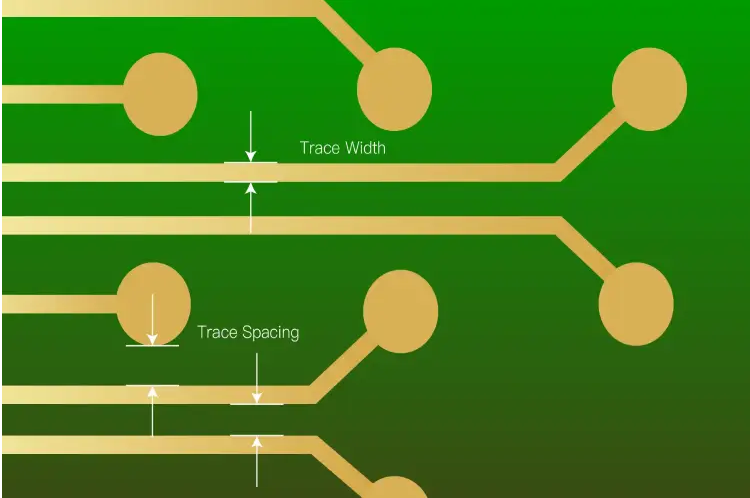
When PCB wiring is being performed, the following situation often occurs: when the trace passes through a certain area, due to the limited wiring space in the area, a thinner line has to be used. After passing through this area, the line returns to its original width. Changes in trace width will cause impedance changes, so reflections occur and affect the signal. So under what circumstances can this effect be ignored, and under what circumstances must we consider its impact?
Three factors are related to this effect: the magnitude of impedance change, signal rise time, and signal delay on narrow lines.
First, let’s discuss the magnitude of impedance change. The design of many circuits requires that the reflected noise is less than 5% of the voltage swing (this is related to the noise budget on the signal). According to the reflection coefficient formula:
It can be calculated that the approximate impedance change rate requirement is: △Z/Z1 ≤10%. You may know that the typical indicator of impedance on a circuit board is +/-10%, and this is the root cause.
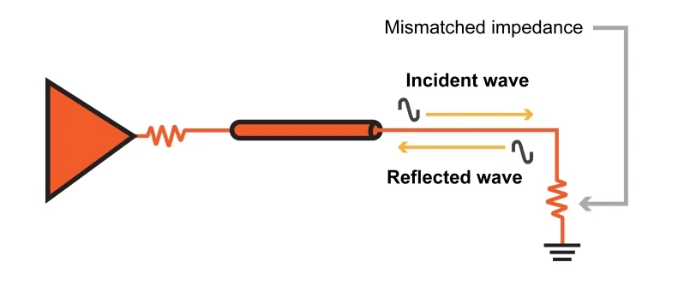
If the impedance change occurs only once, for example, the line width changes from 8mil to 6mil and then remains at 6mil, the impedance change must be less than 10% to achieve the noise budget requirement that the signal reflection noise at the mutation does not exceed 5% of the voltage swing. This is sometimes difficult to achieve. Take the case of microstrip lines on FR4 boards as an example. Let’s calculate. If the line width is 8mil, the thickness between the line and the reference plane is 4mil, and the characteristic impedance is 46.5 ohms. After the line width changes to 6mil, the characteristic impedance becomes 54.2 ohms, and the impedance change rate reaches 20%. The amplitude of the reflected signal must exceed the standard. As for how much impact it has on the signal, it also depends on the signal rise time and the signal delay from the driver end to the reflection point. But at least this is a potential problem point. Fortunately, the problem can be solved by impedance matching termination.
If the impedance change occurs twice, for example, the line width changes from 8mil to 6mil, and then changes back to 8mil after being pulled out 2cm. Then reflection will occur at both ends of the 2cm long 6mil wide line, once the impedance increases, positive reflection occurs, and then the impedance decreases, negative reflection occurs. If the interval between two reflections is short enough, the two reflections may cancel each other out, thus reducing the impact. Assuming the transmission signal is 1V, 0.2V is reflected in the first positive reflection, 1.2V continues to be transmitted forward, and -0.2*1.2 = 0.24v is reflected back in the second reflection. Assuming that the 6mil line length is extremely short and the two reflections occur almost simultaneously, the total reflected voltage is only 0.04V, which is less than the 5% noise budget requirement. Therefore, whether this reflection affects the signal and how much it affects it is related to the delay at the impedance change and the signal rise time. Research and experiments have shown that as long as the delay at the impedance change is less than 20% of the signal rise time, the reflected signal will not cause problems. If the signal rise time is 1ns, then the delay at the impedance change is less than 0.2ns corresponding to 1.2 inches, and the reflection will not cause problems. In other words, for this case, as long as the length of the 6mil wide trace is less than 3cm, there will be no problem.
When the width of the PCB trace changes, it is necessary to carefully analyze whether it causes any impact based on the actual situation. There are three parameters that need to be paid attention to: how big the impedance change is, how long the signal rise time is, and how long the neck part of the line width change is. Make a rough estimate based on the above method and leave a certain margin appropriately. If possible, try to reduce the length of the neck part.
It should be pointed out that in actual PCB processing, the parameters cannot be as accurate as in theory. Theory can provide guidance for our design, but it cannot be copied and cannot be dogmatic. After all, this is a practical science. The estimated value should be appropriately revised according to the actual situation and then applied to the design. If you feel that you lack experience, be conservative first, and then adjust it appropriately according to the manufacturing cost.