
The Impact of Woven Glass Laminates on Printed Circuit Boards (PCBs)
Abstract
This paper examines the significant influence of woven glass laminates on the performance, reliability, and manufacturing of printed circuit boards (PCBs). As the foundational material for most modern PCBs, woven glass reinforced epoxy laminates (particularly FR-4) determine many critical characteristics of the final product. The discussion covers electrical properties, mechanical strength, thermal performance, manufacturing considerations, and emerging alternatives. Understanding these effects enables better material selection for specific PCB applications ranging from consumer electronics to aerospace systems.
Introduction
Printed circuit boards serve as the structural and electrical foundation for virtually all electronic devices. The choice of substrate material profoundly impacts the board’s performance, with woven glass laminates representing the most common solution. These composite materials typically combine glass fiber cloth with an epoxy resin matrix, creating a durable dielectric substrate that meets diverse requirements.
The glass weave style, resin chemistry, and manufacturing processes all contribute to the final laminate properties that PCB designers must consider. This paper explores how these factors influence signal integrity, thermal management, mechanical reliability, and production yields in modern electronic systems.
Electrical Properties
Dielectric Constant (Dk) and Consistency
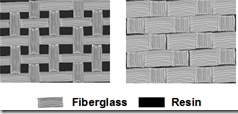
Woven glass laminates exhibit anisotropic dielectric properties due to the alternating pattern of glass fibers (Dk ≈ 6.0) and resin regions (Dk ≈ 3.0-3.5). This variation causes:
- Impedance inconsistencies: The periodic dielectric constant variation creates localized impedance fluctuations, particularly problematic for high-speed signals (>5GHz) where wavelength becomes comparable to weave pitch.
- Skew issues: Differential pairs may experience phase differences when traces align differently relative to the glass weave pattern.
- Resonance effects: In RF applications, the periodic structure can create unwanted resonance at certain frequencies.
Material suppliers have developed “spread glass” and “low-profile weaves” to minimize these effects, though typically at increased cost.
Dissipation Factor (Df)
The loss tangent of standard FR-4 (≈0.02) limits its usefulness for high-frequency applications. Advanced laminates incorporate:
- Modified epoxy resins with lower Df
- Different glass styles (NE-glass vs. standard E-glass)
- Ceramic fillers to reduce overall loss
Surface Roughness
The glass weave texture affects conductor losses, with smoother surfaces preferred for millimeter-wave applications. However, some roughness promotes better adhesion.
Mechanical Characteristics
Dimensional Stability
The glass fabric provides exceptional dimensional stability during:
- Manufacturing: Resists shrinkage and warpage during lamination
- Thermal cycling: Maintains registration between layers
- Moisture exposure: Glass fibers minimize hygroscopic expansion
However, the anisotropic nature causes different CTE values in x-y (12-16 ppm/°C) versus z-axis (50-70 ppm/°C), potentially leading to via reliability issues.
Flexural Strength
The glass reinforcement provides:
- High rigidity for component support
- Resistance to mechanical stresses during assembly
- Improved vibration resistance versus non-reinforced substrates
Downsides include reduced flexibility versus polyimide films for flex circuits.
Drillability and Machining
Glass fibers present unique machining challenges:
- Bit wear: Abrasive glass accelerates drill bit deterioration
- Smear generation: Can create resin smear in drilled holes
- Rough hole walls: May require additional desmear processing
Thermal Performance
Thermal Conductivity
Standard glass-epoxy composites have relatively poor thermal conductivity (0.2-0.3 W/mK), prompting developments like:
- Thermally conductive fillers (alumina, boron nitride)
- Alternative resin systems with improved heat transfer
- Hybrid constructions incorporating metal cores
Glass Transition Temperature (Tg)
Standard FR-4 offers Tg around 130-140°C, while high-performance versions reach 170-180°C. The glass fibers:
- Provide structural support above Tg
- Constrain resin movement during thermal excursions
- Affect the rate of thermal expansion change at Tg
Decomposition Temperature (Td)
The inorganic glass fibers maintain mechanical integrity even as the organic resin decomposes (typically >300°C), providing critical failure containment.
Manufacturing Considerations
Laminate Processing
Glass fabrics influence:
- Resin flow: Tight weaves restrict flow during pressing
- Prepreg handling: Fiber orientation affects drape characteristics
- Copper adhesion: Surface treatments must account for fiber/resin differences
Multilayer Alignment
The visibility of glass fibers under alignment targets assists with:
- Layer-to-layer registration
- Optical inspection systems
- X-ray alignment for buried features
Yield Factors
Glass weave-related yield issues include:
- Weave exposure: Fiber pattern telegraphing through thin copper
- Resin-rich areas: Creating uneven etching conditions
- Fiber print-through: Affecting solder mask application
Environmental and Reliability Factors
Moisture Resistance
While glass fibers themselves don’t absorb moisture, the fiber/resin interface can:
- Create pathways for moisture ingress
- Affect delamination resistance
- Modify dielectric properties in humid environments
Chemical Resistance
The glass reinforcement improves resistance to:
- Solvents used in assembly
- Cleaning chemicals
- Environmental contaminants
Long-Term Reliability
Glass laminates demonstrate excellent:
- Aging characteristics
- Resistance to electrochemical migration
- Thermal cycle performance (with proper material selection)

Emerging Alternatives and Hybrid Approaches
While woven glass dominates the PCB industry, several alternatives have emerged:
- Non-woven substrates: Eliminating weave-related signal integrity issues
- Nanocomposite materials: Incorporating nanotubes or other reinforcements
- Liquid crystal polymer (LCP) films: For ultra-high frequency applications
Hybrid approaches combining glass reinforcement with these new materials show particular promise for next-generation applications.
Conclusion
Woven glass laminates continue to serve as the workhorse material for PCB manufacturing due to their unique combination of electrical, mechanical, and thermal properties. While presenting certain challenges—particularly for high-speed digital and RF designs—ongoing material developments continue to extend their applicability. Understanding these effects enables optimized material selection balancing performance requirements with cost considerations across diverse applications.
The future will likely see more specialized glass weave styles and resin formulations as electronic systems push performance boundaries while demanding improved reliability and manufacturability. PCB designers must maintain awareness of these material developments to fully leverage the capabilities of modern woven glass laminates.