
Round PCBs: Design, Applications, and Manufacturing Considerations
Introduction to Round PCBs
Printed Circuit Boards (PCBs) traditionally come in rectangular or square shapes, but round PCBs have gained significant popularity in recent years for specialized applications. These circular circuit boards offer unique advantages in terms of space utilization, aesthetic appeal, and mechanical integration in certain electronic devices.
Round PCBs present both opportunities and challenges in design and manufacturing compared to their rectangular counterparts. This comprehensive article explores the world of circular printed circuit boards, covering their design considerations, manufacturing processes, applications, and the future of this specialized PCB format.
Design Considerations for Round PCBs
1. Component Placement Challenges
Designing round PCBs requires a different approach to component placement compared to traditional rectangular boards. The circular shape presents unique challenges:
- Radial symmetry considerations: Components must often be arranged in circular or radial patterns rather than linear grids
- Edge clearance requirements: Maintaining proper clearance near the curved edges becomes critical
- Thermal management: Heat dissipation patterns differ from rectangular boards
- Signal integrity: Trace routing must accommodate the circular geometry without compromising performance
2. Routing Strategies for Circular Boards
Effective routing on round PCBs demands specialized techniques:
- Concentric circle routing: Traces can be routed in circular patterns following the board’s shape
- Radial trace routing: Traces extend outward from the center like spokes on a wheel
- Spiral routing: For certain applications, spiral patterns can optimize space utilization
- Layer utilization: Careful planning of multi-layer boards to maximize routing efficiency
3. Mechanical Design Factors
The mechanical aspects of round PCBs require special attention:
- Mounting considerations: Round boards often need custom mounting solutions
- Edge reinforcement: The circular shape may require additional edge support
- Connector placement: Peripheral connectors must accommodate the curved edge
- Board thickness: May need adjustment to maintain structural integrity
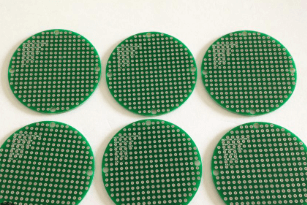
Manufacturing Processes for Round PCBs
1. Panelization Techniques
Round PCBs present unique challenges in panelization for manufacturing:
- Optimal panel layouts: Hexagonal or triangular arrangements often maximize material usage
- Breakaway tab design: Special tabs are needed for secure holding during manufacturing
- Routing vs. scoring: Different depanelization methods must be considered
- Material utilization: Efficient nesting of circular boards in rectangular panels
2. Specialized Cutting Methods
Producing the circular shape requires specific fabrication techniques:
- CNC routing: High-precision computer-controlled routing creates smooth edges
- Laser cutting: For high-volume production or very precise requirements
- Punching: Economical for large-volume production of standard sizes
- Water jet cutting: Alternative method for certain material types
3. Quality Control Considerations
Round PCBs require specialized quality checks:
- Dimensional verification: Ensuring precise circularity and diameter
- Edge quality inspection: Checking for smoothness and delamination
- Registration accuracy: Verifying layer-to-layer alignment
- Electrical testing: Adapting test fixtures for circular formats
Applications of Round PCBs
1. Consumer Electronics
Round PCBs have found numerous applications in consumer products:
- Wearable devices: Smartwatches and fitness trackers often use circular boards
- Audio equipment: Many high-end speakers and audio components utilize round PCBs
- Smart home devices: Voice assistants and smart displays with circular form factors
- LED lighting: Circular boards perfectly match the shape of many light fixtures
2. Industrial Applications
Industrial uses for round PCBs continue to expand:
- Rotary encoders: Naturally suited for circular motion sensing applications
- Control panels: Round interfaces for machinery and equipment
- Sensor arrays: Circular arrangements for 360-degree sensing
- Instrumentation: Gauges and measurement devices with circular displays
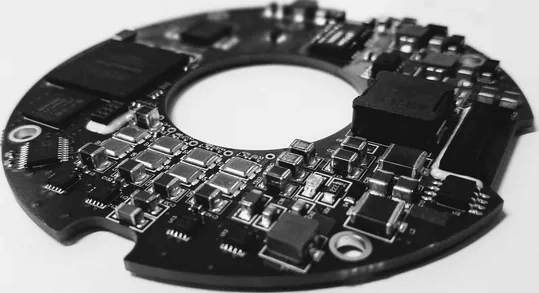
3. Automotive and Aerospace
Round PCBs serve critical functions in transportation:
- Dashboard instruments: Circular gauges and displays
- Sensor modules: Wheel speed sensors and other rotational applications
- Avionics: Round displays and control interfaces in aircraft
- Navigation systems: Circular formats for certain display applications
4. Medical Devices
The medical field has adopted round PCBs for various applications:
- Imaging equipment: Components for circular scanning arrays
- Diagnostic devices: Compact circular boards for portable equipment
- Implantable devices: Where round shapes better match anatomy
- Monitoring equipment: For ergonomic device designs
Advantages of Round PCBs
1. Space Efficiency in Circular Enclosures
Round PCBs offer significant advantages when used in cylindrical or circular products:
- Maximized space utilization: More efficient use of available area in round housings
- Reduced wasted space: Eliminates unused corners present in rectangular boards
- Compact designs: Enables more efficient packaging of circular products
- Better component distribution: Allows radial arrangement of components
2. Aesthetic and Ergonomic Benefits
The visual and functional appeal of round PCBs:
- Sleek appearance: Creates more visually appealing products
- Natural ergonomics: Matches human interaction patterns for certain interfaces
- Innovative designs: Enables unique product differentiation
- User experience: Can improve usability in rotating interfaces
3. Mechanical Advantages
Round shapes offer inherent mechanical benefits:
- Uniform stress distribution: No stress concentration at corners
- Better vibration resistance: Symmetrical structure handles vibrations well
- Improved durability: No weak points at sharp corners
- Rotational symmetry: Ideal for applications involving rotation
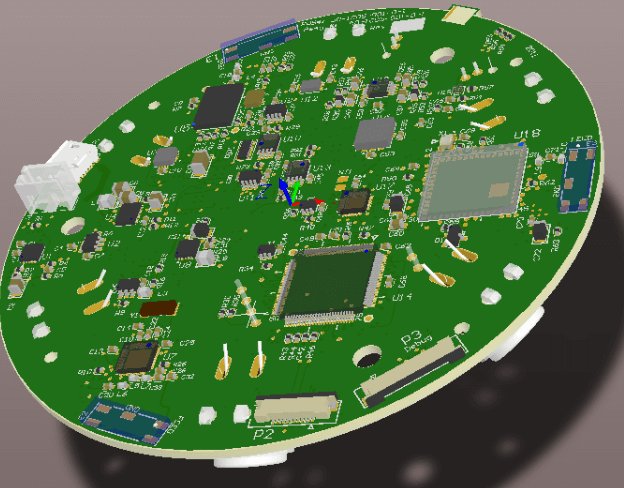
Challenges and Limitations
1. Design Complexity
Round PCBs introduce additional design challenges:
- Specialized design tools: Requires software capable of circular board design
- Non-standard components: Some components may not adapt well to circular layouts
- Signal integrity issues: Unique EMI/EMC considerations
- Thermal management: Different heat dissipation patterns
2. Manufacturing Constraints
Production challenges with round PCBs:
- Higher material waste: From rectangular panels to circular boards
- Specialized equipment: Need for specific cutting and routing tools
- Increased costs: Often more expensive than standard rectangular boards
- Limited suppliers: Not all PCB manufacturers handle round boards
3. Assembly Considerations
Round PCBs present unique assembly challenges:
- Pick-and-place adaptations: Automated assembly may require modifications
- Testing fixtures: Need for custom test jigs and fixtures
- Handling difficulties: Circular boards can be harder to manipulate in assembly lines
- Rework challenges: Repair and rework may be more complex
Future Trends in Round PCB Technology
1. Advanced Materials
Emerging materials will impact round PCB development:
- Flexible substrates: Enabling conformal round PCBs
- High-frequency materials: For improved RF performance in circular formats
- Thermally conductive materials: Better heat management in compact designs
- Sustainable options: Eco-friendly materials for circular boards
2. Manufacturing Innovations
Future production methods may include:
- Additive manufacturing: 3D printing of round PCBs
- Advanced laser processing: More precise circular board fabrication
- Automated nesting algorithms: For optimal material utilization
- Integrated manufacturing: Combining PCB fabrication and assembly
3. Emerging Applications
New uses for round PCBs continue to emerge:
- IoT devices: Circular formats for next-gen connected devices
- Advanced wearables: More sophisticated round wearable electronics
- AR/VR systems: Circular boards for compact display systems
- Robotics: Rotational components in robotic systems
Conclusion
Round PCBs represent a specialized but growing segment of the printed circuit board industry. While they present unique design and manufacturing challenges, their advantages in space-constrained, circular, or rotational applications make them indispensable for many modern electronic products.
As technology advances, we can expect to see continued innovation in round PCB design, materials, and manufacturing processes. The demand for circular boards is likely to increase as more applications are discovered and the benefits of this format become more widely recognized in various industries.
For designers and engineers, understanding the principles of round PCB development opens up new possibilities for innovative product design. While not suitable for every application, round PCBs provide an excellent solution when the application calls for their unique combination of electrical, mechanical, and aesthetic properties.
The future of round PCBs appears bright, with ongoing advancements promising to overcome current limitations while expanding their range of applications. As electronic products continue to evolve in form and function, round printed circuit boards will undoubtedly play an increasingly important role in shaping the devices of tomorrow.