
Aluminum-Based PCBs: Properties, Applications, and Manufacturing Processes
Abstract
Aluminum-based printed circuit boards (PCBs) have gained significant popularity in modern electronics due to their excellent thermal conductivity, mechanical stability, and cost-effectiveness. These PCBs are widely used in high-power LED lighting, automotive electronics, power supplies, and other applications requiring efficient heat dissipation. This article explores the structure, advantages, manufacturing processes, and key applications of aluminum-based PCBs, providing a comprehensive understanding of their role in advanced electronic systems.
1. Introduction
Printed circuit boards (PCBs) are essential components in electronic devices, providing mechanical support and electrical connections for various components. Traditional PCBs use FR4 (a glass-reinforced epoxy laminate) as the substrate, but in high-power applications, heat dissipation becomes a critical issue. Aluminum-based PCBs, also known as metal-core PCBs (MCPCBs), offer superior thermal management, making them ideal for applications where excessive heat can degrade performance.
This article discusses:
- The structure of aluminum-based PCBs
- Key advantages over traditional PCBs
- Manufacturing processes
- Major applications
- Future trends in aluminum PCB technology
2. Structure of Aluminum-Based PCBs
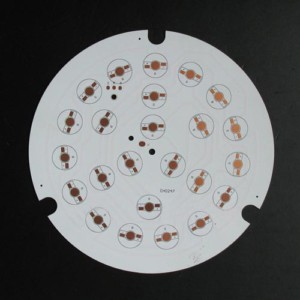
Aluminum-based PCBs consist of three primary layers:
2.1 Circuit Layer
The top layer is made of copper foil, which forms the conductive pathways for electrical signals. The thickness of the copper layer varies depending on current-carrying requirements.
2.2 Dielectric Layer (Insulating Layer)
This layer provides electrical insulation while allowing efficient heat transfer from the circuit layer to the aluminum base. Common dielectric materials include thermally conductive epoxy or ceramic-filled polymers.
2.3 Aluminum Base Layer
The bottom layer is composed of aluminum (typically 5052, 6061, or 1060 alloys), which acts as a heat sink, dissipating heat away from sensitive components.
3. Advantages of Aluminum-Based PCBs
3.1 Superior Thermal Conductivity
Aluminum has a thermal conductivity of about 200 W/m·K, significantly higher than FR4 (~0.3 W/m·K). This property prevents overheating in high-power applications.
3.2 Enhanced Mechanical Strength
Aluminum substrates provide better rigidity and durability compared to FR4, reducing the risk of board warping or cracking.
3.3 Lightweight and Cost-Effective
Aluminum is lighter than copper-based heat sinks and more affordable, making it a practical choice for mass production.
3.4 Improved Heat Dissipation in Compact Designs
Aluminum PCBs allow for smaller form factors in power electronics by eliminating the need for external heat sinks.
4. Manufacturing Process of Aluminum-Based PCBs
4.1 Material Preparation
- Aluminum substrate cleaning and surface treatment
- Copper foil lamination onto the dielectric layer
4.2 Circuit Patterning
- Photoresist application and UV exposure
- Chemical etching to remove excess copper
4.3 Drilling and Machining
- CNC drilling for component holes
- Routing to shape the PCB
4.4 Surface Finishing
- Application of solder mask and silkscreen
- Surface treatments such as HASL (Hot Air Solder Leveling) or ENIG (Electroless Nickel Immersion Gold)
4.5 Testing and Quality Control
- Electrical testing for short circuits or open traces
- Thermal performance validation
5. Key Applications of Aluminum-Based PCBs
5.1 LED Lighting
- High-power LEDs generate substantial heat, requiring efficient thermal management.
- Aluminum PCBs improve LED lifespan and brightness stability.
5.2 Automotive Electronics
- Used in LED headlights, power converters, and engine control units (ECUs).
5.3 Power Supplies and Converters
- Switching regulators and inverters benefit from aluminum PCBs’ heat dissipation.
5.4 Industrial Equipment
- Motor drives, welding systems, and high-power industrial controls.
5.5 Consumer Electronics
- High-performance computing, amplifiers, and audio systems.
6. Comparison with Other PCB Types
| Feature | Aluminum PCB | FR4 PCB | Ceramic PCB |
|---|---|---|---|
| Thermal Conductivity | High (~2-8 W/m·K) | Low (~0.3 W/m·K) | Very High (~24-170 W/m·K) |
| Cost | Moderate | Low | High |
| Mechanical Strength | High | Moderate | Very High |
| Weight | Light | Light | Heavy |
| Typical Applications | LEDs, Power Electronics | Consumer Electronics | Aerospace, RF Modules |
7. Future Trends in Aluminum PCB Technology
- Improved Dielectric Materials: Research focuses on enhancing thermal conductivity while maintaining electrical insulation.
- Hybrid PCBs: Combining aluminum with ceramic or copper for specialized applications.
- Additive Manufacturing: 3D printing techniques for custom aluminum PCB designs.
- Eco-Friendly Production: Reducing chemical waste in the etching process.
8. Conclusion
Aluminum-based PCBs offer a reliable solution for high-power and high-temperature electronic applications. Their excellent thermal management, durability, and cost-effectiveness make them indispensable in industries such as automotive, LED lighting, and power electronics. As technology advances, further improvements in materials and manufacturing processes will expand their applications, reinforcing their importance in modern electronics.