
Power Supply Design: Principles, Topologies, and Considerations
1. Introduction
Power supply design is a critical aspect of electronic systems, ensuring that devices receive stable and efficient voltage and current for proper operation. Whether for consumer electronics, industrial equipment, or high-performance computing, the power supply must meet stringent requirements for reliability, efficiency, and safety. This article explores the fundamental principles of power supply design, common topologies, key components, and design considerations.
2. Fundamentals of Power Supply Design
A power supply converts input power (AC or DC) into a regulated output suitable for electronic circuits. The primary objectives include:
- Voltage Regulation – Maintaining a stable output despite input fluctuations or load changes.
- Efficiency – Minimizing power loss to reduce heat and improve energy usage.
- Noise Reduction – Suppressing electromagnetic interference (EMI) and ripple.
- Protection – Safeguarding against overvoltage, overcurrent, and overheating.
2.1 Types of Power Supplies
- Linear Power Supplies
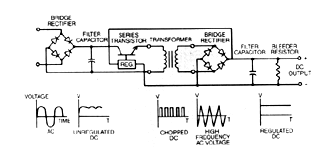
- Simple, low-noise design using a transformer, rectifier, and linear regulator.
- Inefficient due to heat dissipation in the regulator.
- Suitable for low-power, noise-sensitive applications.
- Switching Power Supplies (SMPS)
- High efficiency (up to 95%) using pulse-width modulation (PWM) and fast switching transistors.
- More complex but scalable for high-power applications.
- Generates more EMI but can be mitigated with filtering.
- Uninterruptible Power Supplies (UPS)
- Provides backup power during outages using batteries and inverters.
- Used in critical systems like servers and medical devices.
3. Key Components in Power Supply Design
3.1 Transformers
- Step up or step down AC voltage before rectification.
- Isolate input and output for safety.
3.2 Rectifiers
- Convert AC to DC using diodes or bridge rectifiers.
- Half-wave or full-wave configurations affect efficiency and ripple.
3.3 Filtering Capacitors
- Smooth out rectified DC by reducing ripple voltage.
- Electrolytic capacitors are common but have limited lifespan.
3.4 Voltage Regulators
- Linear regulators (e.g., LDOs) provide clean output but dissipate excess power as heat.
- Switching regulators (e.g., Buck, Boost, Buck-Boost) adjust duty cycle to regulate voltage efficiently.
3.5 Inductors and Chokes
- Store energy in SMPS to smooth current flow.
- Critical in buck and boost converter topologies.
3.6 Control ICs and PWM Controllers
- Manage switching frequency and feedback loops for regulation.
- Examples: UC3842 for flyback converters, LM5117 for buck controllers.
4. Common Power Supply Topologies
4.1 Buck Converter (Step-Down)
- Reduces input voltage efficiently.
- Used in battery-powered devices and voltage regulators.
4.2 Boost Converter (Step-Up)
- Increases input voltage (e.g., for LED drivers).
- Common in renewable energy systems.
4.3 Buck-Boost Converter
- Adjusts output voltage above or below input voltage.
- Useful in battery applications with varying voltage levels.
4.4 Flyback Converter
- Isolated topology for AC-DC conversion.
- Used in low-to-medium power adapters.
4.5 Forward Converter
- Higher efficiency than flyback for medium-power applications.
- Requires additional output inductor.
4.6 Resonant Converters (LLC)
- Soft switching reduces EMI and improves efficiency.
- Used in high-power applications like server PSUs.
5. Design Considerations
5.1 Efficiency Optimization
- Select low-RDS(on) MOSFETs for switching losses.
- Use synchronous rectification in high-current designs.
- Optimize transformer and inductor core materials.
5.2 Thermal Management
- Heat sinks, thermal vias, and proper PCB layout reduce temperature rise.
- Derate components for long-term reliability.
5.3 EMI and Noise Reduction
- Shielding, proper grounding, and snubber circuits minimize interference.
- Compliance with FCC, CE, and CISPR standards.
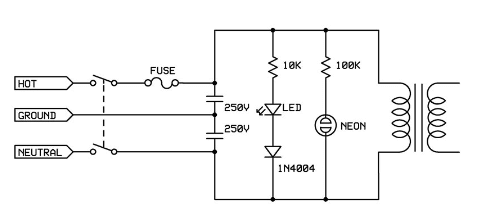
5.4 Protection Circuits
- Overcurrent protection (OCP), overvoltage protection (OVP), and thermal shutdown.
- Fuses, TVS diodes, and current-limiting resistors enhance safety.
5.5 Feedback and Stability
- Voltage feedback loops (using optocouplers in isolated designs).
- Compensation networks to prevent oscillations.
6. Advanced Trends in Power Supply Design
6.1 Digital Power Management
- Microcontrollers (e.g., DSPs) enable adaptive control and monitoring.
- Improves efficiency through real-time adjustments.
6.2 GaN and SiC Devices
- Gallium Nitride (GaN) and Silicon Carbide (SiC) transistors offer higher efficiency and faster switching.
- Used in high-frequency, high-power applications.
6.3 Wireless Power Transfer
- Inductive and resonant charging for consumer electronics and EVs.
6.4 Energy Harvesting
- Solar, piezoelectric, and RF energy conversion for IoT devices.
7. Conclusion
Power supply design is a multidisciplinary field combining analog and digital electronics, thermal engineering, and EMI control. Engineers must balance efficiency, cost, and reliability while adhering to industry standards. With advancements in semiconductor technology and digital control, future power supplies will become even more efficient, compact, and intelligent.
By understanding fundamental principles, selecting appropriate topologies, and implementing robust design practices, engineers can develop power solutions that meet the demands of modern electronic systems.