
The Essential Guide to PCB Board Holders: Design, Types, and Best Practices
Introduction to PCB Board Holders
Printed Circuit Board (PCB) holders are indispensable tools in the electronics manufacturing, testing, and repair industries. These specialized devices serve as secure platforms for holding PCBs during various stages of production and maintenance, providing stability, accessibility, and often additional functionality to streamline workflow processes.
PCB board holders, also called PCB work holders or PCB fixtures, have evolved from simple mechanical clamps to sophisticated systems incorporating power delivery, testing interfaces, and even automated positioning capabilities. Their primary purpose remains consistent: to immobilize circuit boards safely while allowing technicians, engineers, or automated systems to perform necessary operations without risking damage to the board or its components.
The importance of proper PCB holding solutions cannot be overstated in modern electronics manufacturing. As components become smaller and more densely packed, and as production timelines grow tighter, the right holder can mean the difference between efficient operations and costly errors or damage. This comprehensive guide explores the various types of PCB holders, their design considerations, material options, and best practices for implementation in professional settings.
Types of PCB Board Holders
1. Basic Mechanical Holders
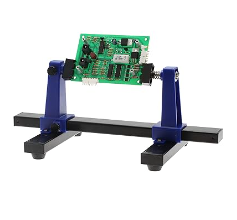
The simplest form of PCB holders consists of mechanical clamping systems that secure the board by its edges. These typically feature:
- Adjustable clamps or jaws to accommodate different board sizes
- Non-conductive, non-marring contact surfaces
- Various base configurations (desktop, benchtop, or portable)
- Often include magnification lenses for detailed work
These basic holders are ideal for low-volume work, prototyping, and repair stations where flexibility is more important than specialized features.
2. Production Fixtures
Designed for manufacturing environments, production fixtures offer:
- Precise, repeatable board positioning
- Quick-change mechanisms for different board designs
- Often integrated with conveyor systems for assembly lines
- May include vacuum hold-down systems for component-side access
3. Testing and Programming Holders
These specialized holders incorporate electrical connections for:
- In-circuit testing (ICT)
- Functional testing (FCT)
- Firmware programming
- Boundary scan operations
They typically feature:
- Custom pin matrices or pogo pin arrays
- Automated or manual actuation
- DUT (Device Under Test) identification systems
- Often include shielding for sensitive measurements
4. Rework and Repair Stations
Designed specifically for repair work, these holders offer:
- 360° board rotation capabilities
- Adjustable tilt angles for ergonomic access
- Integrated heating elements for soldering/desoldering
- Component trays and tool holders
- Often combined with microscope mounting systems
5. Automated Handling Systems
For high-volume production, automated PCB holders include:
- Robotic pick-and-place interfaces
- Vision system alignment features
- Barcode/RFID tracking integration
- Closed-loop positioning feedback
Design Considerations for PCB Holders
1. Board Compatibility
Effective holder design must account for:
- Board dimensions (including panelized boards)
- Thickness variations
- Component clearance requirements
- Edge connector locations
- Any keep-out zones specified in board design
2. Material Selection
Common materials used in PCB holder construction:
- Aluminum: Lightweight, rigid, and good heat dissipation
- Stainless Steel: Durable and chemically resistant
- Delrin/PEEK: Non-conductive, static-dissipative plastics
- Silicone/Rubber: Non-slip, non-marring surfaces
3. Ergonomics and Accessibility
Proper holder design should:
- Position the board at optimal working height
- Allow access to all test points and components
- Facilitate comfortable working posture
- Minimize need for board reorientation
4. Thermal Management
For applications involving soldering or high-power testing:
- Heat-resistant materials
- Active or passive cooling systems
- Thermal isolation of sensitive components
5. ESD Protection
Critical for modern electronics:
- Proper grounding paths
- Static-dissipative materials
- Ionization options for cleanroom environments
Advanced Features in Modern PCB Holders
1. Smart Holders with IoT Integration
Emerging technologies include:
- Usage tracking and predictive maintenance
- Remote monitoring of holder status
- Automated calibration reporting
2. Adaptive Holding Systems
Using:
- Computer vision for automatic board recognition
- Adjustable contact points for mixed-product lines
- Force feedback for delicate component protection
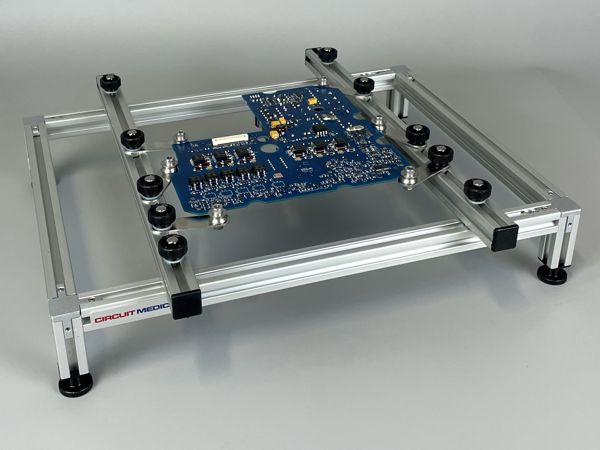
3. Modular Holder Systems
Allowing:
- Quick reconfiguration for different products
- Expansion for larger boards
- Integration of additional test equipment
4. Cleanroom-Compatible Designs
Featuring:
- Reduced particulate generation
- Ultra-clean material choices
- Specialized coatings
Best Practices for PCB Holder Implementation
1. Proper Selection Process
- Analyze production volume and mix
- Consider all stages of product lifecycle
- Evaluate total cost of ownership, not just purchase price
2. Installation and Calibration
- Follow manufacturer’s alignment procedures
- Establish regular calibration schedules
- Document all holder-specific settings
3. Maintenance Protocols
- Regular cleaning procedures
- Wear component inspection
- Lubrication schedules for mechanical parts
4. Operator Training
- Proper loading/unloading techniques
- Recognition of holder malfunctions
- Basic troubleshooting procedures
5. Continuous Improvement
- Collect data on holder performance
- Solicit operator feedback
- Implement upgrades as needed
Industry-Specific PCB Holder Solutions
1. Automotive Electronics
Requirements:
- Vibration resistance
- High-temperature tolerance
- Enhanced ESD protection
2. Aerospace and Defense
Special considerations:
- Ruggedized designs
- Material traceability
- Extreme environment testing
3. Medical Devices
Needs:
- Cleanroom compatibility
- Biocompatible materials
- Extensive documentation
4. Consumer Electronics
Focus areas:
- Rapid changeover capabilities
- High-density component accommodation
- Cost-effective solutions
Future Trends in PCB Holder Technology
1. Increased Automation Integration
- More sophisticated machine interfaces
- AI-assisted board handling
- Predictive adjustment systems
2. Sustainable Designs
- Recyclable materials
- Energy-efficient systems
- Reduced material waste
3. Enhanced Data Collection
- Process monitoring
- Quality control integration
- Digital twin synchronization
4. Miniaturization Support
- Solutions for ultra-small PCBs
- Micro-component access
- High-precision positioning
Conclusion
PCB board holders represent a critical link in the electronics manufacturing chain, bridging the gap between design and production. As electronic devices continue to proliferate across all aspects of modern life, the importance of efficient, reliable, and sophisticated PCB holding solutions will only grow.
From simple mechanical fixtures to fully automated smart systems, PCB holders have evolved to meet the ever-increasing demands of the electronics industry. Proper selection, implementation, and maintenance of these tools can significantly impact product quality, manufacturing efficiency, and overall operational costs.
Looking ahead, PCB holder technology will continue to advance in parallel with developments in electronics manufacturing, incorporating more intelligent features, sustainable materials, and seamless integration with Industry 4.0 systems. Companies that recognize the strategic value of optimized PCB holding solutions will gain competitive advantages in quality, throughput, and adaptability to new technological challenges.
Whether for prototyping, production, or repair applications, investing in the right PCB board holder solution—and the knowledge to implement it effectively—remains an essential consideration for any organization working with printed circuit boards.