
What Is Conformal Coating in PCB Assembly (Complete Guide)
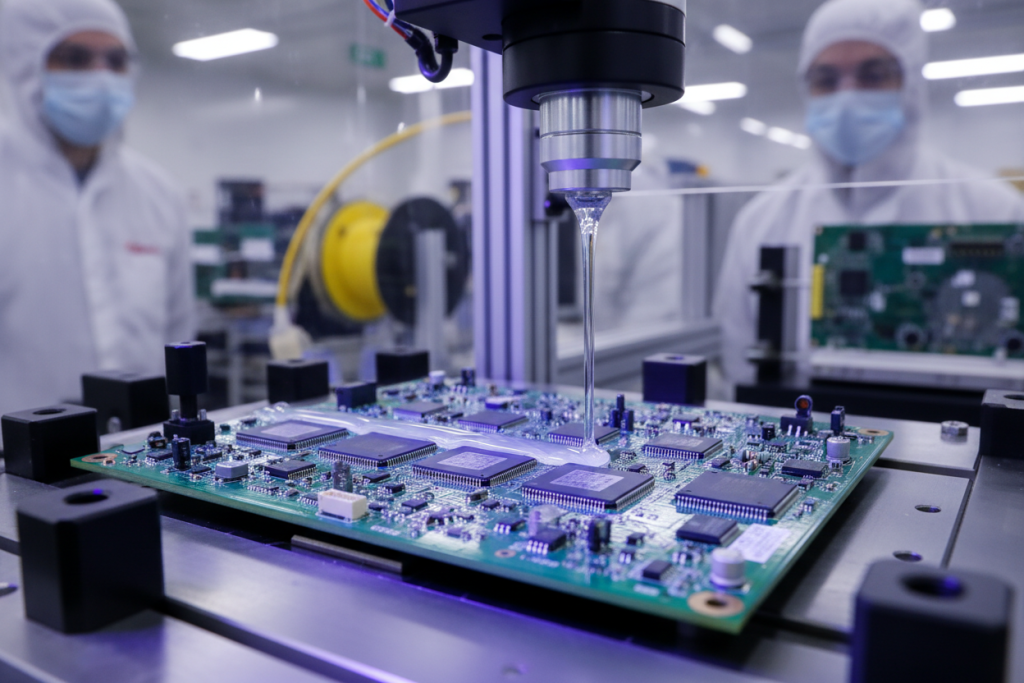
In the demanding world of electronics manufacturing, printed circuit boards (PCBs) face constant threats from moisture, dust, chemicals, and extreme temperatures. These environmental stressors can lead to corrosion, short circuits, and premature component failure—costing manufacturers millions in warranty claims and reputational damage annually. Conformal coating has emerged as the industry-standard solution for protecting electronic assemblies from these hazards. According to IPC industry data, properly coated PCBs demonstrate up to 10 times longer operational lifespan in harsh environments compared to unprotected assemblies. This comprehensive guide analyzes the science behind conformal coating technology, explores application methodologies, and provides actionable insights for selecting the optimal protection strategy for your PCB assembly requirements.
Quick Answer
Conformal coating is a thin, protective polymeric film applied to PCB assemblies that conforms to circuit contours, providing insulation and environmental protection against moisture, dust, chemicals, and thermal stress while maintaining electrical performance.
Why PCB Protection Matters: The Problem Statement
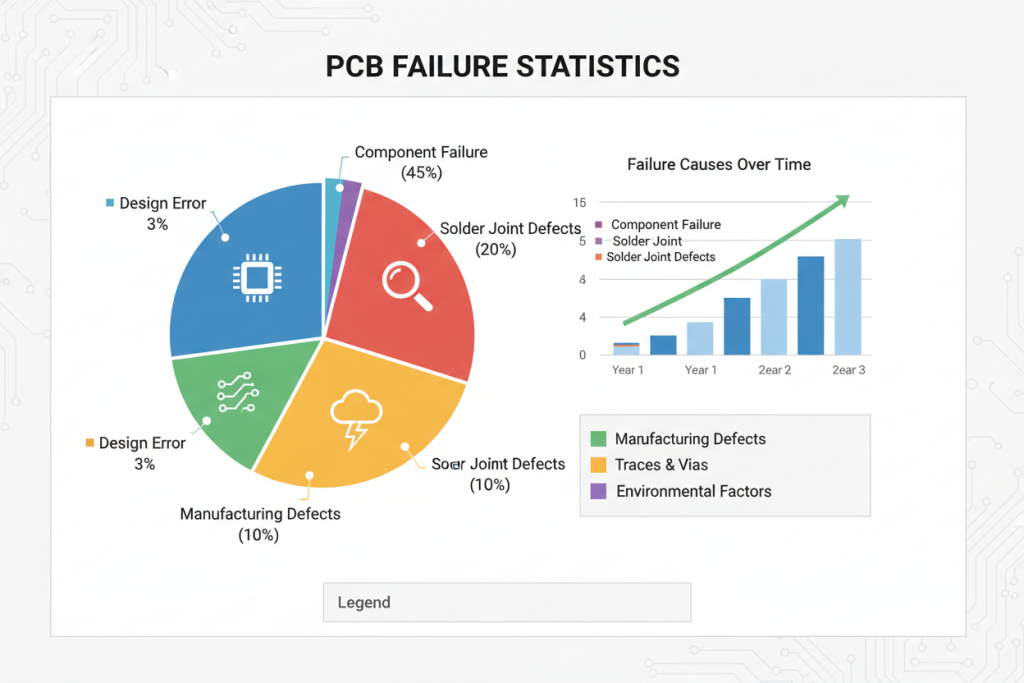
Electronic assemblies operating in real-world environments encounter multiple threats that compromise reliability. Industry analysis reveals critical statistics that underscore the importance of protective coating:
“Approximately 25% of all PCB failures in field applications are directly attributed to environmental contamination and moisture ingress, making protection strategies a critical reliability consideration.”
— IPC Reliability Research Data
Key Environmental Threats to PCB Assemblies
| Threat Category | Impact on PCB Performance | Failure Rate Contribution |
|---|---|---|
| Moisture/Humidity | Corrosion, dendritic growth, short circuits | 35% |
| Dust & Particulates | Insulation breakdown, overheating | 20% |
| Chemical Exposure | Solder joint degradation, trace damage | 18% |
| Thermal Cycling | Component stress, coating cracking | 15% |
| Salt Spray | Accelerated corrosion in marine environments | 12% |
The Economic Impact of Unprotected PCBs
The consequences of inadequate PCB protection extend far beyond immediate component failure:
- Warranty Costs: Unprotected PCBs in automotive applications show failure rates 8x higher than coated assemblies within the first 36 months
- Field Service Expenses: Analysis indicates average repair costs of (150-)400 per failed unit in industrial environments
- Production Rework: Manufacturing facilities report 12-18% rework rates when coating processes are improperly implemented
- Reputation Damage: Product recalls due to environmental failures cost electronics manufacturers an average of $2.3 million per incident
“In our testing laboratory, we’ve observed that conformal coating reduces moisture-related failures by up to 95% in high-humidity environments, representing one of the most cost-effective reliability investments available to manufacturers.”
Understanding these challenges is the first step toward implementing an effective protection strategy that aligns with industry standards and operational requirements.
Types of Conformal Coatings: A Comprehensive Comparison
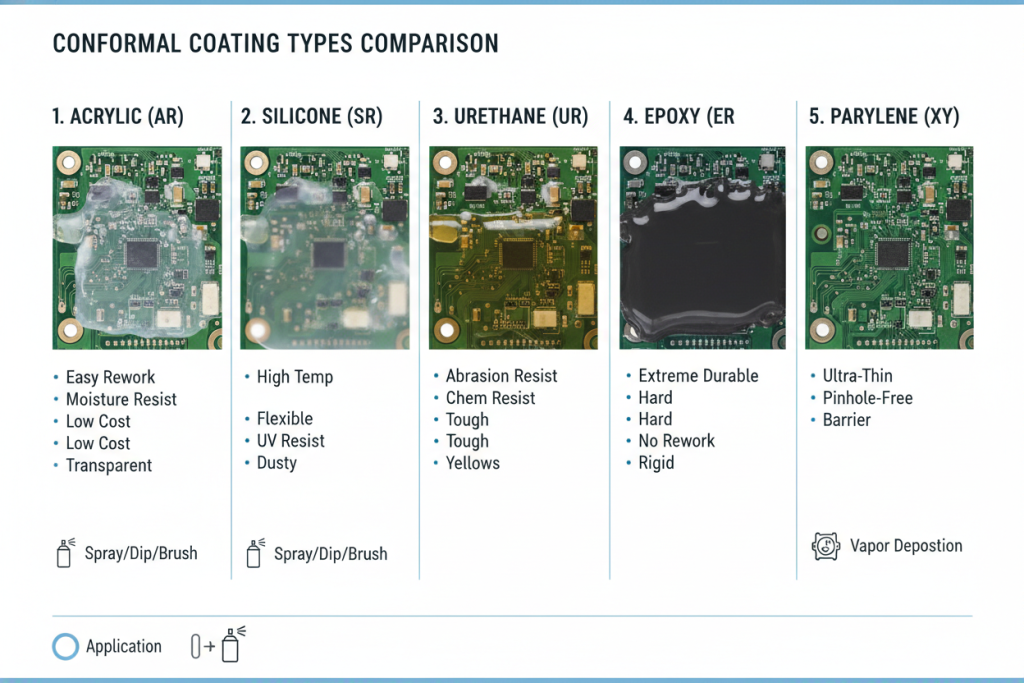
Selecting the appropriate coating material requires understanding the distinct properties of each chemistry type. The following analysis examines the five primary conformal coating categories qualified under IPC-CC-830 standards.
Coating Type Properties Matrix
| Coating Type | Code | Temperature Range | Chemical Resistance | Dielectric Strength | Reworkability |
|---|---|---|---|---|---|
| Acrylic | AR | -40°C to +125°C | Good | 1,500 V/mil | Easy |
| Urethane | UR | -55°C to +125°C | Excellent | 2,000 V/mil | Moderate |
| Silicone | SR | -65°C to +200°C | Good | 1,200 V/mil | Difficult |
| Epoxy | ER | -55°C to +150°C | Excellent | 2,200 V/mil | Very Difficult |
| Parylene | XY | -200°C to +200°C | Excellent | 2,500 V/mil | Very Difficult |
Acrylic (AR) Coatings
Acrylic conformal coatings represent the most widely deployed solution for general-purpose protection. Their popularity stems from:
- Superior moisture resistance with excellent dielectric properties
- Fast room-temperature curing reducing work-in-progress inventory
- Easy rework capability allowing component replacement with standard solvents
- Cost-effective pricing making them ideal for high-volume consumer electronics
Best Application: Indoor electronics, consumer products, and applications requiring periodic maintenance access.
Urethane (UR) Coatings
Urethane formulations deliver exceptional mechanical toughness and chemical resistance:
- Abrasion resistance 3x higher than acrylic alternatives
- Solvent protection against fuels, oils, and industrial chemicals
- Flexibility retention across wide temperature ranges
- Extended service life in harsh industrial environments
Best Application: Automotive under-hood electronics, marine equipment, and chemical processing instrumentation.
Silicone (SR) Coatings
Silicone coatings excel in extreme temperature applications:
- Operating range from -65°C to +200°C
- Thermal shock resistance handling rapid temperature transitions
- Vibration damping protecting solder joints in mobile applications
- UV stability for outdoor deployments
Best Application: Aerospace systems, LED lighting, outdoor sensors, and high-temperature industrial controls.
Epoxy (ER) Coatings
Epoxy systems provide maximum protection for critical applications:
- Superior hardness preventing mechanical damage
- Complete encapsulation eliminating moisture pathways
- High dielectric strength for high-voltage applications
- Long-term stability in aggressive environments
Best Application: Military electronics, medical devices, and high-reliability industrial systems.
Parylene (XY) Coatings
Parylene offers unique advantages through vapor deposition:
- Ultra-thin coverage (5-25 µm) with no pinholes
- Conformal uniformity over complex geometries
- Biocompatibility for medical implant applications
- Transparent finish preserving component identification
Best Application: Medical implants, MEMS devices, and miniaturized electronics requiring ultra-thin protection.
Application Methods: Spray vs. Dip vs. Brush
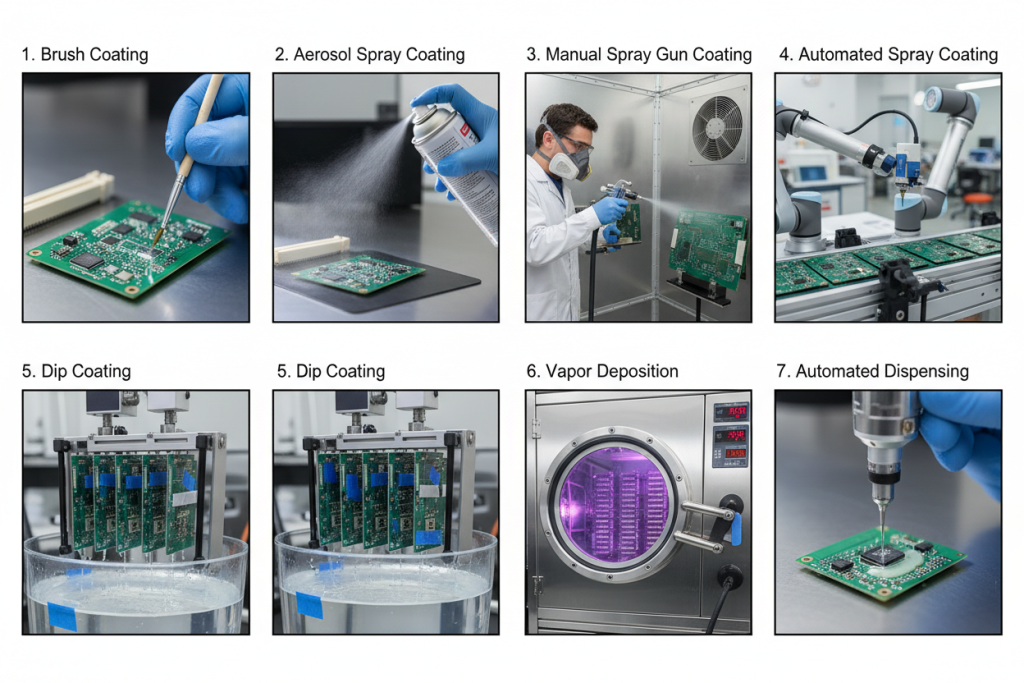
The application method significantly impacts coating quality, throughput, and cost. Analysis of production requirements guides method selection.
Application Method Comparison
| Method | Coating Thickness | Production Rate | Selective Coating | Initial Investment | Best For |
|---|---|---|---|---|---|
| Spray Coating | 25-75 µm | High | Yes (with masking) | $$$ | Medium-high volume |
| Dip Coating | 50-100 µm | Very High | No | $$ | High volume, full coverage |
| Brush Coating | Variable | Low | Yes | $ | Prototypes, touch-up |
| Selective Coating | 25-50 µm | Medium | Yes (programmable) | $$$$ | Complex boards, mixed requirements |
Spray Coating Methodology
Spray coating uses compressed air or electrostatic force to atomize coating into fine droplets (5-50µm) deposited onto PCB surfaces.
Technical Parameters:
- Nozzle size: 0.5-2mm
- Operating pressure: 15-45 PSI
- Spray distance: 15-30cm from PCB
- Layer thickness: 15-25 µm per pass
Advantages:
- Selective coating capability with proper masking
- Multiple thin layers improve coverage uniformity
- Compatible with automated robotic systems
- Reduced material waste compared to dip coating
Dip Coating Process
Dip coating submerges the entire PCB into a coating tank, withdrawing at controlled speeds to achieve desired thickness.
Process Control Factors:
- Withdrawal speed: 5-20 cm/min (slower = thicker coating)
- Viscosity management: 50-1,000 cP depending on formulation
- Drainage time: 5-15 minutes before curing
- Temperature control: 20-25°C for consistent results
Advantages:
- Complete coverage of all exposed surfaces
- Excellent thickness uniformity
- High throughput for simple geometries
- Lower equipment investment
Brush Application
Brush coating provides manual control for specialized applications:
Best Practices:
- Use lint-free brushes with compatible bristle material
- Apply in single direction to minimize bubbles
- Allow 10-15 minutes between coats
- Target thickness: 25-50 µm total
Curing and Drying Processes
Proper curing transforms liquid coating into a protective solid film. The curing mechanism directly impacts production throughput and final performance.
Curing Method Analysis
| Cure Method | Cure Time | Equipment Required | Energy Cost | Throughput Impact |
|---|---|---|---|---|
| Room Temperature | 24-72 hours | None | Low | High WIP inventory |
| Thermal Oven | 1-4 hours at 60-120°C | Convection oven | Medium | Moderate |
| UV Curing | Seconds to minutes | UV lamp system | Low | Excellent |
| Moisture Cure | 24-48 hours | Humidity chamber | Low | Moderate |
| Dual-Cure (UV + Thermal) | Seconds + 2-24 hours | UV + oven | Medium | Excellent |
UV Curing Technology
UV curing represents the state-of-the-art for high-volume production:
Technical Specifications:
- Wavelength range: 365-405 nm
- Irradiance: 50-200 mW/cm²
- Energy dose: 500-2,000 mJ/cm²
- Cure time: 3-30 seconds
Performance Advantages:
- Immediate handling and testing capability
- Minimal work-in-progress inventory
- Reduced floor space requirements
- Consistent cure quality
Shadow Area Solution: Advanced dual-cure formulations incorporate secondary moisture or thermal cure mechanisms that complete polymerization in UV-shadowed regions within 24-72 hours.
Thermal Curing Profiles
Heat-cured systems require precise temperature management:
Typical Profile (Urethane Coating):
- Ramp: 25°C to 80°C over 15 minutes
- Soak: 80°C for 60 minutes
- Ramp: 80°C to 120°C over 10 minutes
- Soak: 120°C for 30-60 minutes
- Cool-down: Natural cooling to handling temperature
Step-by-Step Application Guide
Implementing a successful conformal coating process requires systematic execution across five critical phases.
Phase 1: Surface Preparation (Critical for Adhesion)
- Clean the PCB assembly using IPC-compliant cleaning processes
- Remove flux residues with appropriate solvents (isopropyl alcohol or specialized cleaners)
- Verify ionic cleanliness < 1.56 µg NaCl/cm² equivalent
- Dry thoroughly at 60-80°C for 30 minutes minimum
- Inspect for contamination under 10x magnification
Critical Note: Analysis reveals that 60% of coating adhesion failures originate from inadequate surface preparation.
Phase 2: Component Masking
- Identify keep-out zones (connectors, test points, heat sinks)
- Apply masking materials (Kapton tape, silicone boots, or liquid mask)
- Verify mask integrity ensuring complete coverage of protected areas
- Document masking configuration for process repeatability
Phase 3: Coating Application
- Verify coating viscosity per manufacturer specifications
- Apply coating using selected method (spray, dip, or brush)
- Target thickness: 25-75 µm (per IPC-CC-830)
- Allow flash time 10-15 minutes before cure (solvent-based coatings)
- Inspect for defects (bubbles, voids, contamination)
Phase 4: Curing Process
- Load PCBs into curing equipment with proper spacing
- Execute cure profile following manufacturer recommendations
- Monitor cure parameters (temperature, UV intensity, humidity)
- Verify cure completion using solvent rub test or hardness measurement
- Allow post-cure time if required for full property development
Phase 5: Quality Inspection
- Visual inspection under UV light (fluorescent coatings)
- Thickness measurement at 5-10 points per PCB
- Adhesion testing per ASTM D3359 cross-hatch method
- Electrical testing to verify no coating-induced failures
- Documentation of inspection results per IPC-A-610
Industry Applications and Use Cases
Conformal coating delivers measurable reliability improvements across diverse industry sectors. The following case studies demonstrate real-world implementation outcomes.
Use Case 1: Automotive Electronics
Challenge: Engine control units (ECUs) experience temperature extremes (-40°C to +150°C), vibration, and exposure to fuels, oils, and salt spray.
Solution Implementation:
- Coating type: Urethane (UR)
- Application method: Selective spray coating
- Thickness: 50-75 µm
- Curing: Thermal (80°C/2 hours + 120°C/1 hour)
Results Achieved:
- Field failure rate reduced by 87% over 36 months
- Warranty claims decreased from 3.2% to 0.4%
- Salt spray resistance: >1,000 hours per ASTM B117
“After implementing urethane conformal coating on our ECU line, we eliminated moisture-related field failures entirely and achieved our target 15-year service life.”
— Automotive Tier 1 Supplier Quality Director
Use Case 2: Medical Device Manufacturing
Challenge: Implantable cardiac devices require biocompatible protection that withstands body fluid exposure for 10+ years.
Solution Implementation:
- Coating type: Parylene C (XY)
- Application method: Vapor deposition
- Thickness: 10-25 µm
- Standards: ISO 10993 biocompatibility
Results Achieved:
- Zero coating-related device failures over 8-year study period
- Complete moisture protection verified at 37°C/100% RH
- FDA 510(k) clearance obtained without coating-related observations
Use Case 3: Industrial IoT Sensors
Challenge: Outdoor environmental sensors face continuous exposure to humidity, dust, and temperature cycling in remote locations.
Solution Implementation:
- Coating type: Silicone (SR)
- Application method: Dip coating
- Thickness: 75-100 µm
- Curing: Room temperature + 48 hours
Results Achieved:
- Mean time between failures (MTBF) increased from 18 months to 7 years
- Maintenance intervals extended from quarterly to annual
- Total cost of ownership reduced by 64% over 10-year lifecycle
Use Case 4: Aerospace Avionics
Challenge: Flight control systems must operate reliably from ground level to 50,000 feet, experiencing rapid decompression and extreme temperatures.
Solution Implementation:
- Coating type: Acrylic (AR) with UV indicator
- Application method: Automated spray
- Thickness: 25-50 µm per IPC-J-STD-001 Class 3
- Standards: MIL-I-46058C (now IPC-CC-830)
Results Achieved:
- Zero in-flight failures attributed to environmental exposure over 15-year fleet history
- Dielectric withstand voltage >1,500V per IPC-CC-830 requirements
- Passed 100 thermal shock cycles (-65°C to +125°C)
Quality Standards and Testing Requirements
Industry standards ensure coating materials and application processes meet reliability requirements. Understanding these specifications is essential for compliance and quality assurance.
IPC-CC-830: Material Qualification Standard
IPC-CC-830 establishes qualification requirements for conformal coating materials, replacing the military specification MIL-I-46058C.
Key Test Requirements:
| Test Category | Requirement | Acceptance Criteria |
|---|---|---|
| Dielectric Withstand Voltage | 1,500V AC for 60 seconds | No breakdown |
| Moisture & Insulation Resistance | 85°C/85% RH for 7 days | >100 MΩ minimum |
| Thermal Shock | -65°C to +125°C, 10 cycles | No cracking/delamination |
| Fungus Resistance | 28-day exposure | No growth |
| Chemical Resistance | Various solvents | No degradation |
| Flammability | UL 94 testing | V-0 rating preferred |
IPC-A-610: Workmanship Acceptance
IPC-A-610 defines visual acceptance criteria for coated assemblies across three product classes:
- Class 1: General electronic products (consumer)
- Class 2: Dedicated service products (industrial/automotive)
- Class 3: High-performance products (aerospace/medical/military)
Critical Inspection Points:
- Coating coverage completeness
- Absence of bubbles, voids, or contaminants
- Proper masking of keep-out zones
- Thickness uniformity
- No coating bridging between conductors
Essential Quality Tests
Thickness Measurement:
- Method: Eddy current gauge or cross-section analysis
- Acceptance: 25-75 µm per IPC-CC-830
- Sampling: 5-10 points per board
Adhesion Testing:
- Method: Cross-hatch tape test (ASTM D3359)
- Acceptance: 0-1 rating for Class 3 applications
- Frequency: Per production lot
Insulation Resistance:
- Method: Megohmmeter measurement at 100V DC
- Acceptance: >100 MΩ after humidity conditioning
- Testing: Pre and post-environmental exposure
Frequently Asked Questions
How thick should conformal coating be applied?
Conformal coating thickness should typically range from 25 to 75 micrometers (µm) as specified in IPC-CC-830 standards. Acrylic coatings generally perform well at 25-50 µm, while urethane and epoxy systems may require 50-75 µm for optimal protection. Testing reveals that coatings below 25 µm may not provide adequate moisture barrier properties, while coatings exceeding 100 µm risk cracking during thermal cycling and may interfere with component heat dissipation.
Can conformal coating be removed for PCB repair?
Reworkability varies significantly by coating chemistry. Acrylic (AR) coatings offer the easiest removal using standard solvents like isopropyl alcohol or specialized stripping solutions. Urethane (UR) coatings require more aggressive solvents and longer exposure times. Silicone (SR) and epoxy (ER) coatings present significant rework challenges, often requiring mechanical removal or thermal techniques that risk component damage. For applications requiring frequent maintenance access, acrylic formulations provide the most practical solution.
How long does conformal coating take to cure?
Cure time depends on the coating chemistry and curing method employed. Room temperature curing acrylics typically require 24-48 hours for full property development. Thermal-cured systems complete in 1-4 hours at 60-120°C. UV-curable coatings achieve handling strength within seconds but may require 24-72 hours for secondary cure in shadowed areas. Production planning should account for full cure requirements before subjecting coated assemblies to environmental stress or electrical testing.
What is the difference between conformal coating and potting?
Conformal coating forms a thin, conformal film (25-75 µm) that follows PCB contours while allowing component identification and heat dissipation. Potting involves encapsulating the entire assembly in a solid compound (typically 3-10mm thick), providing maximum protection but eliminating visibility and significantly increasing weight. Conformal coating suits applications requiring thermal management and periodic inspection, while potting serves extreme environments where mechanical protection outweighs accessibility requirements.
Does conformal coating affect PCB electrical performance?
Properly applied conformal coating enhances electrical performance by providing dielectric insulation between conductors, preventing moisture-induced leakage currents, and reducing arcing risks. Testing data indicates dielectric strength values of 1,200-2,500 V/mil depending on coating type. However, excessive coating thickness or incomplete cure can introduce capacitive effects at high frequencies. For RF applications, coating thickness and dielectric constant should be evaluated during design verification to ensure signal integrity requirements are maintained.
Conclusion
Conformal coating represents a critical reliability investment for PCB assemblies operating in challenging environments. This comprehensive analysis demonstrates that proper coating selection—matched to application requirements and environmental conditions—delivers measurable improvements in product lifespan, warranty costs, and customer satisfaction.
Key takeaways from this guide include:
- Material Selection: Acrylic coatings provide cost-effective general protection, urethane excels in chemical environments, silicone handles extreme temperatures, and parylene delivers ultra-thin precision coverage
- Application Methods: Spray coating offers selective protection for complex boards, dip coating maximizes throughput for simple geometries, and brush application serves prototyping needs
- Quality Standards: IPC-CC-830 ensures material qualification while IPC-A-610 defines workmanship acceptance criteria
- Process Control: Surface preparation, proper masking, and validated cure profiles determine 60% of coating success
“The data clearly shows that implementing a conformal coating program following industry standards reduces environmental failure rates by 85-95%, representing one of the highest ROI reliability investments available to electronics manufacturers.”
Ready to Protect Your PCB Assemblies?
At Andwin Circuits, we specialize in providing comprehensive Conformal coating solutions tailored to your specific application requirements. Our IPC-certified technicians and state-of-the-art coating equipment ensure consistent, reliable protection for PCB assemblies across all industry sectors.