
How Conformal Coating Protects PCBs from Moisture and Dust (Material & Rework Guide)
Field failures don’t just eat into your profit margins; they destroy brand reputation. When your hardware is deployed in harsh environments—be it an automotive sensor exposed to high humidity or an industrial controller battling factory dust—unprotected circuit boards are ticking time bombs. You might save a few cents skipping the coating process, but you will pay thousands in RMA (Return Merchandise Authorization) and warranty claims.
In this comprehensive guide, we will bypass the marketing fluff and dive into the engineering reality. You will learn the microscopic mechanisms of how moisture and dust destroy PCBs, how to choose the right chemical barrier, and how to avoid the notorious “rework nightmares” frequently discussed on engineering forums.
Understanding the Threat: The Invisible Killers
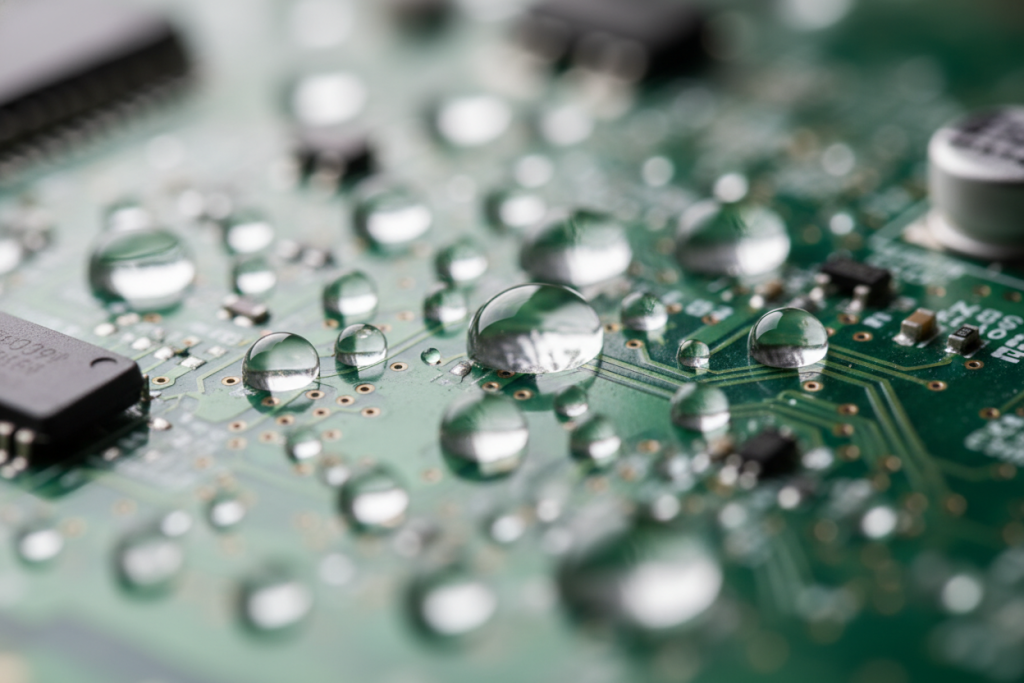
Before discussing the solution, we must understand the exact nature of the problem. If you are wondering why circuit boards need coating in the first place, it comes down to two microscopic phenomena that occur when electronics meet the real world.
The Sponge Effect: Capillary Action in Dust
Many hardware startups assume that dust is merely a cosmetic issue. It is not. Dust acts as a microscopic sponge. Due to capillary action, the tiny crevices between accumulated dust particles actively draw in and trap moisture from the surrounding air. When this damp, mineral-rich dust bridges the gap between two component pins, it creates an unintended conductive path. The result? Overheating, signal degradation, and eventual short circuits.
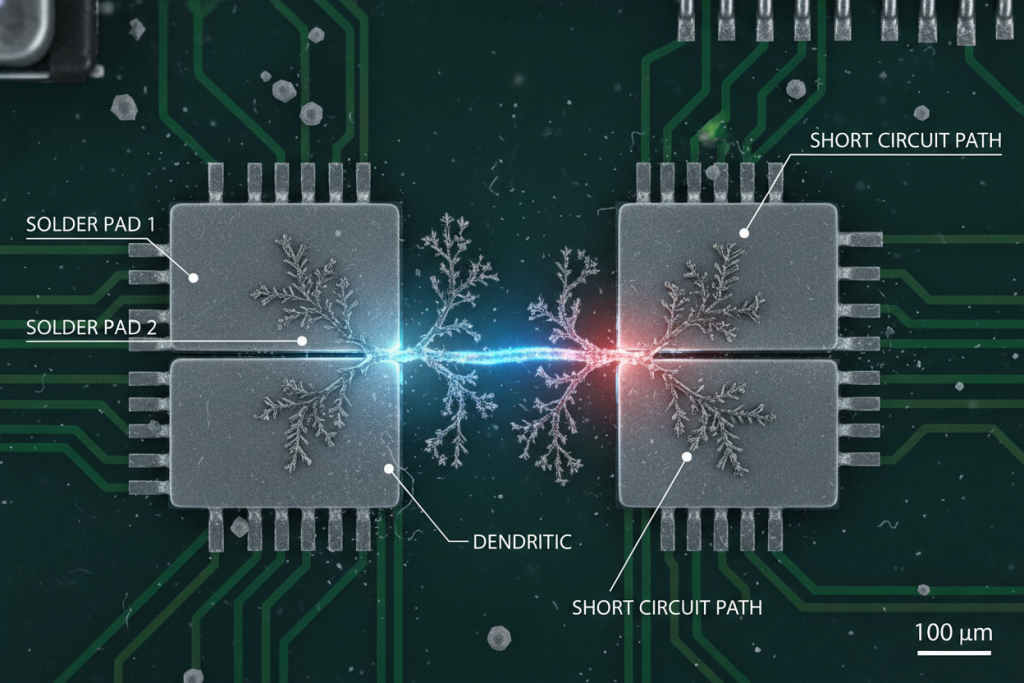
The Silent Short: Dendritic Growth
When you combine moisture, ionic contamination (like leftover flux or salts), and an electrical bias (voltage), a chemical reaction occurs. Metal ions begin to migrate from one pad to another, forming microscopic, tree-like metallic filaments known as Dendritic Growth. Once these “branches” connect two adjacent pins, the board shorts out instantly.
Conformal coating acts as a custom-fitted raincoat for your PCBA. By creating a dielectric, impermeable seal over the board, it physically blocks dust from settling on conductive surfaces and starves the dendritic growth process of the moisture it needs to occur.
Core Concepts Simplified
To make the best engineering decisions, you need to understand how different coating strategies address specific environmental threats. Here is a simplified breakdown of the core concepts.
| Threat Factor | Microscopic Mechanism | How Conformal Coating Solves It | Analogy for Non-Engineers |
|---|---|---|---|
| High Humidity / Water | Moisture acts as an electrolyte, enabling ionic migration and short circuits. | Forms a hydrophobic (water-repelling) dielectric barrier over all exposed metal. | A seamless, custom-tailored raincoat that prevents water from ever touching the skin. |
| Industrial Dust | Capillary action traps moisture; dust acts as a thermal insulator causing overheating. | Fills in microscopic gaps and encapsulates components, leaving no surface for dust to adhere to conductively. | Shrink-wrapping a delicate item so dirt simply falls off the plastic exterior. |
| Salt Fog / Corrosives | Chloride ions rapidly oxidize copper traces and solder joints, eating away the metal. | Provides a chemically inert barrier that blocks corrosive gases and salts from reaching the copper. | Painting a steel bridge with anti-rust primer to stop the ocean air from degrading the metal. |
Material Showdown: Choosing the Right Armor
Selecting the right conformal coating is a balancing act between protection, cost, and reworkability. Choosing the wrong material is a common pitfall that haunts procurement managers when warranty returns start rolling in.
Let’s break down the materials using a simple analogy: Phone Cases.
Acrylic (AR): The Standard Silicone Phone Case
Acrylic is the most common and budget-friendly option. It is easy to apply, cures quickly, and most importantly, it is incredibly easy to remove using standard solvents. It offers excellent protection against basic moisture and dust.
- Best for: Consumer electronics, smart home devices, and prototypes where rework is highly likely.
Silicone (SR): The Heavy-Duty Armor
Silicone coatings are thicker, flexible, and can withstand extreme temperature swings (from -40°C to 200°C) without cracking. However, they are harder to remove and require specialized chemical strippers.
- Best for: Automotive under-the-hood electronics, aerospace, and high-power LED lighting.
Polyurethane (UR) & Epoxy (ER): The Welded Iron Box
These materials offer the ultimate protection against harsh chemicals, solvents, and mechanical abrasion. However, they are practically indestructible. Once an epoxy coating cures, removing it usually destroys the underlying components.
- Best for: Deep-sea equipment, military hardware, and mission-critical devices where failure is not an option, and repair is never intended.
📊 Material Specification & Decision Matrix
| Material Type | Moisture Resistance | Chemical Resistance | Temperature Range | Reworkability | Cost |
|---|---|---|---|---|---|
| Acrylic (AR) | Good | Poor | -40°C to 125°C | Excellent (Solvent) | $ |
| Silicone (SR) | Excellent | Good | -40°C to 200°C | Fair (Chemical/Mechanical) | $$ |
| Polyurethane (UR) | Good | Excellent | -40°C to 125°C | Poor (Thermal/Mechanical) | $$ |
| Epoxy (ER) | Excellent | Excellent | -40°C to 150°C | Nearly Impossible | $$$ |
Application Methods: Balancing Cost and Precision
How the coating is applied is just as important as the material itself. The method dictates the production scale, the unit cost, and the consistency of the protection.
- Brush Coating: Highly manual. Best suited for low-volume prototyping or touching up boards after a repair. It is prone to uneven thickness and human error.
- Dip Coating: The entire board is submerged in a vat of coating. Excellent for high-volume, low-complexity boards. However, masking (protecting connectors from the liquid) is labor-intensive and expensive.
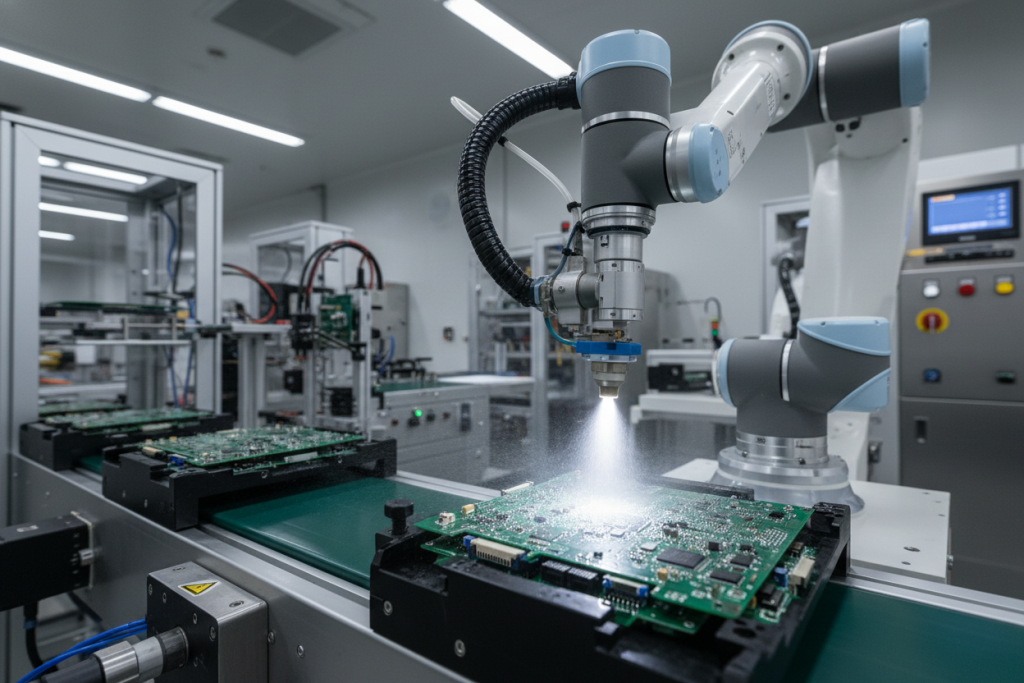
- Automated Spraying: The industry standard for modern manufacturing. Robotic valves selectively spray coating only where needed, avoiding connectors and test points entirely.
If you are scaling up from prototype to mass production, partnering with a facility that offers automated conformal coating PCB assembly is crucial. Automated selective soldering and spraying ensure that every board meets exact thickness tolerances without the high labor costs of manual masking.
The Rework Nightmare (And How to Avoid It)
If you browse engineering subreddits like r/PrintedCircuitBoard or r/AskElectronics, you will find a common horror story: “The coating flaked off after three months,” or “I destroyed the PCB trying to scrape off the coating to replace a blown capacitor.”
Reworking a coated board doesn’t have to be a nightmare if you plan ahead.
Common Rework Strategies:
- Chemical Removal (For Acrylics): Use a specialized pen or solvent swab containing Butyrolactone or similar chemicals. The acrylic dissolves locally, allowing you to desolder the component. After replacing the part, simply brush on a touch-up layer.
- Thermal Removal (For Silicone/Polyurethane): Some coatings can be burned through using a soldering iron at high temperatures. Warning: This produces toxic fumes. Adequate ventilation and fume extraction are mandatory.
- Micro-Sandblasting (For Epoxies): For rock-hard coatings, chemical solvents fail. Technicians must use precision micro-abrasive blasting (firing tiny particles of walnut shells or glass beads) to physically abrade the coating away without damaging the copper traces.
The Importance of Masking
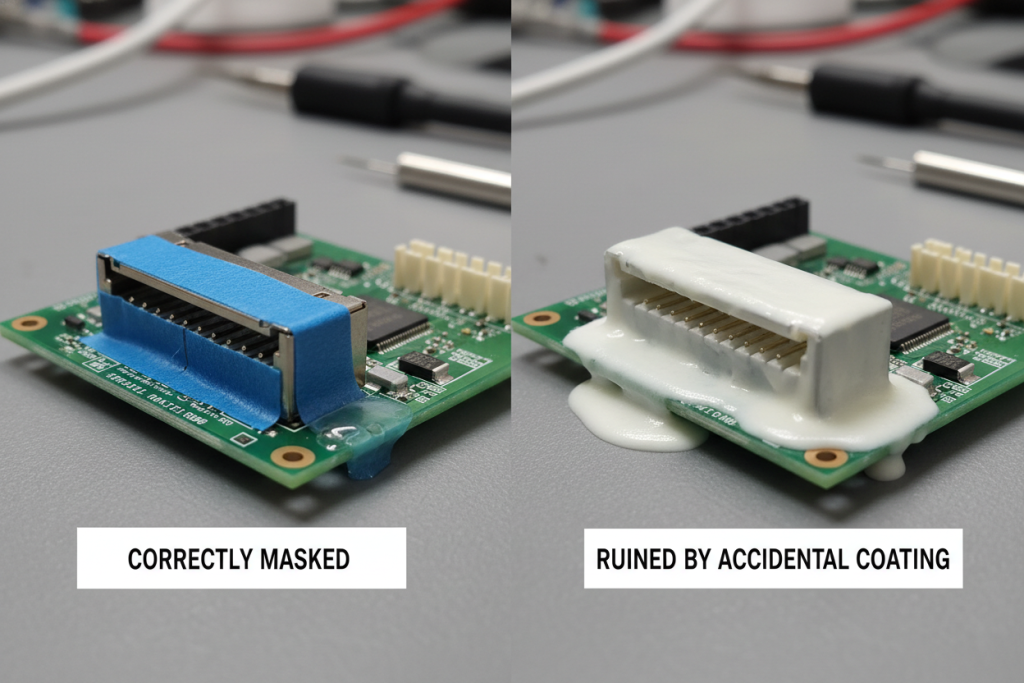
The biggest pitfall in the coating process is getting the material inside connectors, switches, or test points. Conformal coating is an insulator. If it gets onto a connector pin, that connector is dead. Proper masking using Kapton tape or liquid latex before coating is essential. Better yet, utilize automated selective spraying to program the robot to avoid these keep-out zones entirely.
Expert Tips & Real-World Pitfalls
To ensure your investment in conformal coating actually yields a reliable product, keep these expert tips in mind:
- Demand the IPC-CC-830 Standard: Never accept a generic “waterproofing glue” from a low-tier manufacturer. The global electronics industry relies on the IPC-CC-830 standard. If your assembly partner’s coating materials and processes comply with this standard, it guarantees the coating has passed rigorous testing for thermal shock, moisture insulation, and flammability.
- Beware of Trapped Moisture (The Baking Step): A common rookie mistake is coating a board that has been sitting in a humid factory. The coating will trap the existing moisture inside, accelerating corrosion. Professional assembly houses will always “bake” the bare PCBs in an industrial oven to drive out moisture before applying the coating.
- UV Inspection is Non-Negotiable: Most high-quality conformal coatings contain a UV tracer. Under a blacklight, the coating glows bright blue. This allows quality control inspectors to instantly spot pinholes, bubbles, or missed areas. If your PCBA partner doesn’t use UV inspection, find a new partner.
Conclusion & Final Thoughts
Conformal coating is not a magic bullet, but when specified correctly, it is the most effective shield against the devastating effects of moisture, dust, and corrosive environments. By understanding the microscopic threats like dendritic growth, and carefully selecting your materials based on the required reworkability and operating temperatures, you can drastically reduce field failures.
📋 Quick Summary: Making the Right Choice
| Project Requirement | Recommended Material | Recommended Application | Key Consideration |
|---|---|---|---|
| Rapid Prototyping | Acrylic (AR) | Brush / Aerosol Can | Prioritize ease of rework and fast curing times. |
| High-Volume Consumer | Acrylic (AR) | Automated Spraying | Balance cost-efficiency with adequate moisture protection. |
| Automotive / High Heat | Silicone (SR) | Automated Spraying | Ensure material can handle thermal cycling without cracking. |
| Mission Critical / Harsh | Epoxy (ER) / Polyurethane | Dip / Selective Spray | Accept that the board will be non-repairable in the field. |
Don’t let environmental factors dictate the lifespan of your hardware. If you are moving into mass production and need a reliable partner to handle everything from component sourcing to advanced conformal coating and testing, ensure you work with a facility that understands the intricacies of protecting your intellectual property.