
How Thick Should Conformal Coating Be on PCB: Complete Guide to Optimal Thickness
Conformal coating thickness is one of the most critical factors in PCB protection. Too thin, and your board lacks adequate protection. Too thick, and you risk cracking, stress, and component damage. This guide covers everything you need to know about achieving the perfect conformal coating thickness for reliable PCB performance.
What Is Conformal Coating and Why Thickness Matters
Conformal coating is a protective polymer film applied to printed circuit boards to shield them from moisture, dust, chemicals, and temperature extremes. The coating “conforms” to the board’s contours, covering components and traces.
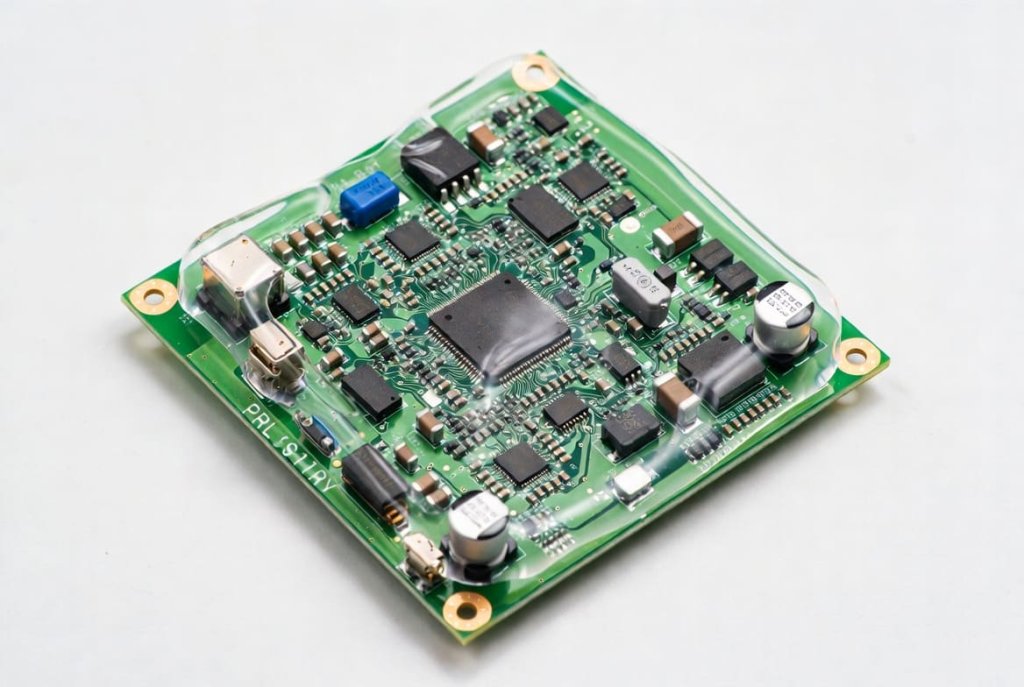
Thickness directly impacts protection effectiveness. A coating that’s too thin won’t provide adequate moisture barrier or dielectric strength. Conversely, excessive thickness can cause mechanical stress, cracking during thermal cycling, and interference with component functionality.
The right thickness balances protection with flexibility, ensuring your PCB withstands environmental challenges without compromising performance or reliability.
Industry Standard Thickness Requirements
The IPC-A-610 standard, the most widely recognized specification for electronic assemblies, provides clear guidance on conformal coating thickness.
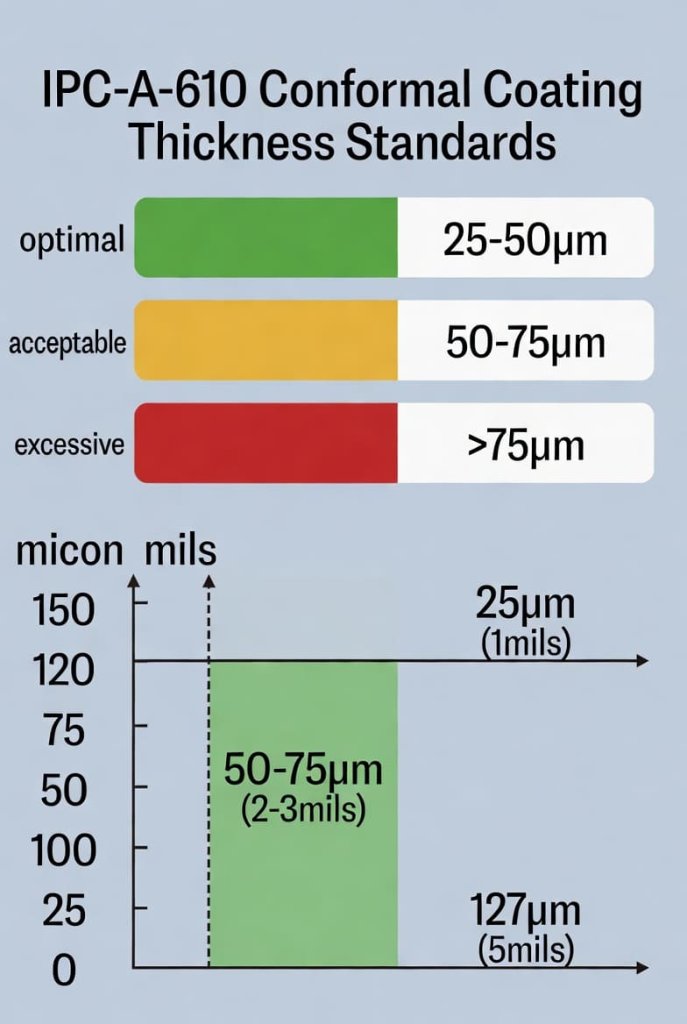
IPC-A-610 Standard Requirements:
- Minimum thickness: 25 microns (0.001 inches or 1 mil)
- Maximum thickness: 127 microns (0.005 inches or 5 mils)
- Typical target range: 25-75 microns (1-3 mils)
- Optimal thickness: 50-75 microns (2-3 mils)
Most manufacturers aim for 50-75 microns as this range provides excellent protection while maintaining flexibility and avoiding stress-related failures. Military and aerospace applications may require thicker coatings up to 127 microns for extreme environments.
Key Considerations:
- Class 1 products (general electronics): 25-50 microns acceptable
- Class 2 products (dedicated service): 50-75 microns recommended
- Class 3 products (high reliability): 75-127 microns for critical applications
Thickness Requirements by Coating Type
Different conformal coating materials have specific thickness requirements based on their chemical properties and protection characteristics.
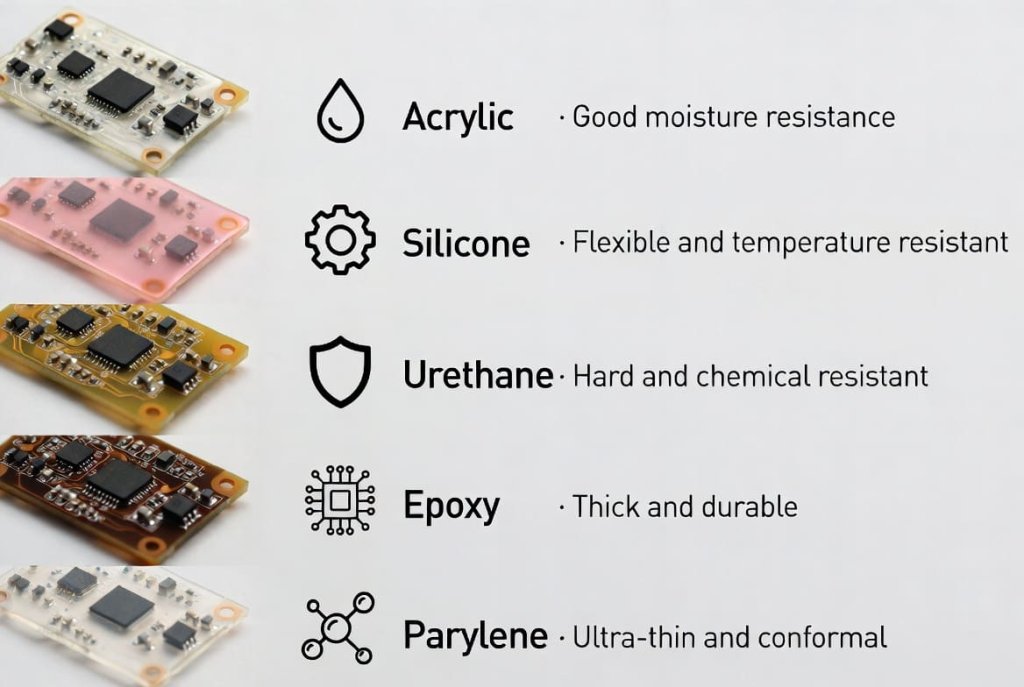
Acrylic (AR)
- Recommended thickness: 25-75 microns (1-3 mils)
- Characteristics: Easy to apply and remove, good moisture resistance
- Best for: General-purpose applications, rework-friendly boards
Silicone (SR)
- Recommended thickness: 50-127 microns (2-5 mils)
- Characteristics: Excellent temperature resistance (-65°C to +200°C), flexible
- Best for: High-temperature environments, automotive applications
Urethane (UR)
- Recommended thickness: 25-75 microns (1-3 mils)
- Characteristics: Superior chemical and abrasion resistance, difficult to remove
- Best for: Harsh chemical environments, long-term protection
Epoxy (ER)
- Recommended thickness: 25-50 microns (1-2 mils)
- Characteristics: Excellent moisture and chemical resistance, very hard
- Best for: Extreme environmental protection, permanent applications
Parylene (XY)
- Recommended thickness: 5-50 microns (0.2-2 mils)
- Characteristics: Ultra-thin, pinhole-free coverage, vapor-deposited
- Best for: Medical devices, implantables, aerospace
Parylene is unique because it can provide excellent protection at much thinner layers due to its vapor deposition process, which creates a uniform, pinhole-free coating.
How to Measure Conformal Coating Thickness
Accurate thickness measurement is essential for quality control and compliance verification. Several methods are available, each with specific advantages.
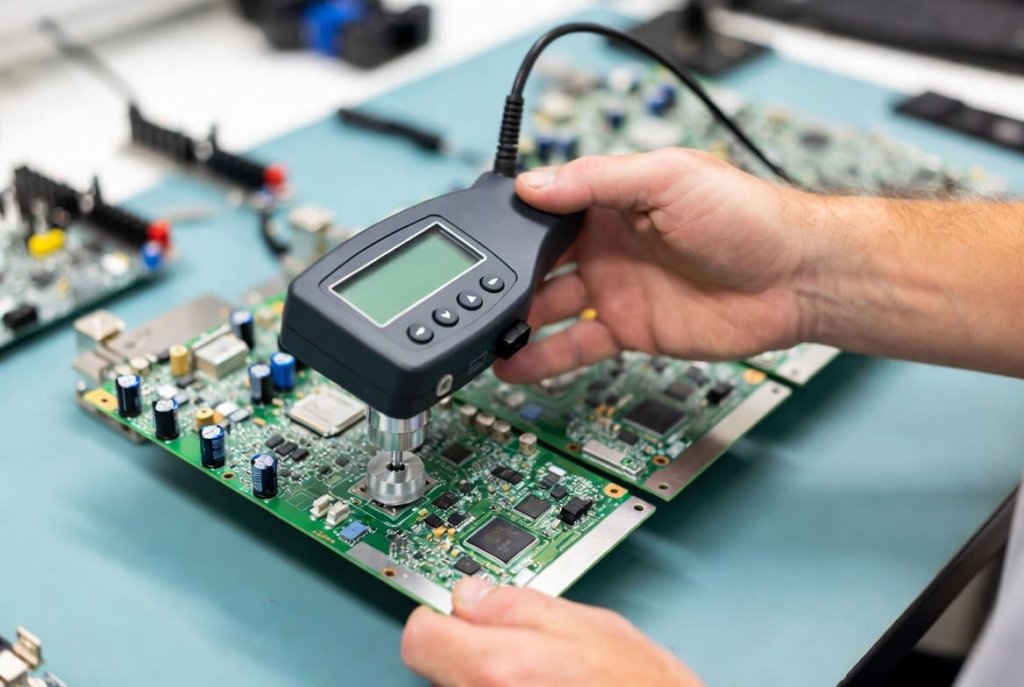
Wet Film Thickness Gauges
- When to use: During application, before curing
- Accuracy: ±5-10 microns
- Method: Comb-style gauge pressed into wet coating
- Advantage: Immediate feedback for process adjustment
Dry Film Thickness Gauges
Magnetic/Eddy Current Gauges:
- When to use: After curing, non-destructive
- Accuracy: ±2-5 microns
- Method: Probe measures coating over metal substrates
- Limitation: Requires conductive substrate
Ultrasonic Gauges:
- When to use: After curing, any substrate
- Accuracy: ±1-2 microns
- Method: Sound waves measure coating thickness
- Advantage: Works on any substrate material
Microscopic Cross-Section
- When to use: Verification, failure analysis
- Accuracy: ±0.5 microns
- Method: Cut sample, polish, measure under microscope
- Advantage: Most accurate, shows coating uniformity
- Limitation: Destructive testing
Coulometric Method
- When to use: Laboratory verification
- Accuracy: ±0.1 microns
- Method: Electrochemical removal and measurement
- Advantage: Extremely precise
- Limitation: Destructive, time-consuming
For production environments, non-destructive ultrasonic or eddy current gauges provide the best balance of accuracy and practicality.
Common Problems with Incorrect Thickness
Both insufficient and excessive coating thickness create reliability issues that can lead to field failures.
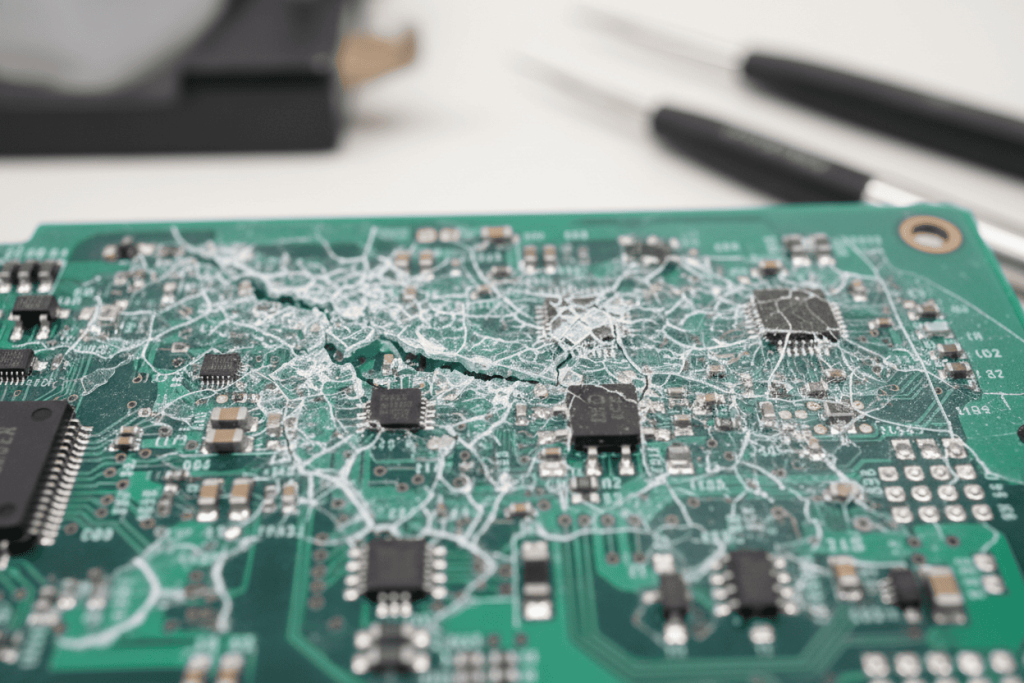
Problems with Coating Too Thin (Under 25 Microns)
Inadequate Protection:
- Pinholes and voids allow moisture penetration
- Insufficient dielectric strength leads to electrical failures
- Poor chemical resistance in harsh environments
Coverage Issues:
- Uneven coating distribution
- Exposed areas vulnerable to corrosion
- Reduced service life
Problems with Coating Too Thick (Over 127 Microns)
Mechanical Stress:
- Cracking during thermal cycling
- Delamination from substrate
- Component lead stress and potential fracture
Thermal Issues:
- Reduced heat dissipation from components
- Thermal runaway in power devices
- Accelerated component aging
Functional Problems:
- Interference with connector mating
- Switch and button operation issues
- Increased weight and cost
Curing Problems:
- Incomplete curing in thick layers
- Solvent entrapment causing outgassing
- Extended production time
The most common field failure mode is cracking from thermal cycling when coatings exceed 100 microns, particularly with rigid materials like epoxy and urethane.
Factors That Affect Coating Thickness
Multiple variables influence final coating thickness, requiring careful process control.
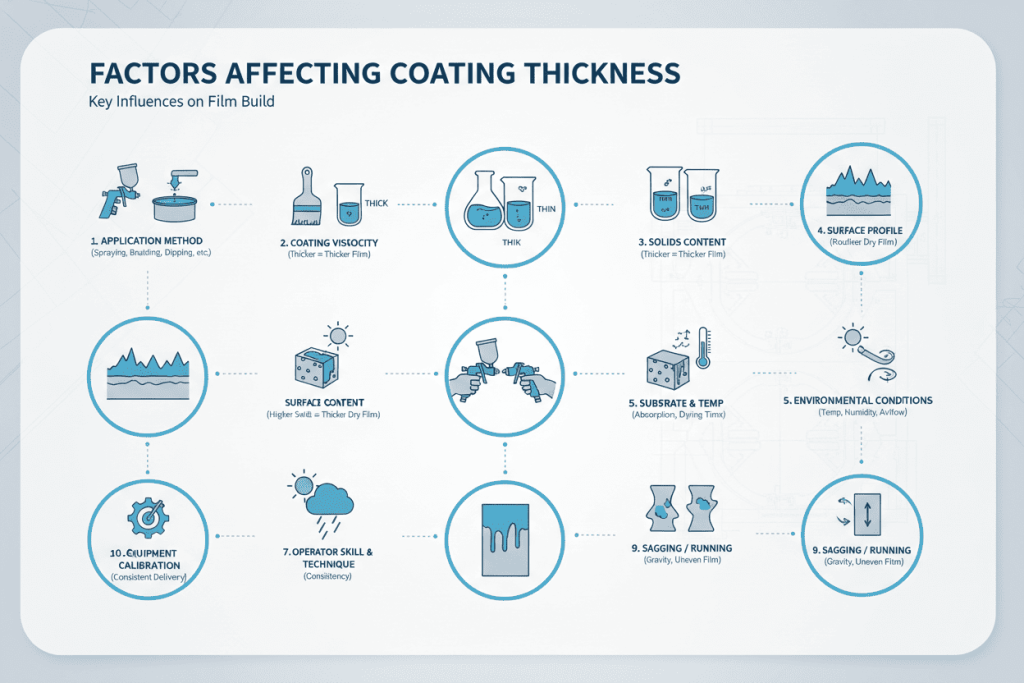
Application Method
Spray Coating:
- Thickness control: Moderate
- Typical range: 25-100 microns
- Variables: Spray pressure, distance, speed, viscosity
- Best for: Complex boards, selective coating
Dip Coating:
- Thickness control: Good
- Typical range: 25-75 microns
- Variables: Withdrawal speed, viscosity, dwell time
- Best for: High-volume, uniform coverage
Brush Coating:
- Thickness control: Poor
- Typical range: 50-150 microns (highly variable)
- Variables: Operator technique, brush type
- Best for: Rework, small batches
Selective Coating:
- Thickness control: Excellent
- Typical range: 50-100 microns
- Variables: Nozzle size, flow rate, speed
- Best for: Automated production, precise masking
Material Viscosity
Lower viscosity materials flow more easily, resulting in thinner coatings. Viscosity is typically adjusted with thinners to achieve target thickness:
- Low viscosity (50-200 cP): 25-50 microns
- Medium viscosity (200-500 cP): 50-75 microns
- High viscosity (500-1000 cP): 75-127 microns
Environmental Conditions
Temperature:
- Higher temperatures reduce viscosity, creating thinner coatings
- Optimal application temperature: 20-25°C (68-77°F)
Humidity:
- High humidity slows curing, can cause surface defects
- Optimal relative humidity: 30-70%
Number of Coats
Multiple thin coats often provide better results than a single thick coat:
- Single coat: 50-75 microns (faster, less uniform)
- Two coats: 25-40 microns each (better coverage, fewer pinholes)
- Three coats: 20-30 microns each (optimal for critical applications)
Best Practices for Achieving Optimal Thickness
Consistent coating thickness requires proper process setup, monitoring, and quality control.
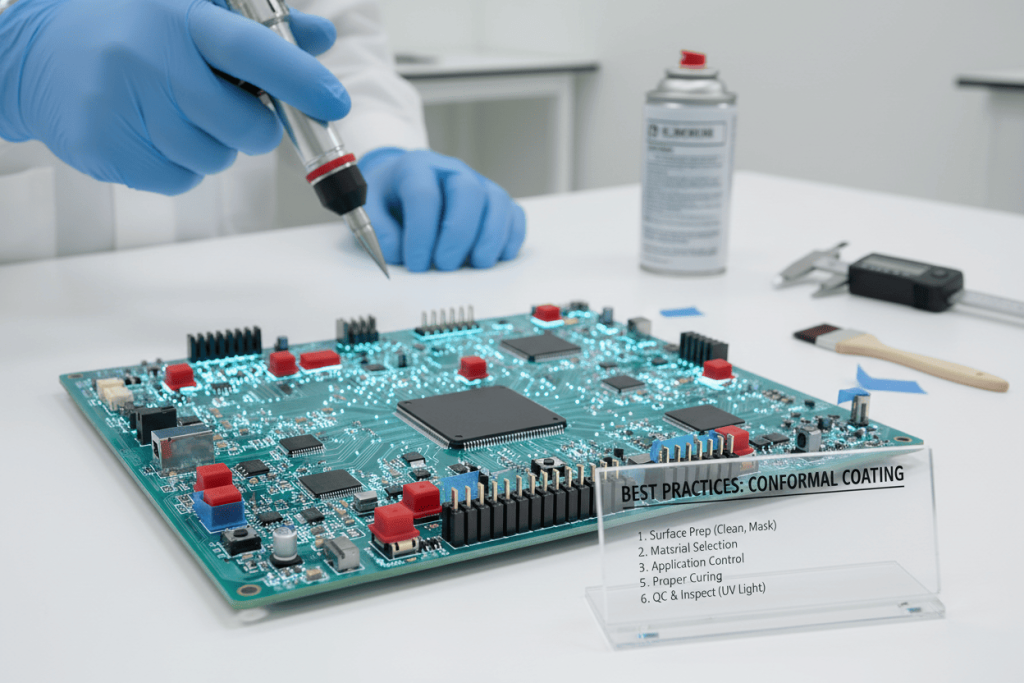
Pre-Application Preparation
Board Cleaning:
- Remove all flux residues, oils, and contaminants
- Use IPA or approved cleaning agents
- Ensure complete drying before coating
Masking:
- Protect connectors, test points, and areas requiring rework access
- Use proper masking materials (tape, boots, liquid mask)
- Verify mask integrity before application
Process Control
Material Preparation:
- Mix coating thoroughly before use
- Adjust viscosity according to manufacturer specifications
- Filter material to remove particles
- Monitor pot life for two-part systems
Application Parameters:
For spray coating:
- Spray pressure: 30-50 PSI
- Spray distance: 6-10 inches
- Spray speed: 12-18 inches/second
- Overlap: 50% between passes
For dip coating:
- Withdrawal speed: 2-6 inches/minute
- Dwell time: 10-30 seconds
- Drainage angle: 5-15 degrees
Curing and Quality Control
Curing:
- Follow manufacturer’s time and temperature recommendations
- Typical: 25°C for 24 hours or 60°C for 2 hours
- Ensure adequate ventilation
- Monitor cure completion with solvent rub test
Inspection:
- Visual inspection under UV light (for UV-traceable coatings)
- Measure thickness at multiple points (minimum 5 per board)
- Document measurements for traceability
- Verify coverage in critical areas
Acceptance Criteria:
- Thickness within specification range at all measurement points
- No pinholes, voids, or contamination
- Uniform appearance and coverage
- Proper cure (no tackiness)
Troubleshooting Thickness Issues
Coating too thin:
- Increase material viscosity
- Reduce spray distance or increase pressure
- Slow withdrawal speed (dip coating)
- Apply additional coat
Coating too thick:
- Decrease material viscosity with thinner
- Increase spray distance or reduce pressure
- Increase withdrawal speed (dip coating)
- Reduce number of coats
Frequently Asked Questions
Q: Can I apply conformal coating too thick?
Yes. Coatings over 127 microns (5 mils) typically cause problems including cracking, stress on components, poor heat dissipation, and extended curing times. Always stay within IPC-A-610 specifications.
Q: What’s the minimum effective thickness for conformal coating?
25 microns (1 mil) is the minimum per IPC-A-610, but 50 microns (2 mils) is recommended for reliable protection. Thinner coatings may have pinholes and inadequate moisture barrier properties.
Q: Does coating thickness affect thermal performance?
Yes. Thicker coatings reduce heat dissipation from components. For power devices and high-heat components, keep coatings at 25-50 microns or use thermally conductive coating materials.
Q: How do I measure coating thickness on a finished board?
Use non-destructive methods like ultrasonic thickness gauges or eddy current gauges. For verification, microscopic cross-sections provide the most accurate measurements but require destructive testing.
Q: Should I apply multiple thin coats or one thick coat?
Multiple thin coats (2-3 layers of 25-40 microns each) provide better coverage, fewer pinholes, and more uniform protection than a single thick coat. This approach also reduces stress and improves flexibility.
Q: What thickness is best for automotive applications?
Automotive electronics typically require 50-75 microns using silicone or urethane coatings for temperature resistance and durability. Some extreme applications may use up to 100 microns.
Q: Can coating thickness vary across the board?
Some variation is normal, but it should stay within the specified range. Edges and corners tend to be thinner, while flat areas may be thicker. Aim for ±10 microns variation maximum.
Q: How does humidity affect coating thickness?
High humidity can slow curing and cause surface defects but doesn’t significantly affect wet thickness. However, it may cause the coating to flow more before curing, potentially reducing final thickness.
Q: What’s the difference between wet and dry film thickness?
Wet film thickness is measured during application before curing. Dry film thickness is the final cured thickness, typically 40-60% of wet thickness depending on solids content. Always specify which you’re measuring.
Q: Is Parylene thickness different from other coatings?
Yes. Parylene can provide excellent protection at 5-25 microns due to its pinhole-free vapor deposition process. Traditional liquid coatings require 25-75 microns for comparable protection.
Conclusion
Achieving the optimal conformal coating thickness of 50-75 microns (2-3 mils) ensures reliable PCB protection without compromising performance. Follow IPC-A-610 standards, select the appropriate coating material for your application, and implement proper process controls for consistent results.
Regular thickness measurement and quality control prevent both under-protection and over-coating issues. Whether you’re coating consumer electronics or mission-critical aerospace systems, maintaining proper thickness is essential for long-term reliability and product success.
Remember: the right thickness isn’t just about meeting specifications—it’s about ensuring your PCBs perform reliably throughout their intended service life.