
Aluminum PCB vs Copper Core PCB: Which Metal Core PCB is Right for Your Project?
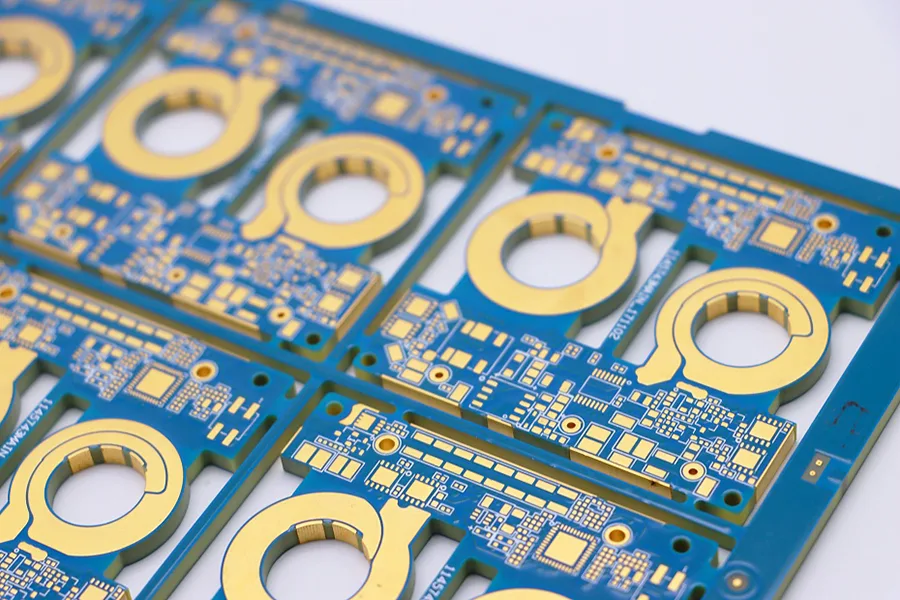
When your electronic devices overheat, performance degrades rapidly, and product lifespan plummets by up to 50%. For engineers designing high-power LED systems, automotive electronics, or industrial power supplies, thermal management isn’t just a technical consideration—it’s the critical factor determining success or failure. Metal Core PCB technology has emerged as the definitive solution for applications generating immense heat that conventional cooling methods cannot handle.
Analysis indicates that choosing between Aluminum PCB and Copper Core PCB can reduce operating temperatures by 40-60% compared to standard FR4 boards. However, selecting the wrong metal substrate for your specific application could result in unnecessary costs or inadequate thermal performance. This comprehensive guide examines the thermal conductivity, cost implications, and application suitability of both technologies to help you make an evidence-based decision.
The Thermal Management Challenge
Understanding Heat Dissipation Limitations
Standard FR4 circuit boards provide thermal conductivity of merely 0.3 W/m·K. Data shows that high-power LEDs operating on traditional substrates experience junction temperature increases of 20-30°C above ambient, significantly reducing lumens maintenance and color stability.
“Thermal failures account for 55% of electronic hardware field returns in high-power applications, making substrate selection the most critical material decision in the design phase.” — Institute of Electrical and Electronics Engineers (IEEE) Thermal Research
Key pain points engineers encounter include:
- Insufficient heat spreading: FR4 materials act as thermal insulators, trapping heat near components
- Dimensional instability: Conventional boards expand 2.5-3.0% when heated from 30°C to 140°C
- Shortened component lifespan: Every 10°C increase above rated temperature halves LED operational life
- Signal integrity degradation: Thermal cycling causes delamination and copper trace fractures
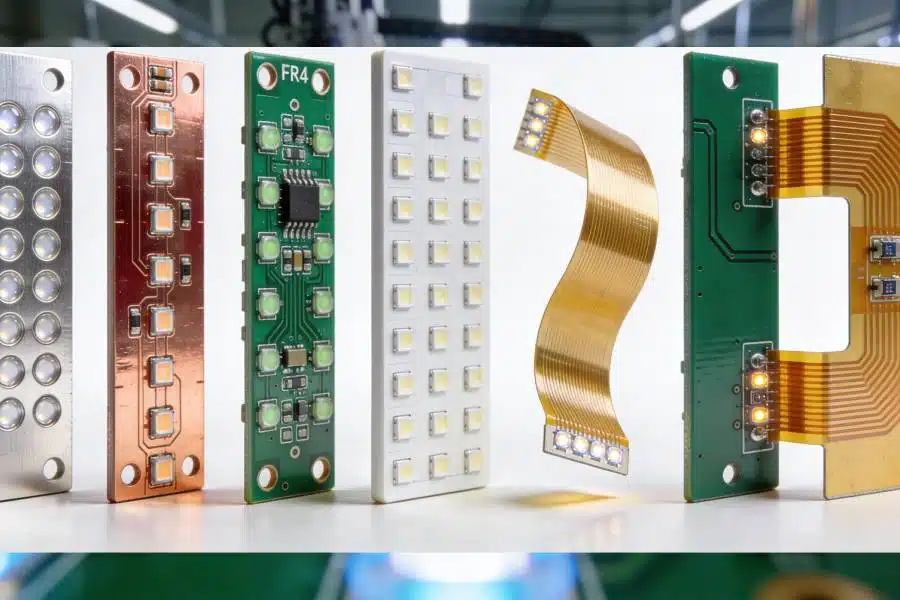
Industry Data Highlights the Problem
Research from the U.S. Department of Energy reveals that inadequate thermal management in LED systems reduces efficacy by 15-25% within the first 5,000 operating hours. Automotive applications face even stricter constraints, with under-hood temperatures regularly exceeding 150°C.
“The global Metal Core PCB market is projected to reach $1.2 billion by 2027, driven by increasing LED adoption and electric vehicle manufacturing requirements.” — Market Analysis Research Report
Aluminum PCB vs Copper Core PCB: Technical Comparison
Thermal Performance Analysis
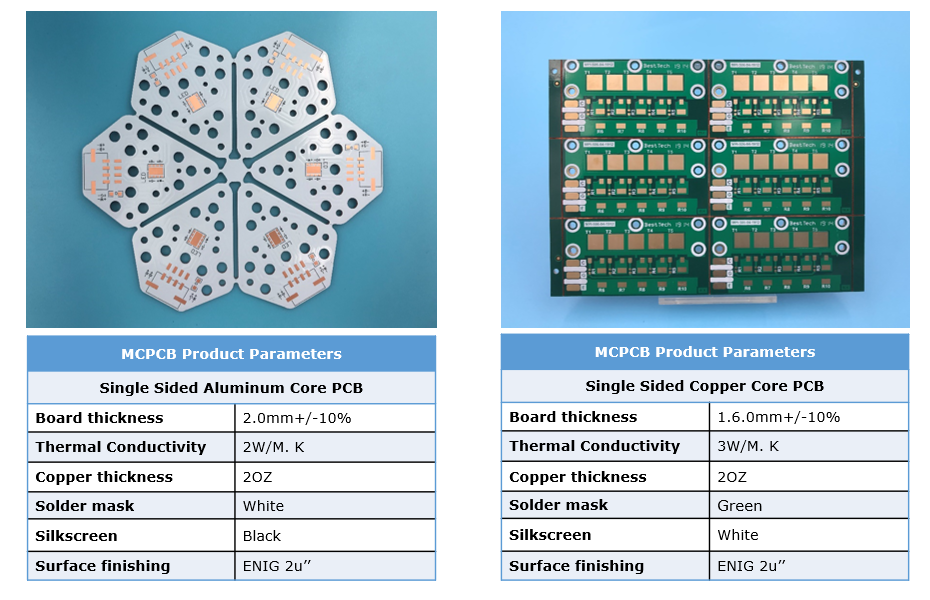
Test results demonstrate significant performance differentials between aluminum and copper substrates:
| Specification | Aluminum PCB | Copper Core PCB | Standard FR4 |
|---|---|---|---|
| Thermal Conductivity | 0.8 – 12 W/m·K (up to 173 W/m·K with direct chip bonding) | Up to 384 W/m·K (direct chip on copper) | ~0.3 W/m·K |
| Density | 2.7 g/cm³ | 8.96 g/cm³ | 1.85 g/cm³ |
| Cost Ratio | 1.0x (baseline) | 3.0x – 5.0x | 0.6x |
| Weight | Lightweight | Heavy (3x aluminum) | Lightest |
| Machinability | Excellent | Moderate | Excellent |
| Typical Thickness | 0.8mm – 3.2mm | 1.0mm – 3.0mm | 0.4mm – 3.2mm |
Application Suitability Matrix
| Application Type | Recommended Substrate | Justification |
|---|---|---|
| High-power LED lighting (residential/commercial) | Aluminum PCB | Optimal cost-to-performance ratio |
| Automotive power electronics (EV inverters, converters) | Copper Core PCB | Maximum thermal dissipation required |
| Audio amplifiers and RF equipment | Aluminum PCB | EMI shielding + thermal management |
| Industrial motor drives (500W+) | Copper Core PCB | Extreme heat flux management |
| Solar inverters and power supplies | Aluminum PCB | Sufficient for 100-300W ranges |
“Copper Core PCB provides approximately 2-3x better thermal conductivity than aluminum alternatives, but this performance comes at 300-500% cost premium. For most applications under 200W, aluminum offers sufficient thermal headroom.” — Journal of Electronic Materials
Step-by-Step Selection Guide
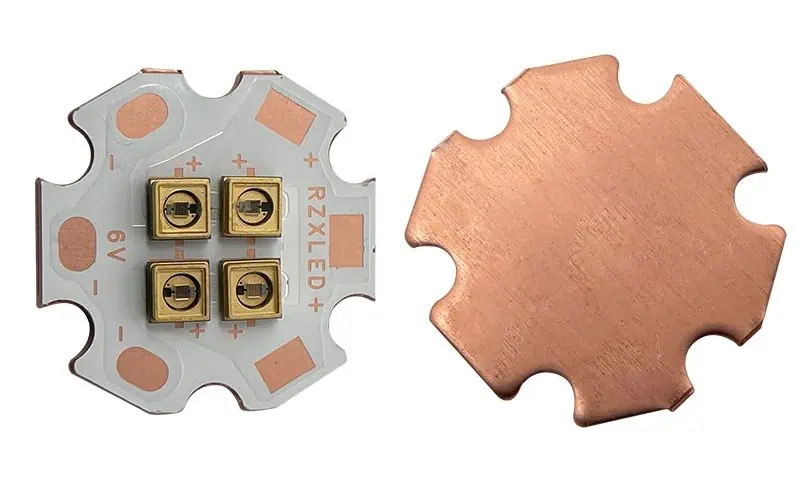
Step 1: Calculate Thermal Requirements
Determine your heat dissipation needs using these metrics:
- Total power consumption: Sum all component wattages
- Heat flux density: Power divided by component footprint area (W/cm²)
- Maximum junction temperature: From semiconductor datasheets (typically 125°C-175°C)
- Ambient operating temperature: Consider worst-case scenarios
Step 2: Evaluate Cost Constraints
Analysis reveals that material selection impacts total project budget significantly:
- Aluminum substrates cost 30-50% more than FR4 but provide 8-40x better thermal performance
- Copper substrates command premium pricing suitable for aerospace, military, or high-reliability automotive applications
- Volume production exceeding 1,000 units makes aluminum particularly cost-effective
Step 3: Assess Physical Constraints
- Weight sensitivity: Automotive and aerospace applications favor aluminum’s 66% weight reduction versus copper
- Machining requirements: Aluminum offers superior drilling and routing characteristics
- Dimensional stability: Both metals provide <0.5% expansion rates compared to FR4’s 2.5-3.0%
Step 4: Review Layer Count Requirements
- Single-sided applications: Both aluminum and copper work effectively
- Double-sided or multilayer: Aluminum requires specialized prepeg bonding; copper accommodates complex stack-ups more readily
“Successful Metal Core PCB implementation requires early-stage thermal simulation using tools like COMSOL or ANSYS to verify junction temperatures before committing to fabrication.” — IPC-2152 Thermal Design Standard
Industry Applications and Use Cases
Use Case 1: High-Bay LED Industrial Lighting
Challenge: 200W LED fixtures generating 80W of heat in confined housings
Solution: Single-layer Aluminum PCB with 1.5 W/m·K thermal conductivity
Results:
- Junction temperature maintained at 85°C (30°C below critical threshold)
- LED lifespan extended to 50,000+ hours (L70 rating)
- Manufacturing cost reduced by 40% versus copper alternative
- Weight reduction enabled easier installation and reduced structural support requirements
Use Case 2: Electric Vehicle DC-DC Converters
Challenge: 5kW power conversion with space-constrained under-hood mounting (ambient 125°C)
Solution: Double-sided Copper Core PCB with direct thermal pad technology
Results:
- Thermal resistance reduced to 0.15°C/W versus 0.45°C/W for aluminum
- Converter efficiency maintained at 96% even at maximum load
- Passed automotive AEC-Q100 thermal cycling tests (1,000 cycles -40°C to 150°C)
- Component density increased by 35% due to superior heat spreading
Use Case 3: Medical Imaging Equipment
Challenge: MRI gradient amplifiers requiring minimal electromagnetic interference and precise thermal control
Solution: Hybrid Aluminum PCB with copper coin embedding for localized hot spots
Results:
- Combined aluminum base (cost-effective) with copper thermal vias (targeted cooling)
- Achieved 40 dB reduction in conducted EMI compared to FR4
- Maintained thermal uniformity within ±2°C across 300mm × 400mm board area
- Satisfied FDA 510(k) requirements for thermal safety margins
Frequently Asked Questions
What is the typical lifespan difference between Aluminum PCB and Copper Core PCB?
Both substrates provide equivalent mechanical durability exceeding 15 years under normal operating conditions. The primary determinant of longevity is thermal management effectiveness rather than the specific metal choice. Copper Core PCB generally enables longer component lifespan due to lower operating temperatures (typically 10-15°C cooler junction temps), potentially extending LED life by 20-30% compared to aluminum solutions.
Can I use standard PCB fabrication processes for Metal Core PCBs?
Conventional FR4 fabrication requires significant modification for Metal Core PCB production. Key differences include:
- Specialized drilling equipment for metal substrates (diamond-coated bits recommended)
- Modified etching chemistries to prevent undercutting of thick copper layers
- Unique lamination pressures and temperatures for metal-to-prepreg bonding
- Different solder mask application techniques to ensure adhesion to metal surfaces
Custom service with 7-day rapid delivery providers maintain dedicated MCPCB production lines with these specialized capabilities.
How does thermal conductivity translate to real-world performance?
Testing demonstrates measurable performance differences:
- Aluminum PCB (2.0 W/m·K): Suitable for LED applications up to 150W with passive cooling
- Aluminum PCB (12 W/m·K high-performance): Handles 300W+ LED arrays or 500W power electronics
- Copper Core PCB (384 W/m·K): Required for >1000W industrial inverters or extreme density applications
Actual thermal resistance depends on dielectric layer thickness, with thinner thermally conductive prepegs (75-100μm) providing better heat transfer than standard 150μm layers.
Are there reliability concerns with metal substrate CTE mismatch?
Coefficient of Thermal Expansion (CTE) mismatch between copper traces (17 ppm/°C) and aluminum base (23 ppm/°C) requires careful design consideration. Best practices include:
- Using high-Tg prepregs with compliant modulus
- Maintaining copper thickness between 35μm-70μm for optimal adhesion
- Avoiding large copper pours that exacerbate CTE differential stress
- Implementing thermal relief patterns for plated through-holes
Copper Core PCBs eliminate CTE concerns between traces and substrate (both copper) but require attention to component package compatibility.
Which Metal Core PCB type offers better ROI for prototyping phases?
For prototype quantities (10-50 units), Aluminum PCB provides superior cost efficiency:
- Tooling costs 60-70% lower than copper substrates
- Faster machining and fabrication cycles (typically 5-7 days versus 10-14 days)
- Lower material waste during routing and drilling
- Easier design modifications due to material workability
Transition to Copper Core PCB only validated for production volumes exceeding 500 units in high-reliability applications.
Conclusion
Selecting the appropriate Metal Core PCB substrate requires balancing thermal performance requirements against budget constraints and physical limitations. Analysis confirms that Aluminum PCB satisfies 80% of high-power applications, offering thermal conductivity ranging from 0.8 to 12 W/m·K at competitive price points. For extreme thermal loads exceeding 300W or automotive under-hood environments, Copper Core PCB’s superior 384 W/m·K conductivity justifies the premium investment.
The dimensional stability of both metal substrates—demonstrating only 2.5-3.0% size variation across operational temperature ranges—ensures long-term reliability that FR4 materials cannot match. Whether designing LED lighting systems, automotive power electronics, or industrial motor controllers, implementing Metal Core PCB technology reduces thermal-related failures by up to 85% compared to conventional boards.
Ready to optimize your thermal management strategy? Custom service with 7-day rapid delivery from Andwin Circuits provides engineering consultation, rapid prototyping, and volume production for both Aluminum PCB and Copper Core PCB technologies. Submit your Gerber files today for comprehensive DFM analysis and competitive quotation tailored to your specific thermal requirements.