
Comprehensive summary of common methods and measures for anti-ESD in PCB board design
Static electricity from the human body, environment and even inside electronic devices can cause various damages to precision semiconductor chips, such as penetrating the thin insulation layer inside the components; damaging the gate of MOSFET and CMOS components; locking the trigger in the CMOS device; short-circuiting the reverse biased PN junction; short-circuiting the forward biased PN junction; melting the welding wire or aluminum wire inside the active device. In order to eliminate the interference and damage of electrostatic discharge (ESD) to electronic equipment, a variety of technical means need to be taken to prevent it.
In the design of PCB boards, the anti-ESD design of PCBs can be achieved through layering, proper layout and installation. During the design process, most design modifications can be limited to adding or removing components through prediction. By adjusting the PCB layout and wiring, ESD can be well prevented. The following are some common preventive measures.
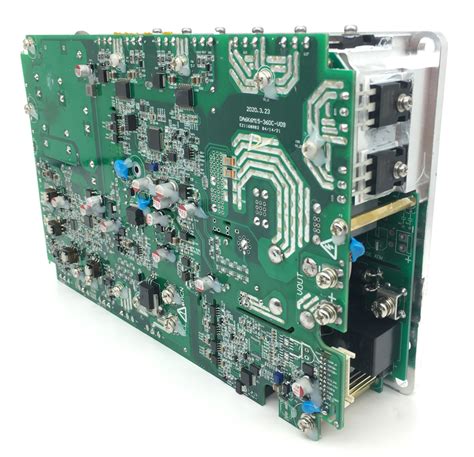
1.Use multi-layer PCBs as much as possible
Compared with double-sided PCBs, the ground plane and power plane, as well as the closely arranged signal line-ground line spacing can reduce the common mode impedance and inductive coupling to 1/10 to 1/100 of double-sided PCBs. Try to place each signal layer close to a power or ground layer. For high-density PCBs with components on both the top and bottom surfaces, very short connecting lines, and many fills, consider using inner layer lines.
2.For double-sided PCBs, use tightly interwoven power and ground grids.
The power lines are close to the ground lines, and as many connections as possible between vertical and horizontal lines or fill areas. The grid size on one side is less than or equal to 60mm, and if possible, the grid size should be less than 13mm.
- Make sure each circuit is as compact as possible.
- Put all connectors on one side as much as possible.
- Set the same “isolation zone” between the chassis ground and circuit ground on each layer; if possible, keep the spacing distance at 0.64mm.
- When assembling the PCB, do not apply any solder to the pads on the top or bottom layers.
Use screws with embedded washers to achieve close contact between the PCB and the metal chassis/shield or bracket on the ground plane.
- If possible, bring the power line in from the center of the card and away from areas that are easily directly affected by ESD.
- Place wide chassis ground or polygonal fill ground on all PCB layers below the connectors that lead to the outside of the chassis (which are easily hit by ESD directly), and connect them together with vias every approximately 13mm.
- Place mounting holes on the edge of the card, and connect the top and bottom pads around the mounting holes to the chassis ground with no solder mask.
- Connect the chassis ground and circuit ground with 1.27mm wide wires along the chassis ground line every 100mm near the mounting holes on the top and bottom layers of the card. Place mounting pads or mounting holes between the chassis ground and the circuit ground adjacent to these connection points. These ground connections can be cut with a blade to keep them open, or jumpered with beads/high-frequency capacitors.
- If the circuit board will not be placed in a metal chassis or shielding device, solder mask should not be applied to the top and bottom chassis ground wires of the circuit board so that they can act as discharge electrodes for ESD arcs.
- Set up a ring ground around the circuit in the following manner:
(1) Place a ring ground path around the entire periphery, except for the edge connector and chassis ground.
(2) Ensure that the width of the ring ground on all layers is greater than 2.5mm.
(3) Connect the ring ground with vias every 13mm.
(4) Connect the ring ground to the common ground of the multi-layer circuit.
(5) For double-sided boards installed in metal chassis or shielding devices, the ring ground should be connected to the circuit common ground. Unshielded double-sided circuits should connect the ring ground to the chassis ground. No solder mask should be applied to the ring ground so that the ring ground can act as a discharge rod for ESD. Place at least a 0.5mm wide gap somewhere on the ring ground (all layers) to avoid forming a large loop. The distance between the signal wiring and the ring ground cannot be less than 0.5mm.

- In areas that can be directly hit by ESD, a ground wire should be laid near each signal line.
- The I/O circuit should be as close to the corresponding connector as possible.
- Circuits that are susceptible to ESD should be placed in an area close to the center of the circuit so that other circuits can provide them with a certain shielding effect.
- Transient protectors are usually placed at the receiving end. Use short and thick wires (less than 5 times the width, preferably less than 3 times the width) to connect to the chassis ground. The signal line and ground wire coming out of the connector should be directly connected to the transient protector before connecting to other parts of the circuit.
- Series resistors and magnetic beads are usually placed at the receiving end, and for cable drivers that are easily hit by ESD, series resistors or magnetic beads can also be considered at the driving end.
18 Filter capacitors should be placed at the connector or within 25mm of the receiving circuit.
(1) Use a short and thick wire to connect to the chassis ground or receiving circuit ground (length less than 5 times the width, preferably less than 3 times the width).
(2) The signal line and ground wire are first connected to the capacitor and then to the receiving circuit.
- Make sure the signal line is as short as possible.
- When the length of the signal line is greater than 300mm, a ground wire must be laid in parallel.
- Make sure the loop area between the signal line and the corresponding loop is as small as possible. For long signal lines, the positions of the signal line and the ground wire should be swapped every few centimeters to reduce the loop area.
- Drive the signal into multiple receiving circuits from the center of the network.
- Where possible, fill unused areas with ground and connect all layers of filled ground every 60mm.
- Make sure the loop area between the power supply and the ground is as small as possible, and place a high-frequency capacitor close to each power pin of the integrated circuit chip.
- Place a high-frequency bypass capacitor within 80mm of each connector.
- Reset lines, interrupt signal lines or edge-triggered signal lines cannot be arranged near the edge of the PCB.
- Ensure that any large ground fill area (approximately larger than 25mm×6mm) is connected to the ground at the two opposite ends.
- When the length of the opening on the power or ground plane exceeds 8mm, use a narrow line to connect the two sides of the opening.
- Connect the mounting holes to the circuit common ground or isolate them.
(1) When a metal bracket must be used with a metal shielding device or chassis, a zero-ohm resistor must be used to achieve the connection.
(2) Determine the size of the mounting hole to achieve reliable installation of the metal or plastic bracket. Use large pads on the top and bottom layers of the mounting hole. Do not use solder resist on the bottom pad, and ensure that the bottom pad is not soldered using wave soldering.
- Do not arrange protected signal lines and unprotected signal lines in parallel.
- Pay special attention to the routing of reset, interrupt and control signal lines.
(1) Use high-frequency filtering.
(2) Keep away from input and output circuits.
(3) Keep away from the edge of the circuit board.
- The PCB should be inserted into the chassis, not installed in the opening or internal seam.
- Pay attention to the routing of signal lines under the magnetic beads, between the pads, and those that may contact the magnetic beads. Some magnetic beads have very good conductivity and may produce unexpected conductive paths.
- If a chassis or motherboard is to be equipped with several circuit boards, the circuit board that is most sensitive to static electricity should be placed in the middle.