Skip to content
Andwin Circuits
  • Home
  • ProductsExpand
    • HDI multilayer PCB
    • Rigid Flex PCB
    • Flex pcb
    • Special PCBExpand
      • High Frequency PCBExpand
        • Rogers RO4350B PCB
        • Rogers RO4003 pcb
        • Rogers RO3003 PCB
        • Rogers 5880 PCB
        • DICLAD 527 PCB
        • Taconic TLX series
        • Taconic TLX-8 RF PCB
        • Taconic TLX-9 RF PCB
      • High speed pcbExpand
        • Megtron 6 High Speed PCB
        • TU-872 SLK Sp High Speed
      • High TG PCBExpand
        • SHENGYI SH260 PCB
        • ISOLA 370HR PCB
        • ISOLA IS410 PCB
        • ISOLA IS420 PCB
      • Heavy copper PCB
      • Copper coin pcb
      • Copper inlay PCB
    • Metal Core PCBExpand
      • Copper core pcb
      • Aluminum PCB
      • 2 Layers Aluminum PCB
      • Direct thermal MCPCB
      • 2 Layers Direct Thermal
    • Ceramic PCBExpand
      • DPC ceramic PCB
      • DBC ceramic PCB
      • Thick film Ceramic PCB
      • Al2O3 Alumina PCB
      • AIN ALN ceramic PCB
      • IGBT Ceramic PCB
  • ServiceExpand
    • PCB Assembly
    • Quick turn PCB assembly
    • PCBA conformal coating
  • IndustryExpand
    • Telecommunication
    • IoT and Wireless
    • Industrial Control
    • Thermal management
    • Power and Energy
    • IC test board
    • Automative
    • Medical
  • CapabilityExpand
    • Rigid PCB
    • Rigid flex PCB
    • Metal core PCB
    • PCB Assembly
  • TechnologyExpand
    • Blogs
    • Via in pad
    • PCB E-test
    • PCB stack up
    • MCPCB panelization
    • Controlled impedance PCB
  • AboutExpand
    • About us
    • Certification
    • Factory Tour
  • Contact
Andwin Circuits
Home / Do you know the design and processing of PCB gold finger?

Do you know the design and processing of PCB gold finger?

ByGrace July 21, 2025July 18, 2025

1.Definition of gold finger

    (Gold Finger or Edge Connector) Insert one end of the PCB into the connector slot, use the connector pin as the outlet for the PCB to connect to the outside, make the pad or copper contact with the corresponding position of the pin to achieve the purpose of conduction, and immerse gold or plate nickel gold on the pad or copper of the PCB. Because it is in the shape of a finger, it is called a gold finger.

    2.Surface treatment of gold finger PCB

    1.Electroplating nickel gold:

    The thickness can reach 3-50u”. Due to its superior conductivity, oxidation resistance and wear resistance, it is widely used in gold finger PCBs that need to be frequently plugged in or PCBs that need to be frequently mechanically rubbed. However, because the cost of gold plating is extremely high, it is only used for local gold plating such as gold fingers. Jieduobang PCB calls it: selective electroplating gold process. The color of electroplating gold process is silvery white, not as yellow as immersion gold. The disadvantage is that the solderability is slightly poor.

    2.Immersion gold:

    The thickness is usually 1u”, and the maximum can reach 3u”. Due to its superior conductivity, flatness and solderability, it is widely used in high-precision PCB boards with key positions, IC binding, BGA and other designs. For gold finger PCBs with low wear resistance requirements, the whole board immersion gold process can also be selected. The cost of the immersion gold process is much lower than that of the electroplating gold process. The color of the immersion gold process is golden yellow.

    3.Matters needing attention in gold finger design

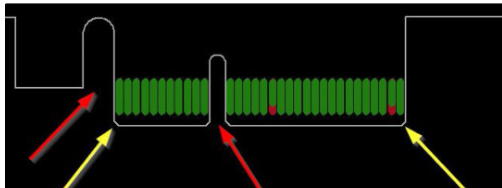
      When you see the shape and package similar to the figure below when designing PCB, the first reaction is that there are gold fingers on the board. A relatively simple way to judge the gold fingers: There are PIN devices on the TOP and BOTTOM surfaces of the device; there will be a fool-proof U-shaped groove as shown in the figure below.
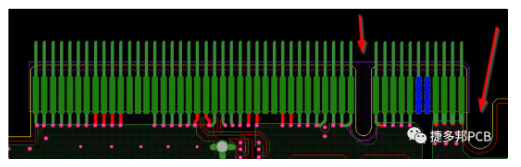
      When there are gold fingers on the board, the details of the gold fingers need to be processed.

      Detailed processing of gold fingers in PCB:

      1) For PCB boards that need to be plugged and unplugged frequently, in order to increase the wear resistance of the gold fingers, the gold fingers usually need to be electroplated with hard gold.

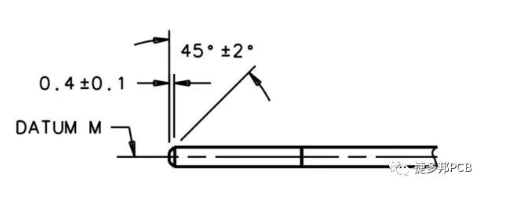
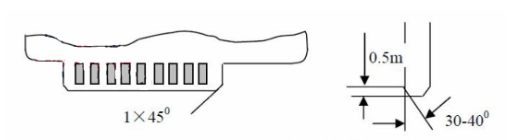
      2) Gold fingers need to be chamfered, usually 45°, other angles such as 20°, 30°, etc. If there is no chamfer in the design, there is a problem; as shown in the figure below, the arrow indicates a 45° chamfer:
      3) Gold fingers need to be processed with a whole piece of solder mask opening, and PIN does not need to open a steel mesh;

      4) The minimum distance between the tin and silver pads and the top of the finger is 14mil; it is recommended that the pads be more than 1mm away from the finger during design, including the via pads;

      5) Do not lay copper on the surface of the gold finger;

      The following figure is a design of a gold finger for reference:
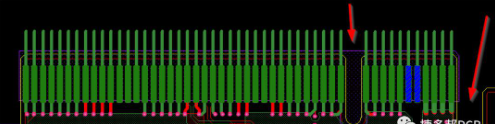
      6) All layers of the inner layer of the gold finger need to be copper-cut, usually with a width of 3mm; half-finger copper cutting and whole-finger copper cutting can be done. In PCIE design, it is also specified that all copper in the gold finger area should be cut off;

      The impedance of the gold finger will be relatively low, and copper cutting (hollowing out under the finger) can reduce the impedance difference between the gold finger and the impedance line, and it is also good for ESD;

      Recommendation: Full copper cutting under the gold finger pad.

      4.PCB gold finger processing of JDB

      1.The thickness of the board that can be beveled can be processed with a thickness of 1.2-2.4m. The bevel cannot be processed if it is not within this thickness range.

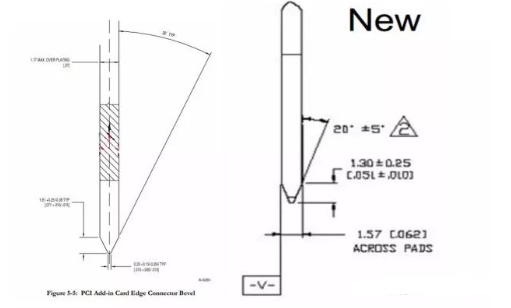
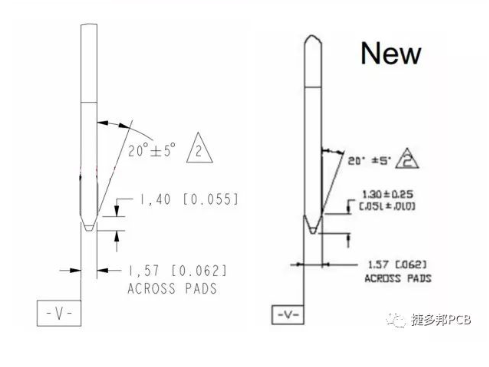
      2.The depth and angle of the bevel are generally between 20-45 degrees by default. There must be enough bevel spacing between the gold finger and the board edge. According to the board thickness or design requirements of different gold finger PCBs, we recommend that the distance between the gold finger and the board edge is 0.6-1.5mm during design to avoid damaging the gold finger during beveling. If the distance between the gold finger and the board edge is less than 0.6mm, there is a risk of damaging the gold finger if beveling is required. The following are several common bevel angle and depth diagrams for your reference.
        Contact us for PCB quote now |
        Post Tags: #aluminum clad pcb#aluminum core pcb#aluminum pcb#assemble pcb#pcb gold finger

        Post navigation

        Previous Previous
        Issues to be noted when soldering PCB
        NextContinue
        What benefits can PCB depaneling machines bring to enterprises

        Search

        Search

        Products

        • HDI Multilayer PCB
        • Rigid Flex PCB
        • Flex pcb
        • High Frequency PCB
        • High speed pcb
        • Heavy copper PCB
        • Metal Core PCB
        • Ceramic PCB

        Address

        Andwin Circuits Co.,Limited
        Email: sales@andwinpcb.com
        Tel: +86 755 2832 9394
        Fax:+86 755 2992  6717
        ADD:1-2F-1217,HouDeQun Industrial park,
        NanTing RD NO.56,ShaJing,BaoAn,Shenzhen 518104,GuangDong,China

        Products

        • HDI Multilayer PCB
        • Rigid Flex PCB
        • Flex pcb
        • High Frequency PCB
        • High speed pcb
        • Heavy copper PCB
        • Metal Core PCB
        • Ceramic PCB

        Technology

        • Blogs
        • Via in pad
        • PCB E-test
        • PCB stack up
        • Metal core PCB panelization
        • Controlled impedance PCB

        CERTIFICATION

        Certification >>


        Copyright© 2003 - 2026 Andwin | All Rights Reserved | Powered by Andwin

        Scroll to top
        • Home
        • Products
          • HDI multilayer PCB
          • Rigid Flex PCB
          • Flex pcb
          • Special PCB
            • High Frequency PCB
              • Rogers RO4350B PCB
              • Rogers RO4003 pcb
              • Rogers RO3003 PCB
              • Rogers 5880 PCB
              • DICLAD 527 PCB
              • Taconic TLX series
              • Taconic TLX-8 RF PCB
              • Taconic TLX-9 RF PCB
            • High speed pcb
              • Megtron 6 High Speed PCB
              • TU-872 SLK Sp High Speed
            • High TG PCB
              • SHENGYI SH260 PCB
              • ISOLA 370HR PCB
              • ISOLA IS410 PCB
              • ISOLA IS420 PCB
            • Heavy copper PCB
            • Copper coin pcb
            • Copper inlay PCB
          • Metal Core PCB
            • Copper core pcb
            • Aluminum PCB
            • 2 Layers Aluminum PCB
            • Direct thermal MCPCB
            • 2 Layers Direct Thermal
          • Ceramic PCB
            • DPC ceramic PCB
            • DBC ceramic PCB
            • Thick film Ceramic PCB
            • Al2O3 Alumina PCB
            • AIN ALN ceramic PCB
            • IGBT Ceramic PCB
        • Service
          • PCB Assembly
          • Quick turn PCB assembly
          • PCBA conformal coating
        • Industry
          • Telecommunication
          • IoT and Wireless
          • Industrial Control
          • Thermal management
          • Power and Energy
          • IC test board
          • Automative
          • Medical
        • Capability
          • Rigid PCB
          • Rigid flex PCB
          • Metal core PCB
          • PCB Assembly
        • Technology
          • Blogs
          • Via in pad
          • PCB E-test
          • PCB stack up
          • MCPCB panelization
          • Controlled impedance PCB
        • About
          • About us
          • Certification
          • Factory Tour
        • Contact
        Search