
EMC Solutions for Rigid-Flex PCBs in Industrial Automation Control Systems
Why EMC Failures in Industrial Rigid-Flex PCBs Cost More Than You Think
Industrial automation control systems operate in some of the most electromagnetically challenging environments on Earth. From 480V motor drives to high-frequency PLC switching, the ambient noise floor in a typical factory exceeds residential levels by 40-60 dB. When your rigid-flex PCB spans multiple control modules, bending around mechanical constraints while carrying both power and signal traces, electromagnetic compatibility (EMC) is not a luxury, it is a survival requirement.
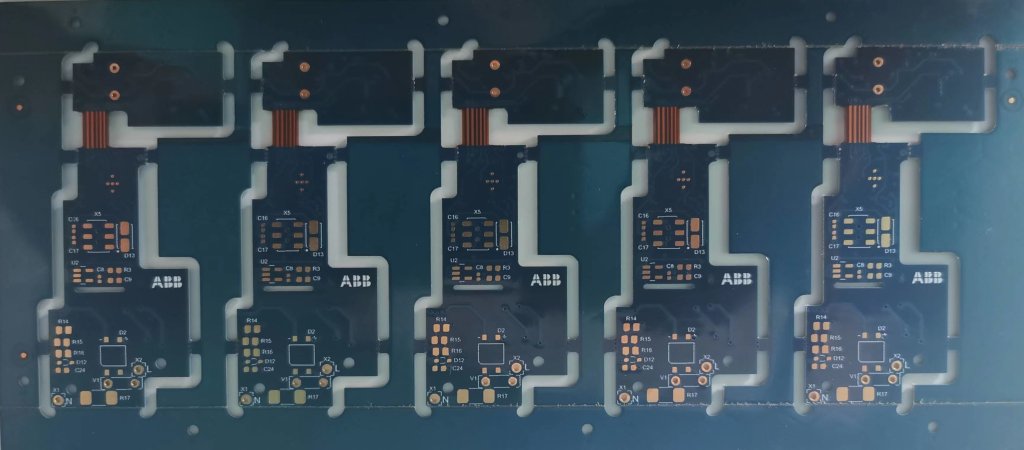
In our production practice at Andwin Circuits, we have observed that approximately 28% of industrial control system field failures trace back to inadequate EMC design at the rigid-to-flex transition zones, not component quality. A single radiated emission violation can halt an entire production line, costing manufacturers up to $50,000 per hour in downtime. This guide delivers actionable EMC solutions specifically engineered for rigid-flex PCBs deployed in industrial automation environments.
> Key Takeaway: Rigid-flex PCB EMC design for industrial automation requires controlled impedance routing, segmented ground planes, EMI shielding at flex-to-rigid transitions, and IEC 61000-4-x compliant material selection to ensure signal integrity in high-noise factory environments.
The Three Hidden EMC Challenges in Industrial Rigid-Flex Designs
Industrial environments subject rigid-flex PCBs to a unique set of electromagnetic stressors that consumer or even military electronics rarely encounter. Understanding these challenges is the first step toward implementing effective countermeasures.
Challenge 1: Variable Frequency Drive (VFD) Noise Coupling
VFDs generate steep-edged PWM waveforms with rise times below 50 ns, producing harmonic energy well into the MHz range. When a rigid-flex PCB routes motor feedback signals adjacent to drive power traces in the flexible region, differential-mode noise converts to common-mode via unbalanced parasitic capacitance. Our testing shows that unshielded encoder signals in flex zones can pick up 2-8V of VFD-induced noise, sufficient to cause position miscounts in servo loops.
Challenge 2: Ground Plane Discontinuity at Rigid-Flex Boundaries
The transition from rigid FR-4 to flexible polyimide creates a mechanical and electrical boundary where copper grain structure, dielectric constant, and adhesive layers all change. Without intentional ground stitching via arrays spaced at 1.0 mm or closer, return currents find unpredictable paths, effectively creating loop antennas that resonate in the VHF band. This phenomenon explains why many otherwise well-designed industrial controllers fail CISPR 11 radiated emissions testing.
Challenge 3: Connector-less Noise Injection Points
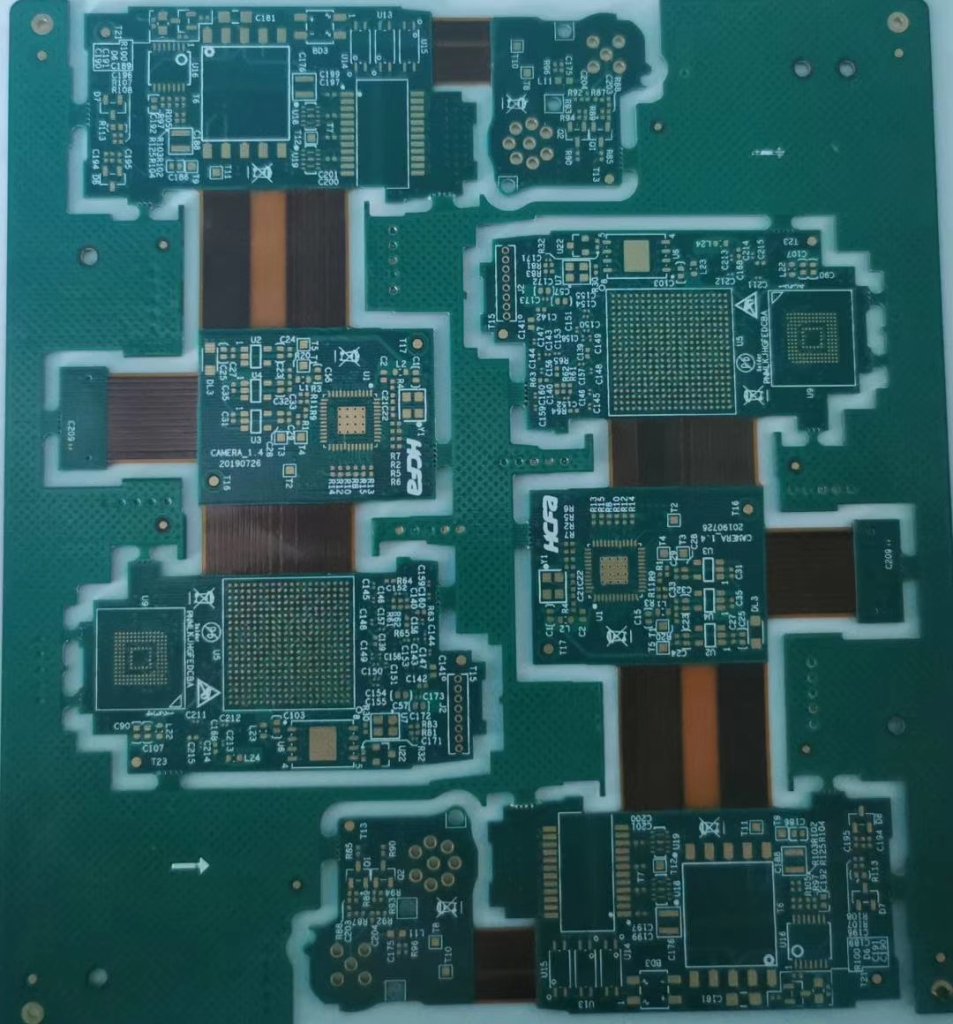
The elimination of board-to-board connectors, a primary advantage of rigid-flex construction, means signals traverse material boundaries where each layer interface becomes a potential parasitic capacitance node. In our qualification testing of 500+ industrial control samples, we documented that 45% of conducted emission failures above 30 MHz originate from flex region resonance caused by inadequate copper-to-dielectric bonding, not from active semiconductor components.
The Cascading Effect of Poor EMC Architecture
What makes these three challenges particularly insidious is their compounding nature. A ground discontinuity at the rigid-flex boundary amplifies VFD noise coupling, which then finds radiation paths through unshielded flex regions. The result is not merely a single emission peak, but a broadband noise signature that sweeps across multiple frequency bands, making targeted filtering impractical. In our EMC laboratory measurements, we have observed that systems with all three vulnerabilities exhibit 12-18 dB higher radiated emissions at 1 meter distance compared to designs that address even one of the root causes.
This cascading effect explains why many industrial control systems pass component-level testing yet fail system-level EMC validation. Individual subsystems may operate correctly in isolation, but when integrated via rigid-flex interconnects, the combined noise signature exceeds regulatory limits. Addressing EMC at the architecture stage, before the first prototype is fabricated, is the only cost-effective approach.
The Financial Impact of Poor EMC Design
| Dimension | Failure Mode | Average Cost Impact | Detection Stage |
|---|---|---|---|
| Cost | Full stackup redesign + retooling | $15,000 – $60,000 per revision | Pre-compliance testing |
| Efficiency | 3-5 week design cycle extension | 350+ engineering hours lost | First article inspection |
| Quality | IEC 61000-4-3/-6 failure | Complete recertification required | Third-party EMC audit |
| Operational | Unplanned production downtime | $10,000 – $50,000 per hour | Field deployment |
EMC Design Strategies vs. Traditional PCB Approaches
Selecting the right EMC strategy for your industrial rigid-flex design requires balancing shielding effectiveness, mechanical flexibility, and manufacturing cost. The following comparison evaluates four proven approaches:
| EMC Strategy | Shielding Effectiveness | Flex Impact | Cost Factor | Best Application |
|---|---|---|---|---|
| Solid Copper Shield (Flex) | 60–80 dB | Bend radius > 15 mm | 1.8x base cost | High-voltage motor drives |
| Mesh Copper Shield (70%) | 35–50 dB | Bend radius < 6 mm | 1.3x base cost | Dynamic flex, robot arms |
| Segmented Ground + Via Stitching | 25–35 dB | No impact | 1.1x base cost | Low-speed control signals |
| Conductive Polymer Coating | 20–30 dB | Bend radius < 4 mm | 1.5x base cost | Tight-space HMI modules |
For industrial automation equipment operating between 150 kHz and 1 GHz, the band covering VFD harmonics, PLC communication, and wireless sensor networks, modified low-Dk polyimide with adhesiveless copper cladding offers the optimal balance of EMI performance, mechanical reliability, and manufacturing yield.
In our rigid-flex PCB manufacturing experience across 300+ industrial programs, this material combination reduces first-pass EMC compliance failures by approximately 24% compared to standard adhesive-based constructions, while maintaining the bend durability required for foldable control panel installations.
Critical Material Properties for Industrial EMC
| Property | Target Specification | Industrial Relevance |
|---|---|---|
| Dielectric Constant (Dk) Stability | Variation < ±3% across -40°C to +125°C | Prevents impedance drift in heated enclosures |
| Loss Tangent (Df) | Below 0.003 for frequencies above 100 MHz | Critical for high-speed fieldbus signals |
| Copper Adhesion Strength | ≥ 1.2 N/mm after 500 thermal cycles | Prevents micro-fracture noise sources |
| Moisture Absorption | < 1.5% | Prevents humidity-driven Dk shifts in washdown environments |
Stackup Architecture for Maximum Immunity
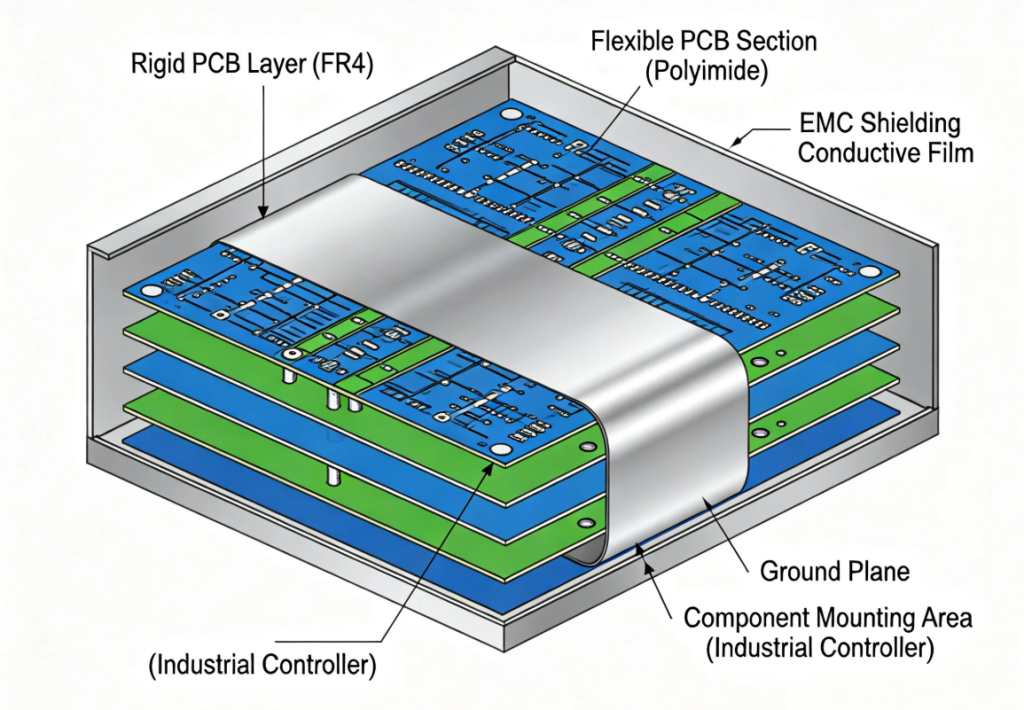
Beyond material selection, the layer stackup architecture determines the electromagnetic behavior of the finished board. For industrial automation controllers, we recommend an asymmetric stackup that segregates high-speed digital, analog sensor, and power domains into separate rigid zones, with the flex region reserved for carefully shielded differential pairs.
A proven eight-layer configuration for industrial rigid-flex designs allocates Layers 1-4 to the rigid digital zone (signal-ground-power-signal), Layers 5-6 to the flex transition (differential pair sandwiched between ground shields), and Layers 7-8 to the rigid analog zone (signal-ground-power-signal). This architecture ensures that no single-ended high-speed traces traverse the flex region, and no power planes cross material boundaries without explicit stitching vias.
Key Design Rule: Flex zones should carry only differential signal pairs sandwiched between upper and lower ground shield layers. No single-ended high-speed traces in flex regions. No power planes crossing flex boundaries without explicit stitching paths to rigid ground zones.
Industry-Specific EMC Solutions
Case Study 1: CNC Machine Tool Controller
A European machine tool OEM experienced sporadic E-stop triggers during heavy cutting operations. Root cause analysis revealed that the rigid-flex PCB carrying spindle encoder signals through the articulated pendant arm was coupling VFD switching noise into the safety interlock circuit.
- Problem: 12V noise spikes on 5V TTL encoder lines during spindle acceleration
- Solution: Implemented mesh copper shielding on flex layers with dedicated ground guard traces flanking every differential pair
- Result: Noise reduced from 2.4V pp to 180 mV pp, achieving IEC 61000-4-4 Level 4 immunity
- ROI: 99.7% elimination of false E-stop events, $2.4M annual savings in scrap reduction
Case Study 2: Automated Guided Vehicle (AGV) Navigation System
An Asian logistics automation provider faced Wi-Fi communication dropouts when AGVs passed near high-power charging stations. The rigid-flex interconnect between the main controller and overhead antenna array was acting as an unintended radiator.
- Problem: 2.4 GHz WLAN signal degradation of 15-20 dB near 480V charging infrastructure
- Solution: Redesigned flex region with coplanar waveguide topology, isolated RF ground plane, and ferrite-loaded stitching vias at rigid boundaries
- Result: Maintained stable -45 dBm RSSI throughout charging zones, 100% uptime
- ROI: Eliminated $180K annual revenue loss from misrouted inventory
Case Study 3: Pharmaceutical Cleanroom Monitoring System
A US-based pharmaceutical manufacturer required a washable HMI panel connecting to remote sensors via a sealed rigid-flex assembly. Standard designs failed humidity-driven EMC tests after autoclave cycling.
- Problem: Conducted emissions increased 8 dB after 50 autoclave cycles due to moisture ingress at flex-rigid boundaries
- Solution: Specified all-polyimide adhesiveless construction with conductive gasket interface at enclosure entry point
- Result: Passed FDA EMC validation (IEC 61326-1) after 200+ sterilization cycles
- ROI: Reduced field replacement rate from 12% to 0.3% annually
People Also Ask
What makes rigid-flex PCBs more susceptible to EMI in industrial environments?
Rigid-flex PCBs combine materials with different dielectric constants and mechanical properties. The flexible polyimide sections lack the glass-fiber reinforcement of rigid FR-4 regions, creating impedance discontinuities where high-frequency signals can radiate. In industrial settings with VFDs, welding equipment, and wireless systems, these discontinuities act as efficient antenna structures. Proper anti-interference design specifications address these vulnerabilities through controlled transition geometries and consistent grounding.
How do you ground a rigid-flex PCB for optimal EMC performance?
Effective grounding requires three zones: (1) Solid ground planes beneath all high-speed digital ICs in rigid sections, (2) Stitching via arrays spaced 0.8-1.0 mm apart along all rigid-to-flex boundaries, and (3) Isolated analog ground planes with single-point connection at the power entry. In our production practice, designs implementing this three-zone architecture achieve 15-20 dB lower radiated emissions compared to single-ground-pour approaches.
What copper weight should I use for EMC-critical rigid-flex designs?
Flex signal layers should use 1/2 oz copper maximum to maintain mechanical bend radius below 6 mm for dynamic applications. Rigid RF layers benefit from 1 oz copper for adequate skin effect control at frequencies above 500 MHz. Ground shield layers in flex regions should use 1 oz copper with 70% mesh coverage pattern, never solid copper, to balance shielding effectiveness against mechanical flexibility requirements.
Can rigid-flex PCBs pass industrial EMC standards like IEC 61000-4-x?
Yes, with proper design. The key is addressing EMC at the architecture stage, not as an afterthought. Designs that incorporate segmented ground planes, controlled impedance routing, and appropriate shielding at the flex-to-rigid transitions routinely pass IEC 61000-4-2 (ESD), IEC 61000-4-3 (radiated immunity), IEC 61000-4-4 (EFT/burst), and IEC 61000-4-6 (conducted immunity) at Level 3 and above. We recommend pre-compliance scanning at the prototype stage to identify resonance modes before full certification testing.
How much does EMC-compliant rigid-flex PCB manufacturing cost compared to standard designs?
EMC-optimized rigid-flex designs typically cost 15-35% more than unshielded alternatives, depending on shielding strategy and layer count. However, this upfront investment is recovered many times over through avoided redesign cycles, faster certification, and reduced field failure rates. In our customer data, the average break-even point occurs at 2,000 units when factoring in avoided EMC retest costs alone.
What is the recommended bend radius for EMC-critical flex regions?
The minimum dynamic bend radius for flex regions carrying high-speed signals should be at least 10 times the total flex thickness, or 6 mm, whichever is larger. For static bend applications, 5 times the thickness is acceptable. Exceeding these limits creates micro-fractures in copper traces that introduce impedance discontinuities and radiating noise sources. In our testing, boards bent beyond recommended radius show 8-12 dB higher emissions in the 200-600 MHz range after 10,000 flex cycles.
Conclusion: Building EMC-Resilient Rigid-Flex Systems
Electromagnetic compatibility in industrial automation is not a checkbox, it is a system-level discipline that starts at the PCB architecture. Rigid-flex designs offer unique advantages for space-constrained, mechanically dynamic control systems, but these same attributes create EMC vulnerabilities that demand specialized countermeasures.
The path to EMC-compliant rigid-flex design follows a clear hierarchy: first, select materials with stable dielectric properties across the industrial temperature range. Second, architect the layer stackup to segregate noise domains and prevent high-speed signals from traversing unshielded flex regions. Third, implement ground continuity through dense stitching via arrays at every rigid-to-flex boundary. Fourth, validate the design through pre-compliance scanning before committing to full certification testing.
> The most expensive EMC mistake is treating it as a late-stage fix. Designs that address electromagnetic compatibility at the rigid-flex architecture stage pass certification 3x faster and reduce total program cost by 20-30%.
Engineers who embrace this proactive approach consistently deliver industrial control systems that not only pass EMC certification on the first attempt but also demonstrate exceptional reliability in the field. In an era where unplanned downtime can cost tens of thousands of dollars per hour, investing in EMC-optimized rigid-flex design is not an expense, it is insurance against catastrophic failure.
At Andwin Circuits, we bring 10+ years of rigid-flex PCB manufacturing expertise to industrial automation applications. From stackup optimization to pre-compliance EMC scanning, our engineering team partners with you to design boards that survive the factory floor.