
Importance of impedance control
Impedance control is related to many factors, such as the characteristics of the PCB, where it is used, etc. If the PCB is designed for digital signals, it is generally differential impedance, which is different from the application of RF signals. However, in these two categories of applications, more subcategories can be subdivided for discussion.
Digital applications, especially high-speed digital applications, have high requirements for the size and consistency of impedance to ensure signal integrity.
To test the integrity of digital signals, methods such as eye diagrams, pulse distortion, bit error rate, slope, etc. are usually used. If the impedance of a key digital signal trace is not well controlled, it will often affect the production quality of the entire PCB.
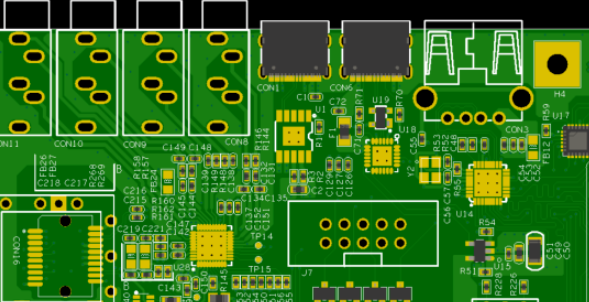
Usually, when a changing energy signal suddenly changes from a fixed impedance environment to other environments, a large number of reflected waves will be generated in the impedance transition zone. Similarly, a digital pulse signal, when switching from a 40 ohm impedance line to a 50 ohm impedance line, will also generate a large number of reflected signals in the transition zone. As a result, the amplitude and shape of the pulse will also change due to the presence of reflected waves. Then, the distortion of the pulse will affect the digital integrity of the high-speed digital signal system.
Another problem that impedance mismatch on PCB brings to digital systems is the existence of electromagnetic interference (EMI).
The reflected signal caused by impedance mismatch will generate electromagnetic radiation within a certain range of the impedance transition zone. The radiated energy will couple to adjacent traces or devices, which may cause their electrical performance to deteriorate.
Impedance matching in RF applications sometimes faces the same problem as high-speed digital applications.
In RF applications, it is often necessary to efficiently transfer energy from one module to another. For example, how to more efficiently transfer the energy generated by the transmitter in a wireless system to the antenna. If the impedance matching of the feeder from the transmitter to the antenna is not very good, part of the signal energy will be lost before the wireless signal is transmitted. If the transmitting port of the wireless system cannot work under appropriate conditions, it may cause the signal quality of the receiving end to deteriorate and shorten the communication distance.
There are many RF, microwave and millimeter wave R&D teams that have been committed to the research of impedance matching.
In addition to the above examples, power amplifiers, radars, low noise amplifiers, etc. are all within their research scope. In these fields, impedance matching has always been very important.
In power amplifier circuits, PCBs are divided into different functional areas.
Impedance matching is required in many areas, and the impedance value varies greatly from one area to another. The input impedance of the power amplifier itself is usually less than 10 ohms, while the impedance line of the PCB is 50 ohms. In order to ensure that energy is efficiently transferred from the 50 ohm area to the area less than 10 ohms, the purity of the input signal of the power amplifier is very important.
There are many types of impedance.
On PCB, the most commonly used is characteristic impedance. There are also input impedance, wave impedance, mirror impedance, etc. Most impedance problems are frequency response problems. This problem occurs more often in broadband power amplifiers. The impedance matching network required in power amplifier design is often only effective within a certain frequency range in actual use. In many cases, the frequency range of power amplifier components is wider than the effective frequency range of their input/output matching networks.
The impedance value of PCB traces is related to many variables.
The order of influence on impedance is as follows: substrate thickness, dielectric constant, line width and copper foil thickness. High-frequency circuit board materials made according to a fixed formula have strict thickness control, just like the control of dielectric constant.
The thickness of copper foil on the substrate also needs to be strictly controlled. However, please remember that in actual circuits, these thicknesses may vary slightly due to different PCB manufacturing technologies.
Some articles on this site are reprinted or posted by netizens for the purpose of conveying and sharing information. They do not mean that this website agrees with their views and is responsible for their authenticity; the copyright of the article belongs to the original author and the original source. If it involves the content of the work, copyright and other issues, we will correct or delete it as soon as possible according to the requirements of the copyright owner.