
Important characteristics of non-adhesive flexible board substrate
Flexible printed circuit board (FPC), also known as flexible board, has the advantages of softness, lightness, thinness and flexibility. With the rapid trend of information and electronic products towards lightness, thinness, shortness and smallness, it has been widely used in notebook computers, digital-related, mobile phones, liquid crystal displays and other uses.
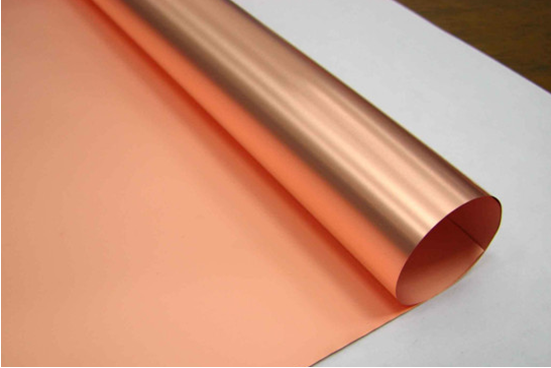
1.Traditional flexible board materials
Traditional flexible board materials are mainly based on the three-layer structure of PI film/adhesive/copper foil. The adhesive is mainly Epoxy/Acrylic, but the heat resistance and dimensional stability of the adhesive are poor. The long-term use temperature is limited to 100 200, which limits the field of three-layer adhesive flexible board substrate (3-Layer Flexible Copper Clad Laminate, 3-Layer FCCL). (A) Three-layer adhesive soft board base floating structure (B) Two-layer adhesive-free soft board substrate structure The newly developed adhesive-free soft board substrate (2-Layer FCCL) is composed only of PI film/copper foil. Because no adhesive is required, the product’s long-term use dependence and application range are increased.
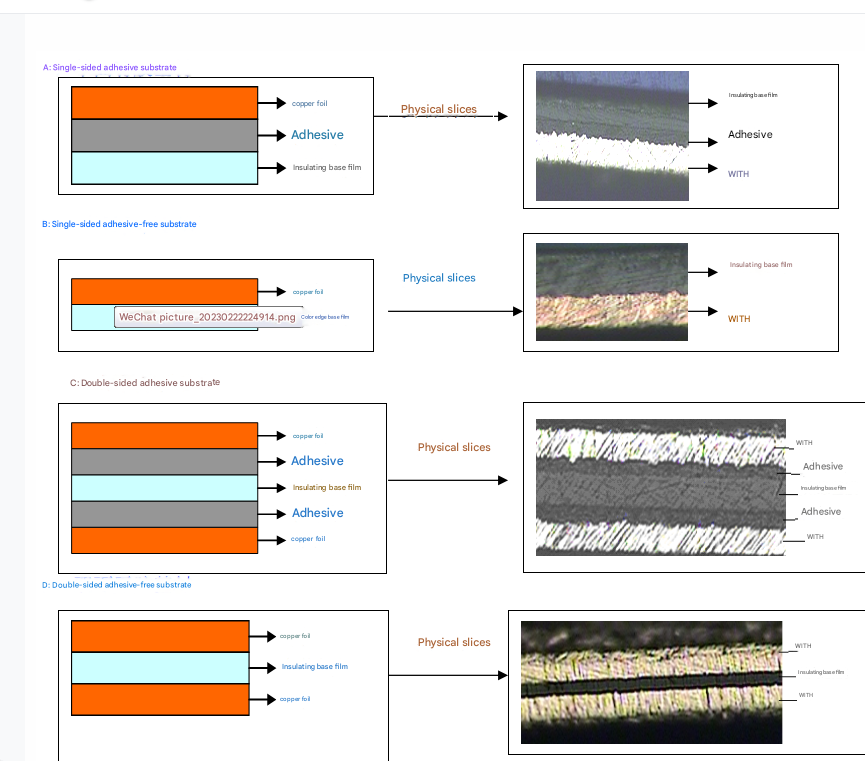
2.Important characteristics of adhesive-free soft board substrate
(1)Heat resistance
The adhesive-free soft board substrate has excellent heat resistance because it does not have a poor heat-resistant adhesive, and the long-term use temperature can reach more than 300 degrees. Figure 2 shows the relationship between the tear strength of the adhesive-free soft board substrate and the three-layer adhesive soft board substrate at a constant temperature of 200 degrees and time.
The results show that the tear strength of the adhesive-free soft board substrate changes very little at high temperature for a long time, while the tear strength of the three-layer adhesive soft board drops sharply at high temperature for a short time. Figure 3 shows the relationship between the tear strength of the non-glue soft board substrate and the three-layer glue soft board substrate and the temperature. The results show that when the temperature of the non-glue soft board substrate is greater than 120, the tear strength of the adhesive deteriorates sharply. Generally, when doing SMT welding on a soft board, the temperature is mostly over 300. In addition, the lamination process temperature in the production of rigid-flex boards is as high as 200, which is not suitable for three-layer glue soft board substrates.

(2)Dimensional stability
The dimensional change of the non-glue soft board substrate is quite little affected by temperature. Even at high temperature (below 300), the dimensional change rate is still within 0.1%; but the dimensional change rate of the three-layer glue soft board is greatly affected by temperature. Good dimensional stability will be of great help to the fine-line process. Today’s high-end electronic products such as LCD, PDP, COF substrates, etc. all emphasize fine lines, high density, high dimensional stability, high temperature resistance and reliability. Therefore, as information electronic products gradually develop towards the trend of being thin and short, non-adhesive flexible boards will become the mainstream of the market.
(3)Chemical resistance
The non-adhesive flexible board substrate has excellent resistance to chemicals, and the tear strength does not change significantly over a long period of time. However, the three-layer adhesive flexible board substrate has poor chemical resistance of the adhesive, and the tear strength decreases significantly over time.
Other characteristics of the non-adhesive flexible board substrate include reducing the thickness of the substrate, which is in line with the trend of being thin and short. In addition, because the residual amount of chloride ions after etching is low, the ion mobility is reduced, which also increases the long-term reliability of fine lines.
3.Manufacturing method of non-adhesive flexible board substrate
There are three methods for manufacturing non-adhesive flexible board substrate:
(1) Sputtering/electroplating: Using PI film as the substrate, a metal layer is plated on the PI film by vacuum sputtering (Sputtering), and then electroplating (Electroplating) is used to increase the copper thickness. The advantage of this method is that it can produce ultra-thin non-adhesive flexible board substrates, with a copper thickness of 3 12. In addition, it can also produce soft boards with different thicknesses on both sides.
(2) Coating method: Using copper foil as the substrate, the synthesized polyamic acid (Ployamic acid) is extruded and coated on the rolled copper foil with a precision die head. After oven drying and imidization (Imidization), the non-adhesive flexible board substrate is formed. The coating method is mostly used for single-sided flexible boards. If the copper thickness is less than 12, this method is not too late to manufacture and it is difficult to manufacture double-sided flexible board substrates.
(3) Hot pressing method: A thin layer of thermoplastic PI resin is first coated on the PI film as the substrate, which is first hardened at high temperature, and then the thermoplastic PI is re-melted under high temperature and high pressure. The thickness of the copper foil is also difficult to be less than 12.
Among the manufacturing methods of non-glue soft board substrates, the [sputtering/electroplating method] can best meet the ultra-thin requirements – the copper foil thickness is 3 12, but it still needs to overcome the problems of excessively high equipment investment and technology to achieve the mass production goal.
4. Application and market status
The non-glue soft board substrate will gradually replace the three-layer glue soft board substrate. For the market of high-end soft boards, taking the Japanese market as an example, the market size of non-glue soft board substrates has increased from 290,000 square meters in 1997 to 1.72 million square meters in 2000, a market size growth of nearly 6 times, and the market share will also increase from 3.4% to 16.8%. In addition, the EU will completely ban the import of products containing toxic substances such as halogen and lead in 2004. The glue-free flexible board substrate does not require the use of adhesives and does not need to use halogen-containing ignition agents. At the same time, it can meet the requirements of lead-free high-temperature processes, which is the best choice for the industry.
5. Conclusion
Information and communication products that emphasize portability and humanization have become the mainstream of the current market. China has become the world’s second largest notebook computer production base, and the communication market has taken off rapidly. Stimulated by other factors, the future trend of portable products is to be thin, short, high-functional, thin-line, and high-density. In the future, the market demand for ultra-thin glue-free flexible board substrates with a copper thickness of less than 5 will be very strong.