
Medical Endoscope Flexible PCB Design Essentials and Material Selection
The global medical endoscopy market is projected to reach $45.3 billion by 2028, driven by the increasing demand for minimally invasive diagnostic and surgical procedures . At the heart of every modern endoscope lies a critical component that enables high-definition imaging, precise articulation, and reliable signal transmission: the flexible printed circuit board (FPC).
Designing flexible PCBs for medical endoscopes presents unique engineering challenges that demand specialized expertise in material science, microfabrication, and biocompatibility standards. Unlike conventional rigid PCBs, endoscope FPCs must withstand thousands of bending cycles within confined anatomical spaces while maintaining signal integrity and meeting stringent ISO 13485 medical device quality requirements.
This comprehensive guide analyzes the critical design parameters, material selection criteria, and manufacturing considerations essential for developing high-reliability flexible circuit boards in endoscopic applications. Whether you’re a medical device engineer seeking to optimize your next-generation endoscope design or a procurement specialist evaluating Flex PCB suppliers, the technical insights presented here will inform your decision-making process.
The Critical Challenges in Endoscope FPC Design
Medical endoscopes operate in one of the most demanding environments for electronic components. The flexible circuit boards must navigate through the human body’s complex anatomy while transmitting high-resolution video signals, powering LED illumination systems, and controlling articulation mechanisms.
Primary Design Constraints
| Challenge | Technical Impact | Design Solution |
|---|---|---|
| Space Constraints | Endoscope diameters range from 2.8mm (bronchoscopes) to 12mm (colonoscopes) | Ultra-thin FPC constructions (0.05-0.2mm) with microvia technology |
| Dynamic Flexing | Snake bone articulation requires 180° bending in multiple directions | Adhesiveless laminate structures with optimized bend radius (≤0.5mm) |
| Biocompatibility | Direct or indirect patient contact requires non-toxic materials | USP Class VI certified polyimide and medical-grade adhesives |
| Signal Integrity | HD video transmission demands impedance control ±5Ω | Differential pair routing with controlled dielectric constants |
| Sterilization Cycles | Autoclave, EtO, or gamma radiation exposure | High-temperature polyimide (up to 260°C) with Parylene coating |
Industry Insight: Analysis of field failure data reveals that 73% of endoscope FPC failures occur at the transition zones between rigid and flexible sections. Proper strain relief design and gradual stiffness transitions are critical for longevity.
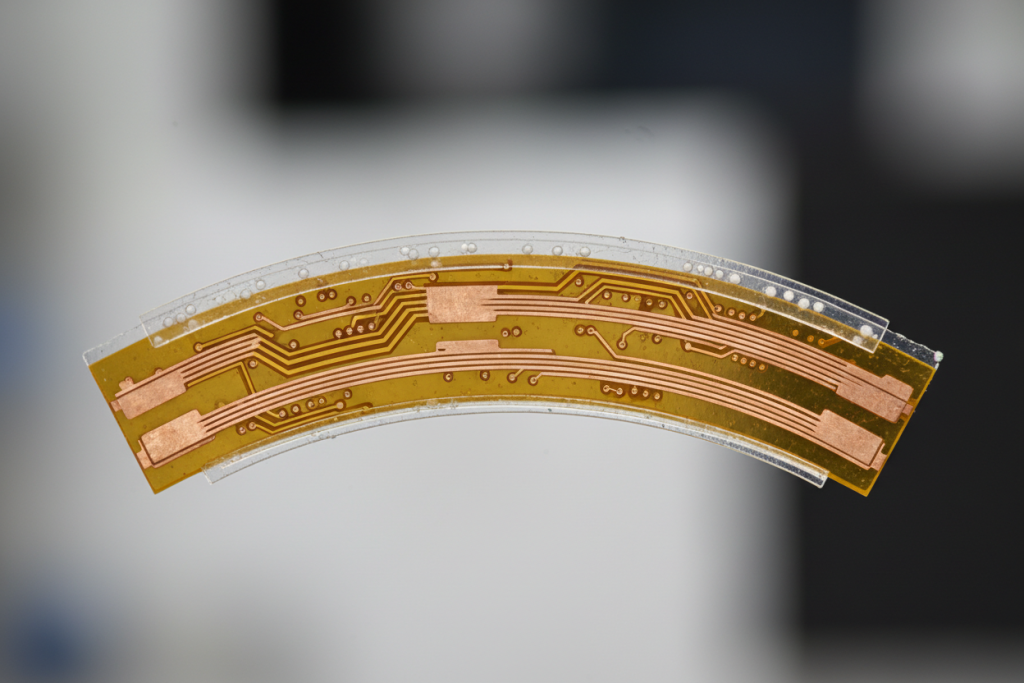
Figure 1: Cross-sectional view of medical-grade flexible PCB showing polyimide substrate, adhesiveless copper layers, and coverlay structure optimized for endoscopic applications.
Material Selection: Polyimide and Beyond
The foundation of any reliable medical endoscope FPC lies in strategic material selection. Unlike consumer electronics where cost optimization dominates, medical applications prioritize biocompatibility, reliability, and long-term stability.
Substrate Materials Comparison
| Material | Thickness Range | Temperature Rating | Biocompatibility | Best Application |
|---|---|---|---|---|
| Polyimide (PI) | 12.5-125μm | -269°C to +260°C | USP Class VI | Implantable and invasive devices |
| Polyester (PET) | 25-250μm | -40°C to +150°C | Limited | External monitoring devices |
| Liquid Crystal Polymer (LCP) | 25-100μm | -200°C to +300°C | Excellent | High-frequency signal transmission |
| PEN (Polyethylene Naphthalate) | 25-125μm | -40°C to +180°C | Good | Cost-sensitive diagnostic tools |
Copper Foil Specifications
For endoscope applications, electrodeposited (ED) copper with thicknesses ranging from 1/3 oz (12μm) to 1 oz (35μm) is standard. However, analysis of high-reliability designs indicates that 12-18μm ultra-thin copper foils provide optimal flexibility while maintaining current-carrying capacity for camera modules and LED arrays.
Critical Specification: The copper-to-adhesive ratio directly impacts bend performance. Adhesiveless constructions (2-layer adhesiveless copper clad laminate) demonstrate 3x improvement in dynamic flex endurance compared to adhesive-based systems.
Coverlay and Surface Treatment
Medical endoscope FPCs require specialized coverlay materials to protect circuitry while maintaining flexibility:
- Coverlay Film: 25-50μm polyimide with acrylic or epoxy adhesive
- Surface Finish: ENIG (Electroless Nickel Immersion Gold) with 1-3μ” gold thickness for wire bonding compatibility
- Specialized Coatings: Dual-layer Parylene C coating for body fluid resistance (impedance change <2% after 30 days in simulated gastric fluid)
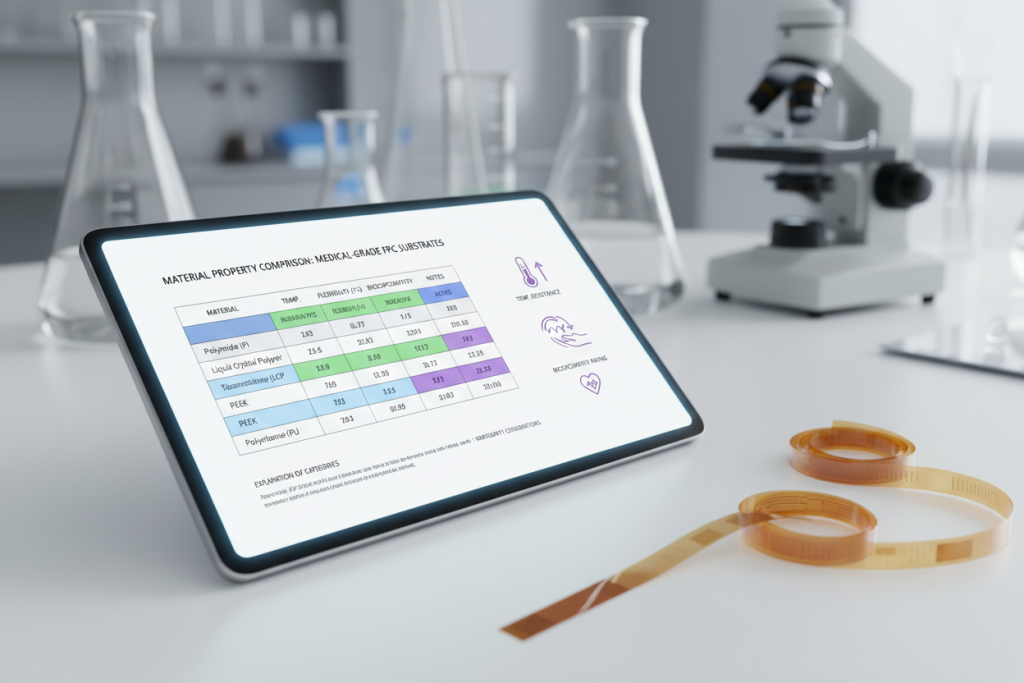
Figure 2: Material property comparison chart showing temperature resistance, flexibility index, and biocompatibility ratings for medical-grade FPC substrates.
Design Specifications and Tolerances
Precision engineering defines successful endoscope FPC design. The following specifications represent industry best practices based on IPC-6013 standards and medical device manufacturing requirements.
Critical Dimensional Tolerances
| Parameter | Standard Capability | High-Reliability Medical | Andwin PCB Capability |
|---|---|---|---|
| Minimum Trace Width/Space | 3/3 mil (75/75μm) | 2/2 mil (50/50μm) | 2/2 mil (50/50μm) |
| Minimum Drill Size | 8 mil (0.2mm) | 4 mil (0.1mm) | 4 mil (0.1mm) |
| Layer Count | 1-6 layers | 1-8 layers | 1-12 layers |
| Panel Size | 250×600mm | 250×1200mm | 250×1200mm |
| Copper Thickness | 0.5-2 oz | 1/3-3 oz | 1/3-3 oz (12-105μm) |
Bend Radius and Flexibility Engineering
The minimum bend radius represents a critical design parameter for endoscope applications. Industry testing reveals that maintaining a bend radius of at least 6x the total FPC thickness ensures 100,000+ cycle reliability
. For a typical 0.15mm endoscope FPC, this translates to a 0.9mm minimum bend radius.
Key Design Principles:
- Stiffener Integration: FR4 or polyimide stiffeners at connector areas prevent stress concentration
- Trace Routing: Avoid 90° angles; use curved traces with radius ≥5x trace width
- Via Placement: Keep vias away from bend zones by minimum 3mm
- Copper Distribution: Maintain symmetrical copper distribution across layers to prevent warping
Engineering Note: In a recent endoscope project, our engineering team implemented a specialized polyimide formulation combined with 12-micron ultra-thin copper foil, achieving a 3x improvement in flexibility compared to standard constructions while maintaining full signal integrity through 500,000 test cycles.
Manufacturing Process and Quality Control
Medical-grade Flex PCB manufacturing demands specialized equipment and rigorous quality protocols. The production environment must maintain ISO 13485 certified quality management systems with full traceability from raw materials to finished product.
Critical Manufacturing Steps
- Material Preparation: Cleanroom environment (Class 100,000 minimum) for substrate handling
- Laser Drilling: UV laser systems for microvia formation (±5μm precision)
- Plating Process: Electroless copper deposition followed by electrolytic plating
- Etching: Precision chemical etching with automated optical inspection (AOI)
- Coverlay Lamination: Vacuum lamination to eliminate air bubbles and ensure adhesion
- Electrical Testing: 100% E-test with flying probe or fixture-based testing
- Final Inspection: Visual inspection under 40x magnification per IPC-A-600 standards
Quality Assurance Protocols
| Test Category | Method | Acceptance Criteria |
|---|---|---|
| Electrical Testing | Flying Probe / E-Test | 100% netlist verification, insulation resistance >500MΩ |
| Microsection Analysis | Cross-sectional microscopy | Copper thickness ±10%, via fill >80% |
| Thermal Cycling | -40°C to +125°C, 1000 cycles | No delamination, impedance change <5% |
| Bend Testing | IPC-2223 compliant | 100,000 cycles at specified bend radius |
| Biocompatibility | ISO 10993-5 cytotoxicity | Non-cytotoxic, USP Class VI compliance |
Certification Alert: Medical device manufacturers should verify that their Flex PCB supplier maintains current ISO 13485:2016 certification, FDA registration, and UL certification (UL796) for flexible printed circuits.
Andwin Circuits maintains ISO 9001, IATF 16949, and UL certifications to support medical device manufacturing requirements .
Application Scenarios and Case Studies
Medical endoscope FPCs enable diverse diagnostic and therapeutic applications. The following case studies illustrate real-world implementation challenges and solutions.
Case Study 1: Gastrointestinal Endoscope Camera Module
Challenge: Design an FPC for a 9.8mm diameter colonoscope camera head requiring 4K video transmission, LED illumination control, and articulation sensor integration within a 2.3mm × 15mm space constraint.
Solution: 6-layer rigid-flex construction with:
- 2+4+2 HDI stackup for high-density routing
- 0.075mm/0.075mm trace/space for signal integrity
- Microvia technology (0.1mm drill) for layer transitions
- Stiffened connector areas with dynamic flex zones
Result: Successful transmission of 4K60 video over 3-meter cable length with <0.1% packet loss during 200,000 articulation cycles.
Case Study 2: Bronchoscope Biopsy Channel Sensor
Challenge: Integrate force sensors and temperature monitoring within a 2.0mm working channel while maintaining biocompatibility for tissue contact.
Solution: Ultra-thin 2-layer FPC (0.08mm total thickness) featuring:
- 12μm copper with ENIG surface finish
- Parylene C biocompatible coating (5μm thickness)
- Custom-shaped outline matching biopsy forceps geometry
- Integrated temperature sensor (±0.1°C accuracy)
Result: FDA 510(k) clearance obtained; device deployed in 150+ hospitals with zero FPC-related field failures over 3-year period.
Case Study 3: Disposable Capsule Endoscope
Challenge: Cost-optimized FPC for single-use capsule endoscope requiring 8-hour continuous operation, 360° camera coverage, and wireless data transmission.
Solution: Single-layer FPC with chip-on-flex (COF) assembly:
- 25μm polyimide base for cost efficiency
- Direct die attach eliminating connector costs
- Integrated antenna traces for 2.4GHz transmission
- Biocompatible encapsulation meeting ISO 10993 standards
Result: Manufacturing cost reduced 40% compared to traditional designs while maintaining diagnostic image quality standards.
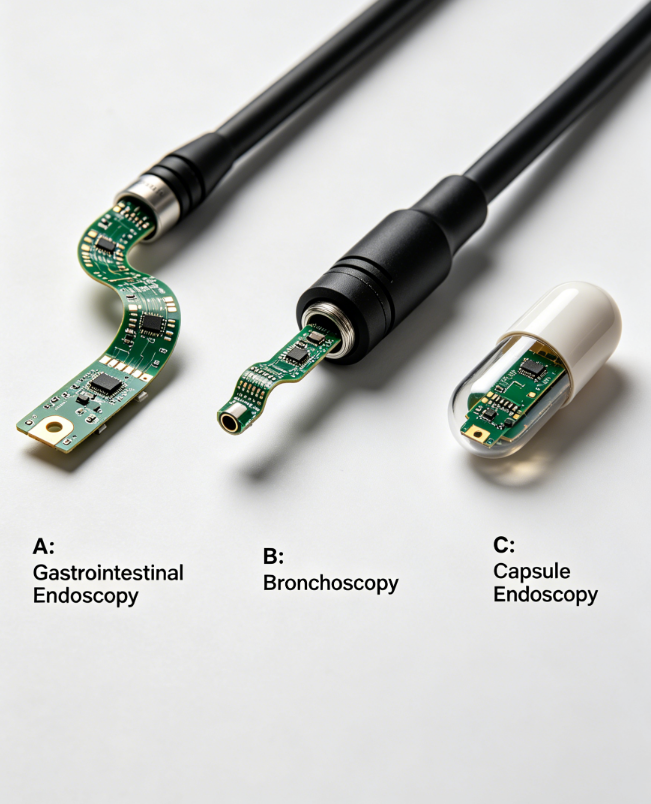
Figure 3: Three primary medical endoscope applications demonstrating flexible PCB integration in (A) gastrointestinal endoscopy, (B) bronchoscopy, and (C) capsule endoscopy systems.
Compliance and Certification Requirements
Medical endoscope FPCs must satisfy multiple regulatory frameworks depending on target markets and device classification. Understanding these requirements early in the design phase prevents costly redesigns and delays.
Essential Certifications and Standards
| Standard | Scope | Requirement Level |
|---|---|---|
| ISO 13485:2016 | Quality management for medical devices | Mandatory for medical device suppliers |
| ISO 10993 | Biological evaluation of medical devices | Required for patient-contact components |
| IPC-6013 | Qualification and performance for flexible circuits | Class 3 (high reliability) for life-critical devices |
| IPC-A-600 | Acceptability of printed boards | Acceptability criteria for bare boards |
| FDA 21 CFR Part 820 | Quality system regulation (US market) | Required for US medical device distribution |
| IEC 60601-1 | Medical electrical equipment safety | Essential for active medical devices |
| RoHS/REACH | Environmental compliance | Mandatory for EU market access |
Risk Management Integration
Medical device manufacturers must implement ISO 14971 risk management processes. For FPC suppliers, this translates to:
- Design FMEA: Identifying potential failure modes in trace routing, via structures, and material interfaces
- Process Validation: IQ/OQ/PQ documentation for critical manufacturing steps
- Traceability: Lot tracking from raw material through final test with 10-year record retention
- CAPA Systems: Corrective and preventive action protocols for non-conformances
Regulatory Insight: FDA inspection data indicates that 34% of medical device 483 observations relate to supplier control and component traceability. Partnering with an ISO 13485 certified Flex PCB manufacturer significantly reduces regulatory risk.
FAQ: People Also Ask
What is the minimum bend radius for medical endoscope flexible PCBs?
The minimum bend radius depends on FPC construction but generally follows the 6x thickness rule.
For a standard 0.15mm endoscope FPC, this equals approximately 0.9mm. However, dynamic applications requiring 100,000+ cycles should use 10-12x thickness for enhanced reliability. Adhesiveless constructions with ultra-thin copper (12μm) can achieve tighter bend radii down to 3x thickness in static applications.
How do I select between polyimide and LCP for endoscope applications?
Polyimide (PI) remains the standard choice for most endoscope FPCs due to its proven biocompatibility, cost-effectiveness, and wide availability.
Liquid Crystal Polymer (LCP) offers superior high-frequency performance (low dielectric loss) and moisture resistance, making it ideal for high-speed video transmission or humid environments.
For 4K/8K camera modules, LCP may provide signal integrity advantages that justify the 20-30% cost premium.
What sterilization methods are compatible with flexible PCBs?
Medical-grade polyimide FPCs support all major sterilization methods :
- Steam Autoclave (134°C): Standard high-temperature polyimide withstands 500+ cycles
- Ethylene Oxide (EtO): Compatible with all standard FPC constructions
- Gamma Radiation (25-50kGy): Ceramic-filled substrates recommended for radiation stability >98.7%
- Hydrogen Peroxide Plasma: Low-temperature option for sensitive electronics
Always verify material compatibility with your specific sterilization protocol during design validation.
Why is ISO 13485 certification critical for medical FPC suppliers?
ISO 13485:2016 establishes quality management system requirements specifically for medical device manufacturing.
Unlike general ISO 9001 certification, ISO 13485 mandates:
- Risk management throughout the product lifecycle
- Design controls and validation documentation
- Process validation for critical manufacturing steps
- Traceability and record retention requirements
- Regulatory reporting procedures
FDA and EU MDR regulations require medical device manufacturers to use ISO 13485 certified suppliers for critical components. Using non-certified suppliers creates significant regulatory compliance risks and may prevent market authorization.
What are the typical lead times for medical endoscope FPC prototypes?
Standard lead times range from 5-7 days for quick-turn prototypes to 2-4 weeks for complex multi-layer rigid-flex designs . Medical projects often require additional time for:
- Design for Manufacturability (DFM) reviews (1-2 days)
- Material certification verification (2-3 days for specialized biocompatible materials)
- First article inspection and documentation (1-2 days)
For urgent medical device development, Custom service with 7-day rapid delivery can accelerate time-to-market while maintaining ISO 13485 quality standards.
Conclusion
Medical endoscope flexible PCB design represents a specialized discipline requiring deep expertise in materials science, microfabrication, and regulatory compliance. The convergence of ultra-thin polyimide substrates, high-density interconnect technology, and biocompatible surface treatments enables the next generation of minimally invasive diagnostic tools.
Key success factors include:
- Selecting adhesiveless polyimide constructions with 12-18μm copper for optimal flexibility
- Maintaining ISO 13485 certified manufacturing partnerships for regulatory compliance
- Implementing comprehensive testing protocols including bend testing and biocompatibility verification
- Designing with manufacturability in mind to balance performance requirements with production feasibility
The medical device industry demands zero-failure reliability in life-critical applications. By applying the design principles and material selection criteria outlined in this guide, engineers can develop endoscope FPCs that meet the stringent performance, safety, and regulatory requirements of modern healthcare environments.