
Metal Core PCB Construction,Design key Points,and Consideration
Metal core PCBs aren’t very common in consumer products,but they are ubiqutious in industrial,aerospace,lighting systerms,power electronics and other fields requiring high reliability.High-power systems generate to prevent component failure. Similarly low-power systems may be exposed to high heat and also need to remove it quickly to prevent damage to the board and components.
Metal core PCB design(including design and maintenance)follows many of the same basic design rules an typical PCBs built on FR4.If you’re designing a new product in any of these field,you may need to use a metal core board to control temperature .This article will briefly explain the construction of metal core PCBs and some important design points to consider before planning a metal core PCBs and some important design points to consider before planning a metal core pcb design.These boards have unique manufacturing requirement,but the right design company can help address these requirements and ensure the pcbs can be mass-produced.
Application of Metal Core PCB design
Metal core PCBs find a place in nearly any application where a device generates significant heat during operation.These boards are not an ideal alternative to ceramics,as they are not an ideal alternative to ceramics ,as they are a lower-cost option and offer higher thermal conductivity,removing heat from critical component.Metal core PCBs are often a starting point when looking for circuit boards for systerm point when looking for circuit board for systerm with high thermal requirements. Some applications for metal core PCBs include:
LED lighting units:Board featuring high-power LEDs are often fabricated on metal core PCBs.These boards provide a sturdy base for high-power LEDs(both SMD and through-hole)while dissopating high heat into the metal core board.
Power conversion and management:Hybrid vehicles,industrial equipment,base station telecommunications equipment,and municipal power distribution systems all operate at high power.Metal core PCBs are common in these areas.
Solar energy equipment:Solar energy equipment needs to be particularly robust and operates at high temperatures and high DC voltages/currents.Similar PCB designs can be implemented in geothermal facilities.
Military applications(eg,submersibles,aircraft):Metal core PCBs can quickly dissipate heat,keeping electronics away from electronics that may be located near high heat sources such as engines or exhaust systems.
High reliability and structural rigidity are also crucial in many other areas,making metal core board an excellent choice.Once you begin to examine the stackup and layout requirements for these board,how to actually design them becomes less obvious.Is it possible to create multi-layer metal core boards?Can it be double-sided?How are via handled during manufacturing?These are important questions related to the Design for Metal core PCBs(DFM).
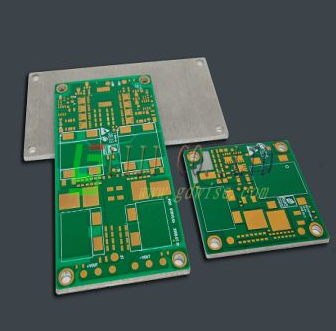
DFM for Metal Core PCBs
As with other PCBs,specific DFM guidelines need to be followed to ensure a successful manufacturing run,Metal core boards utilize a different process than typical PCB stackups involving glass-woven laminate,so they tend to be subject to different DFM rules.The figure below shows a typical stackup for a double sided metal core PCB.
Metal core PCB Structure,Design key Points,and consideration
Note that this stackup can technically be adapted to multilayers board,with multiple dielectrics on each side of the metal core.Alternatively,you can make the board single-sided leaving the backside of the metal core exposed.The following are manufacturing key points to consider when designing for metal core PCBs:
Metal Core Grounding
The metal backing on a PCB can act like a large groud plane or heat sink.If the board requires high-speed/high-frequency circuit blocks,using the backside metal plate as a larger ground plane is used on the board,it can also provide some in-plane capacotance.
Furthermore.metal cores can act as large heat sink.helping to reduce surface tempertatures.
Furthermore, metal cores can act as large heat sinks, especially if exposed. This latter aspect is particularly useful when the board needs to be mounted near a high heat source. In this case, it’s best not to ground the backside while connecting the top side to a standard power supply. This prevents ground loops. This also dissipates heat directly to a very large heat sink, helping to reduce surface temperatures.
Hole in Single-Sided Boards
Hole in metal core PCBs can be placed either as mounting holes or as standard through-holes on double-sided boards. If the holes are used solely for mounting through-hole components on a single-sided board, they should not be plated to prevent short circuits. This is accomplished by drilling through the mounting holes and filling them with a non-conductive epoxy or gel. The holes are then plugged to allow mounting on the upper layer.
Hole in Double-Sided Boards
In double-sided metal core PCBs, components may be mounted on both sides, requiring plated vias between signal layers. Plated through-holes are formed by a process of pre-drilling, insulating filler, re-drilling, and plating, which can present some manufacturing challenges. This process takes extra time and incurs additional costs, but it’s designed to prevent via shorts. In PCB layout, it’s best to use solder mask pads to indicate the area around vias that requires insulating filler material. Ensure the dimensions of the via solder mask are adjusted to adhere to IPC-2221 standards.
Other aspects of design and function management (DFM) for metal core PCBs differ little from those for standard PCBs, although CAD tools aren’t designed for these boards. Power electronics front-ends require adherence to some minor regulations, particularly IPC-2221 (creepage and clearance rules), as well as other defense and aerospace standards.