
Skip to content
Andwin Circuits
  • Home
  • ProductsExpand
    • HDI multilayer PCB
    • Rigid Flex PCB
    • Flex pcb
    • Special PCBExpand
      • High Frequency PCBExpand
        • Rogers RO4350B PCB
        • Rogers RO4003 pcb
        • Rogers RO3003 PCB
        • Rogers 5880 PCB
        • DICLAD 527 PCB
        • Taconic TLX series
        • Taconic TLX-8 RF PCB
        • Taconic TLX-9 RF PCB
      • High speed pcbExpand
        • Megtron 6 High Speed PCB
        • TU-872 SLK Sp High Speed
      • High TG PCBExpand
        • SHENGYI SH260 PCB
        • ISOLA 370HR PCB
        • ISOLA IS410 PCB
        • ISOLA IS420 PCB
      • Heavy copper PCB
      • Copper coin pcb
      • Copper inlay PCB
    • Metal Core PCBExpand
      • Copper core pcb
      • Aluminum PCB
      • 2 Layers Aluminum PCB
      • Direct thermal MCPCB
      • 2 Layers Direct Thermal
    • Ceramic PCBExpand
      • DPC ceramic PCB
      • DBC ceramic PCB
      • Thick film Ceramic PCB
      • Al2O3 Alumina PCB
      • AIN ALN ceramic PCB
      • IGBT Ceramic PCB
  • ServiceExpand
    • PCB Assembly
    • Quick turn PCB assembly
    • PCBA conformal coating
  • IndustryExpand
    • Telecommunication
    • IoT and Wireless
    • Industrial Control
    • Thermal management
    • Power and Energy
    • IC test board
    • Automative
    • Medical
  • CapabilityExpand
    • Rigid PCB
    • Rigid flex PCB
    • Metal core PCB
    • PCB Assembly
  • TechnologyExpand
    • Blogs
    • Via in pad
    • PCB E-test
    • PCB stack up
    • MCPCB panelization
    • Controlled impedance PCB
  • AboutExpand
    • About us
    • Certification
    • Factory Tour
  • Contact
Andwin Circuits
Home / Smaller is not better in precision resistor applications

Smaller is not better in precision resistor applications

ByGrace January 9, 2025January 9, 2025

Today’s trend towards smaller devices requires smaller precision resistors that can support higher power densities. This often means that surface mount chip resistors should be used whenever possible. Or is it? SMT technology is not perfect.

Smaller sometimes means hotter

Due to power density, surface mount chip resistors operate hotter than through-hole devices. Surface mount (SMT) devices dissipate most of their heat through the PCB, while through-hole devices dissipate most of their heat into the surrounding air. Therefore, the heat accumulation caused by surface mount components in the system will affect all other devices on the board. Due to this excess heat, the long-term stability of resistors will decrease when operating at higher temperatures.

Smaller can mean more fragile and harder to clean

SMT components can also cause structural problems. When the chip’s length-to-width ratio (or aspect ratio) exceeds the reliability limit (usually around 2:1), board bending stress can cause the chip to break or detach from the board. Increasing the chip width to keep it within the 2:1 aspect ratio range is not a suitable solution and does nothing to relieve stress. Simply increasing the chip width makes it more difficult to remove solvent and rosin from underneath the chip after assembly.

Resistors specifically designed to provide higher resistance, higher power, tighter tolerances, and better long-term stability while using less board space and making solvent and rosin easier to clean—such as precision resistors configured as molded rectangular frames or metal sealed cans—are often the best choice, especially in high-precision applications. These resistors have through-hole leads extending from the bottom surface.
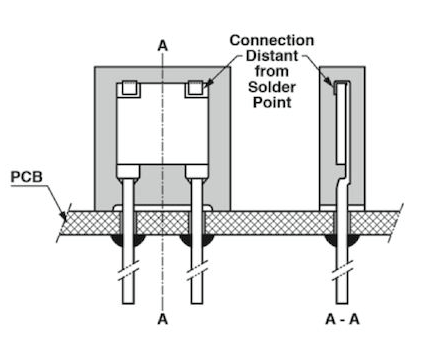
Figure 1: Through-hole components can achieve better stability because they are not subject to thermomechanical stress from the PCB.

This approach minimizes the required board space and includes support structures that can reliably clean bottom debris.

In some cases, SMT may be the only option for a design. In this case, we strongly recommend using surface-mount devices with flexible terminals.
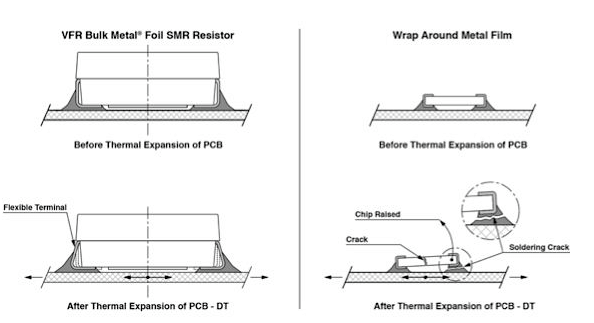
Figure 2: Surface-mount precision resistors with flexible terminals after thermal expansion or PCB flexure.

Small may mean too close


As we push further into device miniaturization, tightly packed boards are not always a good idea in precision applications. For example, if the surface of the resistor component is mounted parallel to the PCB, microphonic noise may result. This parasitic effect is caused by vibrations, which can generate stray signals like the diaphragm in a microphone system. Horizontally arranged resistor components can generate microphonic noise due to physical vibrations or even strong acoustic effects. Microphonic noise is also a reason to avoid using SMT feedback components. A better choice is vertically arranged through-hole devices, whose pin configuration absorbs flexure deformation on the PCB surface.


Summary

The use of surface-mount chip resistors is so popular in modern electronic design that they are often considered a universal method for all design and assembly processes. But in many applications, through-hole technology can provide unique performance and reliability advantages over surface-mount chips.

Contact us for PCB quote now |
Post Tags: #aluminum clad pcb#aluminum core pcb#aluminum core pcb led#aluminum pcb

Post navigation

Previous Previous
Six Tips for Selecting PCB Components
NextContinue
FinFETs drive smarter physical IP choices

Search

Search

Products

  • HDI Multilayer PCB
  • Rigid Flex PCB
  • Flex pcb
  • High Frequency PCB
  • High speed pcb
  • Heavy copper PCB
  • Metal Core PCB
  • Ceramic PCB

Address

Andwin Circuits Co.,Limited
Email: sales@andwinpcb.com
Tel: +86 755 2832 9394
Fax:+86 755 2992  6717
ADD:1-2F-1217,HouDeQun Industrial park,
NanTing RD NO.56,ShaJing,BaoAn,Shenzhen 518104,GuangDong,China

Products

  • HDI Multilayer PCB
  • Rigid Flex PCB
  • Flex pcb
  • High Frequency PCB
  • High speed pcb
  • Heavy copper PCB
  • Metal Core PCB
  • Ceramic PCB

Technology

  • Blogs
  • Via in pad
  • PCB E-test
  • PCB stack up
  • Metal core PCB panelization
  • Controlled impedance PCB

CERTIFICATION

Certification >>


Copyright© 2003 - 2026 Andwin | All Rights Reserved | Powered by Andwin

Scroll to top
  • Home
  • Products
    • HDI multilayer PCB
    • Rigid Flex PCB
    • Flex pcb
    • Special PCB
      • High Frequency PCB
        • Rogers RO4350B PCB
        • Rogers RO4003 pcb
        • Rogers RO3003 PCB
        • Rogers 5880 PCB
        • DICLAD 527 PCB
        • Taconic TLX series
        • Taconic TLX-8 RF PCB
        • Taconic TLX-9 RF PCB
      • High speed pcb
        • Megtron 6 High Speed PCB
        • TU-872 SLK Sp High Speed
      • High TG PCB
        • SHENGYI SH260 PCB
        • ISOLA 370HR PCB
        • ISOLA IS410 PCB
        • ISOLA IS420 PCB
      • Heavy copper PCB
      • Copper coin pcb
      • Copper inlay PCB
    • Metal Core PCB
      • Copper core pcb
      • Aluminum PCB
      • 2 Layers Aluminum PCB
      • Direct thermal MCPCB
      • 2 Layers Direct Thermal
    • Ceramic PCB
      • DPC ceramic PCB
      • DBC ceramic PCB
      • Thick film Ceramic PCB
      • Al2O3 Alumina PCB
      • AIN ALN ceramic PCB
      • IGBT Ceramic PCB
  • Service
    • PCB Assembly
    • Quick turn PCB assembly
    • PCBA conformal coating
  • Industry
    • Telecommunication
    • IoT and Wireless
    • Industrial Control
    • Thermal management
    • Power and Energy
    • IC test board
    • Automative
    • Medical
  • Capability
    • Rigid PCB
    • Rigid flex PCB
    • Metal core PCB
    • PCB Assembly
  • Technology
    • Blogs
    • Via in pad
    • PCB E-test
    • PCB stack up
    • MCPCB panelization
    • Controlled impedance PCB
  • About
    • About us
    • Certification
    • Factory Tour
  • Contact
Search