
Turnkey PCB Assembly vs Consigned Assembly: Cost and Logistics Comparison
When launching a new electronics product, the assembly model you select determines more than just your quoted price per board. It shapes your timeline, resource allocation, and exposure to supply-chain risk. Two models dominate: turnkey, where the assembler sources all components, and consigned, where you purchase and ship parts yourself. The core trade-off isn’t about which looks cheaper on paper—it’s about which model carries hidden costs you’ll actually pay.
What Defines Each Model
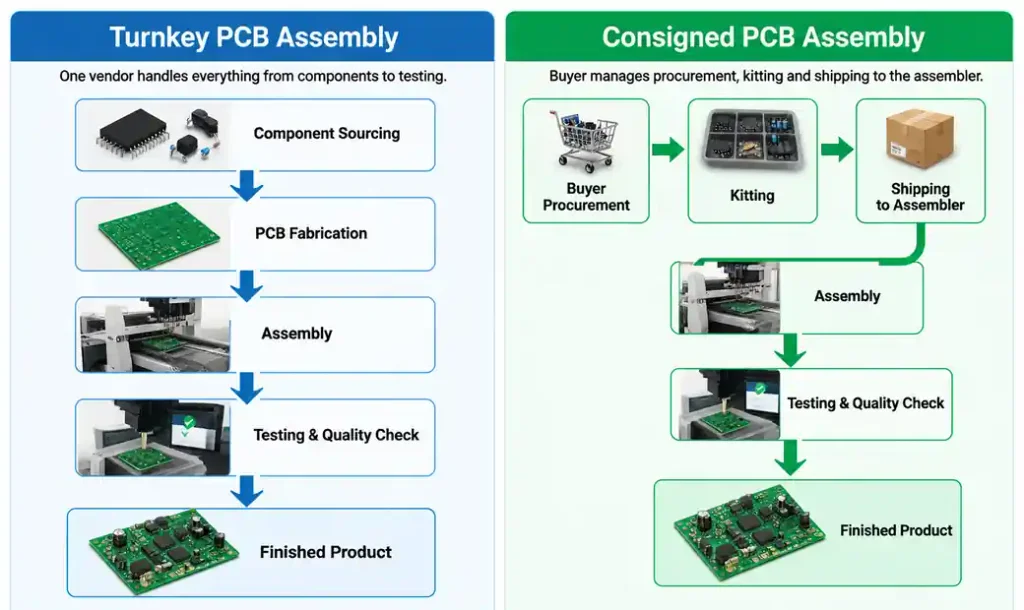
In turnkey PCB assembly, you hand over your Gerber files, bill of materials (BOM), and assembly instructions to a single contract manufacturer. That partner procures every resistor, IC, and connector listed on your BOM, fabricates the bare boards, assembles the components, tests the final units, and ships completed assemblies to your door. You place one purchase order and track one delivery.
In consigned assembly (sometimes called kitted or partial turnkey), you act as the procurement arm. You source components from distributors, consolidate them in your warehouse, kit each line item per board, and ship everything to the assembler. The assembler quotes only labor—placement, reflow, inspection, and test—and invoices for those services alone.
The Real Cost Structure: What Each Model Actually Charges
Turnkey Pricing Components
A turnkey quote bundles five elements into one unit price:
- Component cost — Manufacturer pricing plus a markup, typically 5-15% over distributor cost for high-volume parts
- PCB fabrication — Bare board production, already integrated
- Assembly labor — SMT placement, through-hole insertion, reflow, wave soldering
- Testing and inspection — AOI, ICT, functional testing as specified
- Logistics — Inbound freight from component suppliers to the CM, internal handling, outbound freight to your facility
The per-unit price often looks higher because all those line items roll into the quote. But you’re paying once, to one vendor, and you see the total picture.
Consigned Pricing Components
A consigned quote shows three explicit charges:
- Assembly labor — Same SMT, through-hole, and reflow work as turnkey
- Kit checking and setup — Receiving, counting, and staging your components
- Testing and inspection — AOI, ICT, functional testing as specified
What the quote does not show are the costs you absorb upstream:
- Component purchasing — You negotiate with distributors, place individual POs for 50+ line items, track lead times, and manage minimum order quantities (MOQs)
- Inbound freight — Every distributor ships separately; consolidation is on you
- Warehousing — You hold inventory until kitting day
- Kitting labor — Your team or a third-party kitting house counts, bags, and labels parts per board
- Shortage and substitution handling — When a part arrives damaged or on allocation, you source the replacement and notify the CM
- Counterfeit risk — You own component authentication unless you’re buying exclusively from franchised distributors
Cost Comparison: Direct and Indirect Spend
| Cost Element | Turnkey | Consigned |
|---|---|---|
| Component purchasing | Included in quote | Buyer’s time + PO processing |
| Inbound logistics | Included in quote | Multiple freight invoices |
| Warehousing & kitting | Included in quote | Internal labor or kitting service |
| Assembly labor | $$ | $ (appears lower) |
| Risk of shortage delays | Shared with CM | Buyer absorbs |
| Total landed cost | Higher per-unit quote | Lower quote + hidden overhead |
On a 100-piece prototype run with 80 unique part numbers, consigned may quote $25 per board for labor alone, while turnkey quotes $42 per board all-in. The $17 difference isn’t pure savings—it’s your procurement overhead, freight consolidation, and schedule risk transferred off the quote and onto your internal P&L.
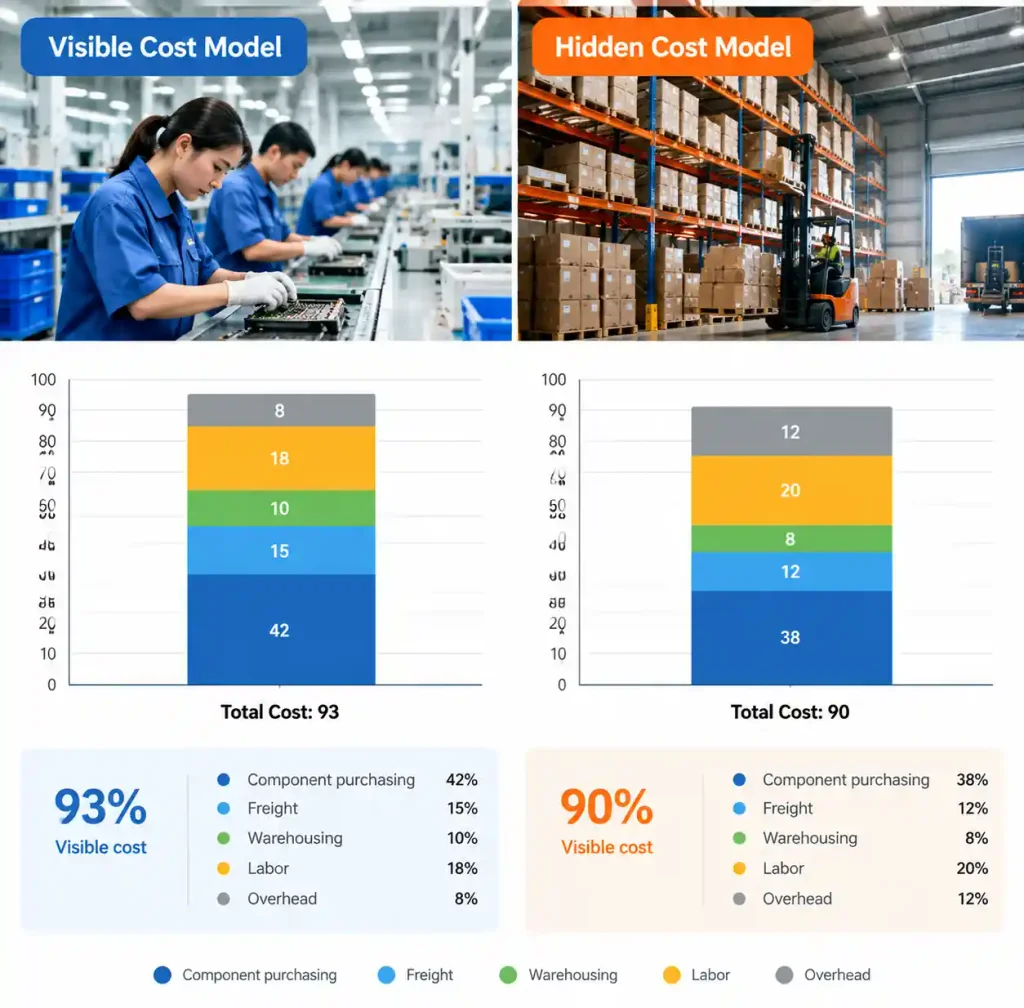
For an engineering team without dedicated procurement staff, that $17 often costs $30+ in fully loaded time once you account for the hours spent chasing distributors, reconciling shipments, and managing kit shortages. The turnkey quote may be the lower total cost of ownership.
Logistics and Lead Time: What Actually Delays Your Build
Turnkey Logistics Flow
- BOM submission — You upload your design files and BOM
- Component sourcing — CM places orders with its distributors (often with better pricing due to volume agreements)
- Inbound consolidation — All parts arrive at the CM’s dock on the CM’s schedule
- Assembly starts when kits are complete — No waiting for your team to deliver missing parts
- Outbound shipment — Finished boards ship directly to you
Lead time: 10-15 business days for prototype quantities, assuming standard components in stock. The CM owns the critical path.
Consigned Logistics Flow
- BOM analysis — You source every line item, chase lead times, negotiate MOQs
- Staggered inbound deliveries — Distributors ship on their own schedules; you wait for the last part to close the kit
- Kitting — Your team or a kitting house counts, bags, labels, and boxes everything
- Freight to CM — You ship the complete kit; any shortage discovered at CM receiving triggers a second shipment
- Assembly starts after kit inspection — CM won’t begin until every line item is verified
- Outbound shipment — Finished boards ship to you
Lead time: 15-25+ business days for the same prototype run. The critical path now includes your procurement cycle, distributor lead times, and kit consolidation. A single allocated capacitor can push delivery by two weeks.
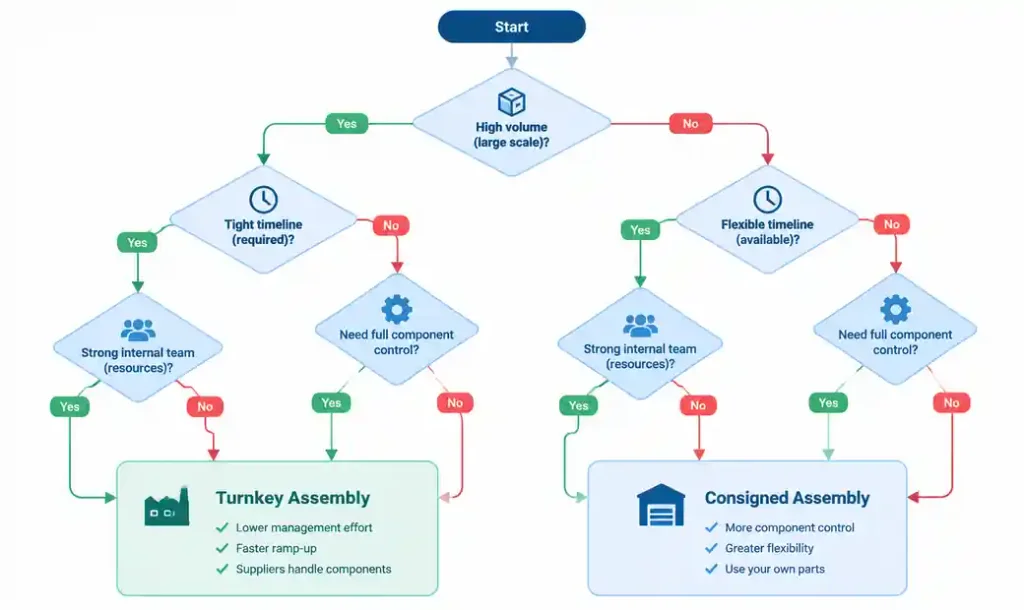
When Consigned Makes Sense
Consigned assembly isn’t inherently worse—it’s optimized for scenarios where you need control or already have infrastructure:
- Proprietary or allocated components — If you’ve secured parts through a strategic supplier relationship or direct fab allocation, consigned lets you use those parts without transferring ownership
- Existing inventory — You’re sitting on $50K of components from a previous build and want to consume that stock
- Recurring production with stable BOMs — Once your BOM is frozen and you’ve negotiated blanket POs, consigned can streamline reorders
- Price-sensitive, high-volume runs — At 10,000+ units, your buying power may exceed the CM’s, and you can pass those savings through

When Turnkey Delivers Better Total Cost
Turnkey shines in development and low-to-medium volume scenarios:
- Prototype and NPI builds — You’re iterating quickly; handing off procurement lets your engineers focus on design validation rather than chasing MOQs
- No dedicated procurement team — Outsourcing component sourcing to specialists who buy in volume and have established distributor relationships
- Tight timelines — The CM’s parallel sourcing and consolidated logistics compress lead time
- Counterfeit risk mitigation — Reputable CMs have supplier qualification programs and incoming inspection processes you’d otherwise build internally
Hidden Cost Factors That Shift the Calculus
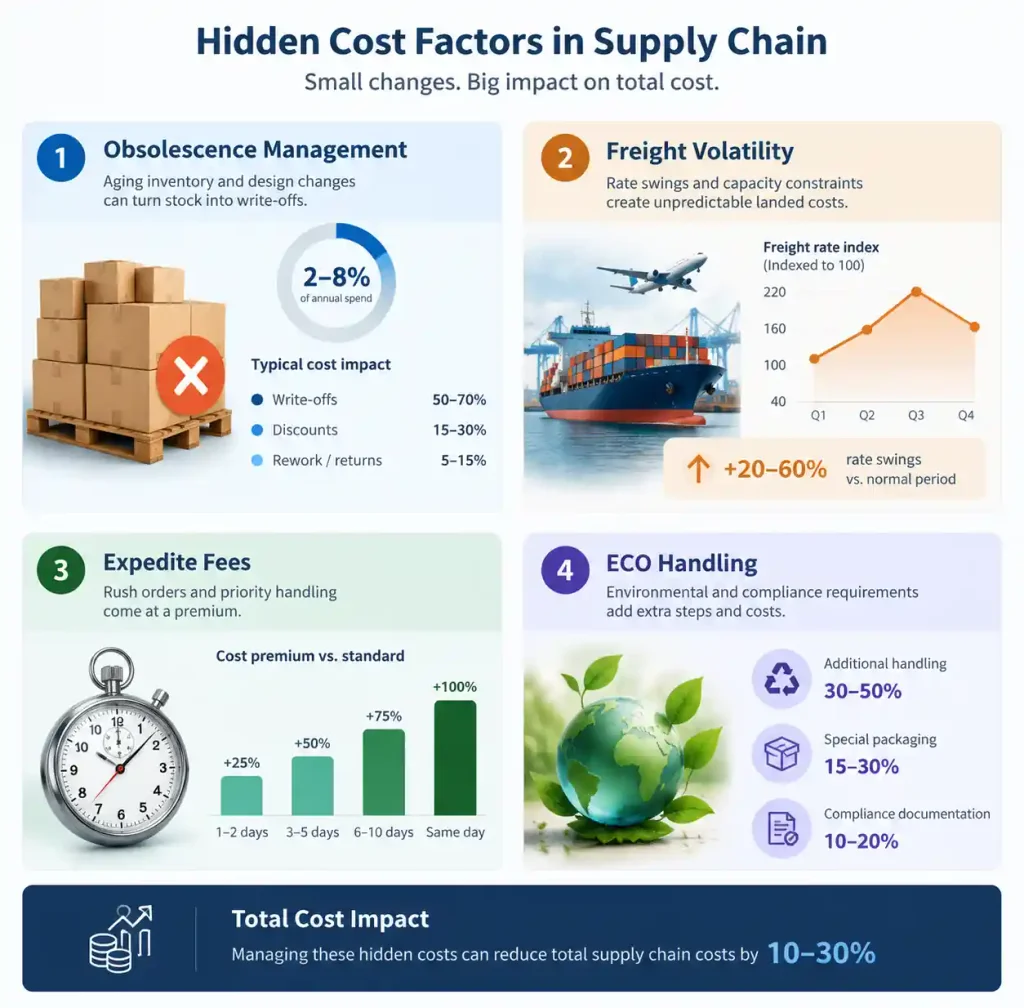
| Factor | Impact on Turnkey | Impact on Consigned |
|---|---|---|
| Component obsolescence | CM absorbs redesign risk on long-tail builds | You handle obsolescence notices and find substitutes |
| Freight cost volatility | CM’s logistics team hedges or absorbs spikes | You pay spot rates on every shipment |
| Shortage-driven expedite fees | CM negotiates or eats the cost to keep your delivery on track | You pay distributor expedite fees and rush freight |
| Engineering change orders (ECOs) | CM updates BOM and resources in one step | You reorder, re-kit, and reship affected parts |
The Supply Chain Reality in 2025-2026
The electronics supply chain stabilized after the 2021-2023 allocation crisis, but procurement risk hasn’t disappeared. Lead times for power management ICs and automotive-grade components still stretch 16-26 weeks. Counterfeit components circulate in gray-market channels—87% of procurement professionals view counterfeits as a major concern, and 88% estimate a single counterfeit incident costs $100K+ in rework, delays, and requalification.
Turnkey mitigates that exposure by shifting authentication and incoming inspection to the CM. Established manufacturers like Andwin Circuits maintain approved vendor lists (AVLs), perform X-ray and decapsulation testing on suspect parts, and carry insurance for supply-chain failures. You’re paying for that risk management in the unit price.
Consigned leaves authentication entirely in your hands unless you’re buying exclusively from franchised distributors. Independent distributors and brokers can deliver allocated parts faster, but without robust incoming inspection, you’re rolling the dice.

Case Study: 500-Unit Production Run
An IoT device manufacturer needed 500 production units with a 78-part BOM including a microcontroller on extended lead time. Two quotes came back:
Turnkey: $68 per board × 500 = $34,000, 18-day lead time
Consigned: $41 per board × 500 = $20,500 labor + $8,200 component cost + $1,100 freight + 40 hours internal procurement labor (loaded cost $3,200) + $800 kitting service = $33,800, 26-day lead time
The $200 cost difference disappeared when the team factored in eight extra calendar days to market and the engineering time diverted from product validation to procurement follow-up. They selected turnkey and launched on schedule.
Logistics Comparison Table
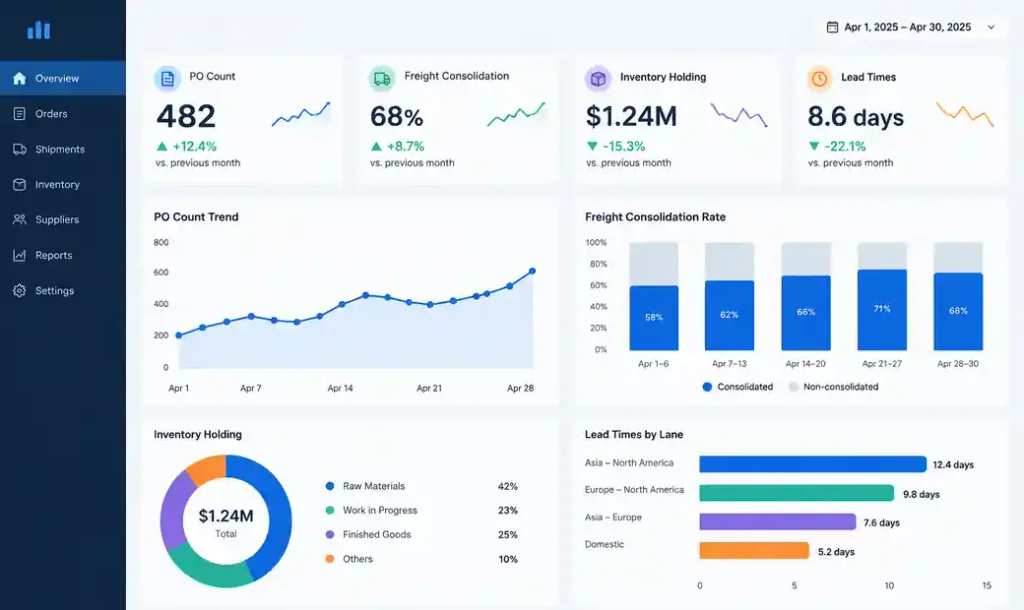
| Logistics Element | Turnkey | Consigned |
|---|---|---|
| Number of purchase orders | 1 | 8-50+ (depending on BOM) |
| Freight consolidation | CM handles | Buyer coordinates |
| Inventory holding cost | Zero (CM warehouses) | Buyer’s warehouse or 3PL |
| Kit shortage resolution | CM sources replacement | Buyer reorders and reships |
| Lead time (prototype, 50-100 units) | 10-15 days | 15-25+ days |
| Lead time (production, 1,000+ units) | 15-20 days | 20-30+ days |
What Internal Teams Should Track
When evaluating total cost of ownership, measure these metrics across three builds:
- Fully loaded procurement time — Engineer and buyer hours spent on component sourcing, PO management, and shortage resolution
- Freight invoice count — Number of inbound shipments you coordinate and pay for separately
- Schedule variance — Delta between planned assembly start date and actual start date due to kit delays
- Counterfeit or quality escapes — Number of suspect parts flagged during assembly or post-delivery testing
If your fully loaded procurement time exceeds 30 hours per build and schedule variance averages 5+ days, turnkey is likely cheaper than your consigned quote suggests.
FAQ
How much does turnkey assembly markup components?
Reputable CMs mark up components 5-15% over distributor cost. You’re paying for procurement labor, supplier qualification, and incoming inspection. On high-volume builds, that markup shrinks as the CM’s buying power increases.
Can I supply some components and have the CM source the rest?
Yes—this is called partial turnkey. It’s common when you’ve secured an allocated IC or have proprietary connectors, but want the CM to handle commodity parts. Expect a higher per-part handling fee for consigned items.
Which model gets to market faster?
Turnkey compresses lead time by 30-40% on prototype and NPI builds. Consigned can match or beat turnkey on high-volume reorders with frozen BOMs and blanket POs already in place.
Does consigned always cost less?
No. Consigned quotes show lower labor rates, but total landed cost includes your internal procurement overhead, multiple freight invoices, kitting labor, and the cost of schedule delays. For teams without dedicated procurement, turnkey often delivers lower total cost of ownership.
What about counterfeit risk?
Turnkey shifts counterfeit risk to the CM, which maintains approved vendor lists and performs incoming inspection. Consigned leaves authentication in your hands—unless you’re buying exclusively from franchised distributors, you’re exposed.
When should I absolutely choose consigned?
When you have proprietary parts the CM can’t source, existing inventory you need to consume, or buying power at 10,000+ units that significantly undercuts CM pricing.
Conclusion
The choice between turnkey and consigned PCB assembly isn’t a pure cost equation. It’s a trade-off between quoted price and total ownership cost, between schedule control and schedule risk, and between operational simplicity and procurement leverage. Turnkey delivers speed, simplicity, and supply-chain risk mitigation—valuable when engineering time is scarce and time-to-market drives revenue. Consigned offers control and potentially lower per-unit costs—when you have procurement infrastructure, frozen BOMs, and volume that unlocks better pricing than your CM can achieve.
For most development teams building prototypes or launching low-to-medium volume products, turnkey reduces total cost and compresses timelines. For high-volume manufacturers with dedicated supply-chain teams, consigned can deliver margin once the design stabilizes. The model that looks cheaper on paper isn’t always the model that costs less in practice.