
What Is IPC Conformal Coating Standard Explained: Complete Guide to PCB Protection Requirements
Conformal coating is a critical protective layer applied to printed circuit boards (PCBs) to safeguard electronic components from environmental hazards. The IPC (Institute for Printed Circuits, now IPC—Association Connecting Electronics Industries) has established comprehensive standards that define how these coatings should be applied, inspected, and qualified. Understanding these standards is essential for manufacturers, quality engineers, and anyone involved in electronics production.
Understanding Conformal Coating Basics
Conformal coating is a thin polymeric film applied to electronic circuit boards to protect them from moisture, dust, chemicals, temperature extremes, and other environmental contaminants. The term “conformal” refers to how the coating conforms to the contours of the circuit board and its components.
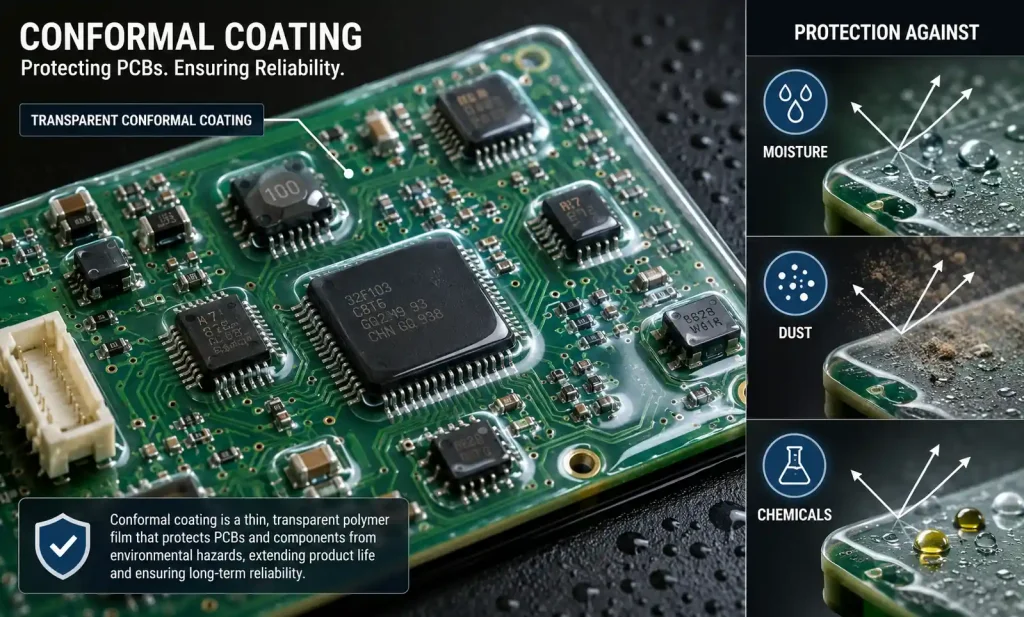
The primary purposes of conformal coating include:
- Moisture protection: Prevents corrosion and electrical failures caused by humidity
- Chemical resistance: Shields components from harsh chemicals and solvents
- Mechanical protection: Provides a barrier against dust, debris, and physical abrasion
- Insulation enhancement: Improves dielectric properties and prevents short circuits
- Extended product lifespan: Increases reliability in demanding environments
Without proper coating standards, manufacturers would face inconsistent protection quality, leading to premature product failures and costly warranty claims.
Key IPC Standards for Conformal Coating
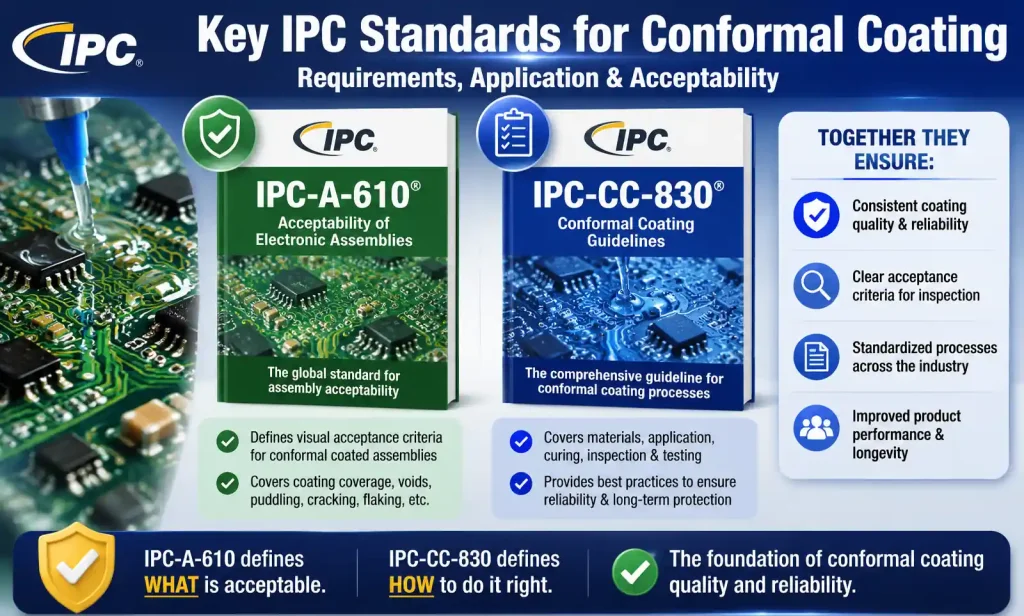
Several IPC standards govern conformal coating processes, but three are particularly important:
IPC-A-610: “Acceptability of Electronic Assemblies” – This is the most widely used standard, defining visual quality acceptance criteria for conformal coating on assembled PCBs. It specifies what constitutes acceptable, process indicator, and defect conditions.
IPC-CC-830: “Qualification and Performance of Electrical Insulating Compound for Printed Wiring Assemblies” – This standard establishes the qualification and performance requirements for conformal coating materials themselves, including testing methods and material properties.
IPC-J-STD-001: “Requirements for Soldered Electrical and Electronic Assemblies” – While primarily focused on soldering, this standard includes requirements for coating application that complements IPC-A-610.
Understanding the relationship between these standards is crucial. IPC-CC-830 qualifies the materials, while IPC-A-610 defines how the applied coating should look and perform on the assembly.
IPC-A-610: Acceptability Standards
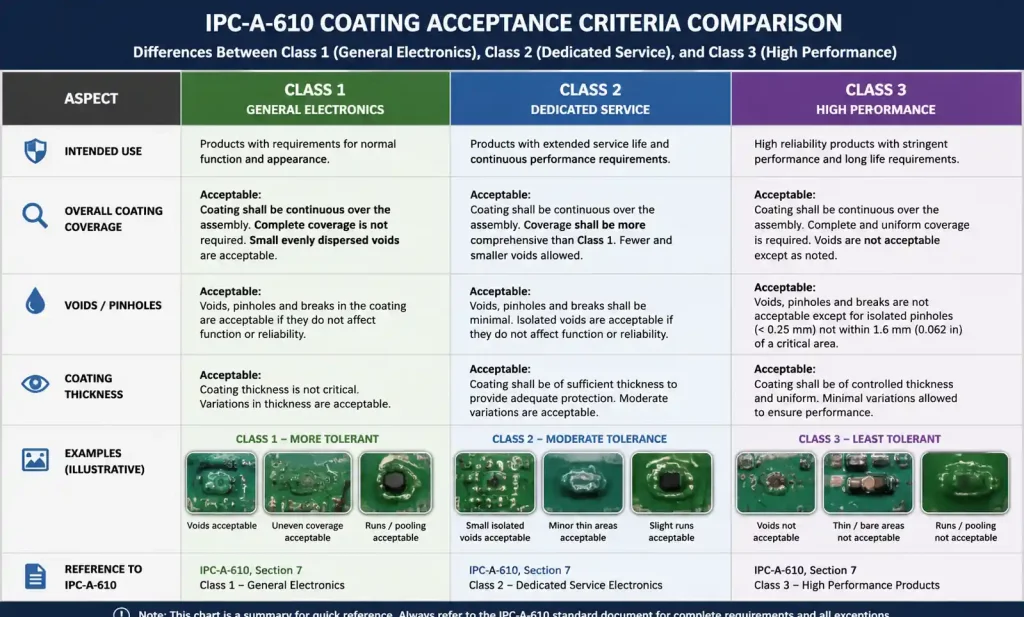
IPC-A-610 is the industry benchmark for electronics assembly quality. Section 10 specifically addresses conformal coating acceptability criteria across three classes:
Class 1 – General Electronic Products: Consumer electronics with limited operational life expectations. Cosmetic imperfections are acceptable as long as functionality isn’t compromised.
Class 2 – Dedicated Service Electronic Products: Products requiring extended life and uninterrupted service, such as communications equipment and business machines. Higher reliability standards apply.
Class 3 – High Performance Electronic Products: Mission-critical applications where continued performance is essential (medical devices, aerospace, military). The strictest criteria apply.
Key IPC-A-610 Coating Requirements:
Coverage requirements: The standard specifies minimum and maximum coating thickness ranges. Typical requirements are 25-250 microns (0.001-0.010 inches), though specific applications may require different ranges.
Visual appearance: Coating should be uniform, transparent or translucent (depending on material), and free from runs, sags, or excessive buildup.
Component restrictions: Certain areas must remain uncoated, including connectors, test points, switches, heatsinks, and areas marked with coating boundaries.
Surface preparation: Boards must be clean and free from contaminants before coating application.
The standard includes detailed photographs showing acceptable versus unacceptable conditions, making it an invaluable visual reference for inspectors.
IPC-CC-830: Qualification and Performance Requirements
While IPC-A-610 focuses on the finished appearance, IPC-CC-830 ensures the coating material itself meets stringent performance benchmarks before it’s approved for use.
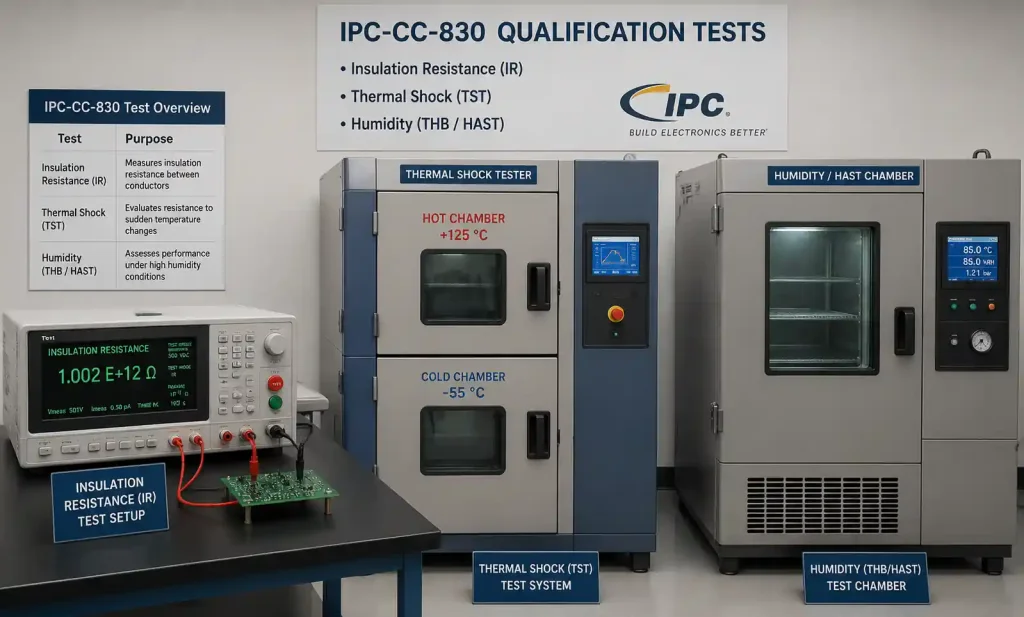
Material Qualification Tests Include:
Insulation resistance: Measures the coating’s ability to prevent current leakage between conductors. Materials must maintain high resistance values even under humidity stress.
Dielectric withstanding voltage: Tests the coating’s ability to withstand high voltages without breakdown.
Thermal shock resistance: Coatings undergo rapid temperature cycling to ensure they don’t crack, delaminate, or lose adhesion under thermal stress.
Moisture and humidity resistance: Extended exposure to 85°C/85% relative humidity tests the coating’s barrier properties.
Fungus resistance: Ensures the coating won’t support fungal growth in tropical or humid environments.
Compatibility testing: Verifies the coating doesn’t damage components, printed wiring, or markings.
Flammability rating: Many applications require UL94 V-0 flame retardant ratings.
IPC-CC-830 categorizes coatings by type (AR for acrylic, UR for urethane, SR for silicone, ER for epoxy, XY for parylene), and each type must meet specific performance criteria.
Types of Conformal Coatings Under IPC Standards
IPC recognizes several coating chemistry types, each with distinct properties, advantages, and application requirements:
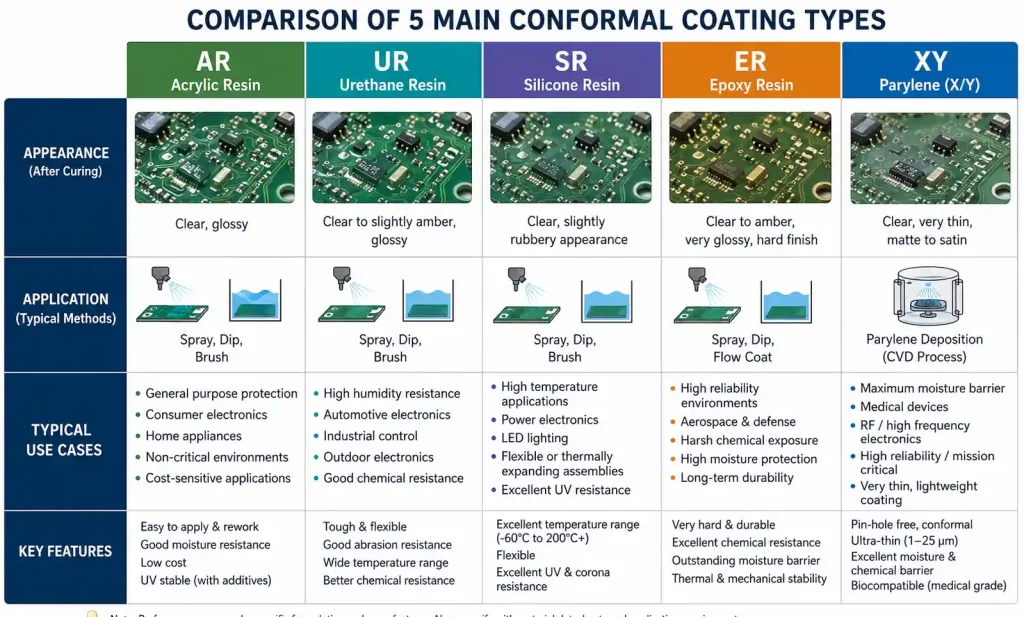
Acrylic Resins (AR)
- Advantages: Easy to apply and remove, fast drying, good moisture resistance, reworkable
- Limitations: Lower chemical and abrasion resistance, moderate temperature range
- Best for: General-purpose applications, prototypes, products requiring rework
- Typical thickness: 25-75 microns
Urethane (UR)
- Advantages: Excellent moisture and chemical resistance, superior abrasion resistance, good dielectric properties
- Limitations: Difficult to remove for rework, requires moisture for curing, longer cure time
- Best for: Harsh environments, automotive, industrial controls
- Typical thickness: 25-100 microns
Silicone (SR)
- Advantages: Widest temperature range (-65°C to +200°C), excellent flexibility, good moisture resistance
- Limitations: Lower abrasion resistance, can contaminate surfaces (silicone migration), difficult to recoat
- Best for: High-temperature applications, aerospace, military
- Typical thickness: 50-200 microns
Epoxy (ER)
- Advantages: Excellent chemical and abrasion resistance, superior hardness, good adhesion
- Limitations: Very difficult to remove, brittle, typically requires heat cure
- Best for: Permanent protection, harsh chemical environments
- Typical thickness: 25-75 microns
Parylene (XY)
- Advantages: Ultra-thin uniform coverage, excellent barrier properties, pinhole-free, biocompatible
- Limitations: Expensive equipment required, vapor deposition process, difficult to remove
- Best for: Medical implants, aerospace, high-reliability applications
- Typical thickness: 5-50 microns
The choice of coating type depends on the application environment, required protection level, rework needs, and cost considerations.
Application Methods and Best Practices
IPC standards recognize several coating application methods, each with specific advantages and process controls:
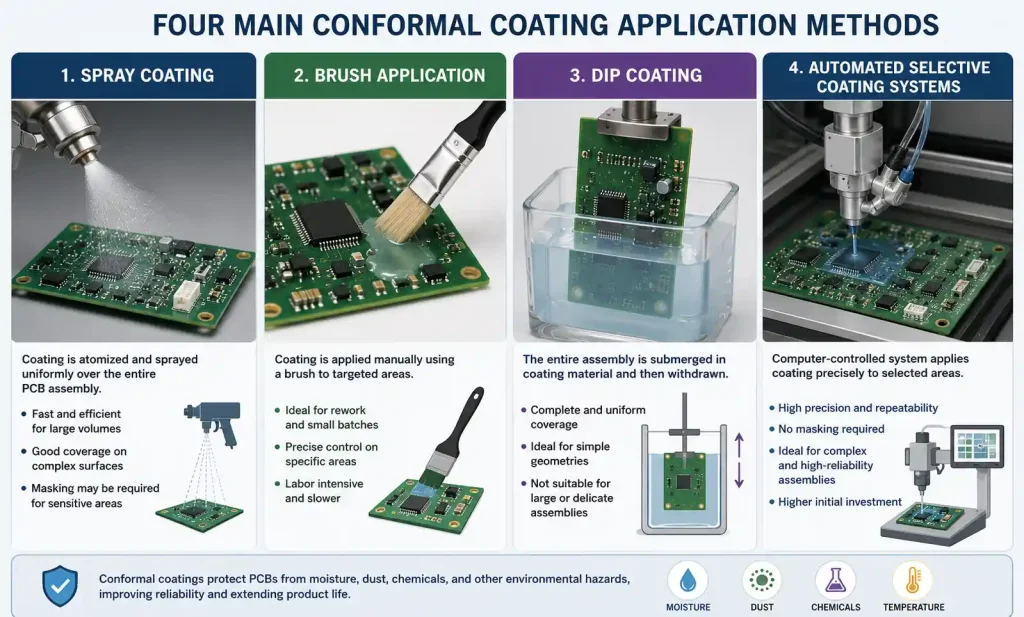
Spray Coating
Most common method using manual spray guns or automated selective coating systems. Provides good coverage and is suitable for high-volume production.
Best practices:
- Maintain consistent spray pattern and distance (typically 6-10 inches)
- Apply multiple thin coats rather than one thick coat
- Control spray booth environment (temperature 20-25°C, humidity 40-70%)
- Use proper masking for areas requiring no coating
Brush Coating
Manual application for low-volume production, rework, or touch-up applications.
Best practices:
- Use soft brushes to avoid component damage
- Apply in smooth, even strokes
- Avoid excessive brush pressure
- Replace brushes regularly to prevent contamination
Dip Coating
Entire assembly is immersed in coating material, providing excellent coverage but requiring extensive masking.
Best practices:
- Control immersion and withdrawal speeds (typically 1-10 cm/minute)
- Maintain coating viscosity within specification
- Allow proper drainage time before curing
- Monitor coating level and replenish regularly
Selective Coating
Automated systems precisely apply coating only to specified areas using programmable paths.
Best practices:
- Program accurate coating boundaries
- Optimize valve pressure and flow rates
- Verify coating thickness with test patterns
- Regular maintenance of dispensing equipment
Regardless of method, IPC standards emphasize proper surface preparation, controlled application environment, and thorough process documentation.
Inspection and Quality Control Requirements
IPC-A-610 establishes comprehensive inspection criteria to ensure coating quality and compliance.
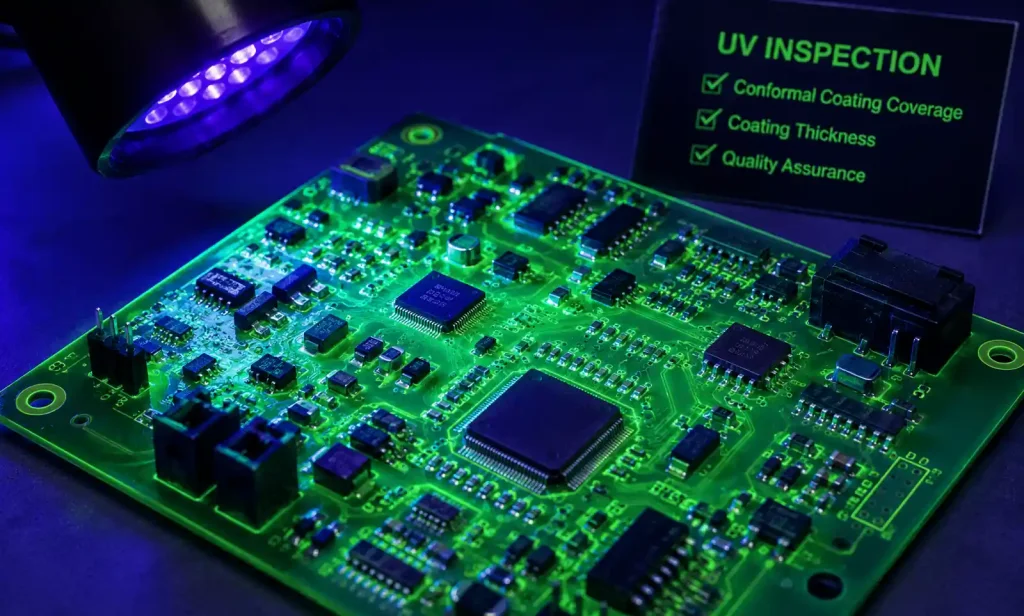
Visual Inspection
Coverage verification: Inspectors verify coating extends to proper boundaries and covers all required areas. UV-traceable coatings (containing fluorescent dye) make inspection easier under UV light.
Thickness measurement: Using wet film thickness gauges during application or dry film thickness gauges after curing. Typical acceptance range is ±25% of target thickness.
Defect identification: Look for voids, pinholes, bubbles, runs, sags, orange peel texture, delamination, or foreign material inclusions.
Automated Optical Inspection (AOI)
Modern production facilities increasingly use AOI systems that can:
- Detect coating presence/absence
- Measure coating thickness (with appropriate sensors)
- Identify surface defects
- Compare against digital standards
- Generate statistical process control data
Electrical Testing
For critical applications, electrical testing verifies:
- Insulation resistance between adjacent conductors
- Dielectric withstanding voltage
- Absence of coating on test points and functional areas
Documentation Requirements
IPC standards require maintaining records including:
- Coating material batch numbers and qualification certificates
- Application parameters (viscosity, temperature, humidity)
- Inspection results and acceptance decisions
- Non-conformance reports and corrective actions
Common Defects and Acceptance Criteria
Understanding what constitutes a defect versus an acceptable process indicator is crucial for proper quality assessment.
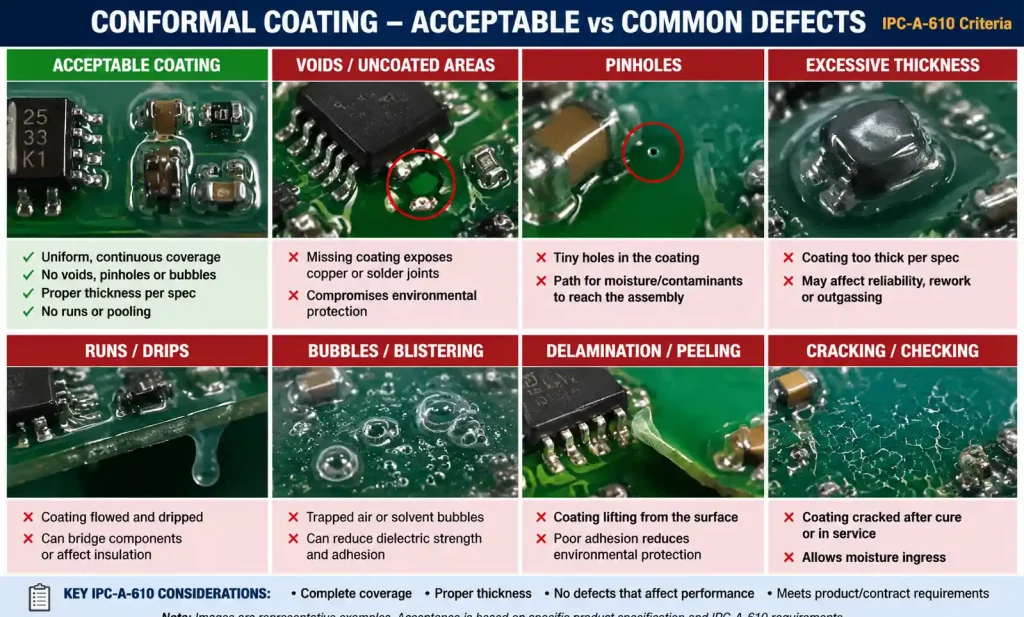
Acceptable Conditions (Per IPC-A-610)
- Minor air entrapment: Small bubbles that don’t compromise protection
- Slight color variation: Due to coating thickness differences
- Coating slightly over boundaries: If functional areas aren’t impaired
- Minor surface texture: Orange peel effect within limits
Process Indicators (May require evaluation)
- Coating meniscus: Slight buildup at component edges (acceptable if within thickness limits)
- Partial coating on component sides: Depending on class and location
- Slight runs or sags: If thickness remains within specification
Defects (Unacceptable)
- Uncoated areas: Exposed copper or components in areas requiring coating
- Excessive thickness: Causing stress on components or impeding functionality
- Coating on restricted areas: Connectors, test points, switches, heatsinks
- Delamination or peeling: Coating separating from substrate
- Contamination: Foreign particles embedded in coating
- Crazing or cracking: Indicating coating failure or improper cure
- Voids or pinholes: Compromising moisture barrier properties
The acceptance criteria become progressively stricter from Class 1 to Class 3. A condition acceptable for Class 1 consumer electronics might be a defect in Class 3 medical devices.
Industry Applications and Compliance
IPC conformal coating standards are adopted across multiple industries with varying compliance requirements:
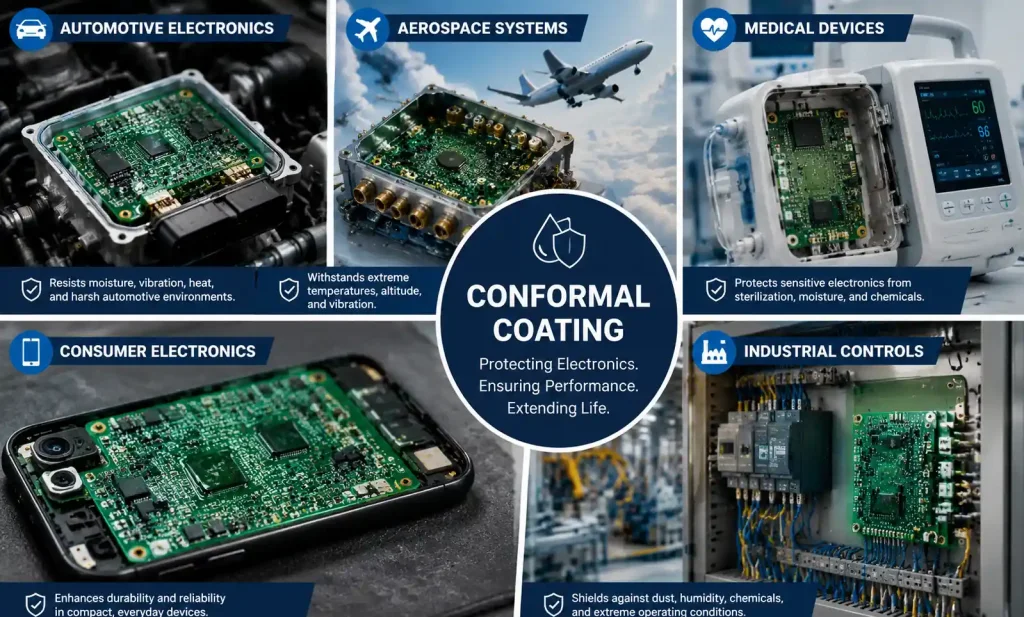
Automotive Electronics
Harsh environment exposure (temperature extremes, moisture, chemicals, vibration) demands robust coating. Automotive manufacturers typically require Class 2 or Class 3 compliance with additional qualification testing per AEC-Q200 standards.
Aerospace and Defense
Military and aerospace applications require Class 3 compliance with additional MIL-STD requirements. Coating materials must be qualified per MIL-I-46058 or equivalent, with extensive documentation and traceability.
Medical Devices
FDA-regulated medical devices require biocompatible coatings (typically parylene or specific silicones) with ISO 13485 quality system compliance. IPC-A-610 Class 3 provides the baseline visual acceptance criteria.
Consumer Electronics
Smartphones, wearables, and IoT devices increasingly use conformal coating for moisture protection. Class 1 or Class 2 compliance is typical, with emphasis on thin, optically clear coatings.
Industrial Controls
PLCs, sensors, and control systems in manufacturing environments require reliable coating protection. Class 2 compliance is standard, with emphasis on long-term reliability.
Compliance Verification
Organizations achieve IPC compliance through:
- Training and certification: IPC-certified trainers and specialists
- Process qualification: Documented procedures meeting IPC requirements
- Material qualification: Using IPC-CC-830 qualified materials
- Inspection standards: Implementing IPC-A-610 acceptance criteria
- Audit readiness: Maintaining documentation for customer or third-party audits
Conclusion
IPC conformal coating standards provide the framework for producing reliable, high-quality protected electronic assemblies. IPC-A-610 defines what acceptable coating looks like on the finished assembly, while IPC-CC-830 ensures the coating materials themselves meet rigorous performance requirements. Together, these standards enable consistent quality across the electronics manufacturing industry.
Understanding coating types, application methods, inspection criteria, and acceptance standards is essential for anyone involved in PCB production. Whether you’re working with Class 1 consumer products or Class 3 mission-critical devices, following IPC standards ensures your conformal coating provides the intended protection and reliability.
As electronics continue to penetrate harsher environments and demand higher reliability, proper conformal coating application according to IPC standards becomes increasingly critical. Investing in training, proper equipment, and quality control processes pays dividends in reduced field failures and enhanced product reputation.