
What is the main function of the backplane PCB? What are the advantages?
The backplane PCB is a special type of circuit board that is usually located on the back or bottom of an electronic device to support and connect various electronic components and subsystems. Unlike conventional PCBs, backplane PCBs have a higher level and complexity to accommodate a large number of connectors, slots and other connection devices. They also have higher durability and stability to cope with the high-demand environment of electronic devices.
The design of the backplane PCB usually takes into account factors such as high-speed signal transmission, power distribution, thermal management and EMI/EMC to ensure the stability and reliability of electronic devices. They can be single-layer, double-layer or multi-layer structures, depending on the requirements and complexity of the device.
What is the main function of the backplane PCB?
01 Provide mechanical support
As a solid foundation for electronic devices, the backplane PCB provides mechanical support and fixation to ensure the stability and safety of the internal components of the device.
02 Electrical connection
The complex circuit network on the backplane PCB connects various electronic components, chips, modules and other devices, realizing electrical connection and communication between various parts inside the device.
03 Signal transmission
The backplane PCB is responsible for transmitting high-speed signals and data, ensuring fast and stable communication between various components, thereby ensuring the normal operation of the entire electronic device.
04 Power distribution
The backplane PCB is responsible for the distribution and management of power, ensuring that each component obtains a stable and reliable power supply to meet the power consumption requirements of the device.
05 Thermal management
The backplane PCB is also responsible for the conduction and dispersion of heat, helping the heat inside the device to be effectively dissipated and preventing the device from overheating and causing damage to electronic components.
06 EMI/EMC control
The design of the backplane PCB takes into account the factors of electromagnetic interference (EMI) and electromagnetic compatibility (EMC), and takes a series of measures to reduce the interference of electronic equipment to the external environment to ensure the stability and reliability of the equipment.
The backplane PCB plays an important role in connection, support, transmission and management in electronic equipment, which directly affects the performance, stability and reliability of the equipment.
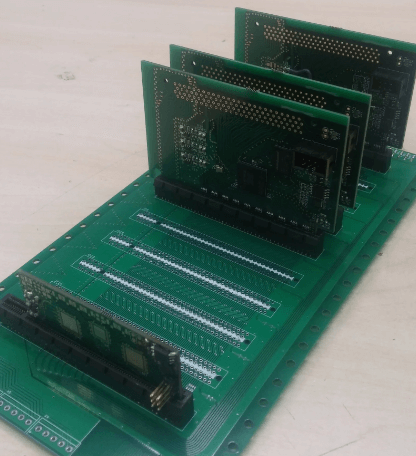
Features and advantages of the backplane PCB
01 Maintainability
The design of the backplane PCB takes into account the convenience of maintenance and repair, and adopts modular design and standard interfaces to facilitate replacement and repair. For example, the industrial control system backplane adopts a modular design, and the faulty module can be quickly replaced, reducing maintenance time and cost.
02 Improved stability
The high-quality materials and advanced manufacturing technology of the backplane PCB ensure its stability and reliability, and it can maintain good working condition in various harsh environments. For example, the military equipment backplane adopts high-reliability materials and processes, and after rigorous testing and verification, it ensures its stability and reliability in battlefield environments.
03 Assembling
The design of the backplane PCB takes into account the needs of assembly and splicing, and can be flexibly combined and assembled with other components to meet the design requirements of different equipment. For example, the backplane of industrial automation equipment can be flexibly combined with various sensors, actuators and other components to achieve complex control functions.
04 High density
The backplane PCB has excellent high-density wiring capabilities, which can realize the transmission and processing of a large number of signals in a limited space, meeting the high requirements of modern electronic equipment for data transmission speed and processing capabilities. For example, the server backplane adopts a high-density wiring design to achieve high-speed transmission and processing of large-capacity data.
05 Functionality
Backplane PCB can integrate multiple functions and communication interfaces to meet the functional requirements of different devices. For example, the industrial control system backplane integrates multiple communication interfaces and control functions to achieve complex control and monitoring functions.
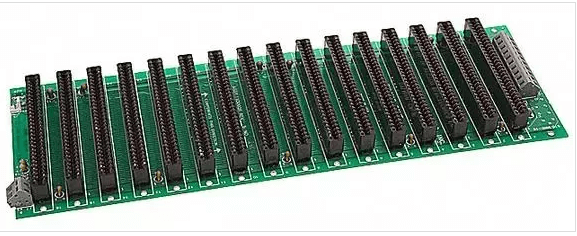
Key points of backplane PCB manufacturing
01 Material selection and thickness control
Backplane PCB is usually thicker and heavier than ordinary PCB, so it needs to be more stringent in material selection and thickness control. Selecting suitable substrates and copper-clad materials, such as FR-4, FR-5, high TG boards, etc., and strictly controlling the thickness of the board can help ensure the mechanical strength, thermal stability and electrical performance of the backplane PCB. In addition, the thermal expansion coefficient matching of the material needs to be considered to avoid deformation or stress concentration of the backplane PCB when the temperature changes, thereby affecting the stability and reliability of the circuit.
02 Interlayer alignment
Due to the large number of layers and drilling numbers of backplane PCB, interlayer alignment has become a key technology in the manufacturing process. High-precision lamination technology and advanced alignment equipment are used to ensure the accuracy and stability of interlayer alignment.
03 Special process treatment
Special process treatment is required during the manufacturing process of the backplane PCB, such as chemical copper plating, surface treatment, pressing, drilling, electroplating, etc. These processes need to be strictly controlled to ensure the quality and stability of the backplane.
04 Thermal management and heat dissipation design
Due to the large thickness and weight of the backplane PCB, heat dissipation and management have become issues that require special attention during the manufacturing process. Design methods such as heat sinks, heat sinks, fan heat dissipation and heat pipes are adopted, and suitable heat dissipation materials such as copper, aluminum, thermal conductive adhesives, etc. are selected to improve the heat dissipation efficiency of the backplane PCB. At the same time, thermal simulation and testing are carried out to evaluate the heat dissipation design effect and ensure the stability and reliability of the backplane PCB.
05 Process monitoring and quality control
During the manufacturing process of the backplane PCB, strict process monitoring and quality control are required to ensure that each process and each link meets the design requirements and standards. By formulating detailed manufacturing process specifications, regularly maintaining and calibrating production equipment, strictly controlling process parameters, real-time monitoring and adjusting the manufacturing process, and strictly inspecting and testing raw materials, processes and finished products, we can ensure that the manufacturing process of backplane PCB is stable and reliable, that product quality meets design requirements and standards, and improve product competitiveness and market share.