
Why Choose Aluminum-Based PCB: A Comprehensive Guide
Introduction
Printed Circuit Boards (PCBs) are the backbone of modern electronics, providing mechanical support and electrical connections for components. Among various PCB types, aluminum-based PCBs (also known as metal-core PCBs or MCPCBs) have gained significant popularity in industries requiring superior thermal management, durability, and performance.
This article explores the key reasons for choosing aluminum-based PCBs over traditional FR4 or other substrates, covering their advantages, applications, and design considerations.
1. Superior Thermal Management
Why Heat Dissipation Matters
Electronic components generate heat during operation, and excessive temperatures can lead to:
- Reduced performance
- Shorter component lifespan
- Device failure
Traditional FR4 PCBs have limited thermal conductivity (~0.3 W/mK), making them unsuitable for high-power applications.
Aluminum PCB’s Thermal Advantage
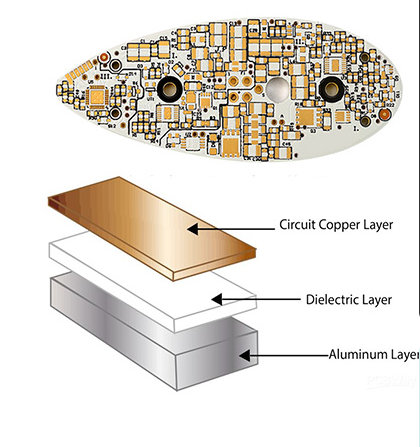
Aluminum PCBs feature a metal core (usually aluminum alloy) with high thermal conductivity (1-3 W/mK), significantly improving heat dissipation.
Key Benefits:
- Efficient heat transfer away from critical components (e.g., LEDs, power transistors).
- Lower operating temperatures, enhancing reliability.
- Eliminates the need for additional heatsinks in some designs, reducing cost and weight.
Industries benefiting from this:
- LED lighting
- Power electronics (inverters, motor controllers)
- Automotive electronics
2. Enhanced Durability and Mechanical Stability
Rigid yet Lightweight Structure
Aluminum PCBs offer:
- High mechanical strength (resistant to bending and cracking).
- Lightweight compared to ceramic or copper-core PCBs.
- Resistance to thermal expansion, reducing stress on solder joints.
Longer Lifespan
- Less prone to warping under high temperatures.
- Better performance in harsh environments (vibration, moisture).
Applications:
- Aerospace and automotive systems
- Industrial power supplies
- High-power LED arrays
3. Cost-Effectiveness in High-Power Applications
While aluminum PCBs may have a higher initial cost than FR4, they offer long-term savings by:
- Reducing the need for external cooling systems (fans, heat sinks).
- Improving energy efficiency (cooler components operate more efficiently).
- Extending product lifespan, lowering replacement costs.
Example:
- In LED lighting, aluminum PCBs help maintain brightness and efficiency over time, reducing maintenance costs.
4. Better Electrical Performance
Lower Thermal Resistance = Higher Efficiency
- Prevents overheating of high-current components.
- Supports higher power densities.
EMI Shielding (In Some Designs)
The metal core can act as a ground plane, reducing electromagnetic interference (EMI).
Applications:
- RF and microwave circuits
- Power converters
5. Environmental Benefits
Aluminum is:
- Recyclable (eco-friendly compared to some PCB materials).
- Non-toxic (RoHS compliant).
- Energy-efficient (reduces cooling needs, lowering overall power consumption).
6. Common Applications of Aluminum PCBs
| Industry | Application | Why Aluminum PCB? |
|---|---|---|
| LED Lighting | Street lights, automotive LEDs | Prevents overheating, extends LED lifespan |
| Power Electronics | Inverters, motor drives, UPS systems | Handles high current without thermal failure |
| Automotive | Headlights, battery management systems | Withstands high temps & vibrations |
| Consumer Electronics | Amplifiers, power supplies | Compact, efficient cooling |
| Aerospace | Avionics, satellite systems | Lightweight, durable in extreme conditions |
7. Design Considerations for Aluminum PCBs
Layer Structure
- Single-layer: Most common (dielectric layer + copper circuit + aluminum base).
- Double-layer: For more complex circuits.
- Multilayer: Rare, but possible with hybrid designs.
Thermal Dielectric Material
- Must have high thermal conductivity and electrical insulation.
- Common materials: ceramic-filled polymers.
Manufacturing Challenges
- Requires specialized CNC machining (aluminum is harder than FR4).
- Higher cost for complex designs.
Conclusion
Aluminum-based PCBs are an optimal choice for applications requiring high thermal conductivity, durability, and long-term reliability. While they may not replace FR4 in all scenarios, their advantages in LED lighting, power electronics, automotive, and industrial systems make them indispensable.
By improving heat dissipation, reducing system costs, and enhancing performance, aluminum PCBs continue to drive innovation in modern electronics.
Final Recommendation:
- Use aluminum PCBs for high-power, high-heat applications.
- Consider cost vs. performance trade-offs for low-power designs.
- Consult with PCB manufacturers for optimal material selection.