
Zirconia Ceramic PCB Applications: When to Justify ZrO2 for Extreme Devices
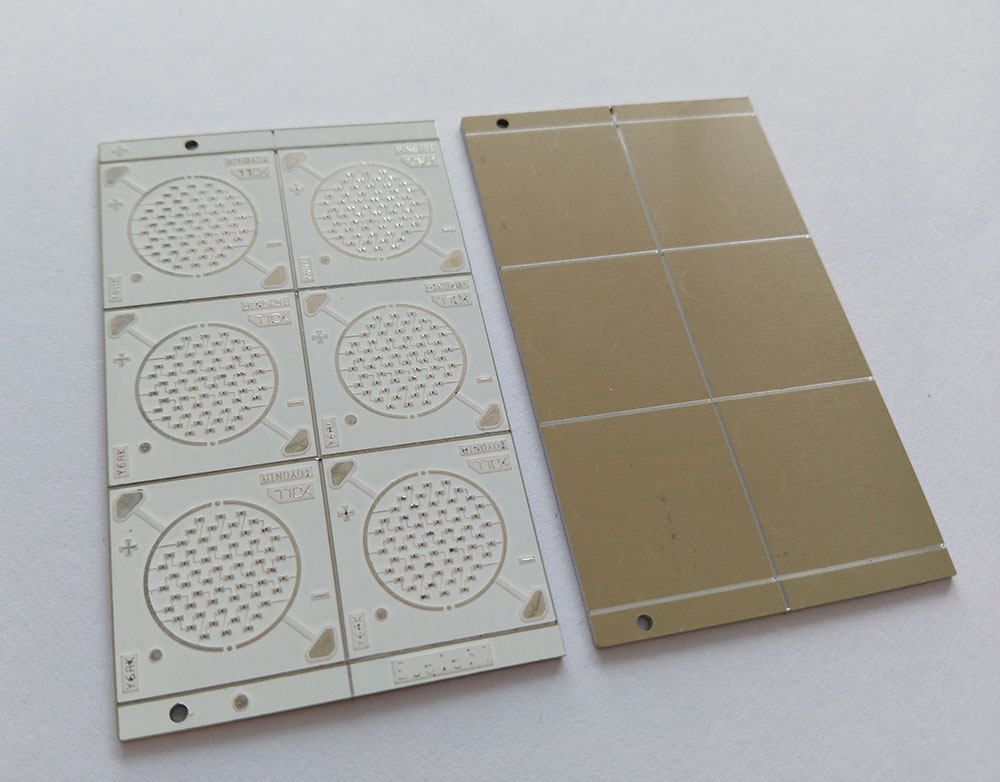
If you are designing electronics for harsh environments, you already know the dilemma: standard FR4 burns up or delaminates at high temperatures, while traditional Alumina (Al2O3) ceramic boards are notoriously brittle. Drop an Alumina board or subject it to high-frequency engine vibration, and it shatters like glass. So, what is the alternative when you need both extreme temperature resistance and mechanical ruggedness?
Enter the Zirconia (ZrO2) Ceramic PCB. Often referred to as “ceramic steel,” ZrO2 solves the fracture problem, but it comes with a premium price tag and a unique thermal profile that catches many designers off guard. In this deep-dive engineering guide, you will learn the exact physical properties of ZrO2, discover the specific scenarios where its ROI makes sense, and learn how to avoid the most common thermal management pitfalls.
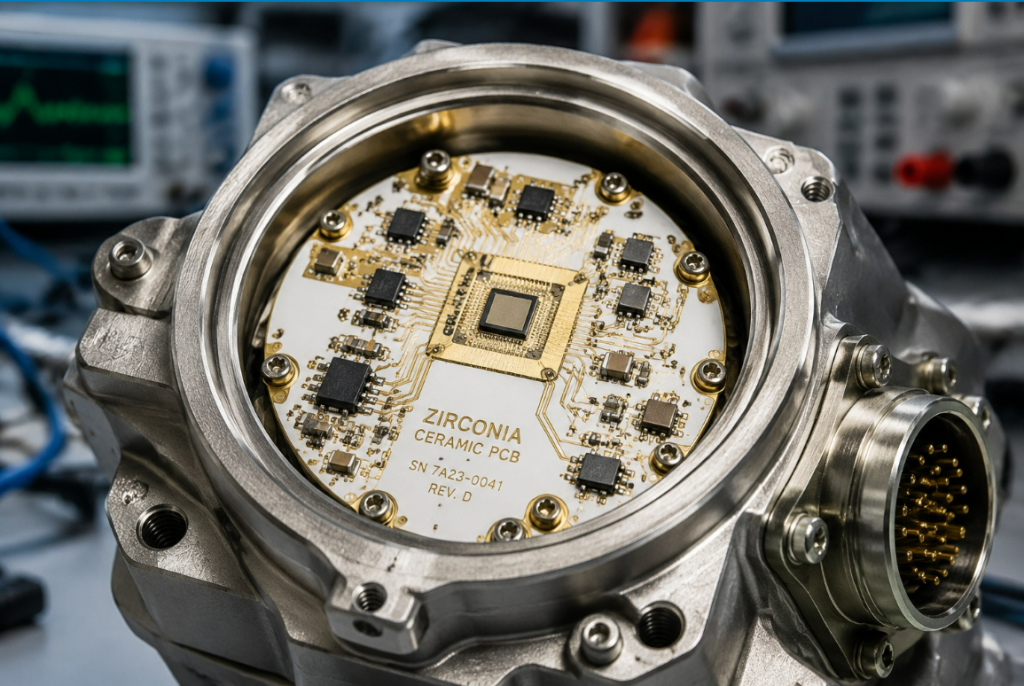
Understanding Zirconia Ceramic PCBs: The Basics
In the realm of advanced electronics manufacturing, engineers are constantly pushing the boundaries of miniaturization and durability. Whether it is a pressure sensor deep inside an oil well, a control unit in a jet engine, or a biocompatible medical implant, standard substrates simply fail.
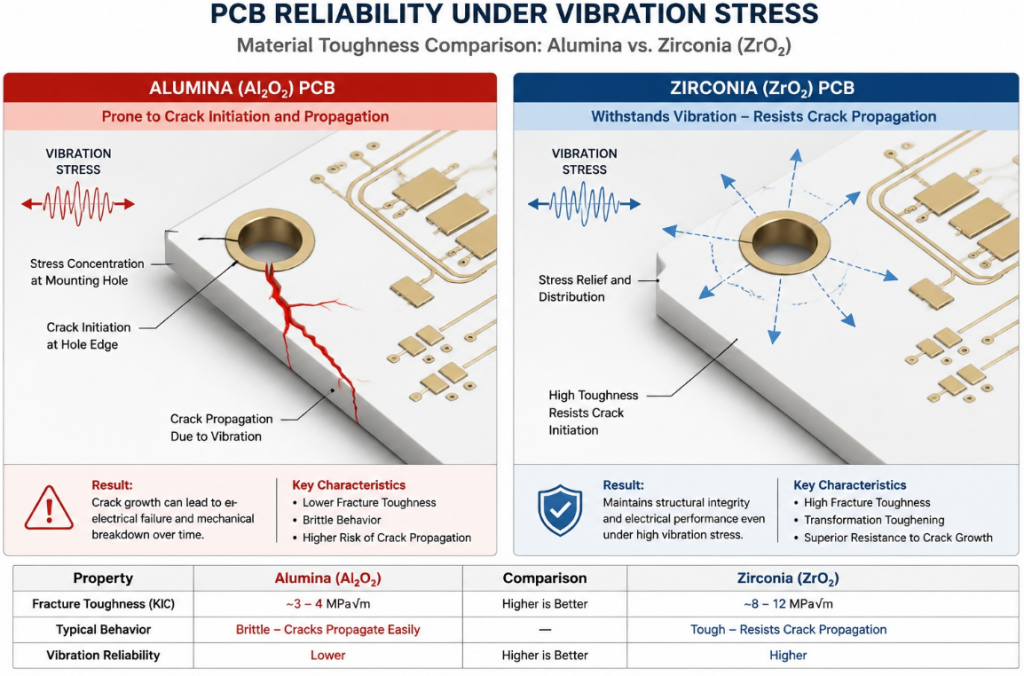
When engineers transition to a Ceramic PCB, they usually default to Alumina (Al2O3) because it is cost-effective and widely available. However, Alumina has a fatal flaw: low fracture toughness. In environments characterized by high impact, mechanical shock, or relentless vibration, Alumina is prone to micro-cracking. These cracks propagate quickly, leading to catastrophic board failure.
Zirconia (Zirconium Dioxide, ZrO2) was introduced to the PCB industry specifically to bridge this gap. By doping Zirconia with Yttrium Oxide (Yttria-stabilized zirconia), material scientists created a ceramic substrate that literally “pushes back” against cracks. When stress is applied, the crystal structure of ZrO2 undergoes a phase transformation that expands its volume, effectively squeezing microscopic cracks shut before they can spread. This makes it the ultimate choice for mechanically demanding applications where failure is not an option.
Core Concepts Simplified
To understand when to specify ZrO2, we must look at the data. Let’s translate the three most critical material specifications into practical engineering terms.
- Fracture Toughness (K1c): The “Anti-Shatter” Metric
In simple terms, fracture toughness measures a material’s ability to resist the spreading of a crack. Think of glass versus polycarbonate plastic. Standard Alumina is like glass; once a crack starts, it shatters. ZrO2 has a fracture toughness (around 8-10 MPa·m½) that is over three times higher than Alumina. If a technician accidentally drops a ZrO2 board, or if it is bolted to a vibrating automotive chassis, it survives. - Coefficient of Thermal Expansion (CTE): Solder Joint Survival
CTE dictates how much the board expands when heated and shrinks when cooled. If your PCB expands at a drastically different rate than the copper traces, the ceramic components, or the metal mounting chassis, the solder joints will experience severe fatigue and eventually shear off. ZrO2 has a CTE (~10.5 ppm/°C) that closely matches many metals (like steel and titanium), making it incredibly stable during aggressive thermal cycling. - Dielectric Constant (Dk): Signal Integrity
Dk measures how well a material stores electrical energy. For high-frequency RF or microwave applications, you need a stable, typically lower Dk to prevent signal loss and distortion. ZrO2 has a relatively high Dk (around 20-25), which means it is not ideal for high-speed digital or RF transmission unless specifically engineered for it.
Material Comparison Table: ZrO2 vs. Industry Standards
Before committing your budget, it is crucial to compare ZrO2 against other ceramics. If you are weighing standard options, you might also want to review the differences between Alumina vs. Aluminum Nitride to understand the baseline.
| Specification | Zirconia (ZrO2) | Alumina (96% Al2O3) | Aluminum Nitride (AlN) |
|---|---|---|---|
| Primary Strength | Mechanical Toughness | Cost-Effectiveness | Extreme Thermal Conductivity |
| Fracture Toughness (K1c) | 8.0 – 10.0 MPa·m½ | 2.5 – 3.5 MPa·m½ | 2.6 – 3.0 MPa·m½ |
| Flexural Strength | ~1000 MPa | ~350 MPa | ~300 MPa |
| Thermal Conductivity | ~2.5 W/m·K (Very Low) | 24 – 28 W/m·K | 170 – 230 W/m·K |
| Cost Profile | $$$$ (Very High) | $ (Low) | $$$ (High) |
Step-by-Step Guide: When to Justify the Cost
Because ZrO2 is significantly more expensive than standard Alumina, procurement managers and lead engineers need a solid ROI justification. You should only select ZrO2 when your application demands a combination of high temperature resistance AND extreme mechanical resilience.
Scenario A: High-Vibration Aerospace and Automotive Sensors
In aerospace and automotive engineering, sensors are often mounted directly onto engine blocks or turbine housings.
- The Threat: Constant high-frequency vibration and temperatures exceeding 200°C.
- The Failure Mode: FR4 melts. Alumina cracks under the vibration, leading to open circuits.
- The ZrO2 Solution: The high flexural strength (~1000 MPa) of ZrO2 ensures the substrate bends slightly without breaking, while its CTE matches the metal housing, preventing solder joint shear during engine heat-up and cool-down phases.
Scenario B: Medical Implants (Active Prosthetics)
For implantable medical devices like pacemakers or neurostimulators, the PCB must survive inside the human body for decades.
- The Threat: Corrosive bodily fluids and the need for absolute structural integrity (a shattered PCB inside a patient is fatal).
- The Failure Mode: Standard polymers degrade. Standard ceramics may chip during the laser welding of the titanium casing.
- The ZrO2 Solution: Zirconia is highly biocompatible and chemically inert. Its fracture toughness ensures that during the harsh manufacturing and sealing processes, no micro-shards are created.
The Procurement Decision Matrix (Specs / Data Table)
If you are currently evaluating materials and trying to balance mechanical strength with thermal performance, you might also be looking at Silicon Nitride PCB vs Alumina. To make your decision easier, use this specification matrix to determine if ZrO2 fits your actual project requirements.
| Project Requirement | Recommended Substrate | Why? (Engineering Justification) |
|---|---|---|
| Budget-constrained, basic high-temp | Alumina (Al2O3) | Good baseline thermal resistance, cheap, but brittle. |
| High power LEDs or IGBT modules | Aluminum Nitride (AlN) | Needs massive heat dissipation (170+ W/m·K). |
| Extreme vibration + High temp | Zirconia (ZrO2) | Will not shatter; phase-transformation toughening. |
| High strength + Good heat transfer | Silicon Nitride (Si3N4) | The middle ground between ZrO2 toughness and AlN cooling. |
Expert Tips & Common Pitfalls to Avoid
If you spend time on engineering forums like EEVblog or the r/PrintedCircuitBoard subreddit, you will frequently see engineers complaining about expensive ceramic PCBs failing in prototype testing. Usually, this is not a manufacturing defect; it is a fundamental misunderstanding of material properties.
Here is the most critical pitfall you must avoid when designing with Zirconia:
⚠️ The Big Myth: “All Ceramics Are Good for Heat Dissipation”
This is completely false when it comes to ZrO2.
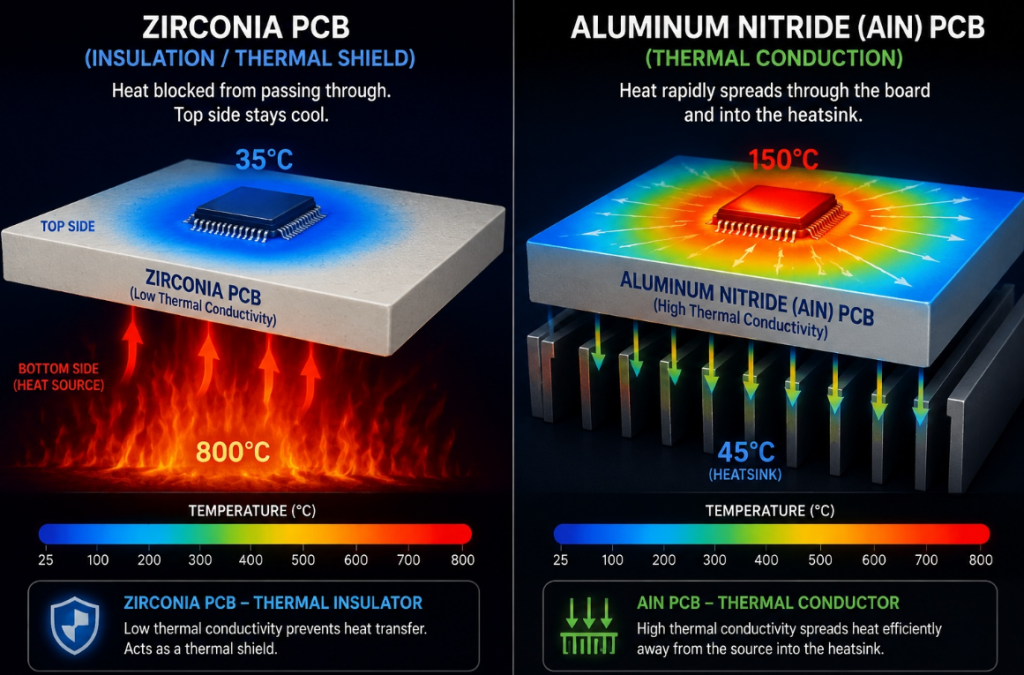
Many engineers assume that because Alumina and AlN are great thermal conductors, Zirconia must be too. In reality, Zirconia is a Thermal Insulator.
Look at the data:
- Aluminum Nitride (AlN): ~170 W/m·K
- Alumina (Al2O3): ~24 W/m·K
- Zirconia (ZrO2): ~2.5 W/m·K
If you mount high-power MOSFETs or a hot CPU on a Zirconia PCB expecting it to act as a heatsink, your components will rapidly overheat and burn out. ZrO2 traps heat.
How to use this to your advantage:
Instead of using ZrO2 to dissipate heat, use it as a Thermal Shield. If you have sensitive control logic that must be placed near a blast furnace or a combustion chamber, a ZrO2 PCB will protect those components by blocking the external heat from transferring through the board.
Expert Tip: If your primary goal is pulling heat away from high-power components, you must abandon Zirconia and look into a high thermal conductivity material like AlN or Beryllium Oxide (BeO).
Conclusion & Final Thoughts
Specifying a Zirconia (ZrO2) Ceramic PCB is a significant engineering decision. It is not a drop-in replacement for standard FR4 or Alumina, nor is it a magical solution for thermal management. However, when applied correctly, it provides unparalleled mechanical reliability in environments where other boards would literally crumble.
Frequently Asked Questions (FAQ)
Q1: When should I use Zirconia (ZrO2) PCB instead of Alumina?
A: Use ZrO2 when your application requires extreme mechanical resilience combined with high-temperature operation. Zirconia’s fracture toughness (8-10 MPa·m½) is over 3x higher than Alumina, making it ideal for high-vibration aerospace sensors, automotive engine-mounted electronics, and medical implants where board shattering would be catastrophic.
Q2: Is Zirconia (ZrO2) PCB good for heat dissipation?
A: No. Zirconia has very low thermal conductivity (~2.5 W/m·K) compared to Alumina (~24 W/m·K) or AlN (~170-230 W/m·K). It acts as a thermal insulator, not a heatsink. Use ZrO2 as a thermal shield to protect sensitive components from external heat sources, not to cool hot components mounted on the board.
**Q3: What makes ZrO2 tougher than other ceramics?**
A: Yttria-stabilized Zirconia undergoes a phase transformation when stressed. The crystal structure expands its volume, squeezing microscopic cracks shut before they can propagate. This “pushes back” against fracture—unlike Alumina or AlN, where cracks spread unchecked until catastrophic failure.
Q4: What is the CTE of ZrO2 and why does it matter?
A: ZrO2 has a CTE of ~10.5 ppm/°C, closely matching steel and titanium. This prevents solder joint shear during aggressive thermal cycling. When your PCB and metal housing expand/contract at similar rates, solder connections survive engine heat-up and cool-down phases that would destroy joints on mismatched materials.
Q5: Why is ZrO2 so expensive compared to Alumina?
A: Zirconia requires Yttrium Oxide doping and complex sintering processes to achieve its phase-transformation toughening. Raw material costs and manufacturing complexity drive the premium price. Only justify ZrO2 for mission-critical applications where mechanical failure is not an option.
Q6: Can I use ZrO2 for high-frequency RF or microwave applications?
A: Generally no. ZrO2 has a high dielectric constant (Dk ~20-25), which causes significant signal loss and distortion at high frequencies. For RF/microwave, use AlN or specialized low-Dk ceramics. ZrO2 excels in mechanical and thermal shielding applications, not signal transmission.
Quick Summary Decision Table
| Feature | The ZrO2 Reality | Actionable Takeaway |
|---|---|---|
| Mechanical Strength | Unmatched in ceramics (K1c > 8.0) | Use for high-vibration, impact-heavy environments. |
| Thermal Conductivity | Very Poor (~2.5 W/m·K) | DO NOT use as a heatsink. Use as a thermal shield. |
| Cost | Premium pricing | Only justify for mission-critical aerospace, automotive, or medical devices. |
Before finalizing your Gerber files, ensure your mechanical and thermal simulations account for ZrO2’s specific CTE and low thermal conductivity. If you are dealing with extreme vibration and need a “ceramic steel” foundation, ZrO2 is undoubtedly the best investment for your device’s longevity.