
10 Essential Qualifications to Audit When Choosing a Rigid-Flex PCB Supplier
Selecting the right rigid-flex PCB supplier isn’t just about finding the lowest quote. When your product requires the complex manufacturing capability, material expertise, and reliability standards that rigid-flex technology demands, supplier qualification becomes a critical engineering and procurement decision. A poorly qualified supplier can lead to costly design respins, extended time-to-market, and field failures that damage your brand reputation.
This guide walks through the 10 most critical qualifications you must audit before committing to a rigid-flex PCB supplier. These criteria are based on real-world manufacturing experience, IPC standards, and the common failure modes we’ve observed when procurement teams skip thorough supplier vetting.
IPC Certification and Quality Management System
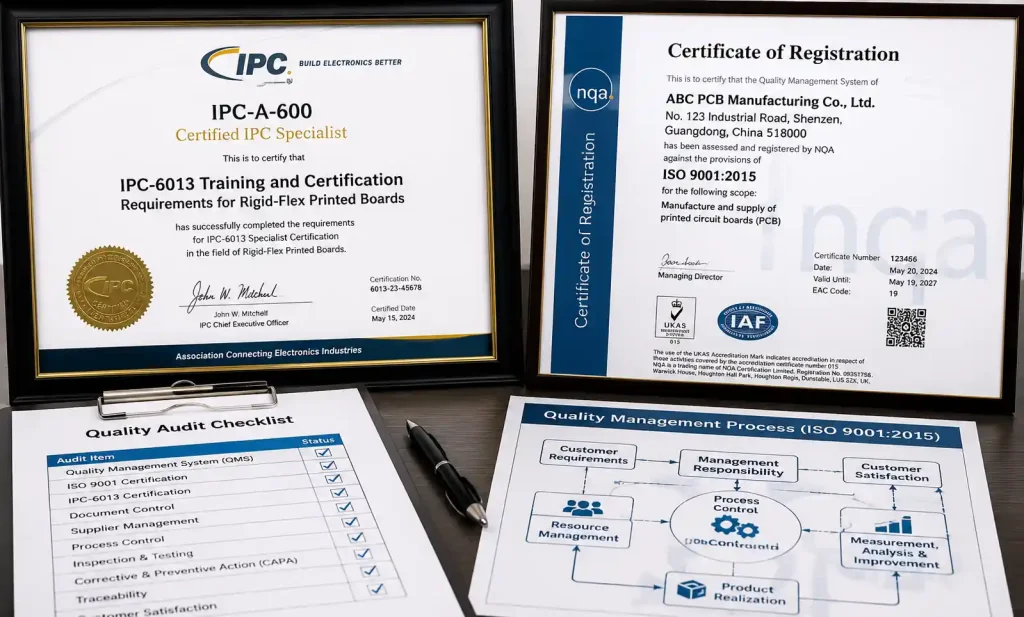
The first qualification to verify is whether your potential supplier holds current IPC certification and operates under a recognized quality management system. For rigid-flex PCBs, IPC-6013 is the controlling specification that defines acceptability requirements specifically for flexible and rigid-flex boards.
At minimum, your supplier should demonstrate:
- Active IPC-6013 qualification (Class 2 minimum, Class 3 for high-reliability applications)
- ISO 9001:2015 certification for quality management
- IATF 16949 certification if you’re in automotive
- ISO 13485 certification if you’re in medical devices
- AS9100D certification if you’re in aerospace
Request copies of current certificates and verify expiration dates. Check that the scope of certification specifically covers rigid-flex construction, not just standard rigid PCBs. Some manufacturers hold IPC-6012 certification for rigid boards but lack IPC-6013 qualification for flex and rigid-flex.
Beyond certifications, ask about the supplier’s internal quality procedures:
- How do they handle non-conforming material?
- What is their approach to corrective and preventive action (CAPA)?
- Do they conduct internal quality audits, and at what frequency?
- Can they provide evidence of continuous improvement initiatives?
A supplier with mature quality systems will welcome these questions and provide documentation without hesitation.
Rigid-Flex Manufacturing Capability and Equipment
Rigid-flex PCB fabrication requires specialized equipment and process expertise that goes beyond standard rigid board manufacturing. During your supplier audit, verify these core capabilities:
| Manufacturing Parameter | Minimum Capability | Advanced Capability | Your Application Requirement |
|---|---|---|---|
| Minimum trace width/spacing | 3/3 mil (75/75 µm) | 2/2 mil (50/50 µm) | __ |
| Minimum via size | 8 mil (0.2mm) | 6 mil (0.15mm) | __ |
| Layer count (rigid section) | Up to 12 layers | Up to 20+ layers | __ |
| Layer count (flex section) | Up to 4 layers | Up to 6+ layers | __ |
| Controlled impedance tolerance | ±10% | ±5% or ±7% | __ |
| Bend radius capability | 6x flex thickness | 3x flex thickness | __ |
| Stiffener attachment methods | Adhesive only | Adhesive + mechanical | __ |
| Coverlay registration accuracy | ±3 mil | ±2 mil | __ |
Ask to tour the facility if possible, or request detailed documentation on:
- Lamination press capability (temperature control, pressure uniformity)
- Laser drilling equipment for microvias (if required)
- Impedance measurement and TDR testing equipment
- Coverlay lamination process and registration control
- Flexible material handling procedures to prevent cracking
- Controlled depth routing capability for selective stiffener pockets
Be cautious of suppliers who claim rigid-flex capability but show limited experience or outdated equipment. Request sample boards or cross-sections from previous rigid-flex projects similar to yours.
Material Sourcing and Traceability
Material quality directly impacts rigid-flex PCB reliability. Substandard or counterfeit materials are a persistent risk in the PCB supply chain, particularly for flexible substrates and adhesive systems.
During supplier qualification, verify:
- Do they source materials exclusively from approved manufacturers (e.g., DuPont, Panasonic, Taiflex, Nikkan, Arisawa)?
- Can they provide material certifications and UL recognition documents?
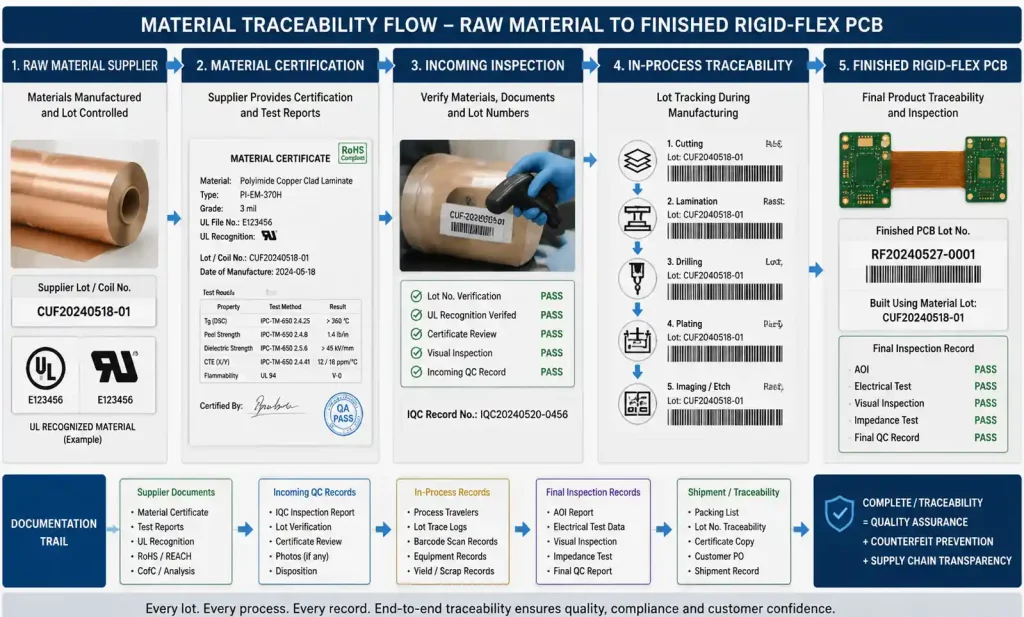
- Do they maintain traceability from material lot to finished board serial number?
- What is their incoming material inspection process?
- Do they stock commonly used flex materials, or do they order on demand?
Request specific information about the flex core materials they use:
| Material Property | Standard Grade | High-Performance Grade | Verification Method |
|---|---|---|---|
| Base material | Polyimide (PI) | High-temperature PI or LCP | Material cert + datasheet |
| Adhesive system | Acrylic adhesive | Adhesiveless (2-layer copper clad) | Cross-section analysis |
| Copper foil type | Electrodeposited (ED) | Rolled annealed (RA) | Tensile test + cert |
| Dielectric constant (1 GHz) | 3.4–3.7 | 3.2–3.5 | Impedance test report |
| Glass transition temp (Tg) | 250°C+ | 280°C+ | DSC test report |
For high-reliability applications, insist on adhesiveless flex constructions and rolled-annealed copper to minimize failure risk under repeated flexing.
Ask if the supplier can handle material substitutions if your specified material becomes unavailable. A mature supplier will have qualified alternate materials and a documented approval process for changes.

Design for Manufacturing (DFM) Review Capability
A competent rigid-flex supplier should catch design issues before fabrication begins. Poor DFM review is one of the most common causes of prototype delays and costly design iterations.
Evaluate the supplier’s DFM capability by asking:
- Do they provide a detailed DFM report before accepting the order?
- Is the review performed by experienced CAM engineers who understand rigid-flex design constraints?
- Do they check for flex-specific issues like copper tear-out risk, bend radius violations, and stiffener placement conflicts?
- Can they suggest design optimizations to improve yield or reduce cost?
A comprehensive rigid-flex DFM review should cover:
- Trace routing through flex-to-rigid transition zones
- Annular ring adequacy for vias in flex sections (minimum 3 mil recommended)
- Bend radius compliance based on layer count and copper weight
- Stiffener placement and clearance from flex bend areas
- Coverlay opening alignment with pads
- Via placement near fold lines or dynamic flex regions
- Copper balancing and stress relief features (hatched fills, teardrop pads)
- Panel utilization and depaneling method compatibility
Request a sample DFM report from a previous project (with customer information redacted) to evaluate the depth and quality of their analysis.
Process Control and Testing Infrastructure
Rigid-flex PCBs require tighter process control and more comprehensive testing than standard rigid boards. Your supplier audit should verify they have the measurement and testing equipment to validate critical parameters.
Essential testing capabilities include:
| Test Type | Purpose | Equipment Required | IPC Reference |
|---|---|---|---|
| Electrical test | Open/short detection | Flying probe or fixture test | IPC-6013 |
| Impedance test | Controlled impedance verification | TDR or VNA | IPC-2141 |
| Microsection analysis | Layer registration, plating quality | Optical microscope + sectioning | IPC-A-600 |
| Peel strength test | Adhesion of coverlay and copper | Tensile tester | IPC-TM-650 2.4.9 |
| Flexibility/bend test | Dynamic flex endurance | Flex tester with cycle counter | IPC-TM-650 2.4.5 |
| Thermal shock test | Material reliability | Thermal chamber | IPC-TM-650 2.6.7 |
Ask to see test reports from previous builds. Check whether impedance testing is performed on every panel or just on test coupons. For Class 3 applications, 100% electrical testing is mandatory, not just sample-based testing.
Verify that the supplier maintains calibration records for all test equipment and follows a documented calibration schedule traceable to national standards.

Experience with Your Application Sector
Rigid-flex PCB design rules and reliability requirements vary significantly across application sectors. A supplier with deep experience in your industry will better understand your design priorities and qualification requirements.
Ask about their experience in your specific application area:
| Application Sector | Key Design Priorities | Typical Reliability Requirements |
|---|---|---|
| Consumer electronics | Cost optimization, thin profile | IPC Class 2, limited flex cycles |
| Automotive | Temperature range, vibration resistance | IATF 16949, AEC-Q200, Class 3 |
| Medical devices | Biocompatibility, sterilization compatibility | ISO 13485, IPC Class 3 |
| Aerospace/defense | High reliability, traceability | AS9100, IPC Class 3, ITAR compliance |
| Industrial control | Wide temperature, long service life | IPC Class 2/3, UL recognition |
Request case studies or reference designs from projects similar to yours. A supplier experienced in your sector will understand application-specific challenges:
- Consumer electronics suppliers know how to optimize panel utilization for cost
- Automotive suppliers understand temperature cycling and vibration testing protocols
- Medical device suppliers are familiar with biocompatibility documentation and sterilization effects on materials
- Aerospace suppliers understand configuration control and traceability requirements
If the supplier lacks experience in your sector, they may be a poor fit even if their technical capabilities appear adequate.
Engineering Support and Technical Documentation
Responsive engineering support can make the difference between a smooth product launch and months of troubleshooting. Evaluate the supplier’s technical support infrastructure:
- Do they assign a dedicated CAM engineer or project manager to your account?
- What are their typical response times for technical questions?
- Can they assist with stackup design and impedance calculations?
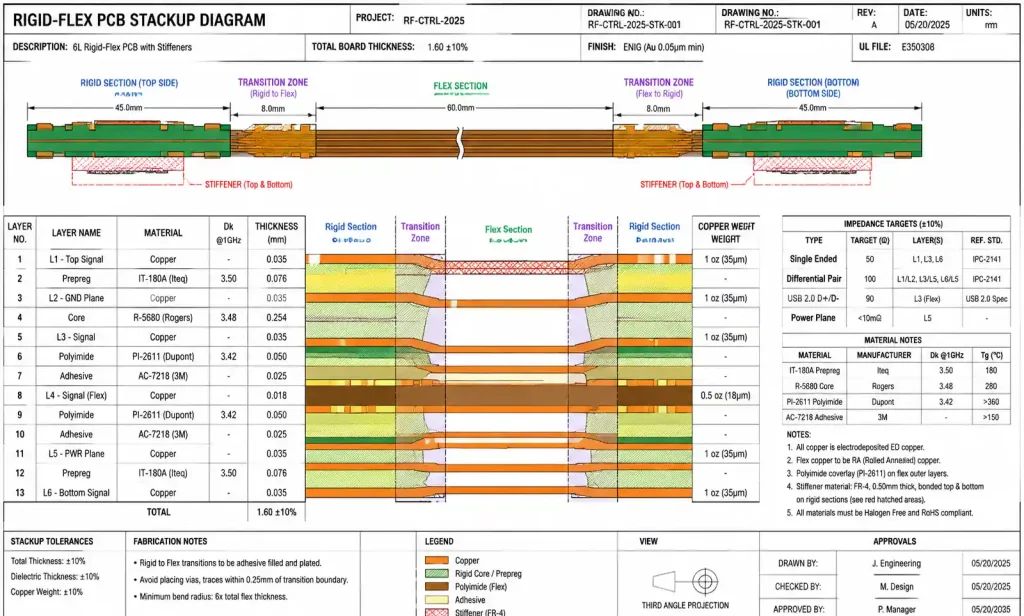
- Do they provide detailed fabrication drawings showing layer stackup, material specs, and process notes?
- Can they support design reviews via video conference or in-person meetings?
Request a sample fabrication drawing package from a previous rigid-flex project. It should include:
- Detailed layer stackup with material callouts and thicknesses
- Controlled impedance requirements and tolerances
- Rigid and flex section outlines clearly marked
- Stiffener placement and attachment specifications
- Coverlay opening dimensions and registration requirements
- Special process notes (e.g., “avoid routing through via pads in flex sections”)
Suppliers with mature engineering support will also offer:
- Online impedance calculators tailored to their material sets
- Downloadable DFM checklists and design guidelines
- Webinars or training sessions on rigid-flex design best practices
- Access to a technical library with material datasheets and process specifications
Production Capacity and Lead Time Reliability
Even a technically capable supplier is a poor choice if they cannot meet your volume and schedule requirements. During qualification, assess:
- What is their monthly rigid-flex production capacity?
- Do they prioritize rigid-flex production, or is it a small sideline to their main rigid PCB business?
- What are typical lead times for prototype vs. production quantities?
- Can they handle expedited orders, and what is the cost premium?
- How do they manage capacity during peak demand periods?
Ask for on-time delivery metrics from the past 12 months. A mature supplier should achieve 90%+ on-time delivery. Request a breakdown of reasons for late deliveries—are they due to material shortages, process issues, or capacity constraints?
Verify production capacity is adequate for your volume ramp:
- Prototype: 5–50 pieces, lead time 2–3 weeks
- Low volume: 50–500 pieces, lead time 3–4 weeks
- Production: 500–5,000+ pieces, lead time 4–6 weeks
Be cautious of suppliers who promise unrealistically short lead times. Rigid-flex PCB fabrication involves more process steps than rigid boards, and rushing can compromise quality.
Supply Chain Transparency and Risk Management
Supply chain disruptions have become increasingly common, making supplier risk management a critical qualification criterion. Evaluate how the supplier manages supply chain risks:
- Do they have backup suppliers for critical materials?
- How do they handle material shortages or obsolescence?
- Can they provide advance notice if your specified material becomes unavailable?
- Do they maintain safety stock of commonly used flex materials?
- What is their policy on material substitutions, and do they require customer approval?
Ask about their approach to counterfeit material prevention:
- Do they purchase materials directly from authorized distributors or manufacturers?
- What incoming inspection procedures do they use to detect counterfeit or substandard materials?
- Can they provide full material traceability from raw material supplier to finished board?
For high-reliability applications, request documentation of their supply chain qualification process. Verify they maintain an approved vendor list and conduct periodic audits of material suppliers.
Customer References and Track Record
Finally, speak with existing customers to validate the supplier’s claims. Request at least three customer references, preferably from companies with similar application requirements and production volumes.
When contacting references, ask:
- How long have you been working with this supplier?
- What is their typical quality level (DPPM or yield rate)?
- How responsive is their engineering support?
- Have they experienced any major quality issues, and how were they resolved?
- Do deliveries consistently meet promised lead times?
- How does this supplier compare to others you’ve used?
Research the supplier’s track record:
- How long have they been manufacturing rigid-flex PCBs?
- Have they experienced any major quality scandals or business disruptions?
- What is their financial stability? (A supplier going out of business mid-project is a catastrophic risk.)
- Do they have a reputation in industry forums and communities?
Check online reviews and discussions in PCB engineering communities (Reddit r/PrintedCircuitBoard, EEVblog Forum, PCB Design StackExchange) to gather unfiltered feedback about the supplier’s performance.
FAQ
What is the difference between IPC-6012 and IPC-6013 certification?
IPC-6012 covers rigid PCBs, while IPC-6013 specifically addresses flexible and rigid-flex PCBs. The key differences include requirements for flex material adhesion, bend testing, and coverlay inspection criteria. Always verify that a rigid-flex supplier holds IPC-6013 qualification, not just IPC-6012.
How do I verify a supplier’s material traceability claims?
Request a sample material certification package from a previous order. It should include material manufacturer certificates, UL recognition documents, and lot traceability records linking raw material lots to specific production panel serial numbers. A mature supplier can generate this documentation within 24–48 hours.
What bend radius should I specify for rigid-flex PCBs?
The minimum bend radius depends on flex layer count, copper weight, and whether the flex is dynamic (repeatedly flexed) or static (one-time installation bend). As a starting point, use 6x the flex thickness for static bends and 10x for dynamic flex applications. Your supplier should validate this based on their specific material set and construction.
Can a supplier experienced only in rigid PCBs successfully manufacture rigid-flex boards?
Generally no. Rigid-flex requires specialized equipment (coverlay lamination, selective stiffener attachment), different handling procedures (flex materials crack easily), and unique DFM expertise (transition zone design, bend radius). Suppliers new to rigid-flex typically experience high scrap rates and quality issues during their learning curve.
How much should I expect to pay for prototype vs. production rigid-flex PCBs?
Prototype pricing is typically 5–10x higher per board than production volumes due to setup costs and lower panel utilization. Expect prototype costs in the range of $500–$2,000 per board for moderately complex designs. Production costs for volumes above 500 pieces may drop to $50–$200 per board depending on complexity.
What is the most common cause of rigid-flex PCB field failures?
Copper cracking in the flex-to-rigid transition zone is the most common field failure mode, typically caused by inadequate bend radius, missing stress relief features (teardrop pads, hatched copper fills), or poor via design in flex sections. A competent supplier’s DFM review should catch these risks before fabrication.
Should I require AS9100 certification even if I’m not in aerospace?
Not necessarily. AS9100 is specifically designed for aerospace and defense supply chains and adds significant cost overhead. For non-aerospace applications, ISO 9001:2015 combined with IPC-6013 Class 3 qualification provides adequate quality assurance. Focus certification requirements on your actual regulatory and contractual obligations.
How can I evaluate a supplier’s CAM engineering capability without visiting the facility?
Request a sample DFM report and fabrication drawing package from a previous rigid-flex project (with customer data redacted). Review the level of detail, clarity of specifications, and whether the DFM report caught issues like via placement in flex zones, bend radius violations, or copper balancing problems. Also schedule a video call with their CAM engineer to discuss your design and observe their technical depth.
Conclusion
Picking a rigid‑flex PCB supplier based purely on price or lead time is a gamble—and it usually doesn’t pay off. Quality issues, delays, and costly design spins are the typical result. The 10 qualifications we covered give you a solid framework to vet suppliers and cut technical risk before you commit.Create a scorecard that weights each factor according to your priorities. For high‑reliability (automotive, medical, aerospace), lean heavily on certifications, test capabilities, and industry experience. For cost‑sensitive consumer goods, put more weight on production capacity, lead time, and DFM support.
When you send out RFQs, include not just Gerbers and BOM, but also your qualification requirements. Ask for documentation on all 10 areas before making a decision. The upfront effort saves you from quality headaches, speeds time‑to‑market, and gives you a more predictable supply chain.If you need help evaluating suppliers or want a free DFM review of your rigid‑flex design, reach out to our engineering team. We’ll help you navigate selection and design optimization so your product is manufacturable and reliable from day one.