
PCB Manufacturing for North American Market: UL and IPC Standards
Supplying PCBs to North America demands more than competitive pricing—your boards must meet UL certification and IPC standards that 70% of North American OEMs specify in their RFQs. UL recognition is mandatory for products entering regulated sectors, and IPC-6012 Class 2 or 3 compliance separates qualified suppliers from rejected quotes.
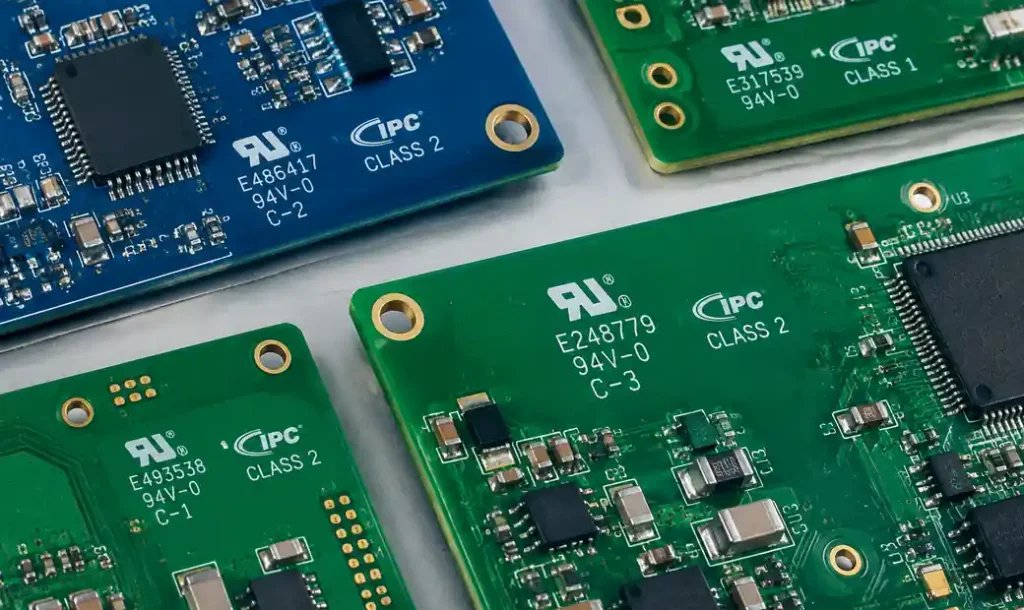
This guide covers certification requirements, quality standards, logistics, and payment terms for successfully serving U.S. and Canadian customers in 2026.
Why North American Market Demands Higher Standards
The North American electronics market generated $420 billion in 2025, with strict oversight from UL, CSA, and the FCC. Unlike markets where certifications are optional, U.S. and Canadian regulations enforce safety standards through product liability laws that make recalls average $2.3 million per incident.
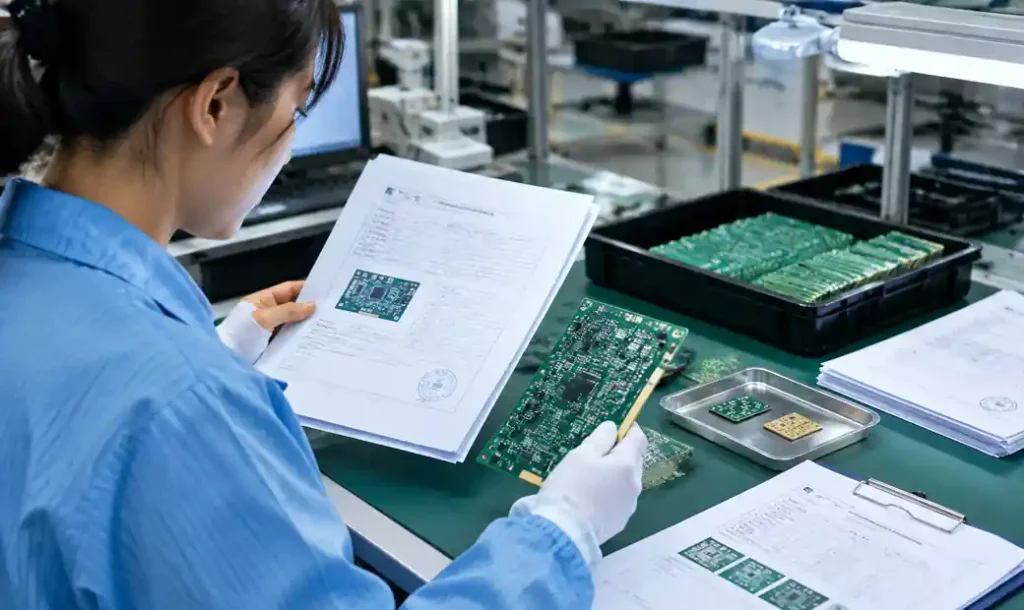
North American buyers prioritize compliance documentation, traceability, and consistent quality above cost. Without UL certification and IPC compliance, your boards cannot enter most supply chains regardless of price advantages.
UL Certification Requirements
UL 796 Standard Overview
UL 796 defines safety requirements for rigid PCBs sold in North America. Updated November 2025, it mandates five critical tests that your boards must pass for UL recognition.
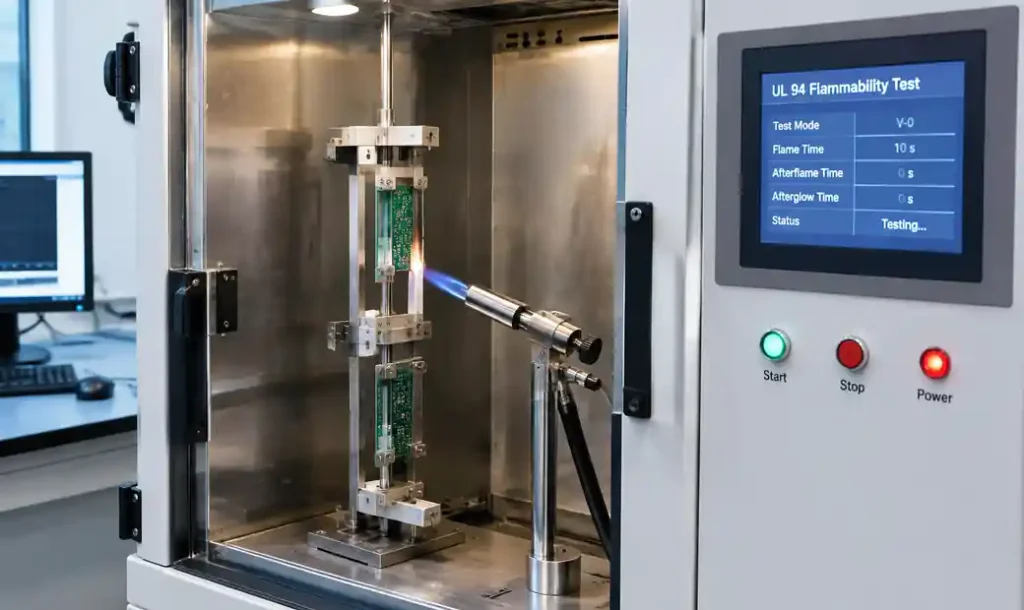
Flammability testing follows UL 94 with V-0, V-1, or V-2 ratings. Most customers require V-0 (self-extinguishing within 10 seconds) for consumer electronics, automotive, and medical applications. The test exposes boards to direct flame measuring burn time and dripping.
Dielectric withstanding voltage requires 40V per mil (1.6kV/mm) between conductors, tested at 500V for 60 seconds. High-voltage applications need 60V/mil verified through destructive testing.
Bond strength ensures copper-to-laminate adhesion meets 6 lbs/inch minimum per IPC-TM-650. The 90-degree peel test catches poor lamination or surface contamination before assembly failures occur.
| UL 796 Test | Requirement | Test Method | Application |
|---|---|---|---|
| Flammability | V-0 rating (10s self-extinguish) | UL 94 | Consumer, automotive, medical |
| Dielectric Strength | 40V/mil (1.6kV/mm) | UL 796 Section 8 | All applications |
| Bond Strength | 6 lbs/inch minimum | IPC-TM-650 2.4.8 | Mechanical stress environments |
| Moisture Resistance | <5% weight gain | UL 796 Section 10 | High-humidity operation |
| Thermal Stress | No delamination at 288°C | IPC-TM-650 2.4.13 | Lead-free assembly |
UL Recognition Process
Obtaining a UL file number requires submitting production samples for 6-8 week laboratory testing. The UL Recognition Mark (UR) appears on component PCBs incorporated into assemblies. Your manufacturer must print the UL file number and flame rating (e.g., “94V-0”) on each board—North American purchasing departments verify these against the UL database before approving suppliers.
IPC Standards for Manufacturing Quality
IPC-6012 Class Requirements
IPC-6012 defines three quality classes based on reliability requirements. North American buyers specify classes in RFQs—using the wrong class means automatic rejection.
Class 1 (General Electronic Products) permits cosmetic imperfections and 0-mil annular ring breakout on internal layers. This covers 2-5 year lifespan consumer electronics where cost matters most.
Class 2 (Dedicated Service) represents the North American mainstream, covering computers, telecom, and industrial controls. Minimum annular ring increases to 1 mil internal and 2 mils external for extended reliability.
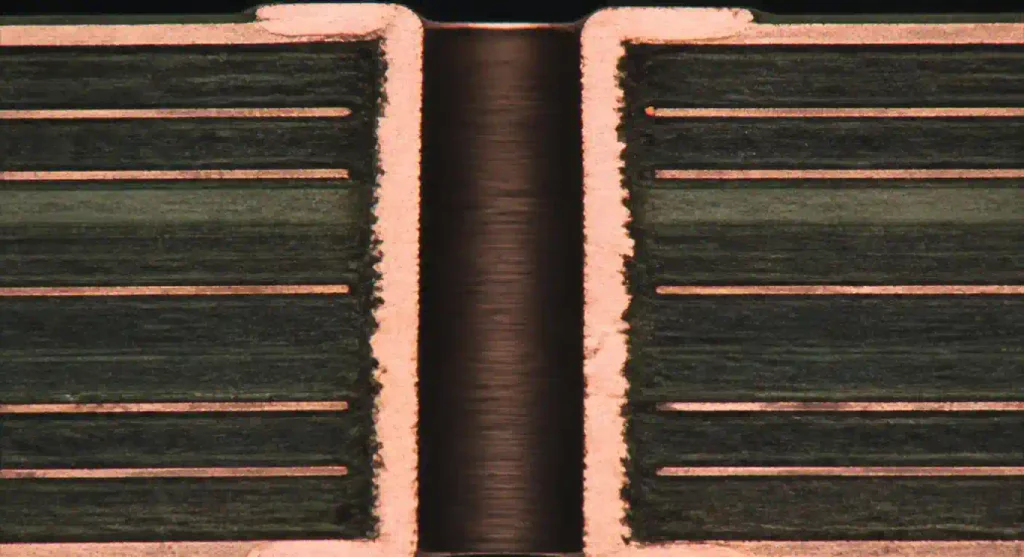
Class 3 (High-Performance) serves life-safety applications—medical devices, aerospace, military. Requirements include 2 mil minimum annular rings on all layers, 75% via barrel fill, and zero cosmetic defects. Production yield drops 15-25% versus Class 2.
| Parameter | Class 1 | Class 2 | Class 3 | Application Focus |
|---|---|---|---|---|
| Annular Ring (External) | 1 mil | 2 mil | 2 mil | Mechanical strength |
| Annular Ring (Internal) | 0 mil breakout OK | 1 mil | 2 mil | Electrical reliability |
| Via Barrel Fill | 25% minimum | 50% minimum | 75% minimum | Thermal cycling |
| Copper Thickness Tolerance | -20% to +30% | -15% to +20% | -10% to +15% | Current capacity |
| Registration Accuracy | ±6 mils | ±4 mils | ±3 mils | Fine-pitch components |
IPC-A-600 Acceptability Standards
IPC-A-600 illustrates acceptable versus defective conditions through visual examples. Inspectors use this during incoming quality control to accept or reject shipments.
Conductor spacing must meet design minimums with zero violations—a 5-mil spacing cannot show 4.9 mils anywhere. North American buyers reject entire panels for single violations flagged by automated inspection.
Solder mask registration requires 2-mil minimum pad coverage on Class 2 boards. Exposed copper causes solder bridging. Class 3 demands 3-mil coverage with zero voids larger than 0.125 square inches.
Shipping Logistics and Lead Times
Air vs Sea Freight Economics
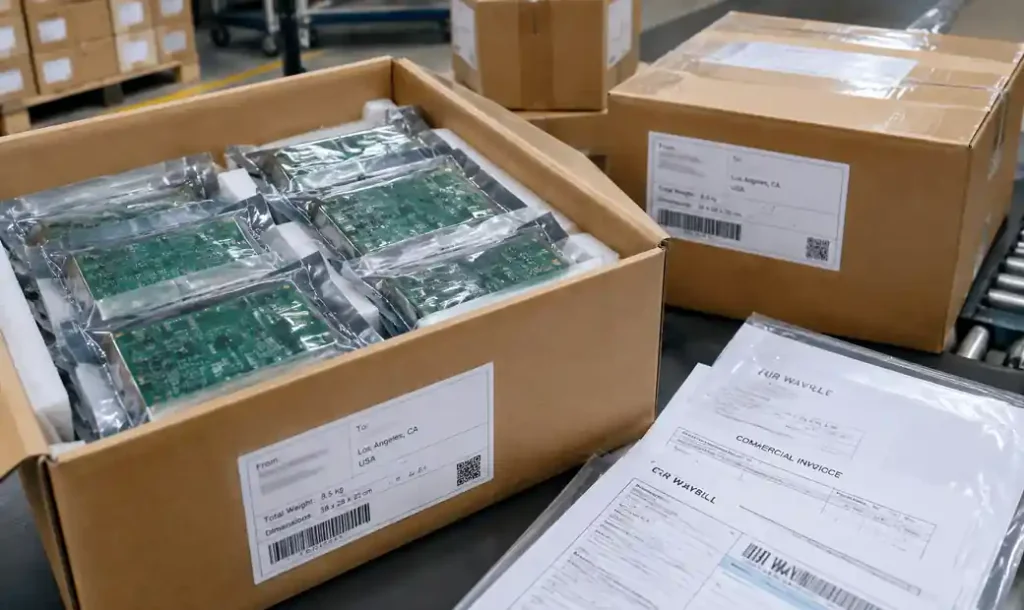
Prototype and low-volume orders ship via air freight—5-7 days Shenzhen to Los Angeles door-to-door. Express delivers in 3-4 days at 40-60% premium. Sea freight becomes economical above 100kg, taking 25-30 days to West Coast (add 10-14 days for East Coast). Electronics shipments clear customs in 2-3 days average, extending to 10 days during peak seasons.
Current tariff environment: September 2026 bare PCBs from China face 10% base tariff (HTS 8534) plus 25% Section 301 on multilayer boards—35% total. The 2026 tariff landscape changed twice already this year; verify current rates before quoting.
USMCA Considerations
The United States-Mexico-Canada Agreement provides duty-free treatment for PCBs meeting 75% regional value content. This benefits Mexican manufacturers sourcing from North American suppliers. Canadian PCBs traditionally entered duty-free, but September 2026 trade tensions introduced temporary tariffs—verify current USMCA status with customs brokers before committing.
Payment Terms and Currency
Standard Payment Practices
U.S. buyers expect Net 30 terms as standard, with Fortune 500 companies demanding Net 60-90. New suppliers start with 50% deposit and 50% upon delivery, transitioning to standard terms after 3-6 months payment history.
Small buyers prefer credit cards through platforms like Alibaba Trade Assurance (2.5-3.5% fees). Orders exceeding $50,000 use letters of credit—banks guarantee payment upon proof of shipment at 0.5-1.5% transaction fees.
Currency risk: RMB/USD fluctuated 6.5% in 2025, potentially eliminating margins on fixed-price contracts. Consider hedging tools or exchange rate adjustment clauses for agreements exceeding six months.
Documentation Requirements
Commercial Invoice and Customs
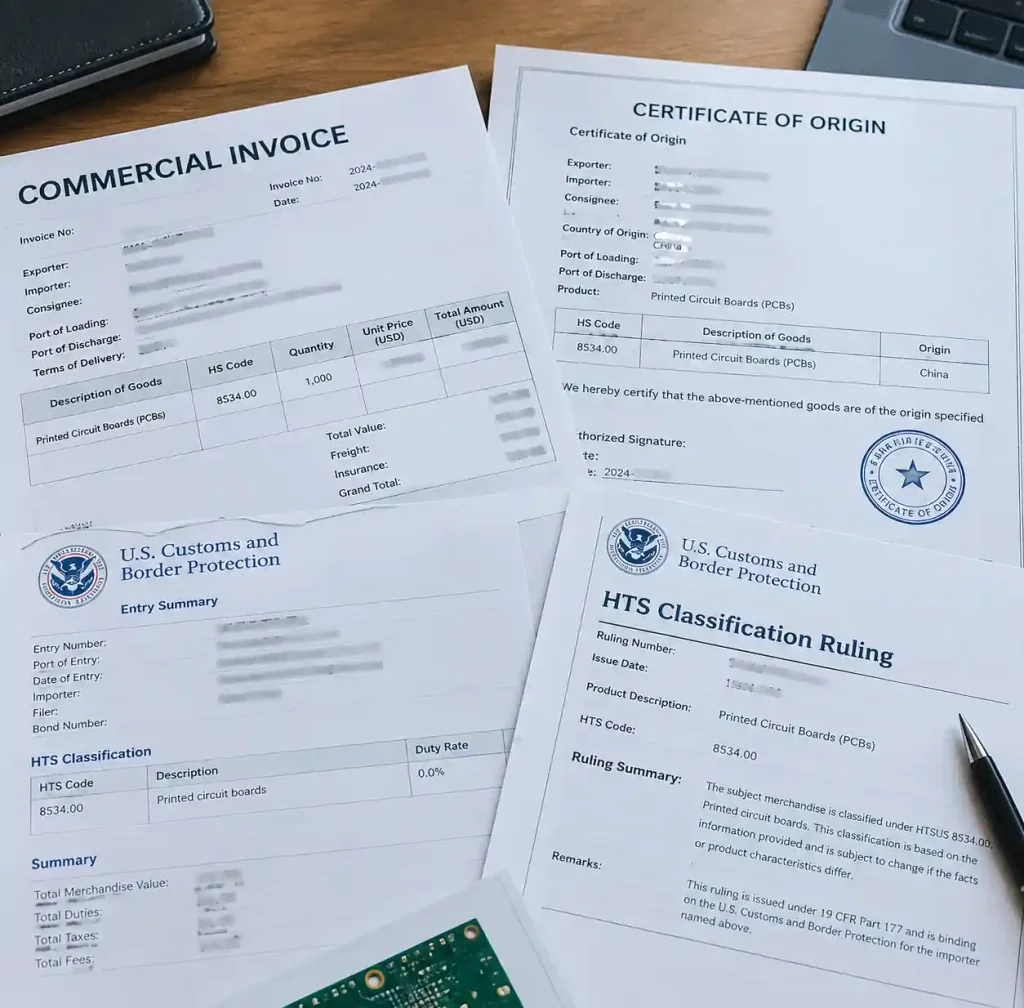
U.S. Customs requires detailed commercial invoices with HTS codes, country of origin, and material composition. Misclassification triggers audits and retroactive duties extending three years back.
Include on every shipment: manufacturer and buyer details, product descriptions (not just “PCB”), quantity/price, HTS codes, and clear Incoterms. Certificate of Origin is mandatory when claiming USMCA benefits—must be signed by manufacturer and retained five years. False origin claims carry $10,000 per violation penalties.
Quality Expectations Beyond Certifications
First Article Inspection
North American buyers expect First Article Inspection reports documenting pilot production meets specs. Complete FAI includes dimensional verification, cross-section analysis showing copper thickness and via barrel fill, impedance testing, and J-STD-003 solderability testing. Medical and aerospace customers require full AS9102 FAI with balloon drawings tracing every measurement.
Ongoing Documentation
Provide Certificates of Conformance with every shipment certifying IPC class, UL flame rating, and material specs. Include test coupon results for impedance and copper thickness. Implement lot coding linking finished boards to raw material batches, plating chemistry, and operator certifications—critical for failure analysis and regulatory audits.
Selecting Manufacturers for North American Supply
Certification Verification
Verify active UL file numbers through UL Product iQ database. Confirm IPC-A-600 and IPC-A-610 certified inspectors work at the facility—certifications require biennial renewal. ITAR compliance is necessary for defense PCBs—the State Department restricts technical data sharing, requiring domestic manufacturing or approved facilities with technology transfer agreements.

Capability Assessment
North American customers evaluate beyond certifications. Assess minimum trace widths—5/5 mil (125/125μm) is standard capability, 3/3 mil indicates advanced processes. Layer count should reach 16+ for complex designs.
Lead time reliability matters more than speed. Supply chains plan around committed dates, making predictability more valuable than rushed production. Late deliveries damage relationships more than slightly longer quoted times—implement systems for accurate quotes and consistent delivery.
Andwin Circuits North American Expertise
Andwin Circuits serves North American OEMs with full UL certification and IPC-6012 Class 3 capabilities. Our quality system delivers 98.5% on-time performance with complete traceability documentation that U.S. and Canadian buyers require.
We manufacture 1-50 layer PCBs with 3/3 mil trace capabilities and controlled impedance testing standard. Fast-turn prototypes ship in 7 days, production volumes in 10-15 days. Our team understands North American documentation requirements and provides complete customs packages with every shipment.
Reference our PCB assembly inspection guide for quality standards and manufacturer selection guide for capability assessment.
FAQ
What is the difference between UL Recognition and UL Listing for PCBs?
UL Recognition (UR mark) applies to component PCBs incorporated into assemblies. UL Listing (UL mark) applies to complete end products. Most bare PCBs carry UL Recognition. Testing requirements under UL 796 remain identical for both.
How long does UL certification take for new PCB designs?
Initial UL file establishment takes 6-8 weeks for testing. Once a manufacturer has a UL file, adding new constructions using approved materials takes 2-3 weeks. Existing UL recognition can cover your boards if they use listed materials and processes.
Do I need different certifications for USA vs Canada?
UL and CSA have mutual recognition agreements for most PCB applications. UL-recognized PCBs typically satisfy Canadian requirements, though some products need specific CSA testing. Verify with your customer whether C-UL or CSA marks are specifically required.
What are current PCB tariff rates from China to USA?
September 2026 rates: bare PCBs (HTS 8534) face 10% base plus 25% Section 301 on multilayer boards (35% total). Simple 2-layer and 4-layer boards qualify for lower rates. Rates changed multiple times in 2026—verify before shipping.
How does IPC Class 3 affect manufacturing cost?
Class 3 increases costs 20-35% versus Class 2 due to tighter tolerances, additional inspections, and lower yields. Stricter annular ring, via fill requirements, and zero defect acceptance reduce throughput. Only specify Class 3 when reliability requirements justify the premium.
Conclusion
Successfully supplying North America requires understanding that compliance and documentation equal technical capabilities in importance. UL certification provides required safety validation while IPC-6012 Class 2 or 3 compliance ensures quality expectations built into purchasing specifications. Master logistics including tariffs, shipping, and customs documentation for competitive landed costs. Establish payment terms balancing your cash flow with buyer expectations. Most importantly, implement quality systems providing the traceability and consistency North American supply chains demand for long-term partnerships.