
Automotive PCB Requirements: AEC-Q100 and IATF 16949 Compliance Guide
If you design PCBs for automotive electronics, you need to understand AEC-Q100 qualification testing and IATF 16949 quality management requirements that ensure reliability in harsh automotive environments where failure affects vehicle safety.
Automotive electronics now account for 35-40% of vehicle cost, climbing to 50%+ in electric vehicles. From ADAS systems to battery management handling 400V+ in EVs, automotive PCBs face conditions that destroy standard boards within months. Temperature swings from -40°C to +150°C, continuous vibration, chemical exposure, and 15-year lifespan demand rigorous qualification.
This guide covers essential AEC-Q100 stress testing and IATF 16949 quality requirements for manufacturing automotive-grade PCBs.
What Are Automotive PCB Standards?
Automotive PCB standards define qualification testing and quality management for electronics surviving extreme vehicle conditions. Unlike consumer electronics in controlled environments, automotive PCBs face temperature extremes under the hood, constant vibration, exposure to automotive fluids, and must function reliably for 10-15 years.
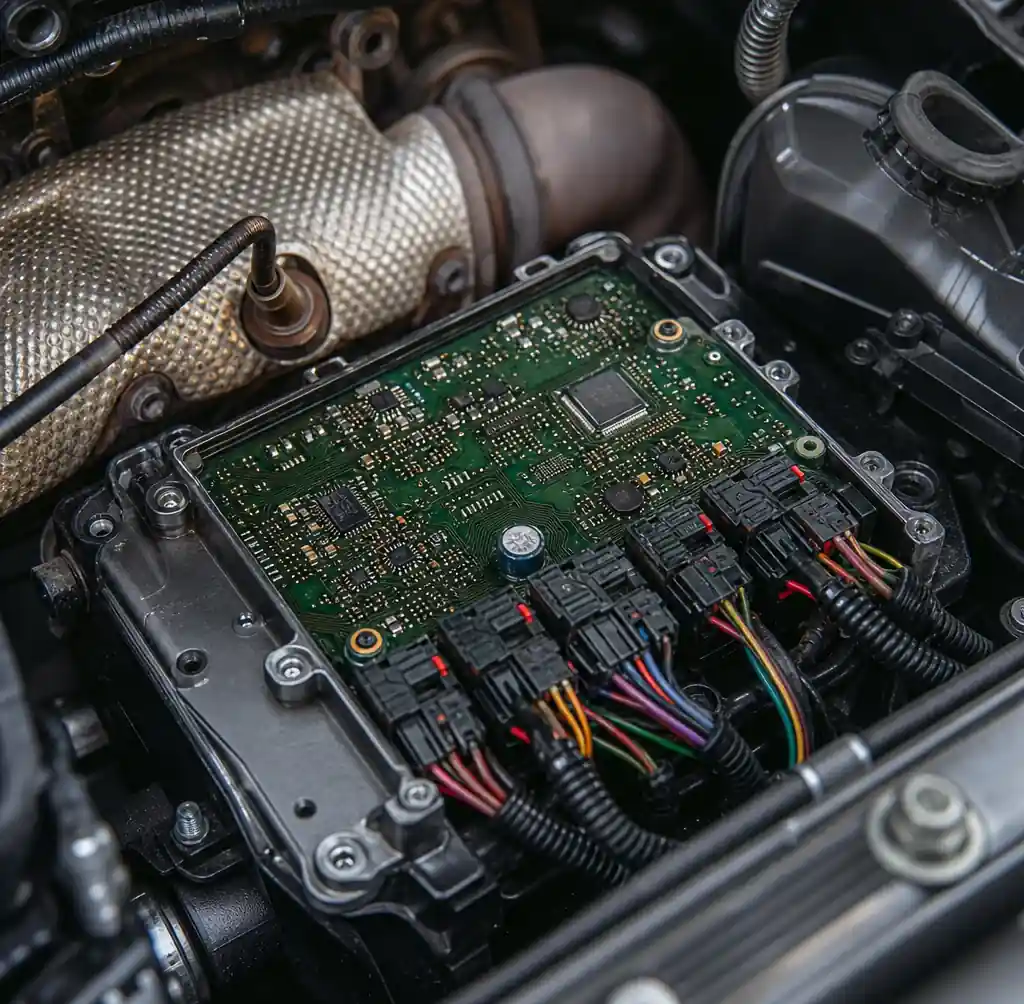
The two primary standards governing automotive PCB manufacturing are AEC-Q100 for component qualification and IATF 16949 for quality systems. Automotive-grade PCBs cost 30-50% more than industrial boards due to enhanced materials, testing, traceability, and zero-defect manufacturing.
AEC-Q100 Qualification Standard
AEC-Q100 is a stress test qualification standard developed by the Automotive Electronics Council ensuring components meet automotive reliability. While designed for integrated circuits, testing principles apply to PCB assemblies.
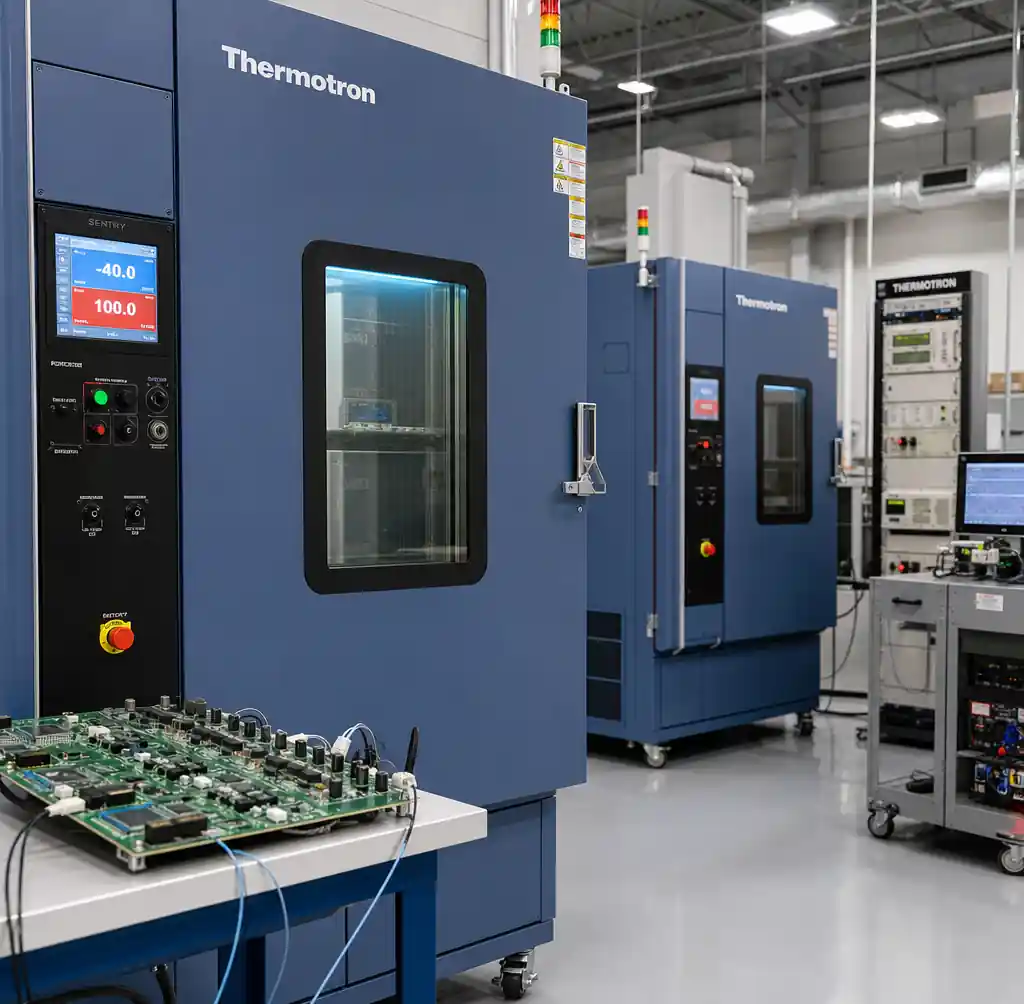
The standard defines stress tests accelerating aging to validate lifespan survival. Tests include temperature cycling verifying solder joint integrity, high temperature operating life (HTOL) compressing years into weeks, and environmental stress tests covering humidity, shock, and EMC. Design changes or material substitutions require re-qualification.
Temperature Grade Classifications
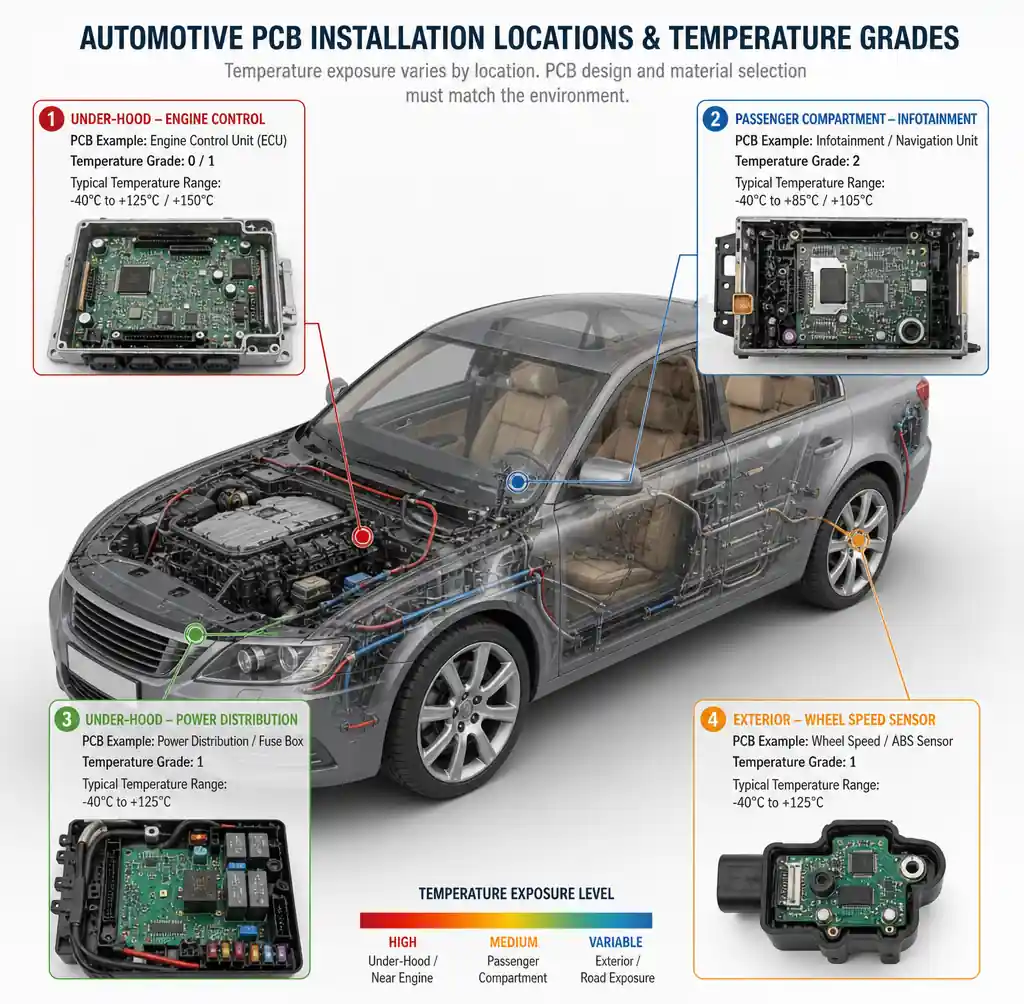
AEC-Q100 defines four temperature grades that classify automotive electronics by their operating environment and thermal stress requirements.
| Grade | Temperature Range | Typical Applications | PCB Requirements |
|---|---|---|---|
| Grade 0 | -40°C to +150°C | Engine control, turbocharger electronics, exhaust systems | High-Tg polyimide or specialized FR-4 (Tg >170°C) |
| Grade 1 | -40°C to +125°C | Under-hood electronics, transmission control, ABS systems | High-Tg FR-4 (Tg 150-170°C), controlled impedance |
| Grade 2 | -40°C to +105°C | Passenger compartment, dashboard, infotainment systems | Standard FR-4 (Tg 130-150°C) acceptable |
| Grade 3 | -40°C to +85°C | Low-stress environments, some sensor applications | Standard FR-4 |
Choose grade based on PCB location and maximum temperature. Under-hood applications require Grade 0 or Grade 1. Grade 1 is most common, balancing performance with costs. Temperature cycling validates reliability across the range—Grade 1 components undergo 1000-2000 thermal cycles with rapid transitions creating stress on solder joints.
IATF 16949 Quality Management System
IATF 16949 is the international automotive quality standard defining requirements for design, development, production, and servicing. This builds on ISO 9001 adding automotive-specific requirements for defect prevention and variation reduction.
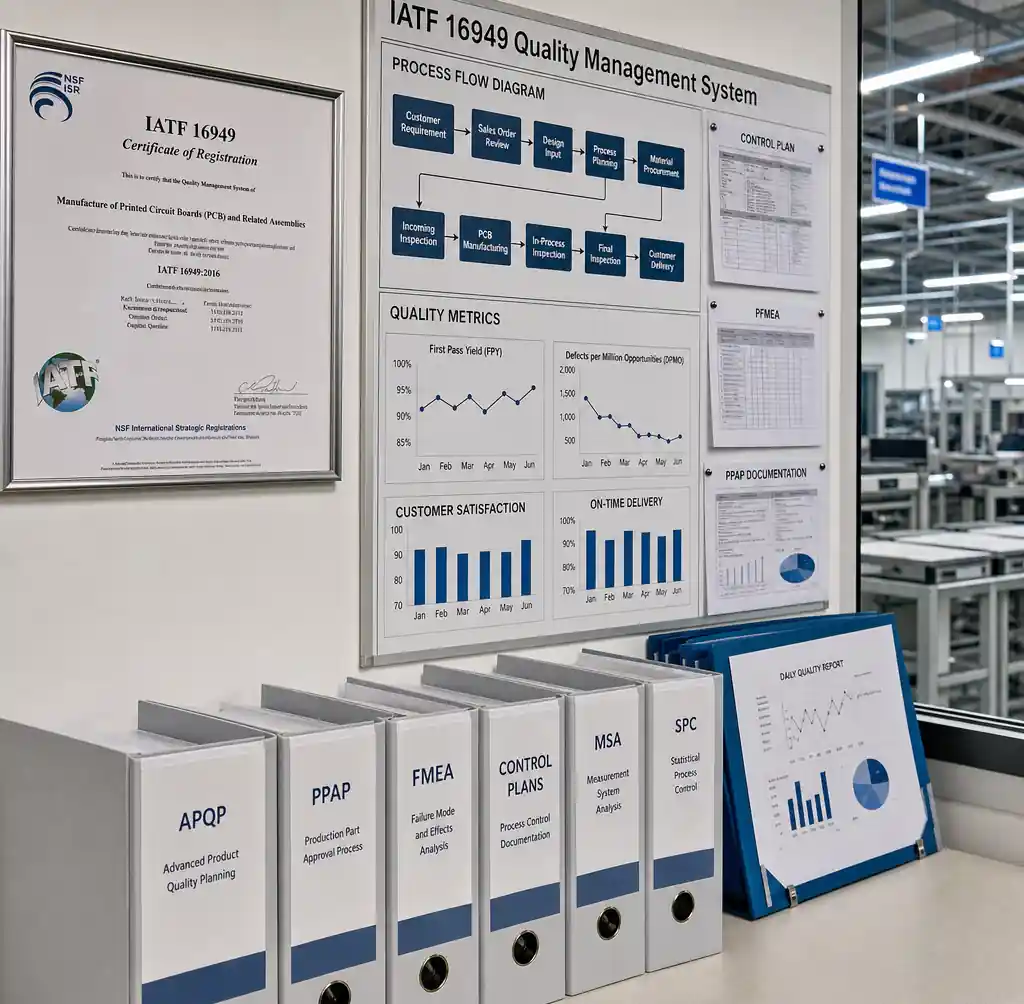
PCB manufacturers supplying automotive OEMs must achieve IATF 16949 certification. Key requirements include Advanced Product Quality Planning (APQP), Production Part Approval Process (PPAP), Failure Mode and Effects Analysis (FMEA), Statistical Process Control (SPC), and Measurement System Analysis (MSA). Maintain complete traceability from raw materials through finished product. Certification requires 12-18 months preparation and third-party audit, with surveillance audits every six months.
Automotive PCB Design Requirements
Layer Count and Stackup Design
Most automotive applications require 6-12 layer PCBs for power distribution, signal routing, and ground planes needed for EMC. PCB stackup design should place ground planes adjacent to high-speed signals providing return paths and minimizing EMI.
Thermal Management
Power electronics generate significant heat. Use thermal management techniques including thermal vias connecting components to copper planes and adequate copper pour for heat spreading. For applications exceeding 50W, consider metal core PCB with aluminum substrates providing 1-8 W/m·K conductivity versus 0.3 W/m·K for FR-4.
Via Reliability
Use 0.3mm minimum drill with 0.15mm minimum annular ring. For HDI PCB requiring microvias, specify filled and capped vias. Avoid via in pad unless completely filled with conductive epoxy and plated over. Staggered vias distribute stress better than stacked vias.
Material Selection for Automotive PCBs
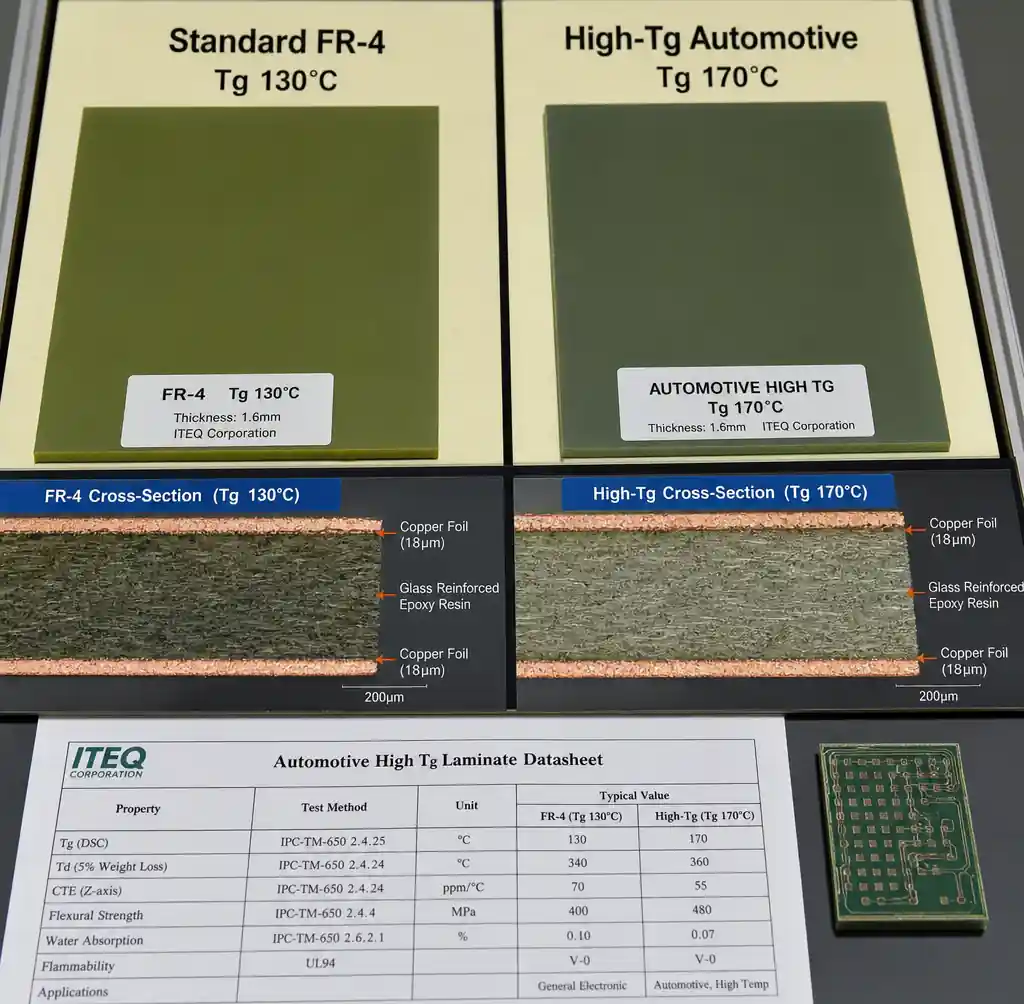
Standard FR-4 with Tg 130-140°C fails Grade 1 under-hood requirements, requiring high-temperature materials.
| Material Property | Standard PCB | Automotive Grade 1 | Automotive Grade 0 |
|---|---|---|---|
| Glass Transition Temp (Tg) | 130-140°C | 150-170°C | 170-180°C+ |
| Decomposition Temp (Td) | 300-320°C | 340-360°C | 360°C+ |
| CTE Z-axis | 50-70 ppm/°C | 40-55 ppm/°C | 35-45 ppm/°C |
| Moisture Absorption | 0.10-0.15% | <0.10% | <0.08% |
| Operating Temperature | Up to 130°C | Up to 150°C | Up to 170°C |
High-Tg FR-4 provides adequate performance for most Grade 1 applications while remaining cost-effective. For Grade 0 or high-frequency radar, polyimide substrates offer Tg above 250°C but cost 3-5x more.
Conformal Coating Requirements
Conformal coating provides environmental protection against moisture, dust, chemicals, and contamination. Automotive applications face oils, fuels, brake fluids, and road salt degrading unprotected assemblies.
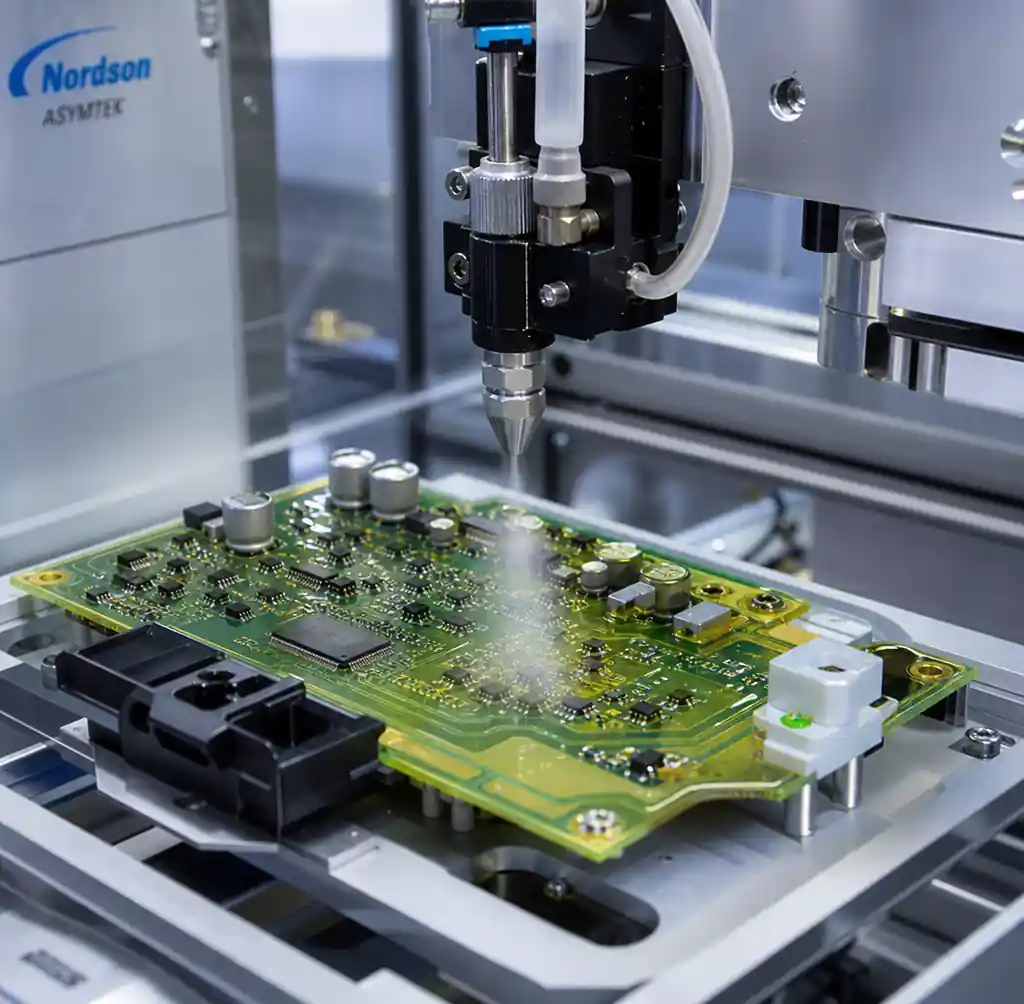
Common types include acrylic (AR) offering moisture protection with easy rework, polyurethane (UR) providing superior chemical resistance, and silicone (SR) maintaining flexibility across -55°C to +200°C. Specify conformal coating thickness 25-75 microns. Testing includes thermal cycling, humidity at 85°C/85% RH for 1000+ hours, and salt spray per ASTM B117.
Testing and Validation Requirements
Automotive PCBs undergo extensive testing before production approval and throughout manufacturing.
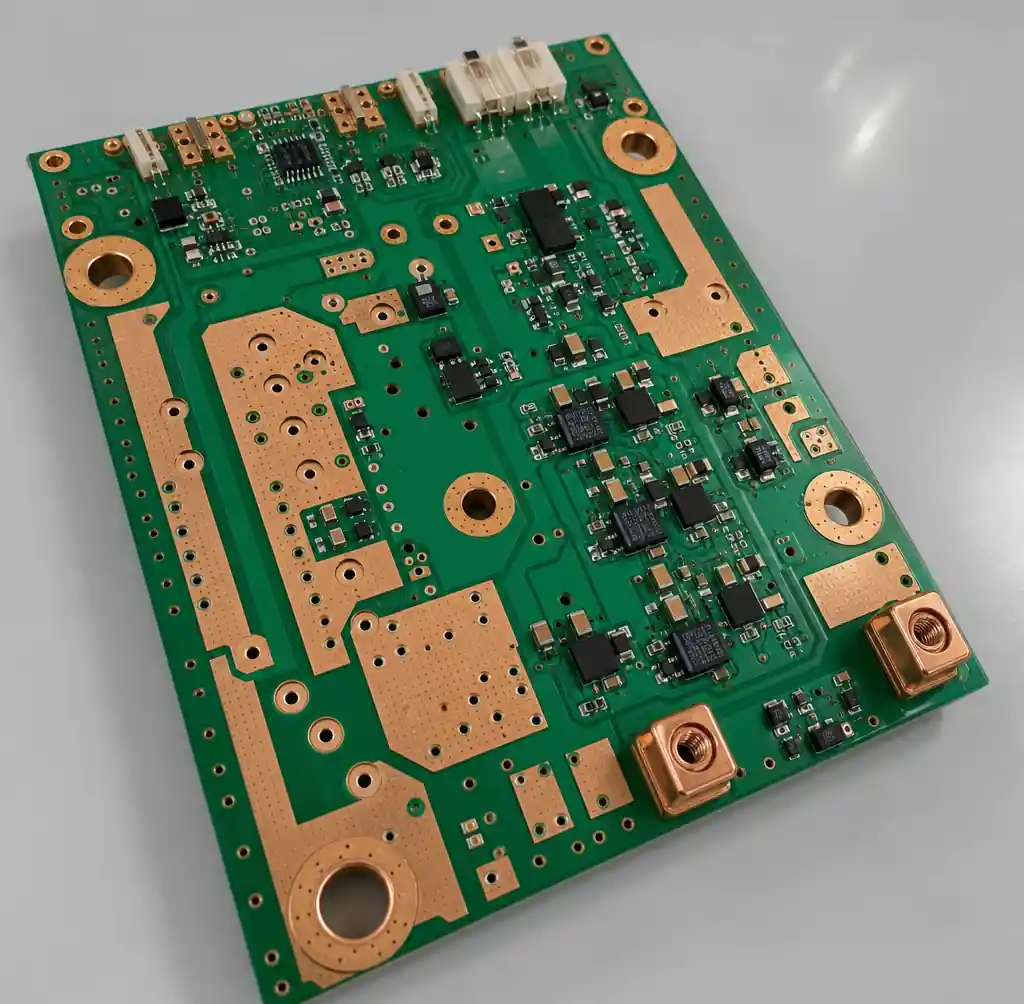
Pre-production validation includes DFM review, electrical testing, impedance testing confirming controlled impedance, and thermal analysis. Perform accelerated life testing: 1000-2000 temperature cycles, vibration testing, humidity testing at 85°C/85% RH for 1000+ hours, and thermal shock.
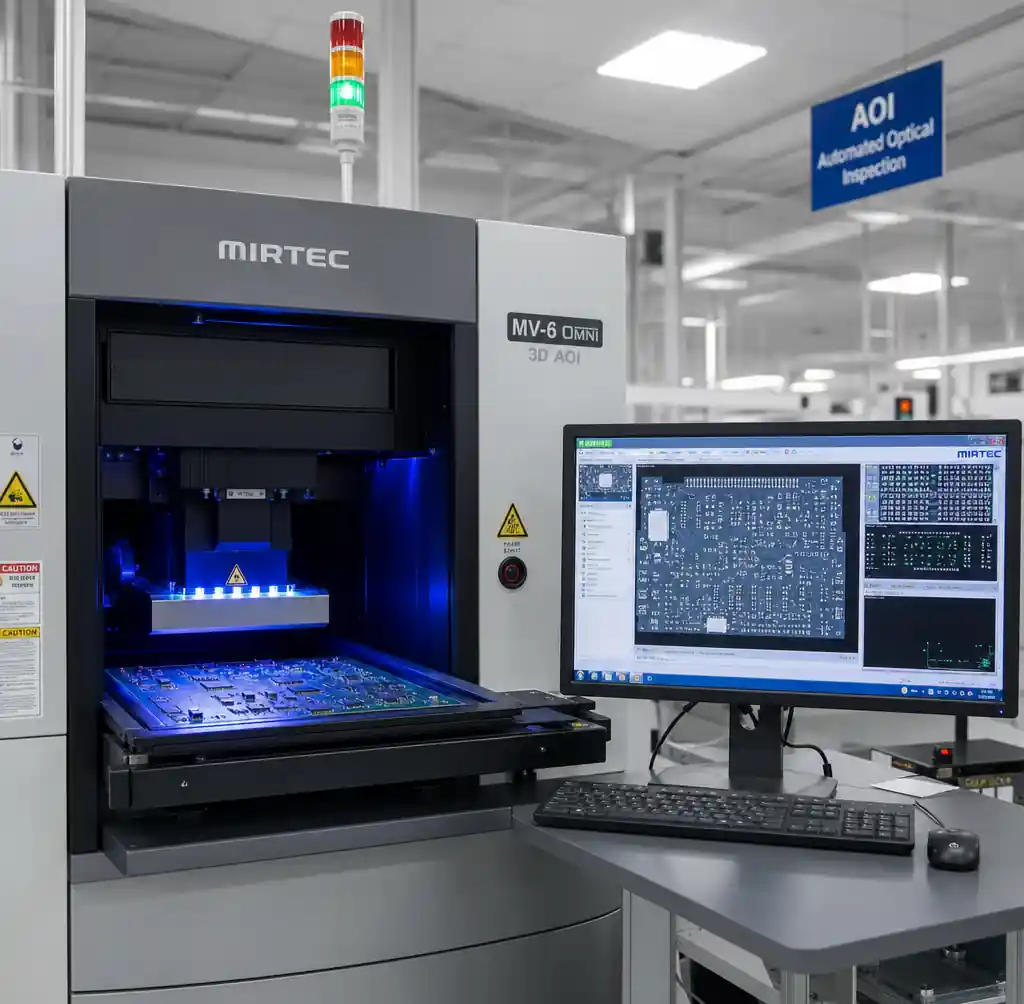
Production testing includes 100% electrical testing per PCB E-test, automated optical inspection (AOI), X-ray inspection for BGA components, and functional testing. Documentation requires complete traceability, material certificates, test reports, and PPAP documentation maintained 15-20 years.
FAQs
What is the difference between AEC-Q100 and IATF 16949?
AEC-Q100 is a component qualification standard defining stress tests validating reliability, while IATF 16949 is a quality management system standard defining manufacturing processes. You need AEC-Q100 qualification proving product design meets automotive reliability, and IATF 16949 certification proving your facility consistently produces quality products.
How long does automotive PCB qualification take?
Typically 3-6 months for complete testing including temperature cycling (1000-2000 cycles), humidity testing (1000+ hours), and vibration testing. Rush programs compress to 8-12 weeks but may miss failure modes appearing after extended stress.
Can standard FR-4 be used for automotive PCBs?
Standard FR-4 with Tg 130-140°C is acceptable only for Grade 3 applications. Grade 1 and Grade 0 require high-Tg FR-4 (Tg 150-170°C+) or polyimide. Standard FR-4 in under-hood applications fails rapidly.
What copper thickness is required for automotive power electronics?
For 20-50A, specify 2oz copper (70μm) on power layers. High-current applications above 50A require 3oz-6oz heavy copper. Calculate using current density limits of 20-30 A/mm² internal layers.
Is conformal coating required for all automotive PCBs?
Conformal coating is required for PCBs exposed to environmental conditions including under-hood electronics, exterior sensors, and assemblies facing moisture or chemical exposure. Passenger compartment electronics in sealed enclosures may not require coating depending on OEM specifications.
Conclusion
Meeting automotive PCB requirements demands rigorous attention to AEC-Q100 qualification testing and IATF 16949 quality management. Temperature cycling validation, proper material selection for Grade 1 operation (-40°C to +125°C), adequate copper thickness for high current handling, and comprehensive environmental protection through conformal coating create the foundation for automotive reliability.
If you need automotive-grade PCBs for ADAS systems, EV power electronics, or safety-critical applications, Andwin Circuits offers IATF 16949 certified manufacturing with comprehensive testing capabilities. Our facility manufactures automotive PCBs meeting AEC-Q100 qualification requirements with complete traceability, supporting designs from 4 to 50 layers with heavy copper options up to 6oz.
Contact us today for automotive PCB manufacturing with IATF 16949 certification, AEC-Q100 qualification testing support, and technical consultation.