
Conformal Coating for PCB: Types, Application, and Selection Guide
A field failure traced back to a $0.02 coating decision is the most expensive mistake in electronics. Moisture, salt fog, and condensation short fine-pitch traces long before the silicon ever wears out.
Conformal coating is the thin polymer film that keeps that from happening. But picking the wrong chemistry, thickness, or application method causes as many field returns as skipping the coating entirely. This guide gives you the exact numbers, standards, and shop-floor rules our engineers use so you specify it right the first time.
What Is Conformal Coating?
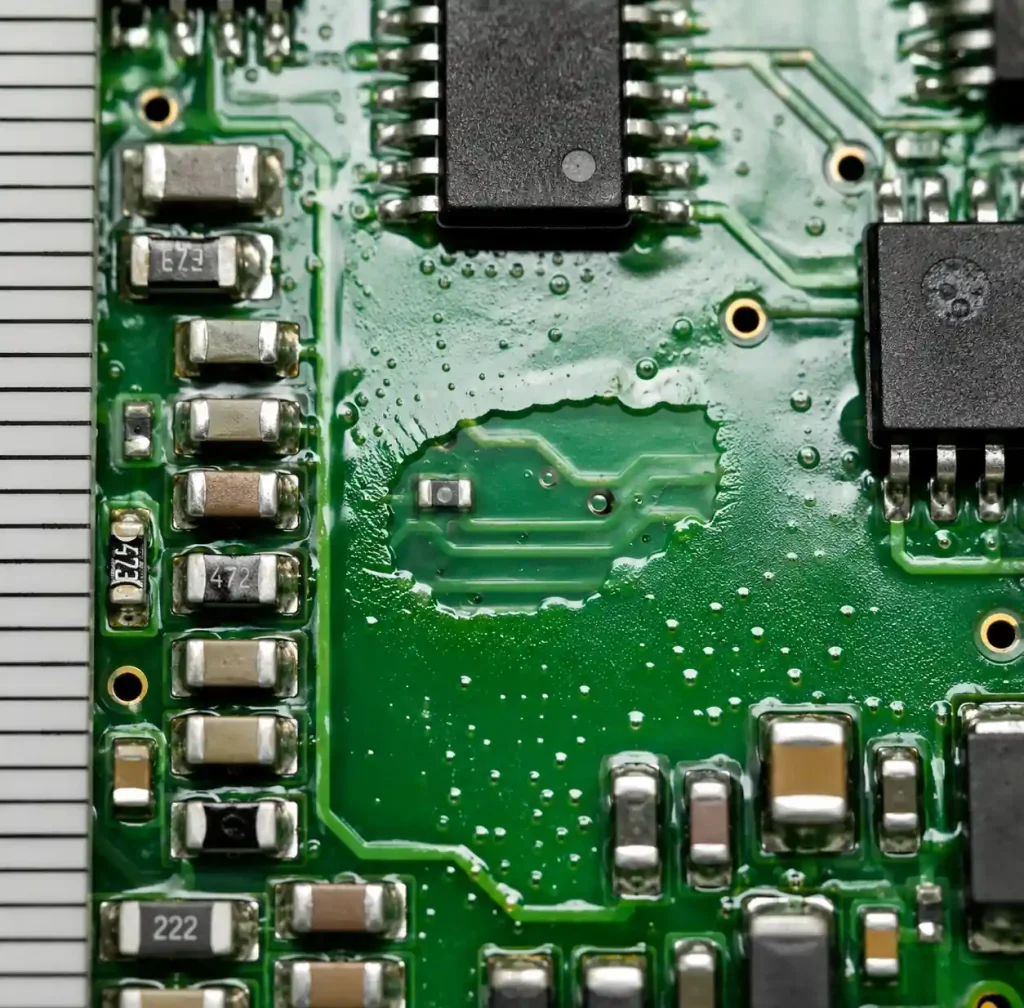
Conformal coating is a dielectric polymer film, typically 25-127 µm (1-5 mil) thick, applied over a populated board to insulate it from its environment. It “conforms” to the topology of the components rather than encapsulating them in a solid block like potting.
The film raises surface insulation resistance, which suppresses dendrite growth and electrochemical migration between closely spaced conductors. It blocks humidity, condensation, dust, salt spray, chemicals, and fungus. One insider caveat: coating slows tin-whisker growth but does not prevent it, a point NASA’s NEPP program confirmed in whisker testing.
The 5 Coating Types Compared
IPC-CC-830 classifies coatings by a two-letter code: acrylic (AR), urethane (UR), silicone (SR), epoxy (ER), and parylene (XY). Each trades cost against temperature range, chemical resistance, and how easily you can rework it later.
| Type | Thickness | Temp Range | Chemical Resist. | Rework | Best For |
|---|---|---|---|---|---|
| Acrylic (AR) | 25-75 µm | -60 to +125°C | Poor | Easiest (solvent) | Consumer, general-purpose |
| Urethane (UR) | 25-127 µm | -65 to +130°C | Excellent | Hard | Fuel, solvent exposure |
| Silicone (SR) | 25-210 µm | -55 to +200°C | Good | Hard | High-temp, vibration |
| Epoxy (ER) | 25-75 µm | -65 to +150°C | Excellent | Near impossible | Abrasion, rugged |
| Parylene (XY) | 12-50 µm | -70 to +125°C | Excellent | Hardest (plasma) | Medical, aerospace |
Acrylic dominates commercial and industrial control work because it dries in minutes and dissolves in common solvents, so field repair stays cheap. Silicone is the go-to for anything that runs hot or vibrates, LED drivers and drone flight controllers included, thanks to its 200°C ceiling and flexibility. Urethane and epoxy resist fuels and abrasion but fight you at rework. Parylene is a class apart: a vacuum-deposited, pinhole-free film that reaches crevices no liquid can, which is why it protects implantable and medical electronics.
How to Select a Coating
Match the chemistry to the dominant stressor, not to habit. Start with the harshest condition the board sees in service, then work backward.
For wide thermal swings and vibration, specify silicone. For chemical or fuel splash in automotive under-hood modules, urethane. For maximum barrier performance on high-density or safety-critical boards where rework is not expected, parylene. For cost-sensitive volume that may need field service, acrylic. When two stressors compete, weight the one that causes field returns, usually moisture plus temperature cycling.
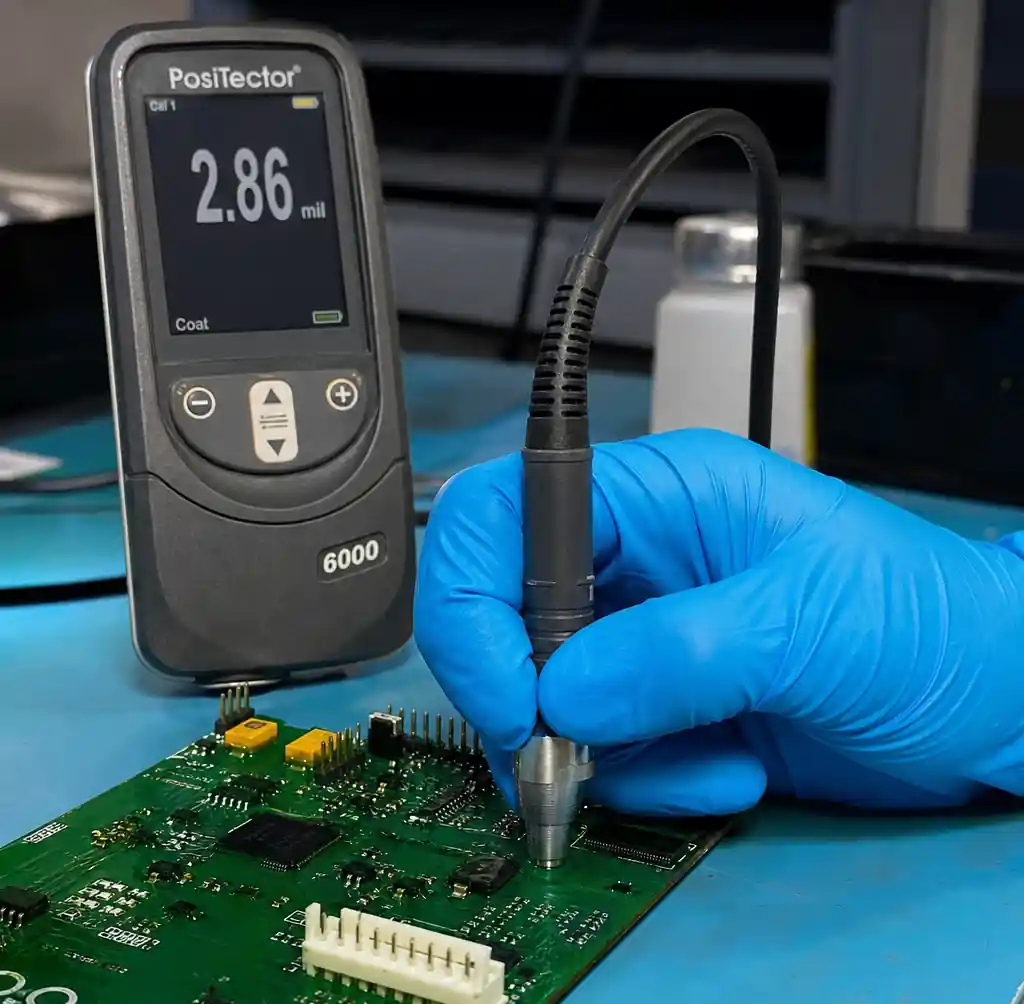
Thickness follows the chemistry. Liquid coatings target 25-75 µm dry per IPC-A-610 acceptance criteria; parylene delivers equivalent protection at 12-25 µm because the film is uniform and pinhole-free.
Application Methods
How you apply the coating decides film uniformity, throughput, and how much masking you’ll need. Five methods cover nearly all production.
| Method | Thickness Control | Throughput | Masking Needed |
|---|---|---|---|
| Brush | Poor | Low | Minimal |
| Aerosol spray | Fair | Low-med | Heavy |
| Automated spray | Good | High | Moderate |
| Dip | Good (both sides) | High | Heavy |
| Selective robotic | Excellent | High | Little to none |
| Vapor (CVD) | Excellent | Low (batch) | None |
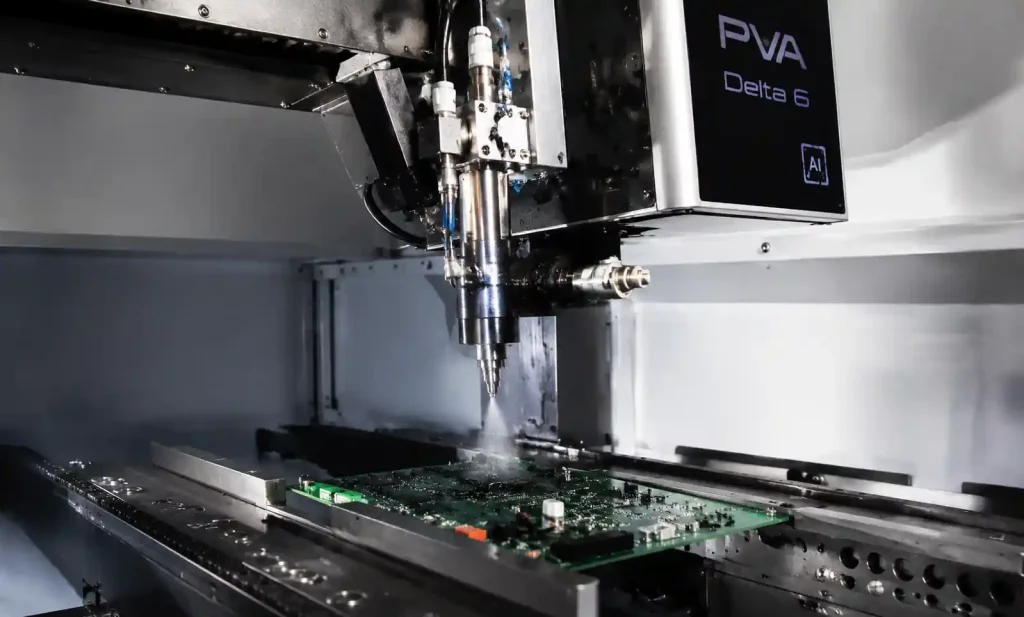
Brushing suits repair and prototypes but leaves operator-dependent film. Dip coating is fast and uniform but coats everything, so it demands the most masking. Selective robotic spray is where modern high-mix PCB assembly lines land: programmable keep-outs eliminate most masking, cut waste, and repeat within tight tolerance. Parylene runs only by chemical vapor deposition in a vacuum chamber.
One rule beats all equipment: clean first. Adhesion failures almost always trace to flux residue or finger oils, not the coating. Apply thin, multiple passes rather than one heavy coat to avoid bubbles and cracking.
Masking: What You Must Keep Bare
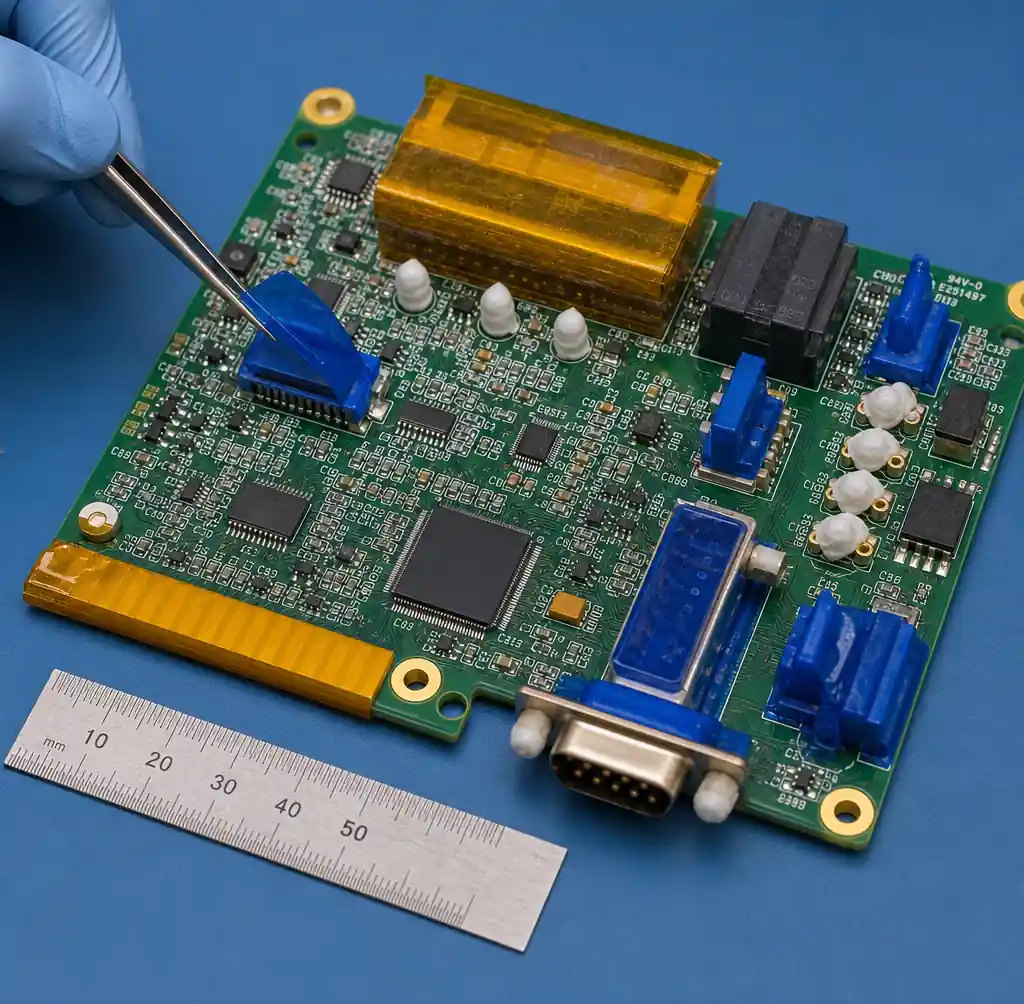
Coating is an insulator, so any surface that needs electrical contact, movement, heat transfer, or later access must be masked as a keep-out zone. Skipping this is the most common coating defect we see on incoming boards.
Mask connectors and edge fingers, test points and probe pads, grounding lugs, potentiometers and trim components, switches and relays, heat-sink interfaces, sensors with ports, and LED optical windows. Designate these keep-outs in your Gerber files early rather than taping them by hand later.
Curing and Rework
Cure mechanism drives your line speed. Acrylic air-dries by solvent evaporation, tack-free in minutes. Silicone and single-part urethane cure by atmospheric moisture over 12-24 hours. Epoxy and two-part urethane cure by catalyst and heat. UV-cure coatings surface-cure in seconds under 365 nm light, with a secondary moisture cure reaching the shadowed areas under tall parts.
Rework difficulty runs opposite to durability. Acrylic strips with solvent, often without scrubbing. Silicone and urethane resist solvents and need localized heat or micro-abrasion. Epoxy is nearly impossible to remove without board damage, and parylene requires plasma etching or mechanical abrasion. If your product will ever see field repair, that reality should weigh heavily in type selection.
Standards That Govern Coating
Three documents matter, and they do different jobs. Confusing them causes specs that can’t be inspected.
IPC-CC-830 qualifies the material itself, testing thermal shock, moisture and insulation resistance, dielectric withstanding, and fungus resistance. IPC-A-610 accepts the applied result on your board, defining coverage and thickness criteria by Class 1, 2, or 3. UL 746E covers electrical safety and flammability. The old military spec MIL-I-46058C is obsolete for new designs but still cited in legacy defense programs.
What’s New in 2026
Coating technology is moving fast on three fronts. Dual-cure UV formulations now pair a seconds-fast UV surface cure with a secondary moisture cure, solving the shadowing problem that once ruled UV out for tall assemblies. Low-VOC and solvent-free chemistries are replacing older solvent-heavy products as environmental limits tighten. And plasma-deposited hydrophobic nanocoatings offer parylene-like protection at sub-micron thickness for the densest boards.
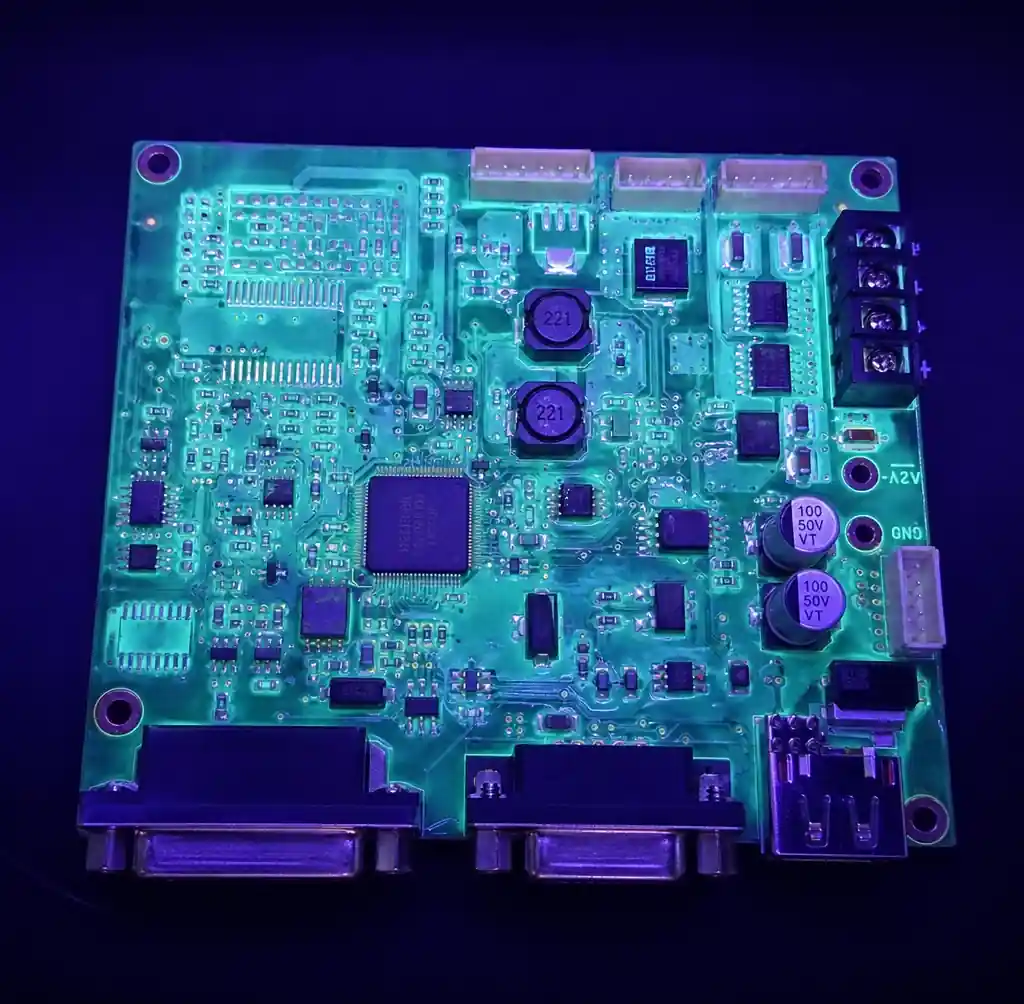
Inspection has advanced too. Coatings now carry UV fluorescent tracers, so a 365 nm lamp, increasingly paired with automated vision, verifies 100% coverage and catches thin spots the human eye misses.
FAQs
How thick should conformal coating be?
For acrylic, urethane, and silicone, target 25-75 µm (1-3 mil) dry per IPC-A-610. Parylene achieves the same protection at 12-25 µm because the vapor-deposited film has no pinholes.
Which conformal coating is easiest to remove?
Acrylic. It dissolves in common solvents, often without mechanical scrubbing, which makes it the default for products that may need field repair.
Does conformal coating stop tin whiskers?
No. It slows whisker growth and resists bridging, but does not prevent formation. Treat it as mitigation, not a cure.
Do I need to mask connectors before coating?
Yes. Coating insulates any contact surface. Mask connectors, test points, gold fingers, and adjustable or moving parts, ideally defined as keep-outs in your design files.
Can conformal coating be applied over dirty boards?
No. Flux residue and oils cause dewetting and delamination. Clean with IPA and verify before coating.
Conclusion
Conformal coating is a small line item with an outsized effect on field reliability. Choose acrylic for cost-sensitive, reworkable products; silicone for heat and vibration; urethane or epoxy for chemical and abrasion resistance; and parylene for the highest barrier on medical and aerospace boards. Hold liquid films to 25-75 µm, mask every contact and moving surface, clean before coating, and inspect coverage under UV. Match the chemistry to your worst environmental stressor and confirm final specs against the product datasheet and IPC-A-610 class.
If you need professional conformal coating and PCB assembly for demanding applications, Andwin Circuits offers up to 50-layer manufacturing with in-house coating, free DFM review, and fast delivery in 7 days, backed by ISO 9001 and IATF 16949 certification.
Contact us today for custom coating specifications and competitive factory-direct pricing.