
Ensure Proper PCB Conformal Coating Thickness
Working with printed circuit boards (PCBs) requires following strict PCB quality control methods to ensure that components perform as expected and have the expected lifespan. One of the important things to check is proper PCB conformal coating thickness.
Properly applied conformal coatings can protect delicate components from water, dust, and other things that can damage the PCB. Here are some actionable ways to achieve consistent quality assurance regarding this critical step.
Provide employees with thorough and ongoing training to improve quality control
People who apply conformal coatings require in-depth training to ensure they understand the proper procedures. The specifics will vary depending on the type of application method used and the conformal coating being applied.
In addition to on-the-job training conducted in-house, managers may also consider sending employees to conferences that provide enhanced training during the event schedule. One conformal coating conference in Texas has at least two professional development boot camps available.
Investing in employee education tends to have a positive impact on PCB quality control. However, employees must adapt and update content as needed, especially if the company changes processes or products.
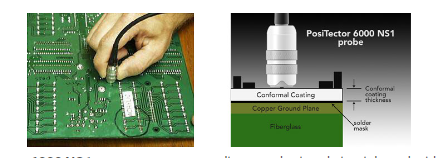
Understanding PCB Coating Thickness Needs for Specific Applications
Meeting PCB quality control goals also means understanding if the industry or application has requirements for using finished PCBs. Products with water-repellent features have ingress protection codes within their specifications that explain how effectively they can repel water. They range from 0 to 8, and the associated ratings provide a benchmark for performance.
People who apply conformal coatings can also follow established parameters in their work. Doing so should improve the overall level of PCB quality control. For example, MIL-I-46058 is a widely used military standard for conformal coatings. There is also a newer standard called IPC-CC-830.
In addition to spelling out the details of different types of conformal coatings, the standards also explain what people should do to give their PCBs the best chance of passing internal tests or those required by customers.
Coating Flat Test Coupons to Test PCB Quality Control
The IPC A 610 standard has various types of conformal coatings and ranges for ideal thicknesses. Best practice is to compare the information in its documentation with what the manufacturer recommends.
People should also view thickness ranges as averages rather than absolutes. Factors such as the surface tension of the liquid and the design of the board will mean that it won’t always be possible to stay within the recommended PCB coating thickness range in all cases.
However, the IPC A 610 standard recommends coating a flat test coupon while following the company’s internal processes. The results are then compared to the standard to check for any discrepancies.
Relying on advanced technology to improve coating consistency
It’s becoming increasingly common for people to rely on automation when building PCBs. One such system produces more than a dozen product types per day. Companies also install robotic cells specifically to handle the conformal coating step. This is often a wise choice when the process has been perfected.
Automated equipment doesn’t experience things that might keep humans from doing, such as boredom, distraction, or fatigue. In addition, having robots do tasks that people once did allows those employees to focus on duties that are more valuable to them, the company, or both.
Another possibility is to leverage a coating solution that works with artificial intelligence. One product on the market combines AI with machine vision inspection to speed up PCB quality control and allow operators to verify the technology’s findings.
It can tell if PCB thickness is under- or over-applied. The technology also creates logs that let managers track trends. The solution also reduces average detection time to 20 seconds and reduces false alarm and escape rates to less than 5%.
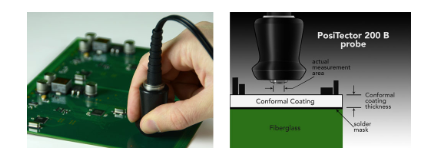
Implementing Reliable Technology to Measure PCB Coating Thickness
How someone applies conformal coating is only part of the story of the final PCB coating thickness. Maintaining quality assurance in a production facility means using a variety of measurement options at different stages throughout the process.
One possibility is to use a wet film gauge to check if the thickness is correct before the coating cures. The device has a machined comb that contains markings that show different thicknesses. The operator lowers the tool into the coating and checks if at least one of the comb teeth is not submerged.
Alternatively, one can use a caliper for dry film measurement by checking the PCB coating thickness at several points. This is a low-cost option, but has limited accuracy. The thickness measurement occurs before and after the PCB is coated. One then takes an average to estimate the coating thickness.
These are just two of many avenues. The goal is to find at least one measurement technology that can help a company maintain tight PCB quality control.
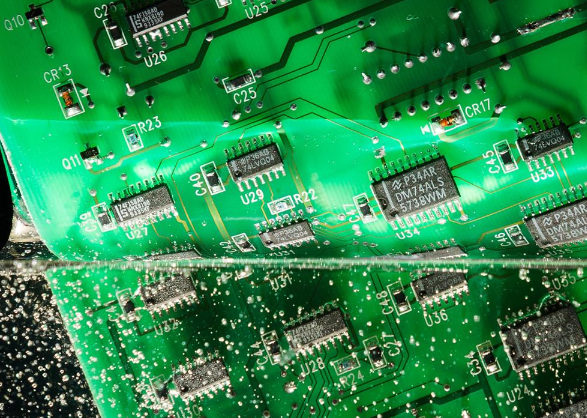
Correct PCB coating thickness is important
Failure to apply enough conformal coating can result in components not receiving the protection they were intended to. However, trying to overcompensate by applying too much presents a host of potential problems. These include cracking, wrinkling, and blistering. Another thing to be aware of when improving PCB quality control is that some parts of the board may not require coating.
The tips here will help production managers understand quality control as it relates to conformal coating. However, it is also useful to collect failure rate metrics and examine whether process improvements will reduce failure rates.