
HDI PCB Cost vs Standard PCB Calculator: Price Comparison Guide
HDI PCB costs 30-50% more than standard multilayer PCBs with comparable layer counts, but delivers 40% smaller board sizes and improved signal integrity. A 6-layer HDI board runs $25-$45 per unit versus $15-$28 for a standard 4-layer design at 100-unit volumes. This cost calculator breaks down material, manufacturing, and design factors that determine when HDI technology justifies its premium pricing.
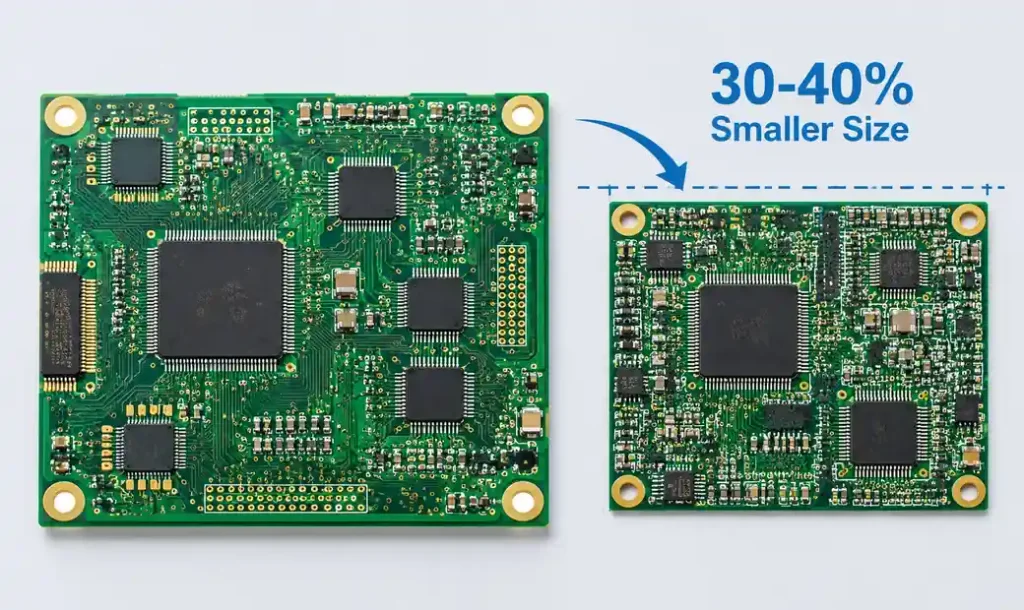
If you need to estimate PCB costs for your electronics project, understanding the specific cost drivers for HDI versus standard PCB helps you make data-driven decisions about board technology selection, design optimization, and budget planning.
What Determines HDI vs Standard PCB Pricing
PCB manufacturing costs follow a formula driven by material expenses, process complexity, and production volume. Standard PCBs rely on mechanical drilling and simple lamination, while HDI PCB technology requires laser drilling, sequential lamination, and advanced via structures that increase both material and labor costs.
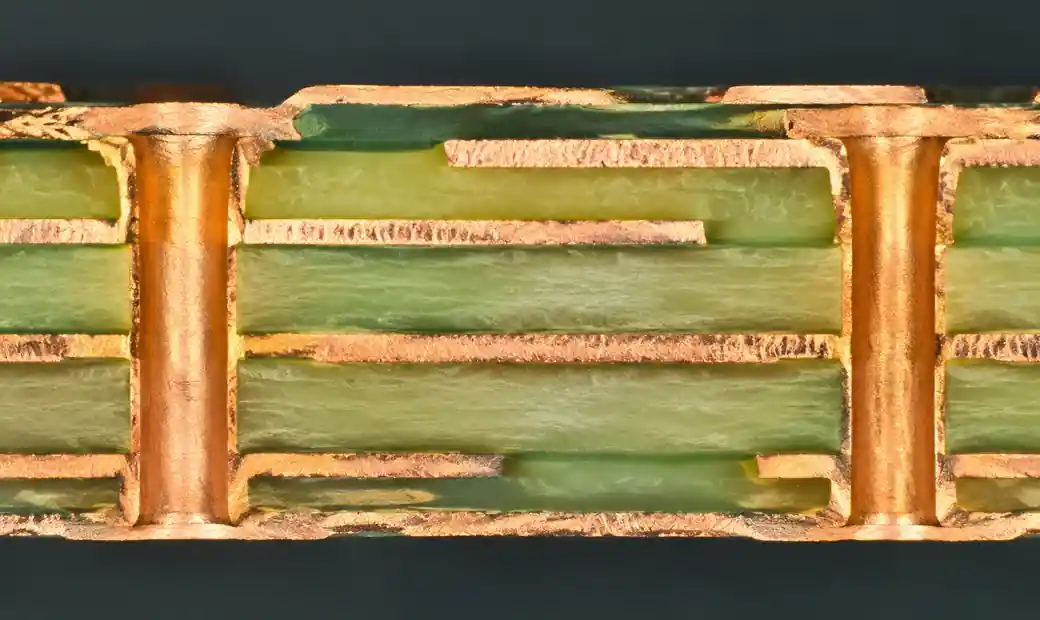
Layer count establishes the baseline cost for any PCB. Each copper layer requires imaging, etching, and oxide treatment before lamination. Standard 4-layer boards complete in one lamination cycle, while 8-layer HDI designs need 2-3 sequential build-ups with precise layer-to-layer registration per IPC-6016 standards. This adds 15-25 minutes of press time per lamination cycle, translating to $8-$15 additional labor cost per board.
Material costs differ significantly between technologies. Standard FR4 TG130-140 costs $15-$30 per square meter. HDI-grade FR4 with controlled resin content and tighter thickness tolerances runs $35-$55 per square meter. Laser-drillable dielectric films for microvia formation add another $45-$75 per square meter for Type I-II HDI stackups.
Cost Breakdown by Layer Count
Understanding how layer count impacts pricing helps you balance electrical performance requirements against budget constraints. Each additional layer pair increases material, drilling, and inspection costs.
| Board Type | Layer Count | Standard PCB (per unit, 100 pcs) | HDI PCB (per unit, 100 pcs) | Cost Increase |
|---|---|---|---|---|
| Simple Design | 2 layers | $5-$10 | N/A (HDI not used) | — |
| Moderate Complexity | 4 layers | $15-$28 | $20-$35 | +30-40% |
| High Density | 6 layers | $28-$45 | $35-$60 | +25-35% |
| Advanced Design | 8 layers | $45-$75 | $65-$110 | +40-50% |
| Complex Applications | 10 layers | $70-$120 | $110-$180 | +50-60% |
The cost gap narrows at higher layer counts because advanced standard PCBs require finer features approaching HDI capabilities. An 8-layer standard board with 4mil traces costs nearly as much as a 6-layer HDI design, but the HDI version offers superior signal integrity and 30% smaller footprint.
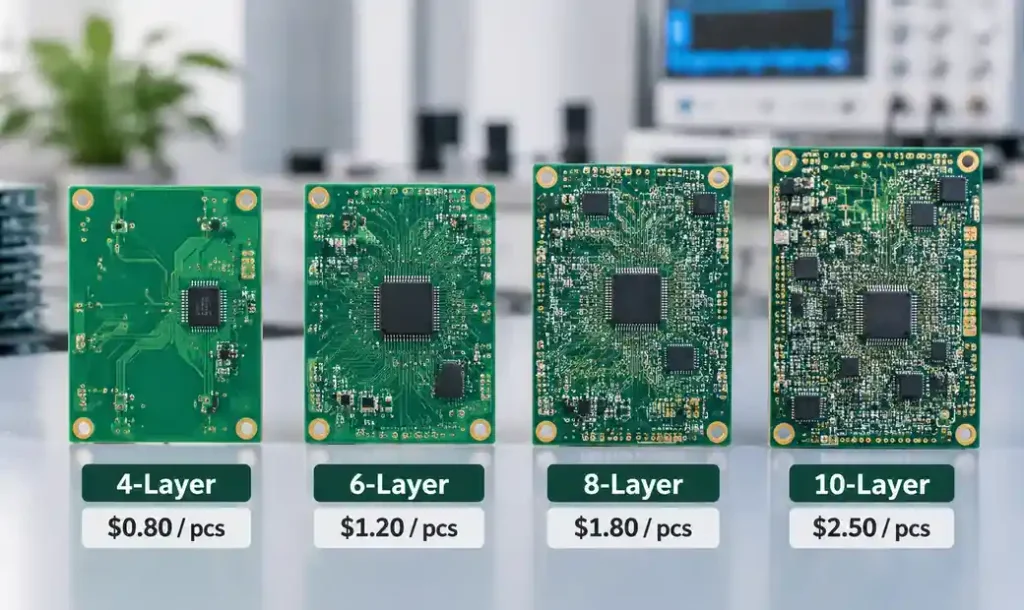
You should evaluate total system cost rather than bare board pricing alone. HDI boards eliminate layers through higher routing density, reducing material costs that can offset the per-layer premium. A 6-layer HDI design often replaces an 8-10 layer standard stackup, saving $15-$35 per board while improving electrical performance.
Manufacturing Process Cost Factors
Manufacturing complexity drives 40-60% of the price difference between HDI and standard PCBs. Process step count, equipment requirements, and yield rates determine unit economics.
Drilling Technology
Standard PCBs use mechanical drilling with 0.20-0.35mm bit sizes, processing 150-200 holes per minute at $0.02-$0.05 per hole. HDI boards require laser drilling for microvias (0.10-0.15mm diameter), operating at 80-120 holes per minute and costing $0.15-$0.40 per via. A design with 500 microvias adds $75-$200 to board cost compared to through-hole equivalents.
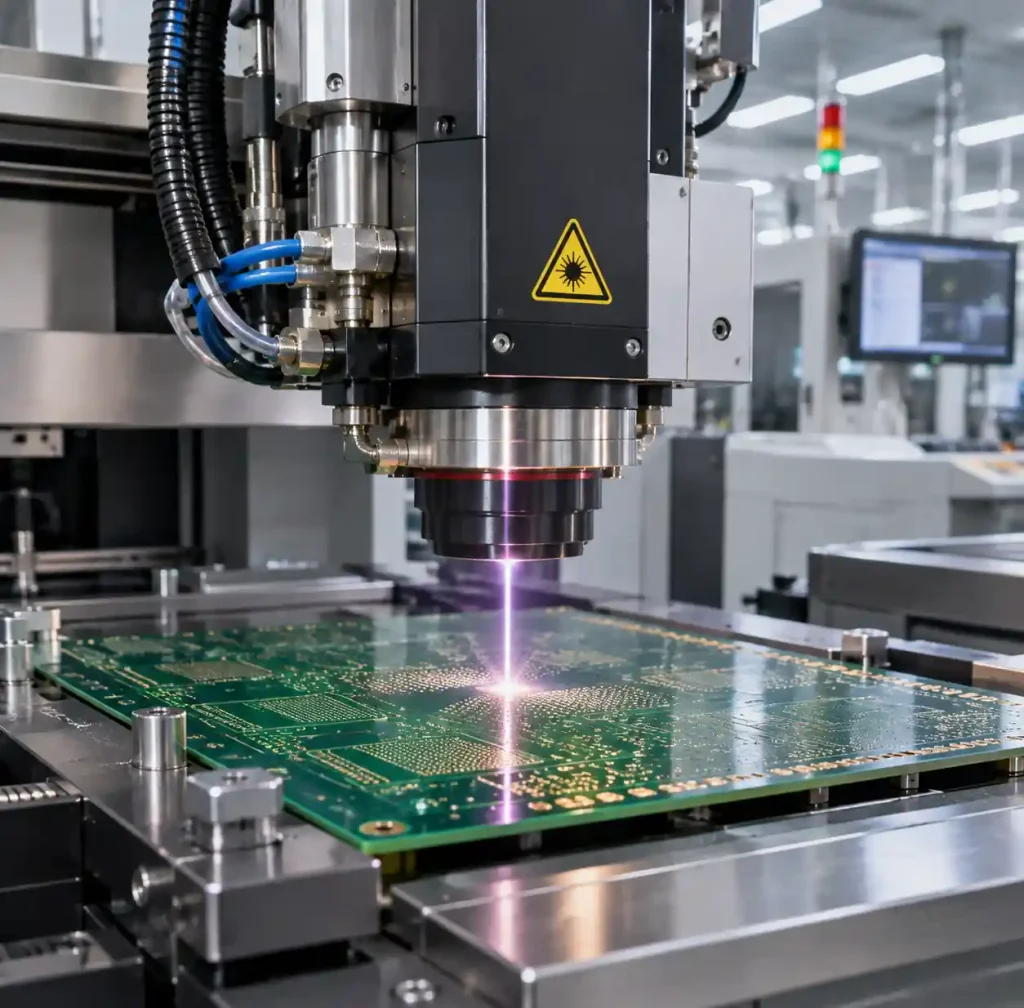
Laser drilling systems cost $500K-$2M versus $80K-$150K for mechanical drilling equipment. This capital investment amortizes across production volumes, making HDI more cost-effective above 1,000-5,000 units depending on via count and board complexity.
Lamination Cycles
Standard multilayer boards complete in one lamination cycle, pressing all inner layers simultaneously. Type I HDI requires 2 lamination cycles (core + build-up layers), Type II needs 3 cycles, and Type III demands 4+ cycles with stacked microvias. Each cycle adds 45-75 minutes of production time and costs $12-$25 per board in press time, handling, and registration verification.
Sequential lamination requires precise layer-to-layer alignment within ±0.05mm tolerance per IPC-6012 Class 3 specifications. Registration systems and optical alignment add $15K-$45K to production line costs, increasing overhead charges by 8-15% for HDI versus standard manufacturing.
Via Fill and Plating
Unfilled microvias cost baseline rates, while resin-plugged vias add $8-$15 per board and copper-filled vias (required for stacked microvia structures) add $20-$35 per board. Standard through-hole vias need no filling, eliminating this cost entirely.
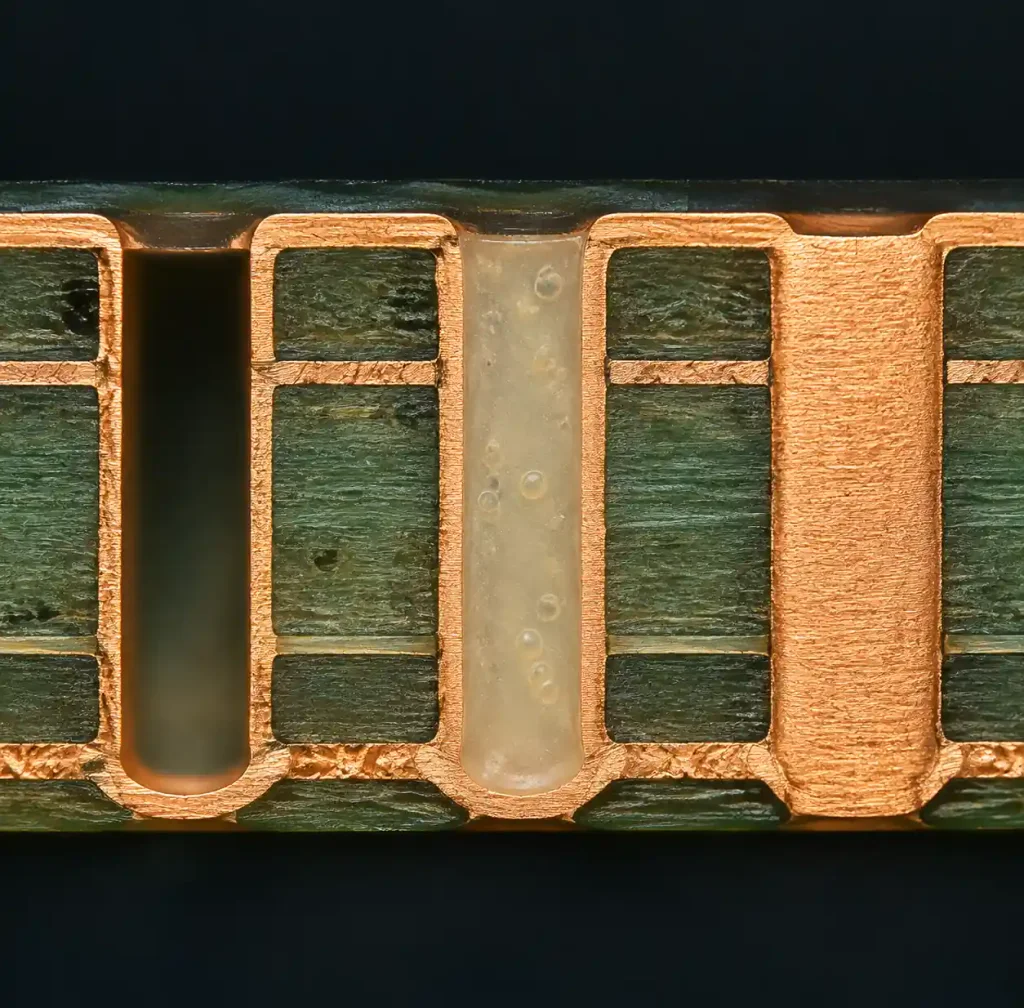
Via Technology Impact on Pricing
Via architecture represents the single biggest cost differentiator between standard and HDI PCBs. Through-hole vias cost $0.02-$0.05 each, blind vias run $0.10-$0.25, and buried vias with copper fill range from $0.30-$0.60 per connection.
| Via Type | Drilling Method | Cost per Via | Applications | HDI Type |
|---|---|---|---|---|
| Through-Hole | Mechanical | $0.02-$0.05 | Standard PCB | Standard |
| Blind (single-sided) | Laser | $0.10-$0.25 | Type I HDI | I |
| Blind (stacked, 2 layers) | Laser + fill | $0.30-$0.50 | Type II HDI | II |
| Buried + Stacked | Laser + fill | $0.50-$0.80 | Type III+ HDI | III+ |
| Any-Layer (ELIC) | Laser + advanced fill | $0.80-$1.20 | Advanced HDI | III+ |
A smartphone PCB design with 800 laser-drilled microvias costs $80-$200 more than a through-hole equivalent with 300 vias at $6-$15. However, the HDI version achieves 40-50% higher routing density, eliminating 2-4 layers and saving $30-$80 in material costs—partially offsetting via premiums.
You can optimize costs by mixing via types strategically. Place through-hole vias for power distribution and ground connections (low cost, high current capacity) while reserving microvias for signal routing in dense areas. This hybrid approach reduces average via cost from $0.35-$0.50 to $0.15-$0.25 per connection.
Volume-Based Pricing Comparison
Production volume dramatically impacts per-unit pricing for both technologies. HDI boards show steeper volume discounts due to higher NRE (non-recurring engineering) costs amortized across order quantities.
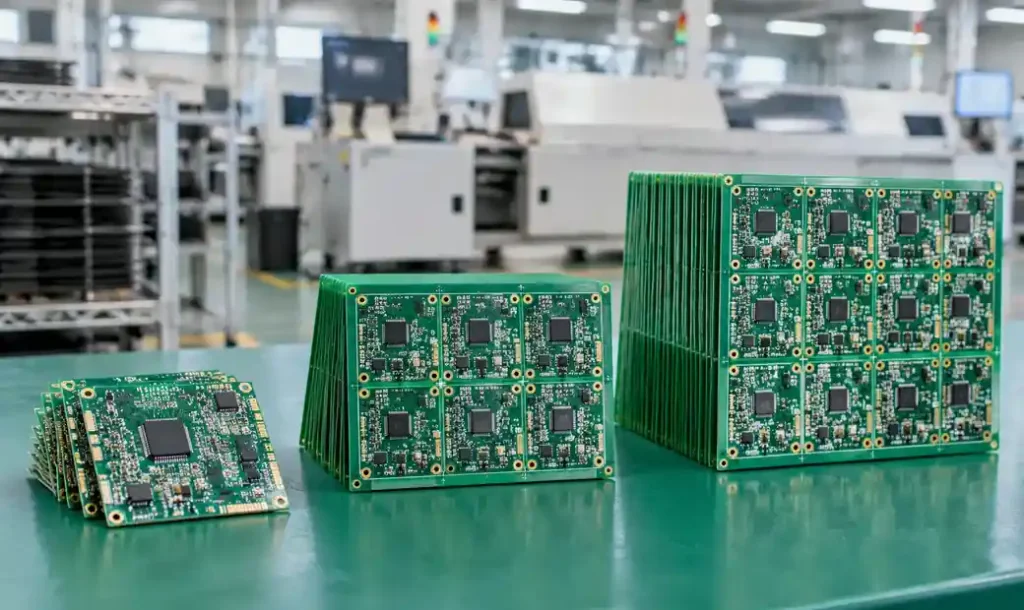
Prototype Volumes (10-50 units):
Standard PCB: $35-$65 per board
HDI PCB: $80-$150 per board
HDI premium: 130-150%
Setup costs (tooling, programming, stencils) range from $150-$300 for standard boards versus $400-$800 for HDI designs. At low volumes, NRE contributes 40-60% of total cost. You should use standard PCB technology for initial prototyping unless HDI features are required for electrical validation.
Low Production (100-500 units):
Standard PCB: $15-$35 per board
HDI PCB: $25-$55 per board
HDI premium: 50-70%
NRE amortization drops to 15-25% of unit cost. This volume range often represents the crossover point where HDI technology becomes cost-competitive when accounting for board size reduction and eliminated layers.
Medium Volume (1,000-5,000 units):
Standard PCB: $8-$18 per board
HDI PCB: $12-$28 per board
HDI premium: 40-55%
Turnkey PCB assembly costs begin dominating total expenses, reducing bare board price sensitivity. Component placement and inspection labor costs equalize between technologies at this volume.
High Volume (10,000+ units):
Standard PCB: $4-$10 per board
HDI PCB: $6-$15 per board
HDI premium: 30-50%
Volume discounts flatten pricing curves. Material costs dominate unit economics, and HDI’s smaller board sizes deliver freight and handling savings that partially offset manufacturing premiums.
When HDI Cost Premium Justifies ROI
HDI technology costs more per square inch but delivers measurable ROI through board size reduction, improved reliability, and enhanced electrical performance. You should evaluate total product cost rather than isolated PCB pricing.
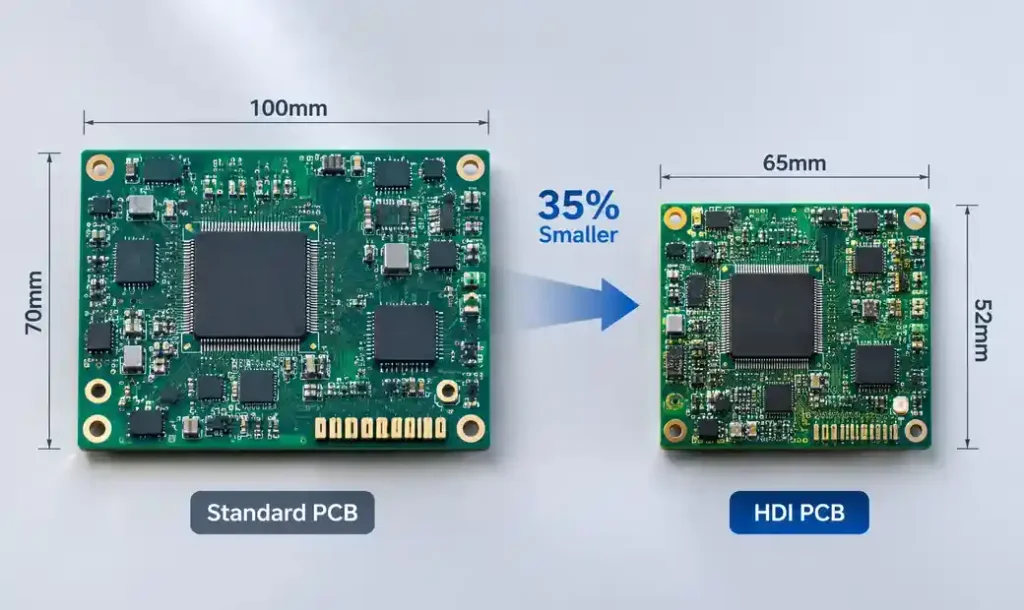
Board Size Reduction:
HDI designs achieve 30-50% smaller footprints than standard PCBs with equivalent functionality. A 100×100mm standard 8-layer board shrinks to 70×70mm with 6-layer HDI, reducing PCB cost by $8-$15 through material savings. Smaller boards also reduce enclosure size, cutting injection molding costs by $0.50-$2.00 per unit and shipping weight by 15-25%.
Layer Count Optimization:
Every eliminated layer pair saves $6-$12 per board in material and processing costs. HDI’s higher routing density allows 6-layer designs to replace 8-10 layer standard stackups. At 5,000-unit volumes, this generates $30K-$60K in cumulative savings that exceed initial NRE investment.
Reliability Improvements:
Microvias reduce thermal stress compared to through-hole vias, improving solder joint reliability by 25-40% per IPC-6012 testing standards. This translates to 15-30% lower field failure rates, reducing warranty costs and returns that can exceed the initial PCB premium by 3-10x over product lifetime.
Signal Integrity Requirements:
High-speed designs above 1 GHz require controlled impedance and shorter signal paths. HDI provides superior signal integrity through:
- 40-60% shorter trace lengths reducing propagation delay
- Reduced via stubs (0.10mm vs 1.60mm) cutting resonance issues
- Better ground plane coupling improving return path performance
For RF applications, high-frequency PCBs using HDI technology eliminate signal integrity issues that cause redesigns costing $15K-$50K in NRE plus 4-8 weeks of schedule delays.
How to Calculate Your PCB Cost
You can estimate PCB pricing using this calculation framework that accounts for material, manufacturing, and design complexity factors.
Step 1: Determine Base Cost by Layer Count
Start with standard pricing for your target layer count:
- 4-layer standard: $15-$28 (100 pcs)
- 6-layer standard: $28-$45 (100 pcs)
- 4-layer HDI: $20-$35 (100 pcs)
- 6-layer HDI: $35-$60 (100 pcs)
Step 2: Apply Board Size Multiplier
Standard PCB pricing assumes 100×100mm dimensions. Adjust for actual size:
- 50×50mm: 0.4x multiplier
- 150×150mm: 1.8x multiplier
- 200×200mm: 3.0x multiplier
Step 3: Add Via Cost
Calculate total via charges:
- Count microvias × $0.15-$0.40 each (HDI)
- Count through-holes × $0.02-$0.05 each (standard)
- Add fill cost: $8-$15 for resin plug, $20-$35 for copper fill
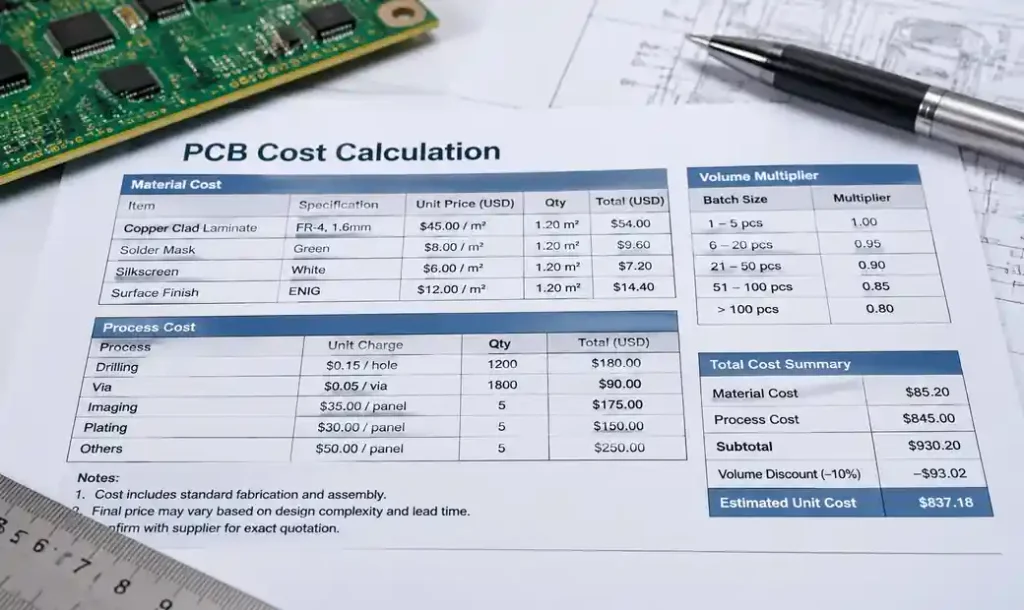
Step 4: Apply Material Premiums
Add costs for specialized materials:
- High-Tg FR4: +20-30% base cost
- Rogers high-frequency: +150-200%
- Metal core PCB: +80-120%
- Rigid-flex: +200-300%
Step 5: Include Surface Finish
Add finishing costs:
- HASL: Included in base pricing
- ENIG: +$8-$15 per board
- Immersion Silver: +$6-$10
- Hard Gold (edge contacts): +$15-$25
Step 6: Calculate Volume Discount
Apply quantity breaks:
- 10 units: Base pricing
- 100 units: 0.60x multiplier
- 1,000 units: 0.35x multiplier
- 10,000 units: 0.20x multiplier
Example Calculation:
6-layer HDI board, 80×80mm, 400 laser vias, ENIG finish, 500 units:
- Base (6L HDI): $35
- Size adjustment (0.9x): $31.50
- Via cost (400 × $0.25): $100.00
- ENIG: $12.00
- Subtotal: $143.50
- Volume discount (500 pcs @ 0.45x): $64.60 per board
This calculation provides ±20% accuracy for budgeting. Final pricing depends on design complexity, manufacturer capabilities, and current material costs. You should request quotes from multiple PCB manufacturers to compare actual pricing.
FAQs
What is the main cost difference between HDI and standard PCB?
HDI PCBs cost 30-50% more than standard multilayer boards due to laser drilling ($0.15-$0.40 per via vs $0.02-$0.05 for mechanical holes), sequential lamination adding 2-3 press cycles, and specialized materials. A 6-layer HDI runs $35-$60 per unit versus $28-$45 for standard 6-layer at 100-piece volumes.
At what production volume does HDI become cost-effective?
HDI technology typically reaches cost parity with standard PCBs at 1,000-5,000 unit volumes when board size reduction and layer count optimization offset manufacturing premiums. For designs where HDI enables 2-4 fewer layers or 30%+ smaller footprint, breakeven occurs at 500-1,000 units.
How much do microvias add to PCB cost?
Laser-drilled microvias cost $0.15-$0.40 each for unfilled blind vias, $0.30-$0.50 for stacked structures with resin plug, and $0.50-$0.80 for buried copper-filled vias. A design with 500 microvias adds $75-$400 to board cost depending on via type and fill requirements.
Can mixing HDI and standard vias reduce costs?
Yes, hybrid designs using through-hole vias for power/ground distribution ($0.02-$0.05 each) and microvias only for dense signal routing ($0.15-$0.40 each) can reduce average via cost by 40-60%. This strategy maintains HDI routing density benefits while controlling manufacturing expenses.
What PCB specifications increase HDI costs most?
Stacked microvias (+$20-$35 per board for copper fill), tight line width/spacing below 3mil (+15-25%), high layer counts above 10 layers (+$40-$80 per layer pair), and specialized materials like Rogers laminates (+150-200%) drive the largest cost increases for HDI designs.
How do I calculate PCB cost for my project?
Multiply base layer cost by board size factor, add via charges (count × cost per via type), include surface finish premium, and apply volume discount multipliers. Request quotes from PCB assembly manufacturers with your Gerber files for accurate pricing reflecting your specific design complexity and production volumes.
Conclusion
HDI PCB pricing runs 30-50% above standard multilayer boards but delivers measurable ROI through 30-40% board size reduction, improved reliability, and enhanced signal integrity for high-speed designs. The cost premium narrows significantly above 1,000-unit volumes as NRE amortization and material savings from eliminated layers offset manufacturing complexity.
Your technology decision should balance total product cost—including enclosure, assembly labor, and field reliability—rather than isolated PCB pricing. HDI justifies its premium when board space constraints, signal integrity requirements, or layer count optimization create system-level savings exceeding $15-$30 per unit.
Andwin Circuits manufactures both standard multilayer PCBs and advanced HDI boards with capabilities up to 50 layers and delivery in 7 days. Our facility maintains ISO 9001, IATF 16949, and UL certifications for automotive, medical, telecommunications, and industrial applications. We provide detailed cost breakdowns, DFM analysis, and instant PCB quotes to help you optimize design and budget planning.
Contact us today for custom PCB cost estimates, technical specifications, and competitive factory-direct pricing with 100% quality guarantee.