
Surface Mount Pick and Place Machines: Revolutionizing PCB Assembly
Introduction
The electronics manufacturing industry has undergone significant transformations over the past few decades, with surface mount technology (SMT) playing a pivotal role in enabling faster, more efficient, and more compact circuit board assembly. At the heart of SMT assembly is the pick and place machine, a highly automated system designed to accurately place surface-mount devices (SMDs) onto printed circuit boards (PCBs).
This article explores the working principles, types, key components, advantages, and future trends of surface mount pick and place machines, highlighting their critical role in modern electronics manufacturing.
1. How Pick and Place Machines Work
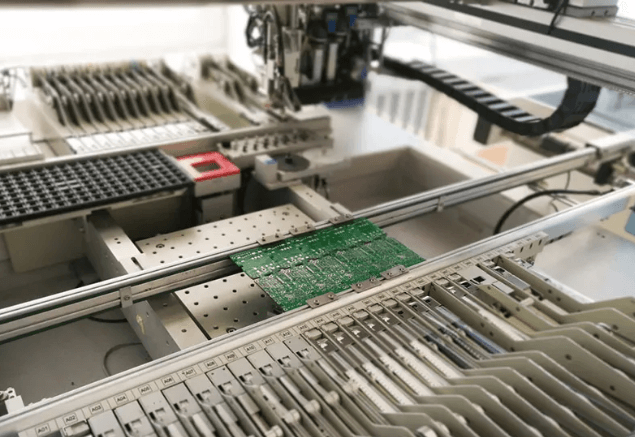
Pick and place machines are automated robotic systems that precisely pick up electronic components from feeders and place them onto designated locations on a PCB. The process involves several key steps:
1.1 PCB Loading and Alignment
- The PCB is loaded onto the machine’s conveyor system.
- Optical sensors or fiducial cameras detect alignment marks to ensure accurate component placement.
1.2 Component Feeding
- Components are supplied via tape reels, trays, or stick feeders.
- The machine picks components using a vacuum nozzle or gripper.
1.3 Vision System Inspection
- High-resolution cameras verify component orientation, size, and alignment before placement.
- Advanced systems correct misalignments in real-time.
1.4 Placement Process
- The machine’s robotic arm moves the component to the programmed location on the PCB.
- The nozzle releases the component with precise force to ensure proper soldering.
1.5 Conveyor Output
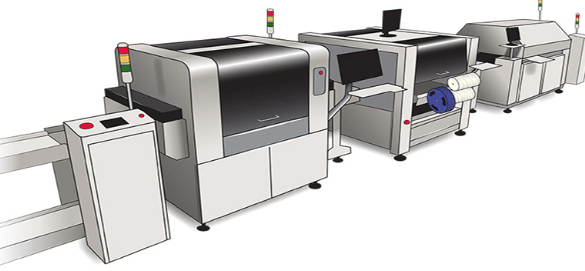
- After placement, the PCB moves to the next stage (reflow soldering or inspection).
2. Types of Pick and Place Machines
Pick and place machines are categorized based on speed, precision, and flexibility:
2.1 High-Speed Pick and Place Machines
- Designed for large-scale production (e.g., consumer electronics).
- Capable of placing 30,000–100,000 components per hour (CPH).
- Typically use gantry-style mechanisms for rapid movement.
2.2 Precision Pick and Place Machines
- Used for fine-pitch components (e.g., BGAs, QFNs, 01005 chips).
- Offer high accuracy (up to ±25 microns).
- Slower than high-speed machines but essential for complex PCBs.
2.3 Modular/ Flexible Pick and Place Machines
- Allow customization with different nozzles and feeders.
- Suitable for low-to-medium production volumes with frequent changeovers.
2.4 Desktop Pick and Place Machines
- Affordable and compact, ideal for prototyping and small-scale production.
- Slower (typically 1,000–5,000 CPH) but cost-effective for startups.
3. Key Components of a Pick and Place Machine
A modern pick and place machine consists of several critical subsystems:
3.1 Feeder System
- Tape Feeders: Most common, used for reels of SMD components.
- Tray Feeders: For larger or irregularly shaped components.
- Stick Feeders: For cylindrical components like diodes.
3.2 Placement Head & Nozzles
- Multi-nozzle heads increase speed by picking multiple components simultaneously.
- Nozzles vary in size to handle different component shapes.
3.3 Vision System
- Upward Cameras: Verify component dimensions before pickup.
- Downward Cameras: Ensure precise PCB alignment.
- 3D Inspection (Advanced Models): Detects coplanarity and bent leads.
3.4 Motion Control System
- Linear motors or servo-driven arms ensure fast, precise movement.
- High-end machines use dual-lane conveyors for continuous production.
3.5 Software & Programming
- CAD/CAM integration allows direct import of PCB design files.
- AI-driven optimization improves placement sequence for maximum efficiency.
4. Advantages of Pick and Place Machines
The adoption of automated pick and place machines offers numerous benefits:
4.1 High Speed & Efficiency
- Replaces manual labor, drastically reducing assembly time.
- Enables mass production with minimal errors.
4.2 Precision & Consistency
- Eliminates human errors in component placement.
- Ensures repeatability even with ultra-small components.
4.3 Flexibility
- Can handle a wide range of component sizes and types.
- Quick changeovers between different PCB designs.
4.4 Cost-Effectiveness
- Reduces labor costs and material waste.
- Increases yield by minimizing defects.
4.5 Scalability
- Suitable for both prototyping and high-volume manufacturing.
5. Future Trends in Pick and Place Technology
The evolution of pick and place machines continues with advancements in automation, AI, and miniaturization:
5.1 AI & Machine Learning Integration
- Self-optimizing placement paths for maximum throughput.
- Predictive maintenance to reduce downtime.
5.2 Enhanced 3D Vision Systems
- Better handling of odd-shaped components.
- Improved defect detection before soldering.
5.3 Hybrid Machines (SMT + Through-Hole)
- Combining SMT and through-hole assembly in a single system.
5.4 IoT & Industry 4.0 Connectivity
- Real-time monitoring and remote diagnostics.
- Integration with smart factory systems.
5.5 Miniaturization & Higher Speed
- Support for 0201 and 01005 components (smaller than ever).
- Ultra-high-speed machines exceeding 150,000 CPH.
6. Conclusion
Surface mount pick and place machines are indispensable in modern electronics manufacturing, enabling the rapid, precise, and cost-effective assembly of PCBs. As technology advances, these machines are becoming smarter, faster, and more adaptable, supporting the growing demand for smaller, more complex electronic devices.
Whether for consumer electronics, automotive systems, or IoT devices, pick and place machines will remain a cornerstone of efficient PCB assembly, driving innovation in the electronics industry for years to come.