
PCB Quotation Guide: Understanding Price Breakdown and Cost Drivers
Three quotes for identical PCB designs: $2.80, $6.40, and $11.50 per board. Same Gerber files, same specifications—yet prices vary by 300%. PCB pricing in 2026 reflects material costs, manufacturing complexity, and design specifications that create dramatically different price points across suppliers.
Global PCB demand reached $89.7 billion in 2026, with copper-clad laminate prices jumping 18-22% since Q4 2025. Understanding these cost drivers helps you evaluate quotes accurately and negotiate effectively.
PCB Pricing Fundamentals
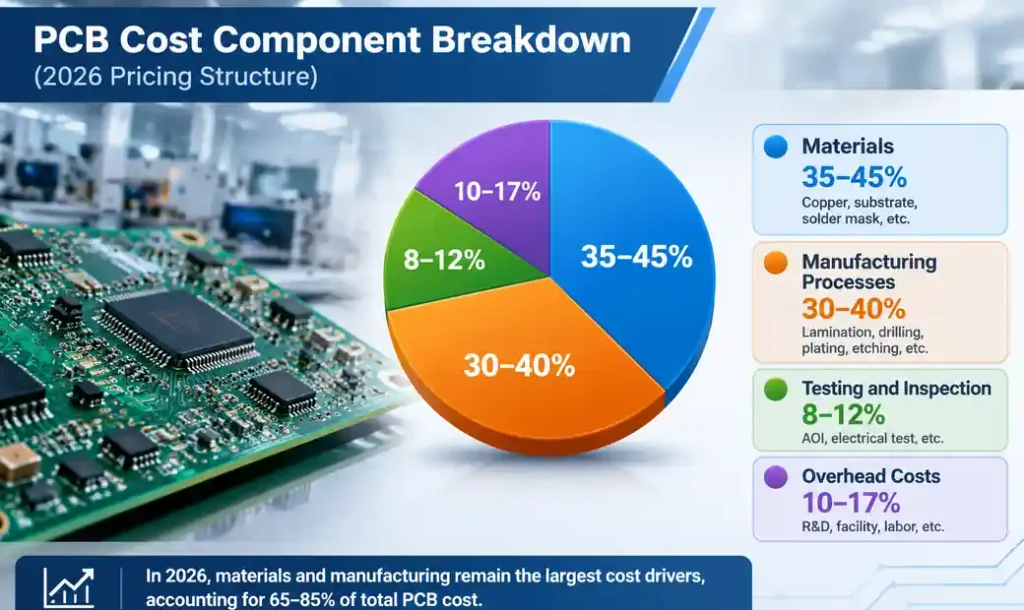
Manufacturers calculate quotes through six cost categories: raw materials (35-45%), manufacturing processes (30-40%), testing and inspection (8-12%), plus tooling, engineering, and overhead. Volume transforms economics—prototype runs of 5 boards carry 5-15x per-unit premiums versus 500-board orders where fixed costs amortize efficiently.
Lead time impacts pricing significantly. Standard 10-15 day production provides baseline pricing. Five to 7-day delivery adds 30-50% premiums, while 24-72 hour rush service commands 100-200% upcharges because your order monopolizes production capacity.
Material and Layer Count Impact
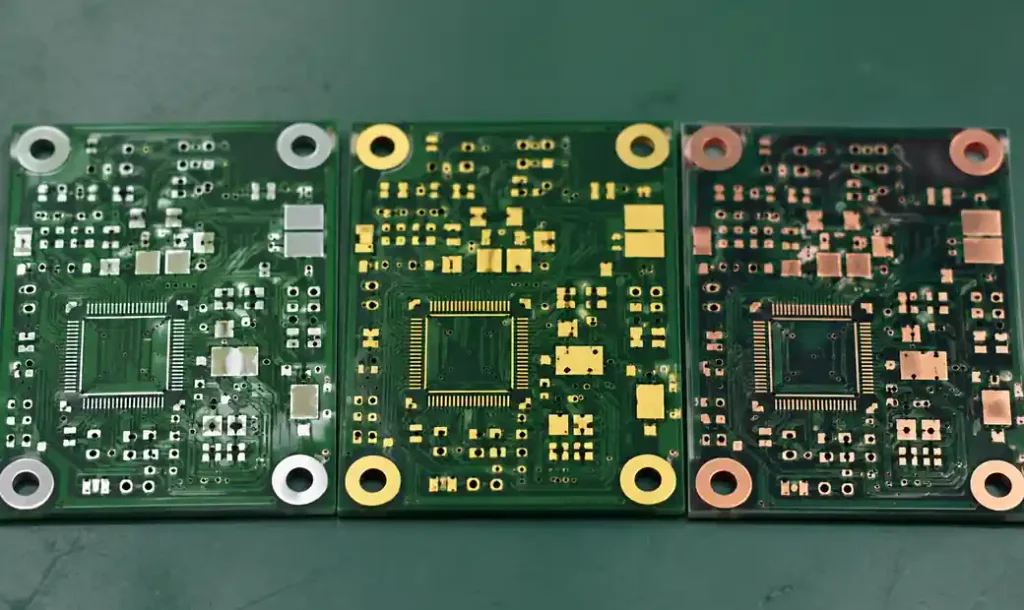
FR4 laminate costs $8-15/m² for standard grades, while high-Tg materials run $18-28/m² and Rogers RF laminates reach $120-180/m². Copper weight scales costs linearly—2oz copper adds 40-60% versus 1oz standard. Surface finishes range from HASL at $0.15-0.25/dm² (6-12 month shelf life) to ENIG at $0.45-0.75/dm² (12+ months, flat surface for fine-pitch).
Layer count creates exponential cost progression—each layer multiplies processing steps and registration complexity:
| Layer Count | Relative Cost | Applications | Lead Time |
|---|---|---|---|
| 2-layer | 1.0x (baseline) | Simple circuits, prototypes, low-density designs | 3-5 days |
| 4-layer | 1.8-2.2x | Standard products, impedance control, mixed signal | 5-7 days |
| 6-layer | 2.8-3.5x | High-speed designs, complex routing, EMI control | 7-10 days |
| 8-layer | 4.2-5.8x | Advanced products, HDI, multiple power/ground planes | 10-14 days |
| 10+ layers | 6.5-12x | Telecom, servers, automotive ADAS, medical imaging | 14-21 days |
HDI features add significant costs: blind vias $0.08-0.15 each, buried vias $0.12-0.20, microvias $0.05-0.10. A design with 200 microvias across 50 boards adds $500-1,000. Via-in-pad designs carry 15-25% premiums over standard routing. Costs compound multiplicatively—6-layer with controlled impedance (+20-30%), plus HDI blind vias (+50-70%), plus via-in-pad filling reaches 80-120% total premium.
Board Size and Panel Efficiency
Most factories use 18×24″ (457×610mm) panels. A 100×80mm design yields 10 boards per panel efficiently. Change to 95×85mm and only 8 fit, increasing per-unit cost by 25% despite similar area. Small boards under 50×50mm face minimum handling charges—setup and processing time doesn’t scale with size.
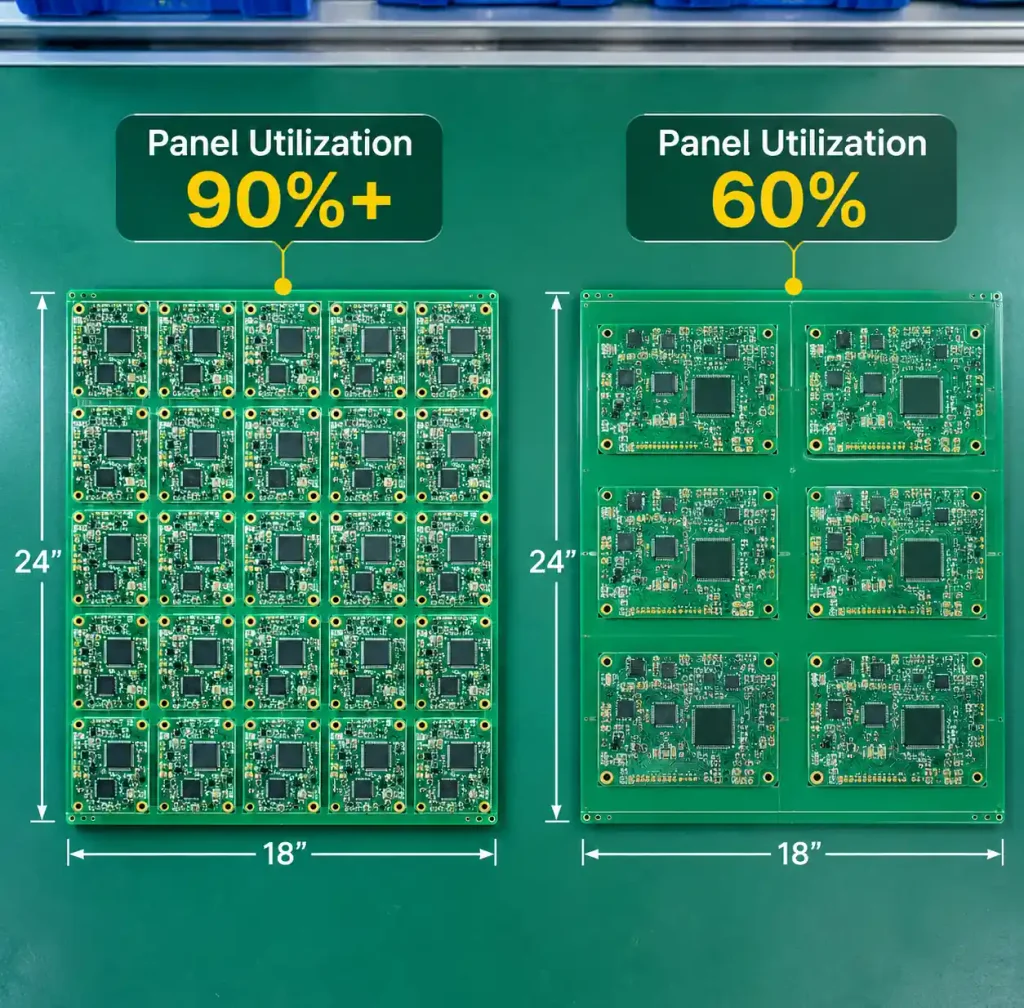
Depanelization methods carry different costs: V-scoring ($15-25 setup, straight lines only), tab routing ($30-50, handles irregular shapes), or combined methods ($60-90 tooling). Strategic panelization optimizes costs significantly.
Design Specifications That Drive Cost
Standard 6/6mil trace/space works without premiums. Tighten to 4/4mil and costs rise 15-25%; 3/3mil requires HDI capabilities at 40-60% premiums. Controlled impedance adds 20-30% for stackup documentation, TDR testing, and tighter tolerances.
Drilling scales with hole count and aspect ratio. Standard 0.3mm minimum drill size uses conventional equipment. Drop to 0.2mm requiring HDI laser drilling adds 25-40%. Aspect ratios above 12:1 (board thickness/hole diameter) increase costs 15-30% through challenging plating requirements. Via filling for via-in-pad adds $0.45-0.85/in² depending on density.
Hidden Costs in Quotes
Engineering charges ($50-300 depending on complexity) cover CAM processing. Tooling fees include solder mask/silkscreen ($40-80), flying probe test fixtures ($100-200), or ICT fixtures ($800-1,500 for high volume). First-time orders include these charges; reorders typically waive them.
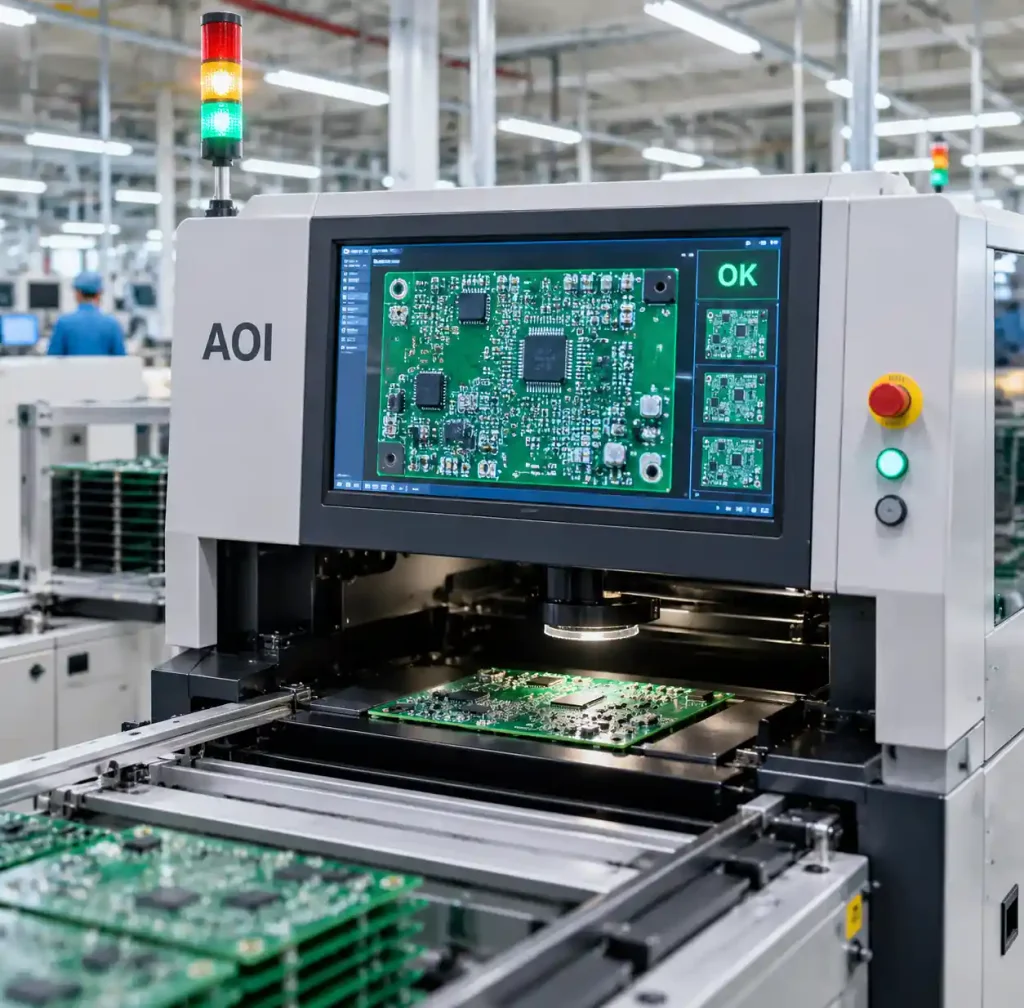
Testing options vary: flying probe costs $0.50-1.20/board (good for <100 units), while ICT drops to $0.15-0.35/board for 500+ volumes. AOI inspection is usually included, but X-ray inspection for BGAs adds $0.80-1.50/board. Impedance testing requires TDR measurements at $15-30 per panel, distributed across boards.
Optimized panelization often hidden as standard cost reduction lever—requesting custom panel layouts can reduce per-board cost 10-15% for non-standard sizes, though suppliers may charge $50-100 for custom design.
Volume Pricing Economics
MOQs reflect manufacturing efficiency thresholds: 5-10 pieces for prototypes, 25-50 mid-tier, 500-1,000 for high-volume specialists. Pricing follows step functions at specific break points: 5, 10, 25, 50, 100, 500, 1000 pieces—ordering 45 units costs the same as 50 because manufacturers price in production panel batches.
| Order Quantity | Price Multiplier | Cost Driver | Typical Application |
|---|---|---|---|
| 1-5 pieces | 8-12x | Full engineering and setup for minimal output | Proof of concept, first prototype |
| 10-25 pieces | 4-6x | Setup costs amortized slightly, material waste high | Design verification, DVT testing |
| 50-100 pieces | 2-3x | Improved panel utilization, reduced scrap rates | Engineering validation, pilot production |
| 250-500 pieces | 1.5-2x | Volume material pricing, optimized panel layouts | Limited production, early market launch |
| 1000+ pieces | 1.0x (baseline) | Full volume economics, automated production | Mass production, established products |
Strategic ordering optimizes total program cost. Ordering 250 boards at the 250-piece break ($4.50/board = $1,125) beats two 100-board orders ($6/board × 200 = $1,200-1,600 with duplicate setup charges), even carrying 50 extra inventory.
Regional Pricing and Logistics
China commands 55-60% global market share with most competitive pricing. A standard 4-layer board quotes $4.50-6.50 in China, $8-12 in Taiwan/Korea, $15-22 in Europe, $18-25 in North America—reflecting labor costs, automation, and market positioning.

Shipping impacts total cost significantly: sea freight adds $0.15-0.30/board (25-35 days), air freight $1.20-2.50/board (5-7 days). For a 500-board $2,250 order, air shipping adds $600-1,250 (27-56%) versus sea at $75-150 (3-7%). Import duties vary—US multilayer PCBs currently 0%, EU 0-2.7%.
Local sourcing trades 3-4x higher per-unit costs for speed, communication, and risk reduction. For development projects with frequent changes, local suppliers often prove cheaper total cost despite higher unit pricing.
Quote Evaluation Red Flags
Suspiciously low quotes (40-50% below competitors) signal cut corners—inferior materials, skipped testing, or weak quality systems. Incomplete itemization hides costs surfacing later. Vague “all-inclusive” pricing prevents comparison; request detailed breakdowns showing material, fabrication, testing, and NRE separately.
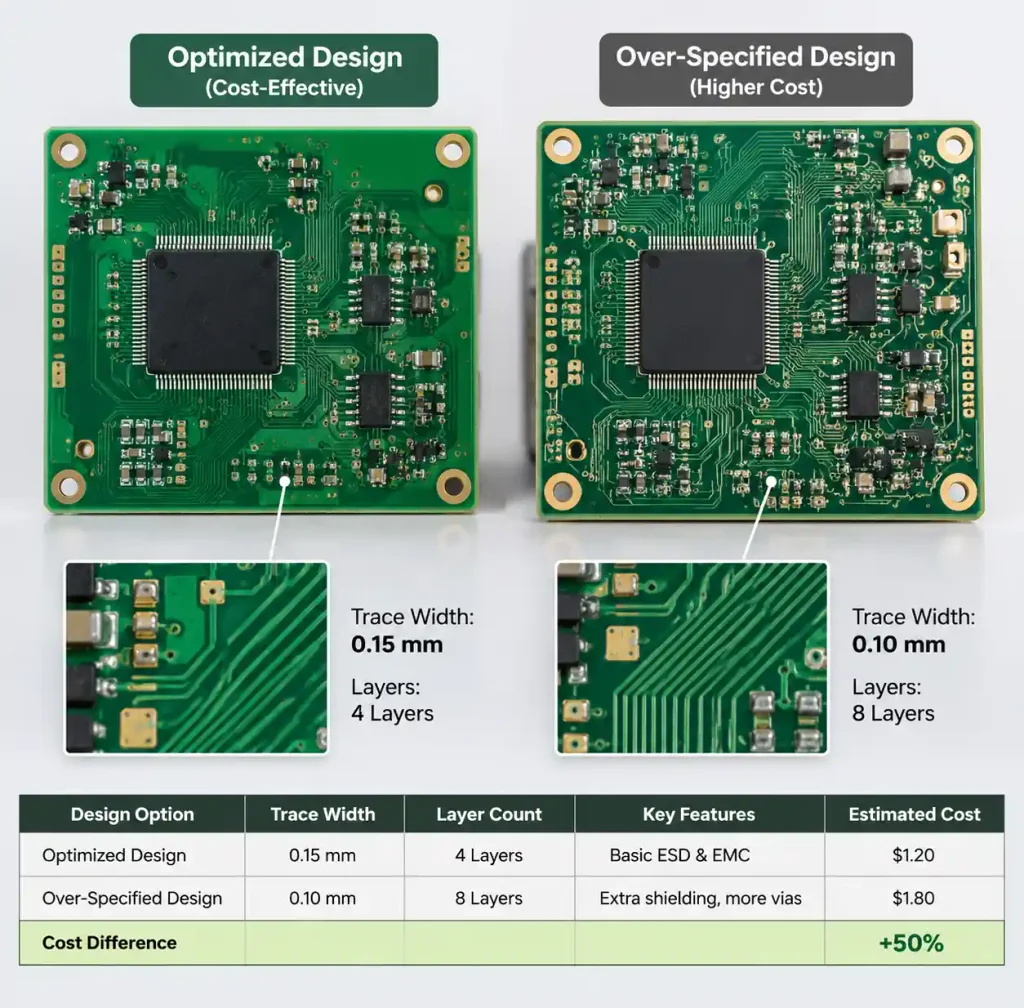
Payment terms indicate supplier stability: standard 30-50% deposit with balance before shipment. 100% upfront demands suggest cash flow problems; Net 60-90 terms signal financial strength and quality confidence. Missing certifications (ISO 9001, UL, IATF 16949, RoHS/REACH) create regulatory risk—factor beyond unit price.
Effective Negotiation Approaches
Volume commitments unlock better pricing. Committing to 500 units across quarters gives suppliers confidence for 15-25% discounts. Long-term relationships compound savings—waived engineering fees on reorders, priority during capacity constraints, absorbed minor design changes.
Specification optimization beats hard negotiation. Asking “Can we relax 4mil traces to 5mil?” or “Will 8-layer work instead of 10-layer?” demonstrates technical knowledge and opens collaborative cost reduction discussions yielding 20-30% savings while meeting performance needs.
Payment terms flexibility offers leverage: Net 15 instead of Net 30 can secure 2-5% discounts. Full prepayment sometimes earns 3-7% discounts—evaluate whether your capital cost makes this worthwhile.
Quote Comparison Best Practices
Send identical Gerber files and specifications to all vendors. Specify quantity breaks: 25, 100, 500, 1000 pieces. Request itemized NRE charges, testing costs, shipping. Create comparison matrices tracking unit price, lead time, payment terms, certifications, and testing included.
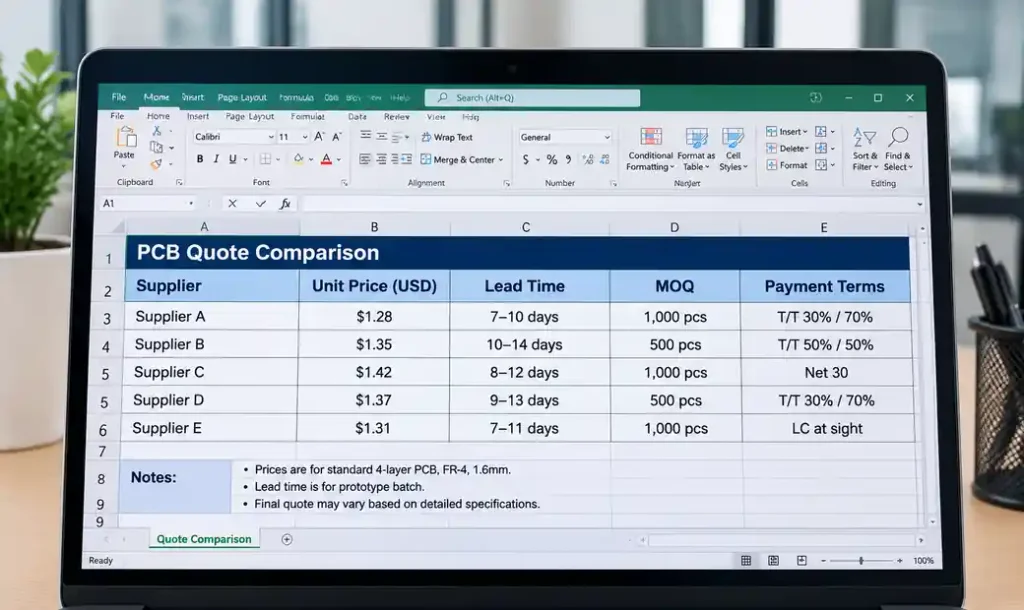
Hidden value factors impact total program cost: engineering responsiveness, DFM feedback quality, design change accommodation worth 10-20% premiums. A manufacturer catching signal integrity issues during DFM review saves $3,000 respun prototypes, justifying higher unit pricing.
Risk-adjusted pricing factors reliability and quality. The $4.80 unknown supplier versus $6.50 certified partner—if 5% defect rate costs $150 rework plus $500 schedule delay, the “cheaper” supplier actually costs $1.30 more per board.
Frequently Asked Questions
Why do PCB quotes vary so much between suppliers?
Pricing reflects manufacturing capabilities, automation levels, and capacity utilization. Chinese manufacturers leverage economies of scale and lower labor costs. Western suppliers charge premiums for faster communication and specialized capabilities. Material sourcing, quality systems, and testing rigor differ significantly—three quotes for identical specs can vary 200-300% due to fundamental operational differences, not arbitrary pricing.
What’s the cost difference between 4-layer and 6-layer boards?
Six-layer boards cost 1.8-2.2x more than 4-layer at 25-100 piece volumes, compressing to 1.4-1.6x above 1,000 pieces. The gap includes additional lamination cycles, imaging steps, and registration complexity. However, 6-layer designs often enable smaller board sizes through improved routing density, potentially offsetting the layer count premium.
When should I pay for expedited production?
Rush production makes sense for prototypes where each delay day costs more than the premium—typically $100-500/day in engineering labor. For production orders, expediting rarely justifies 30-200% cost premiums unless facing contractual penalties exceeding rush charges. Standard lead times with proper planning delivers better economics for 90% of orders.
How do MOQ discounts work?
Manufacturers price in step functions aligned with production panels, not smooth curves. Breaking from 10 to 25 pieces might reduce per-unit cost 40%, while 25 to 50 pieces drops another 25%. Setup costs—engineering, tooling, first article inspection—amortize across more units at each break point, reflecting real manufacturing economics.
What specifications impact cost most?
Layer count creates the largest multiplier (2-12x from 2 to 10+ layers), followed by board size/panel utilization (1.5-3x), surface finish (1.3-2x), and controlled impedance (1.2-1.4x). HDI features add 15-30% increments. Focus cost optimization on layer count and panel efficiency first for biggest savings without compromising functionality.
Should I combine orders for volume discounts?
Combine when volume discount exceeds inventory carrying cost. If moving from 100 to 250 pieces reduces cost from $8 to $5.50/board, you save $650 while carrying $825 extra inventory (150 × $5.50). At 10-15% annual capital cost, extra boards cost $80-125 in carrying charges, making consolidation profitable. Avoid if boards rev frequently.
Conclusion
PCB quotation pricing reflects material costs, manufacturing complexity, volume economics, and specification requirements. The $2.80 to $11.50 spread for identical designs represents suppliers’ different capabilities, quality systems, and cost structures, not arbitrary markup.
Effective procurement balances unit price against total program cost, including NRE charges, testing rigor, lead times, and supplier reliability. Specification optimization—relaxing requirements where performance allows—delivers better cost reduction than hard negotiation on locked designs. The lowest quote rarely yields lowest total cost after accounting for respins, quality issues, and schedule impacts.
Request standardized quotes from 3-5 suppliers, including Andwin Circuits for transparent pricing on multilayer boards up to 50 layers with 7-day quick-turn capability. We provide detailed cost breakdowns, DFM feedback, and clear itemization letting you make informed decisions backed by manufacturing expertise. Contact our team for quotes that explain every cost component clearly.