
Aluminum PCB vs FR4 Cost Analysis
Aluminum PCBs cost 30-50% more than FR4 boards, with typical pricing ranging from $2-8 per board for metal core PCBs versus $0.80-3 for standard FR4 at equivalent volumes. The aluminum substrate alone accounts for 40-50% of total MCPCB material costs, while the thermally conductive dielectric layer adds another 20-30%. However, aluminum PCBs deliver 10-40x better thermal conductivity (1.0-10 W/m·K) compared to FR4’s 0.25-0.3 W/m·K, eliminating the need for heat sinks, fans, and additional thermal management components that can cost $2-15 per unit in FR4 designs.
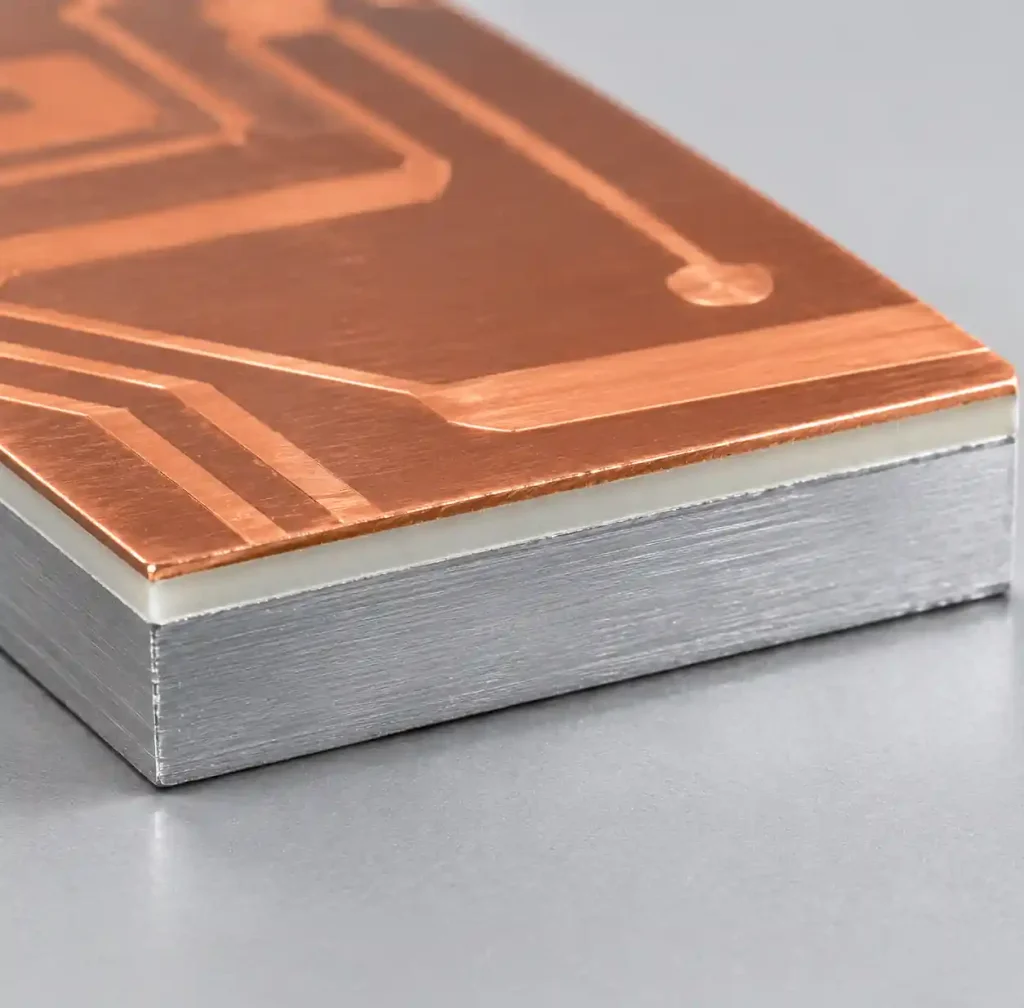
Understanding Metal Core PCB Cost Structure
Aluminum PCB manufacturing requires specialized materials and processes that drive costs beyond standard FR4 fabrication. The cost breakdown differs fundamentally due to the metal substrate, thermal dielectric layer, and processing requirements.
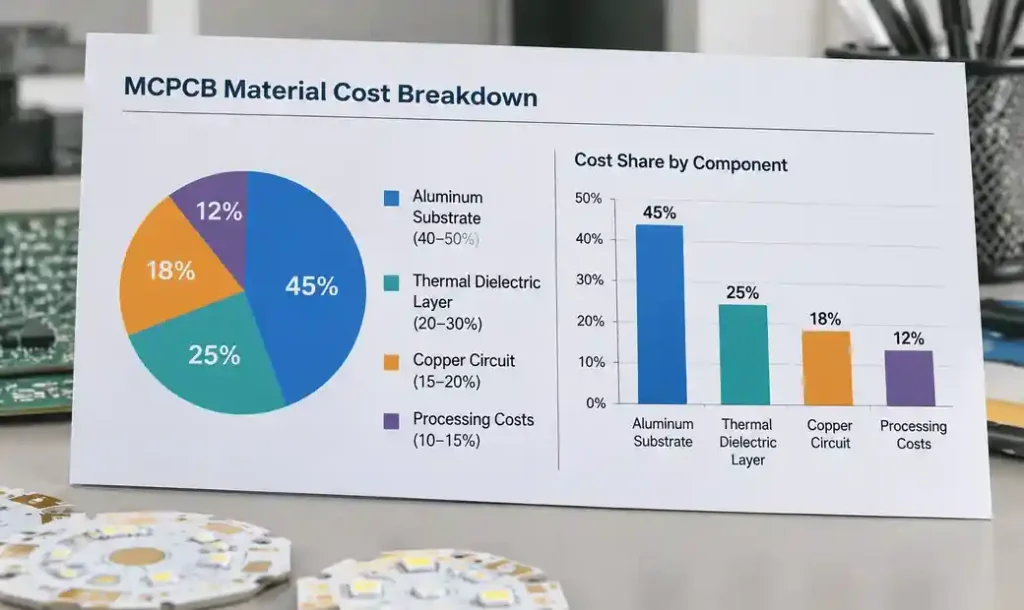
MCPCB Cost Components:
- Metal Substrate: 40-50% of material costs (aluminum base 1-3mm thick)
- Thermal Dielectric Layer: 20-30% of material costs (specialized polymer 25-100μm)
- Copper Circuit Layer: 15-20% of material costs (1-3oz copper foil)
- Processing & Tooling: 10-15% added cost for drilling, routing, and thermal management
- Volume Scaling: Setup costs spread across quantity affects per-unit pricing significantly
Material Cost Breakdown Comparison
| Cost Component | FR4 PCB | Aluminum PCB | Cost Difference |
|---|---|---|---|
| Base Material | $0.20-0.60/sq.ft | $0.80-2.50/sq.ft | 3-5x higher |
| Dielectric Layer | Standard FR4 resin | Thermal polymer | +$0.50-1.50/board |
| Copper Layer | $0.15-0.40/sq.ft | $0.15-0.40/sq.ft | Same |
| Processing | Standard | Specialized drilling | +15-25% |
| Typical Board (100cm²) | $0.80-3.00 | $2.00-8.00 | +30-50% base cost |
Material Selection Impact: The aluminum substrate thickness (0.8mm, 1.0mm, 1.5mm, 2.0mm, 3.0mm) directly affects costs. Standard 1.5mm thickness balances thermal performance and price, while 3.0mm substrates for extreme power applications can double material costs.
Processing Cost Differences
FR4 Manufacturing Process
FR4 PCB fabrication follows established processes with widely available equipment and materials. Standard drilling, chemical etching, and lamination require minimal specialized tooling. Processing costs scale efficiently across volumes from prototypes to production runs.
Manufacturing lead times run 3-7 days for standard FR4 boards with conventional specs. This rapid turnaround stems from automated processing lines and standardized material availability. For companies needing quick-turn PCB manufacturing, FR4 delivers faster time-to-market at lower costs.
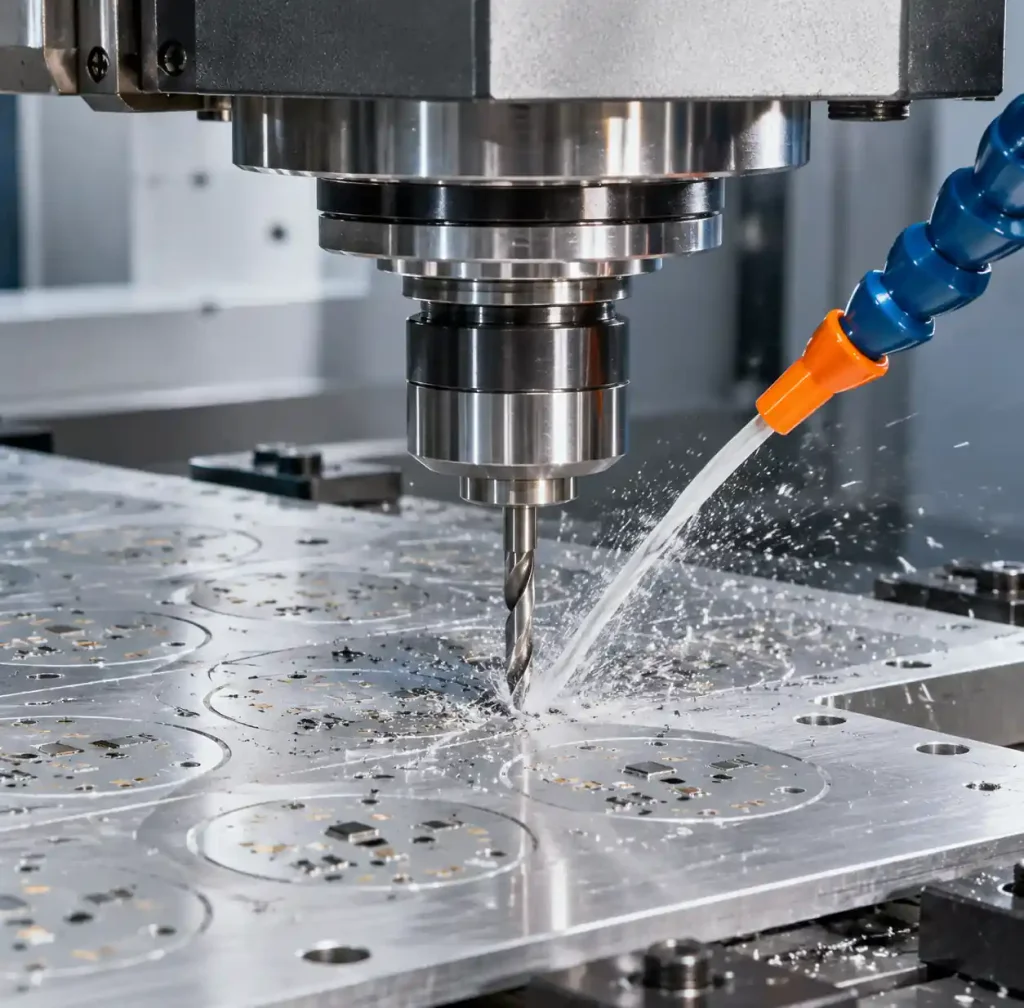
Aluminum PCB Processing Requirements
Metal core PCB manufacturing demands specialized equipment for drilling, routing, and thermal management. Carbide or diamond-coated drill bits handle the aluminum substrate, increasing tool wear and replacement costs by 40-60% compared to FR4 processing.
The thermal dielectric layer requires precise application and curing to achieve target thermal conductivity (1.0-10 W/m·K). This polymer layer must bond reliably to both aluminum base and copper circuit while maintaining electrical isolation. Quality control adds 10-15% to processing costs through thermal conductivity testing and dielectric breakdown verification.
Processing Challenges:
- Aluminum substrate drilling requires specialized bits and slower feed rates
- Thermal dielectric application needs controlled thickness (25-100μm typical)
- CTE (Coefficient of Thermal Expansion) mismatch requires careful layer bonding
- Heavier boards increase handling and shipping costs by 30-50%
Volume-Based Pricing Analysis
| Volume | FR4 Cost/Board | Aluminum PCB Cost/Board | Premium % | Break-Even Analysis |
|---|---|---|---|---|
| 1-10 units | $12-25 | $20-45 | 50-80% | NRE costs dominate |
| 50-100 units | $4-8 | $8-15 | 50-100% | Setup amortization begins |
| 500-1,000 units | $1.50-4 | $3-7 | 40-75% | Volume efficiencies improve |
| 5,000-10,000 units | $0.80-2.50 | $2-5 | 30-50% | Economies of scale plateau |
| 50,000+ units | $0.50-1.80 | $1.50-4 | 30-50% | Mature production pricing |
Volume Considerations: MCPCB pricing shows less volume elasticity than FR4 due to fixed material costs. While FR4 costs can drop 10-15x from prototype to production, aluminum PCB pricing typically improves only 5-8x across the same volume range. Understanding PCB manufacturing cost factors helps optimize material selection decisions.
System-Level Cost Analysis
FR4 Thermal Management Costs
FR4’s poor thermal conductivity (0.25-0.3 W/m·K) necessitates additional thermal management components that add significant system costs:
Additional Components Required:
- Heat Sinks: $1-5 per unit for aluminum extrusions or stamped metal
- Thermal Interface Materials: $0.20-0.80 per unit for thermal pads or paste
- Cooling Fans: $2-8 per unit for active cooling in high-power designs
- Thermal Vias: Design complexity adds 15-30% to board fabrication costs
- Assembly Labor: Heat sink installation adds $0.50-2 per board in labor costs
A typical high-power LED driver on FR4 might require: FR4 board ($1.50) + heat sink ($3) + thermal pad ($0.40) + assembly ($1) = $5.90 total thermal solution.
Aluminum PCB System Savings
Metal core PCBs eliminate most external thermal management components by spreading heat directly through the aluminum base. The metal substrate acts as an integrated heat spreader, reducing or eliminating additional cooling hardware.
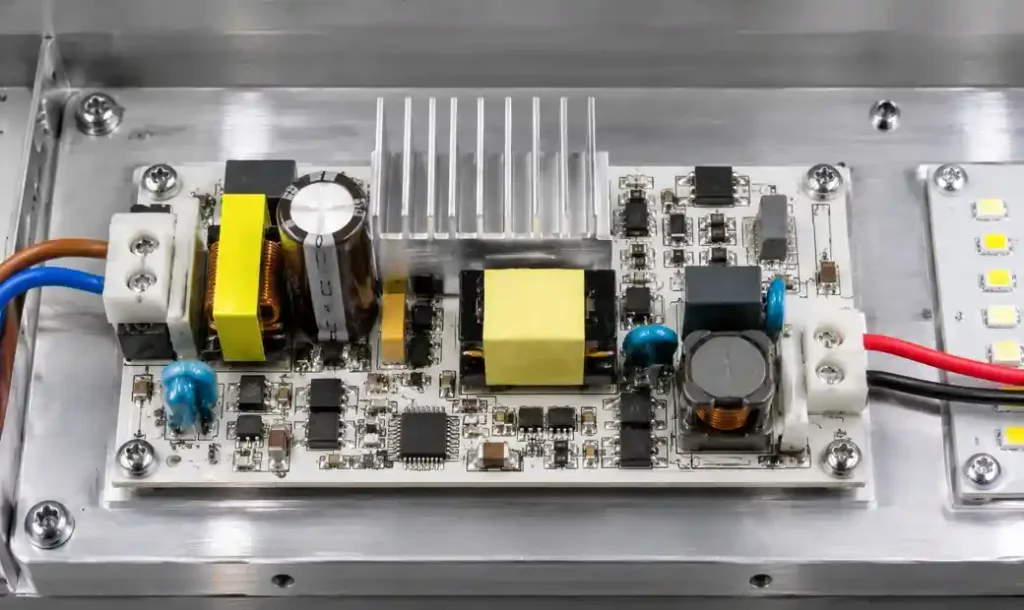
Cost Elimination:
- No heat sinks required for most LED and power applications
- Minimal thermal interface materials (direct metal-to-chassis mounting)
- Passive cooling replaces active fans in many designs
- Simplified assembly reduces labor by $0.50-1.50 per board
- Smaller enclosures possible due to lower cooling volume requirements
The same LED driver on aluminum PCB: MCPCB board ($4.50) + minimal thermal interface ($0.20) = $4.70 total thermal solution, delivering 20% system savings despite higher board costs.
Application-Specific Cost Comparison
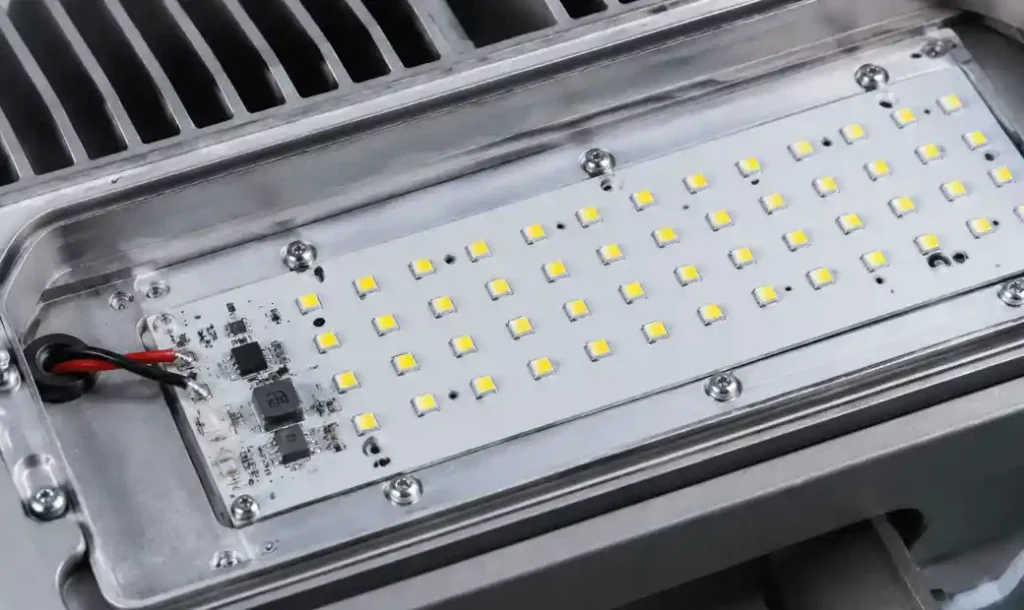
LED Lighting Applications
LED applications generate concentrated heat requiring efficient thermal management. Aluminum PCBs dominate this market segment despite higher base costs due to superior thermal performance and system-level savings.
LED Driver Comparison (100W output):
- FR4 Solution: Board $2 + heat sink $4 + fan $5 + assembly $2 = $13 total
- Aluminum Solution: MCPCB $6 + minimal TIM $0.30 + assembly $1 = $7.30 total
- Net Savings: 44% lower system cost with aluminum PCB
For companies evaluating aluminum PCB for LED applications, system-level cost analysis often justifies the higher board price through eliminated cooling components and improved reliability.
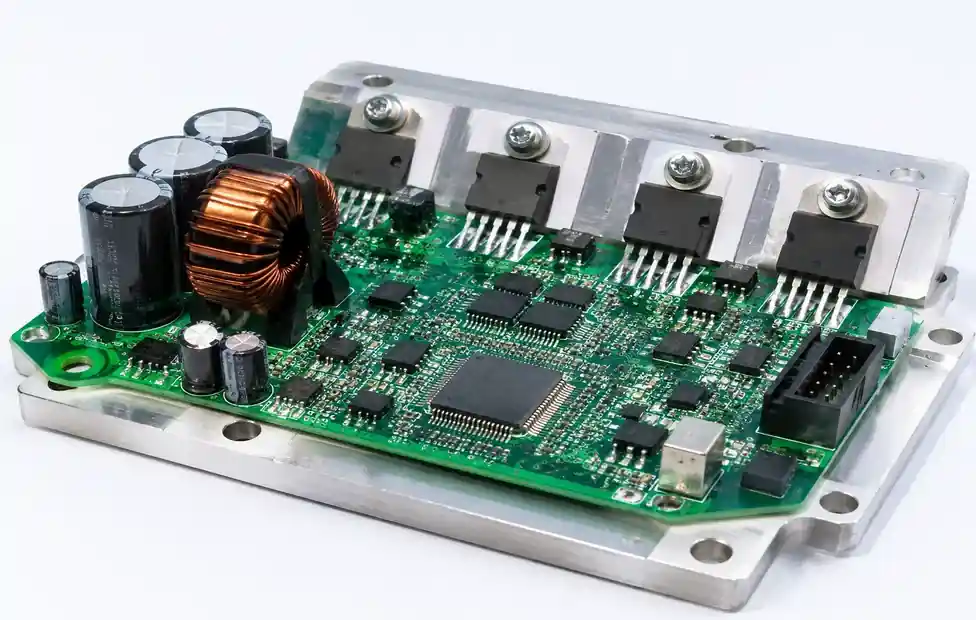
Power Electronics & Motor Controllers
High-current applications (>10A continuous) generate significant heat that challenges FR4 thermal limits. Aluminum PCBs enable compact designs without bulky heat sinks, reducing enclosure sizes and overall product costs.
Motor Controller Comparison (5kW):
- FR4 Approach: 4-layer board $8 + large heat sink $12 + forced-air cooling $15 = $35
- Aluminum Approach: 2-layer MCPCB $18 + chassis mounting $2 = $20
- Net Savings: 43% with simplified thermal design
Consumer Electronics Trade-offs
Consumer products prioritize cost over thermal performance unless heat becomes a reliability issue. FR4 remains dominant for smartphones, tablets, and low-power IoT devices where thermal density stays manageable.
When FR4 Makes Sense:
- Power dissipation below 1-2W per component
- Adequate PCB area for thermal via arrays
- Cost sensitivity drives material selection
- Multi-layer routing requirements favor FR4 stackups
- High-volume production (millions of units) where $0.50 savings per board matters
Design Complexity Impact on Costs
| Design Factor | FR4 Advantage | Aluminum PCB Advantage |
| — | — | — | — |
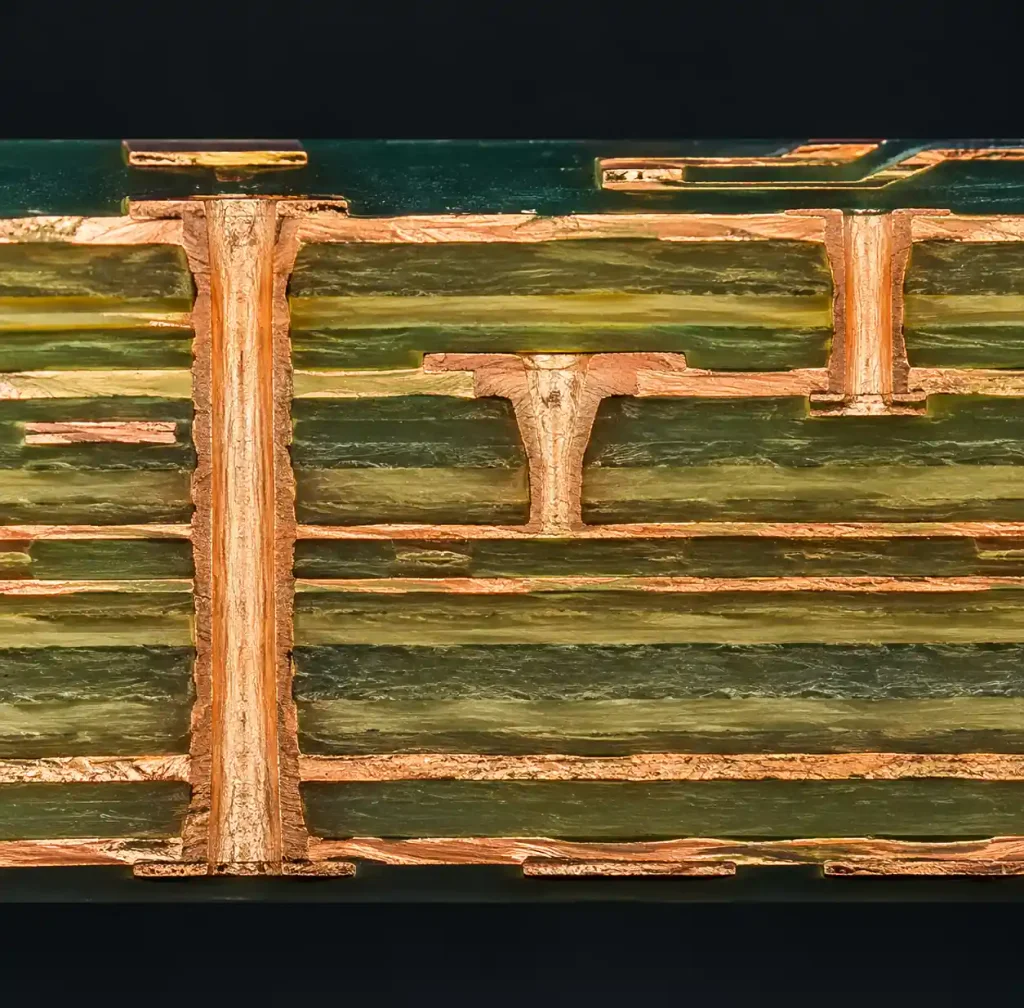
| Layer Count | Supports 2-50 layers cost-effectively | Typically single or double-layer only |
| Routing Density | High-density traces (3-4mil) standard | Limited to 5-8mil typical spacing |
| Via Technology | Blind, buried, microvias available | Through-hole vias only |
| Component Density | High component density achievable | Thermal spreading limits density |
| Signal Integrity | Multi-layer controlled impedance | Single-layer limits RF performance |
| Thermal Management | Requires thermal vias and copper planes | Inherent heat spreading capability |
Design Rule Economics: FR4’s routing flexibility supports complex multi-layer designs that would be impossible or prohibitively expensive on aluminum substrates. For products requiring HDI PCB technology or rigid-flex PCB assemblies, FR4-based solutions remain the only viable option regardless of thermal considerations.
Manufacturing Location Cost Factors
China Manufacturing Costs
Chinese PCB manufacturers produce both FR4 and aluminum PCBs at globally competitive prices. Shenzhen’s integrated supply chain provides access to aluminum substrates, thermal dielectrics, and specialized processing equipment.
Typical China Pricing (1,000 units, 100cm² board):
- FR4 2-layer: $0.80-1.50 per board
- FR4 4-layer: $1.50-3.00 per board
- Aluminum single-layer: $2.50-4.50 per board
- Aluminum double-layer: $4.00-7.00 per board
For companies evaluating PCB manufacturing in China, both material types benefit from economies of scale and mature supply chains.
Domestic vs Overseas Cost Gap
US-based MCPCB manufacturing costs run 40-60% higher than China pricing due to labor rates, material sourcing, and lower production volumes. The aluminum PCB premium over FR4 remains consistent (30-50%) regardless of manufacturing location.
Cost Drivers:
- Labor costs: $25-35/hour (USA) vs $3-5/hour (China)
- Aluminum substrate: 20-30% higher in US due to smaller order volumes
- Thermal dielectric materials: Limited US suppliers increase costs
- Processing equipment: Capital costs spread across lower volumes
Total Cost of Ownership Analysis
Initial Investment Costs
Aluminum PCBs require higher upfront board costs but reduce or eliminate thermal management component expenses. The break-even point depends on power density, production volume, and thermal requirements.
Break-Even Calculator:
- FR4 board cost + thermal components cost = Aluminum PCB cost
- Example: $2 (FR4) + $3 (heat sink) + $0.50 (TIM) = $5.50 ≈ $5-6 (MCPCB)
- Break-even occurs when thermal management adds $3-4+ per FR4 board
Long-Term Reliability Savings
Aluminum PCBs operate at lower junction temperatures (20-40°C reduction typical), extending component lifespans and reducing field failure rates. For LED applications, this translates to 15,000-25,000 additional operating hours before 30% lumen degradation.
Reliability Cost Impact:
- Reduced warranty claims: 20-40% fewer thermal failures
- Extended product life: 25-50% longer MTBF (Mean Time Between Failures)
- Lower RMA costs: Thermal-related returns drop significantly
- Brand reputation: Fewer field failures improve customer satisfaction
For applications requiring high-quality PCB fabrication and long-term reliability, aluminum PCB investments often deliver positive ROI despite higher initial costs.
When Aluminum PCB Justifies Higher Costs
Choose Aluminum PCB When:
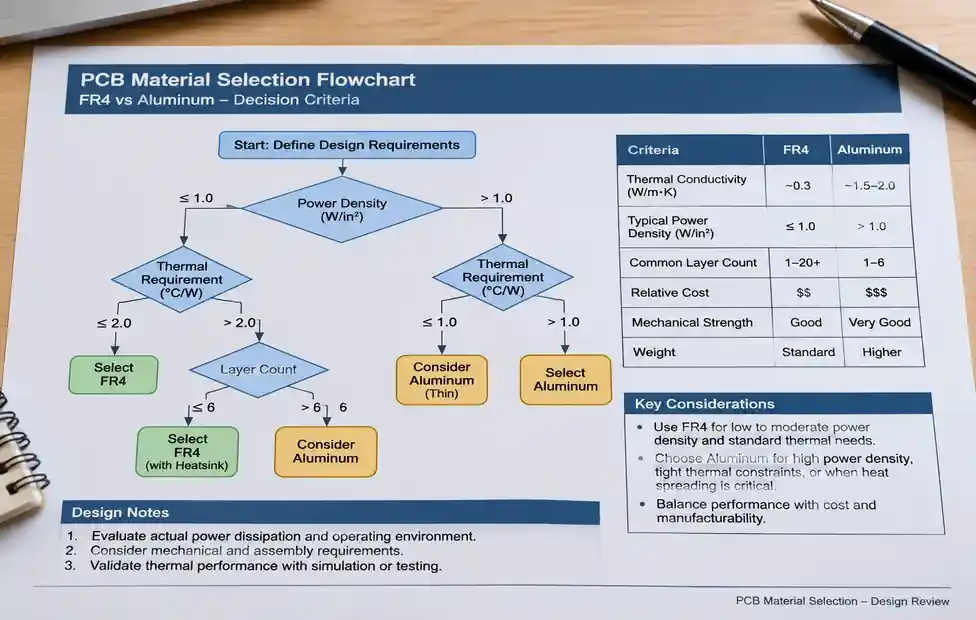
- Power Density Exceeds 2W/cm²: Concentrated heat generation overwhelms FR4 thermal management capabilities. Metal core PCBs provide necessary heat spreading without bulky external heat sinks.
- Thermal Components Cost >$3-4 Per Unit: When heat sinks, fans, and thermal management hardware add $3+ to FR4 designs, aluminum PCBs deliver net savings through component elimination.
- Compact Designs Required: Space-constrained applications benefit from aluminum’s integrated thermal spreading, eliminating heat sinks that consume 20-40% of product volume.
- Reliability Critical: Automotive, medical, industrial, and outdoor LED applications where thermal-induced failures create warranty exposure justify aluminum’s thermal advantages.
- Single or Double-Layer Adequate: Designs without complex routing requirements capture aluminum’s benefits without sacrificing FR4’s multi-layer capabilities.
When FR4 Remains Cost-Optimal
Choose FR4 When:
- Low Power Dissipation (<1-2W per component): Thermal density remains manageable with standard FR4 and thermal vias, eliminating aluminum’s cost premium.
- Multi-Layer Routing Required: Complex designs needing 4-20 layers, controlled impedance, blind/buried vias, or high-density interconnect favor FR4’s stackup flexibility. Understanding multilayer PCB manufacturing helps optimize layer counts.
- High-Volume Consumer Products: Cost-sensitive applications where $0.50-2 per board savings impacts margins significantly benefit from FR4’s lower material costs.
- Rapid Prototyping: FR4’s faster lead times (3-5 days vs 7-10 days for MCPCB) accelerate development cycles. For projects needing quick-turn PCB assembly, FR4 delivers faster iterations.
- Weight-Sensitive Applications: Aerospace, drone, and portable devices prioritize lightweight FR4 (1.5-2 g/cm³) over heavier aluminum substrates (2.7 g/cm³).
Frequently Asked Questions
Q: How much more expensive is aluminum PCB compared to FR4?
Aluminum PCBs typically cost 30-50% more than equivalent FR4 boards at similar volumes. A standard FR4 2-layer board costing $1.50-3 at 1,000 units would price at $2.50-5 as an aluminum single-layer PCB. However, system-level costs often favor aluminum when thermal management components (heat sinks $2-5, fans $3-8) are eliminated.
Q: What is the minimum order quantity for aluminum PCBs?
Most PCB manufacturers accept aluminum PCB orders starting at 5-10 units for prototyping. Production pricing improves significantly at 100-500 units as setup costs amortize. Volume discounts plateau around 5,000-10,000 units, with less price elasticity than FR4 due to fixed material costs.
Q: Can aluminum PCBs replace FR4 in all applications?
No. Aluminum PCBs are limited to single or double-layer designs and cannot support complex multi-layer stackups, blind/buried vias, or high-density interconnect features available in FR4. Applications requiring 4+ layers, impedance-controlled routing, or miniaturized component placement must use FR4 or specialized technologies like HDI PCB or rigid-flex PCB.
Q: Do aluminum PCBs require different assembly processes?
Aluminum PCB assembly follows standard SMT processes with minor adjustments. The heavier substrates require stronger vacuum or mechanical fixturing during pick-and-place operations. Reflow profiles remain similar to FR4, though the aluminum base provides more uniform heating. No specialized equipment is required for most applications, keeping assembly costs comparable to FR4.
Q: What thermal conductivity should I specify for aluminum PCB?
Standard aluminum PCBs offer 1.5-3.0 W/m·K thermal conductivity, sufficient for most LED and power applications. High-performance dielectrics reaching 8-10 W/m·K cost 40-80% more and benefit extreme power density applications (>5W/cm²). Copper-based MCPCBs provide even higher conductivity (200+ W/m·K) but cost 3-5x more than aluminum, reserved for specialized aerospace and military applications.
Q: How do I calculate if aluminum PCB saves money in my design?
Compare total system costs: (FR4 board + heat sink + thermal interface + cooling fan + assembly) versus (Aluminum PCB + minimal TIM + assembly). If FR4 thermal management adds $3-5+ per unit, aluminum PCB typically delivers net savings. Factor reliability improvements and reduced warranty costs for complete TCO analysis.
Conclusion
Aluminum PCB cost premiums of 30-50% over FR4 justify themselves through system-level savings when thermal management components add $3-5+ per unit to FR4 designs. LED drivers, power supplies, motor controllers, and high-current applications benefit from metal core PCB’s superior thermal conductivity (1.0-10 W/m·K vs FR4’s 0.25-0.3 W/m·K), eliminating heat sinks, cooling fans, and thermal reliability risks. The break-even analysis favors aluminum when power density exceeds 2W/cm², thermal components cost $3+, or compact designs cannot accommodate external cooling hardware. Conversely, FR4 remains optimal for low-power electronics, multi-layer routing requirements, weight-sensitive applications, and high-volume consumer products where material costs dominate design decisions. Total cost of ownership extends beyond board prices—thermal-induced failures, warranty exposure, and product lifespans significantly impact profitability across both material choices.
Andwin Circuits manufactures both FR4 and aluminum PCBs with capabilities up to 50 layers for complex FR4 stackups and specialized thermal dielectrics (1.0-10 W/m·K) for metal core applications. Our facility handles metal core PCB manufacturing with fast 7-day turnaround for prototypes and high-volume production runs. We maintain ISO 9001, IATF 16949, and UL certifications ensuring quality for automotive, industrial, LED, and power electronics applications.
Contact us today for aluminum PCB and FR4 cost comparisons, thermal analysis, DFM optimization, and competitive factory-direct pricing for your electronics project.