
Low Volume PCB Assembly: MOQ and Cost Optimization Strategies
When transitioning from prototype to pilot production, low volume PCB assembly presents distinct procurement challenges. Small-batch orders face higher per-unit costs, MOQ barriers, and limited negotiating leverage. For hardware teams managing 10-500 unit builds, understanding cost structure and optimization strategies determines whether NPI execution stays on budget.
Understanding MOQ in Low Volume PCB Assembly
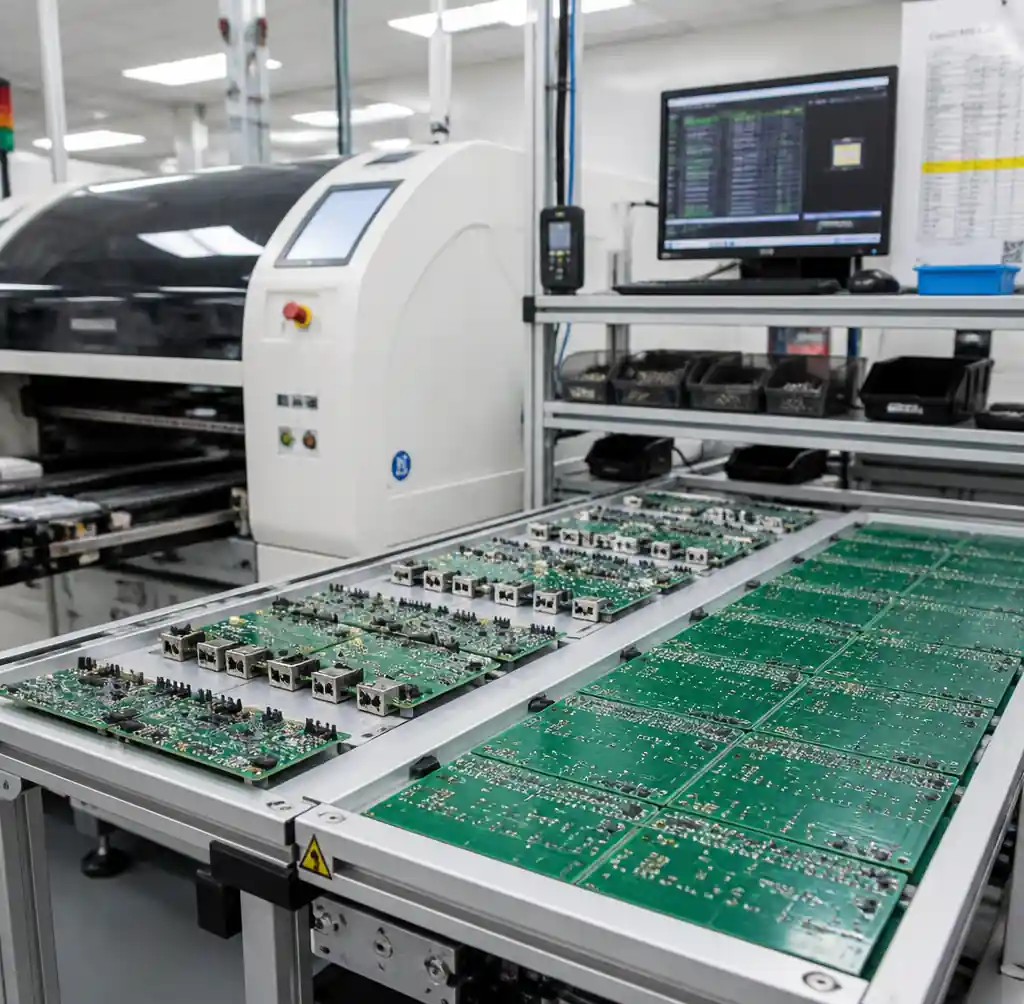
Minimum Order Quantity (MOQ) represents the smallest production batch a manufacturer accepts to cover fixed setup costs. Setup costs—stencil fabrication, machine programming, AOI calibration—remain constant whether you build 10 boards or 1,000. A $300 setup cost adds $30 per board at 10 units but only $0.30 at 1,000 units.
Industry MOQ Benchmarks by Volume Tier
| Volume Tier | Typical MOQ | Lead Time | Primary Use Case |
|---|---|---|---|
| Prototype | 1-5 units | 3-5 days | Design validation, functional testing |
| Low Volume NPI | 10-100 units | 7-15 days | Pilot production, market testing |
| Small Batch Production | 100-500 units | 15-25 days | Limited product launch, niche markets |
Specialized low-volume PCB assembly providers now offer flexible MOQ structures starting at single units for prototypes and 10-25 units for NPI builds. This flexibility comes from optimized setup processes and batch consolidation where multiple small orders share machine setup time.
Forcing a 500-unit MOQ when actual demand is 100 units creates inventory risk beyond capital tie-up. Each defect—soldering issue, wrong component orientation, design flaw—now impacts 5x more product than necessary, amplifying risk and costs.
Cost Structure Breakdown
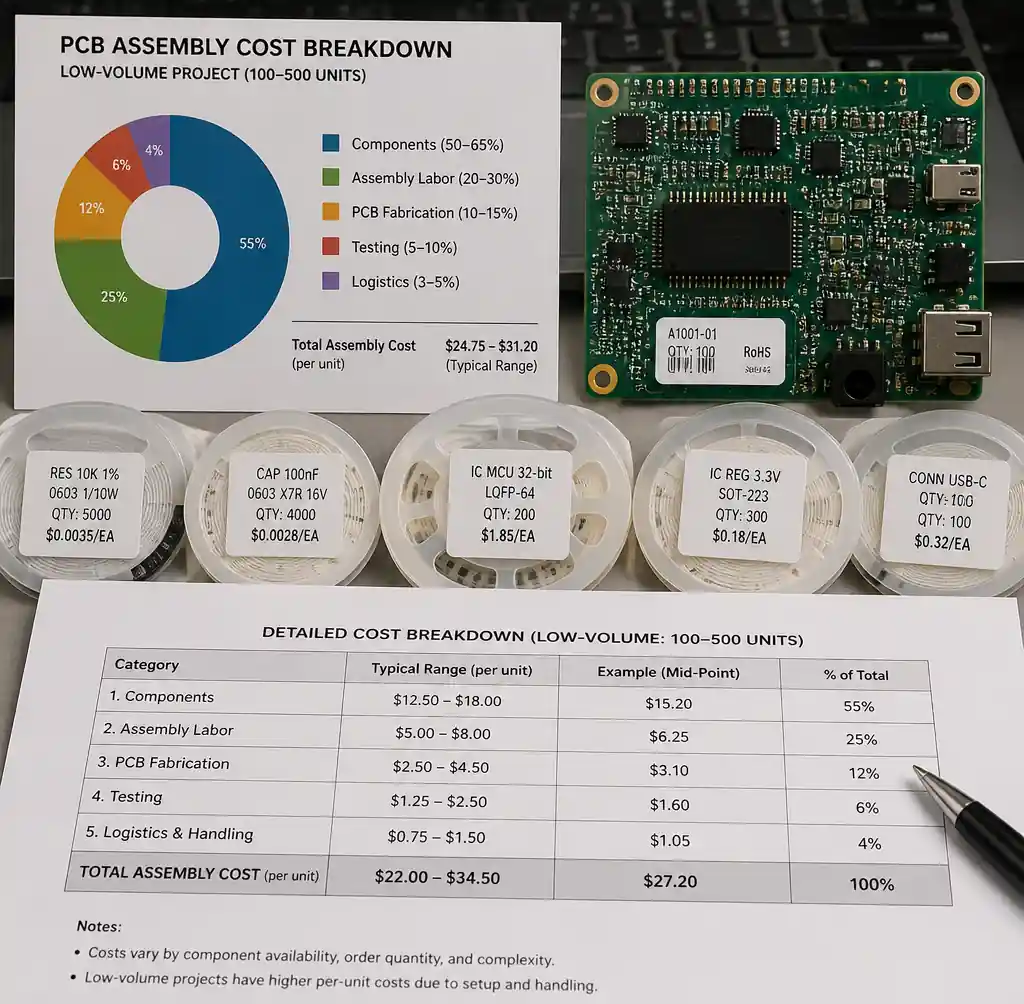
Component costs dominate at 50-65% of total spend. Setup costs typically run $200-600, adding $4-12 per board on a 50-unit order—a material cost that vanishes at higher volumes.
Per-Unit Cost Components
| Cost Element | Percentage | Optimization Leverage |
|---|---|---|
| Component procurement | 50-65% | High—design and sourcing strategy |
| Assembly labor & setup | 20-30% | Medium—volume dependent |
| PCB fabrication | 10-15% | Medium—panel utilization |
| Testing & inspection | 5-10% | Low—quality requirements fixed |
Component Procurement Strategies
Component sourcing for small batches differs fundamentally from volume production. Standard distributor pricing assumes volume purchases; at low quantities, unit prices run 2-4x higher.
Turnkey vs. Consigned Assembly
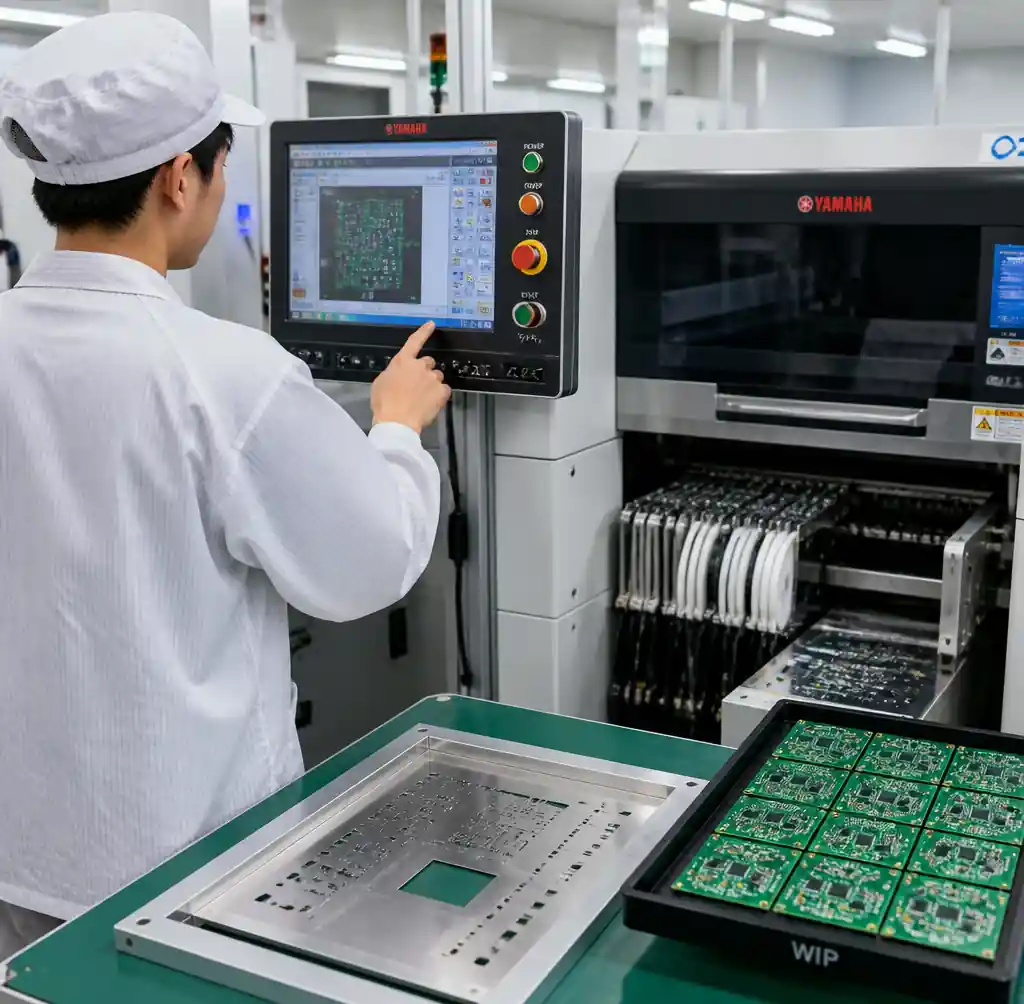
Turnkey assembly means your manufacturer sources all components, consolidating procurement and leveraging existing supplier relationships. For teams prioritizing speed, turnkey offers the fastest path.
Consigned assembly means you source and ship components, maintaining direct pricing control but adding procurement workload and coordination complexity.
For most projects under 100 units, turnkey PCB assembly reduces total project cost when factoring engineering time. The 10-20% component premium gets offset by eliminated procurement labor and faster execution.
Practical Sourcing Tactics
Use manufacturer’s preferred parts list (PPL). Designing with PPL components eliminates minimum buy quantities. A 2,000-unit distributor minimum becomes irrelevant when your manufacturer stocks that resistor.
Consolidate component SKUs. Every unique part number adds procurement complexity. Using standard resistor values instead of tight tolerances reduces SKU count and simplifies procurement.
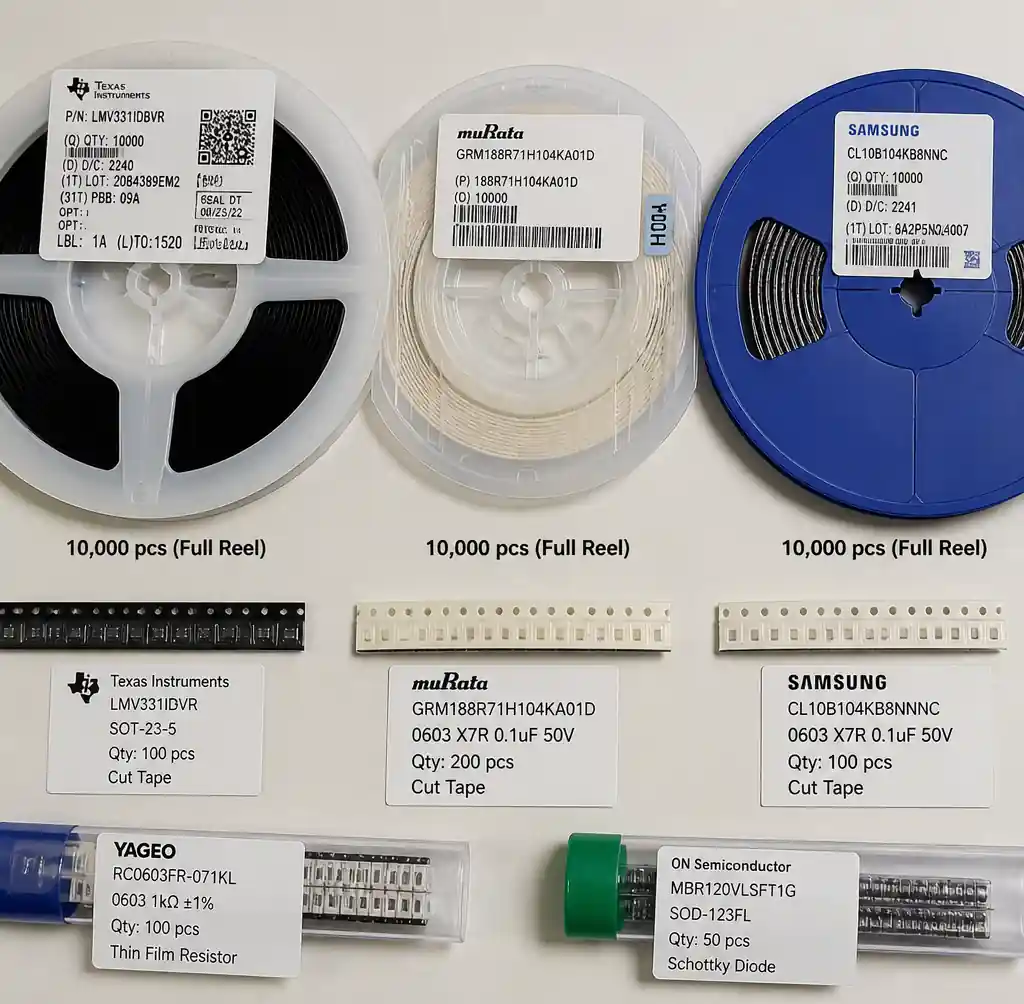
Request partial reel pricing. Many distributors sell cut tape for common passives at reasonable premiums. A 10,000-piece reel at $0.10 costs $1,000; buying 200 pieces on cut tape at $0.15 costs $30.
Leverage broker networks for scarce parts. When designs require EOL components or allocation-constrained chips, brokers access secondary markets without forcing full reels at reasonable premiums for low quantities.
Design for Manufacturability in Low Volumes
DFM optimization for low volumes focuses on lowest total project cost and fastest time-to-market, not maximum throughput.
Minimize unique part types. Using 100 instances of the same capacitor creates less cost burden than 10 different values. Procurement complexity drives cost more than placement time in small batches.
Avoid exotic components. That 0.35mm pitch CSP might save board space, but if your quick-turn assembly provider charges $150 fine-pitch setup, the cost at 25 units overwhelms space savings. Standard 0.5mm pitch BGAs keep setup costs predictable.
Design for standard panel sizes. A 50mm x 80mm board fits standard panel layouts better than 47mm x 83mm. Panel utilization significantly impacts economics in the 100-500 unit range.

Pricing Negotiation Tactics
Negotiating leverage in low-volume assembly comes from different sources than volume production. You won’t win on volume commitment alone, but strategic approaches still influence pricing.
Bundle multiple projects. Consolidating three different PCB designs with one manufacturer creates larger total volume. A 25-unit order looks different as the first of four builds totaling 200 units.
Establish design freeze discipline. Last-minute changes force setup rework. Committing to freeze deadlines 5-7 days before production earns credibility and often preferential pricing.
Accept longer lead times. Rush fees for 3-5 day quick turn assembly add 30-50% to cost. If schedules tolerate 10-15 days, you’ll access standard production slots at lower pricing.
Request volume pricing projections. Ask for pricing at 50, 100, 250, and 500 units even if current order is 25. This signals growth potential and often unlocks volume-tier pricing earlier.
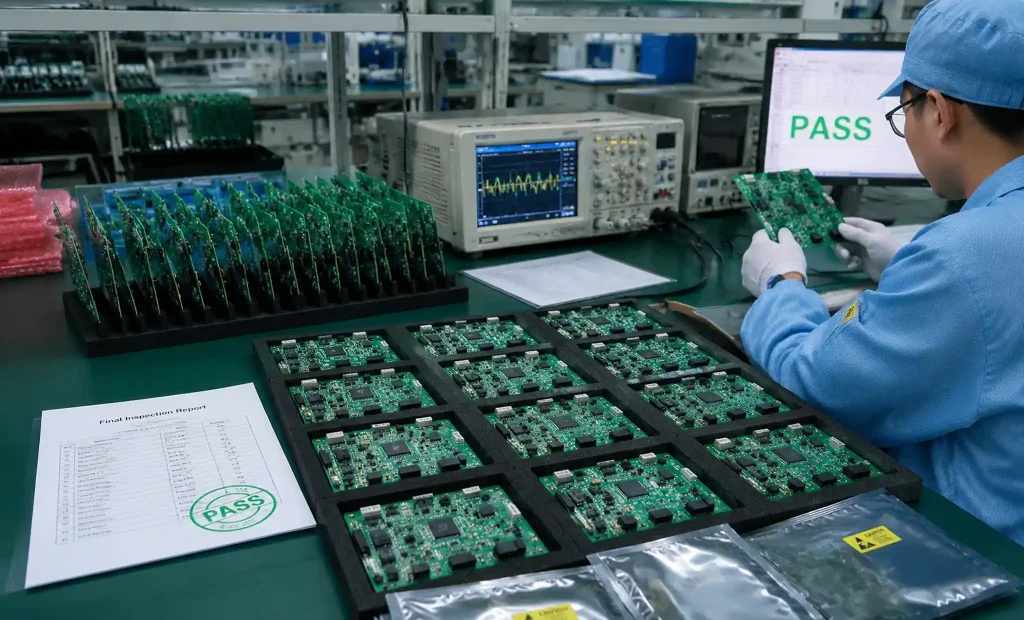
Don’t negotiate on quality standards. Accepting reduced AOI coverage or skipping functional testing might save $2-3 per board but creates downstream rework costs that dwarf savings.
When to Use Prototype vs. Production Services
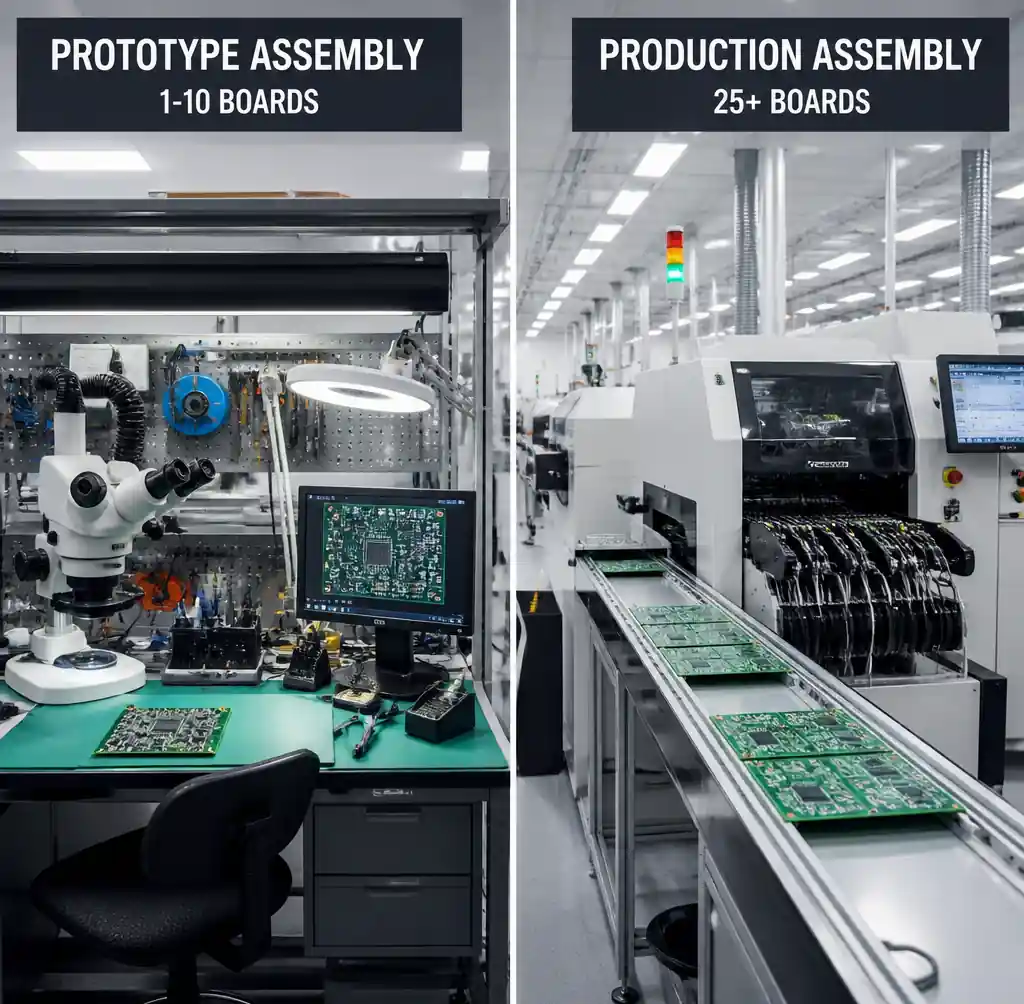
The line between prototype and production assembly matters for pricing and capability matching.
Use prototype assembly (1-10 units) when:
- Design is still iterating and changes are likely
- You need functional boards in 3-5 days for time-critical testing
- You’re validating new component selections
- Budget can absorb $50-150 per board premium for speed
Use low-volume production (25-500 units) when:
- Design is frozen and validated
- You need consistent quality across all boards
- You’re building regulatory samples or pilot production
- Per-unit cost matters more than maximum speed
Avoid the 10-25 unit middle zone unless requirements are clear. This quantity is too large for economical prototype pricing but too small for efficient production setup.
Alternative Sourcing Models
Aggregation platforms consolidate multiple small orders to achieve volume economies. Your 25-unit order gets batched with others, spreading setup costs. This works for simple boards but limits component selection flexibility.
Prototype-to-production manufacturers specialize in 1-500 units with optimized changeover processes. They charge 20-40% more per unit than high-volume EMS but eliminate MOQ barriers and reduce lead times.
Regional assembly shops offer responsive service for local customers. When iterative design changes require collaboration or when shipping costs and tariffs make overseas manufacturing uneconomical, regional assembly makes financial sense despite higher labor rates.
Cost Reduction Strategies That Preserve Quality
Cutting costs without compromising reliability requires surgical precision.
High-Impact Reductions
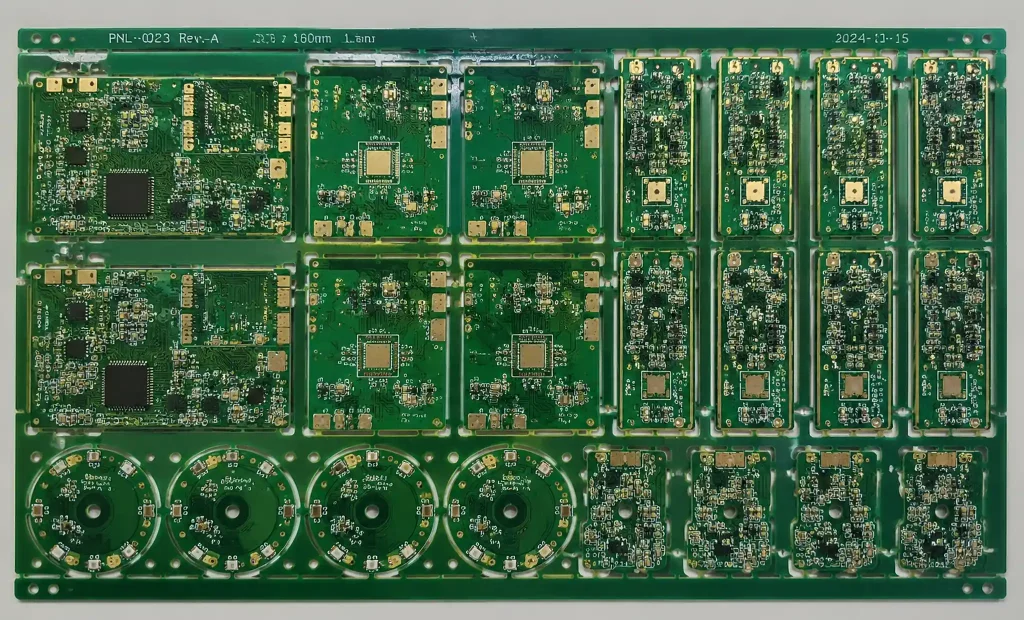
Optimize board dimensions to standard panel sizes. This can reduce PCB fabrication cost 15-25% by improving panel utilization. Ask your fabricator what dimensions maximize panel efficiency before finalizing board outline.
Use manufacturer stencil instead of custom framed stencil. Framed stencils cost $100-200; manufacturer-made laser-cut foil costs $25-50 and works fine for low volumes.
Combine multiple designs into one panel. If building three 50mm x 50mm boards at 25 units each, panelizing all three reduces setup from three runs to one. You’ll separate boards post-assembly, but total cost drops significantly.
Request functional test program reuse. If your design uses standard interfaces (UART, SPI, I2C), manufacturers often have existing test fixtures you can adapt. Custom test development costs $500-1,500; adapting existing programs costs $100-200.
Cost Cuts That Backfire
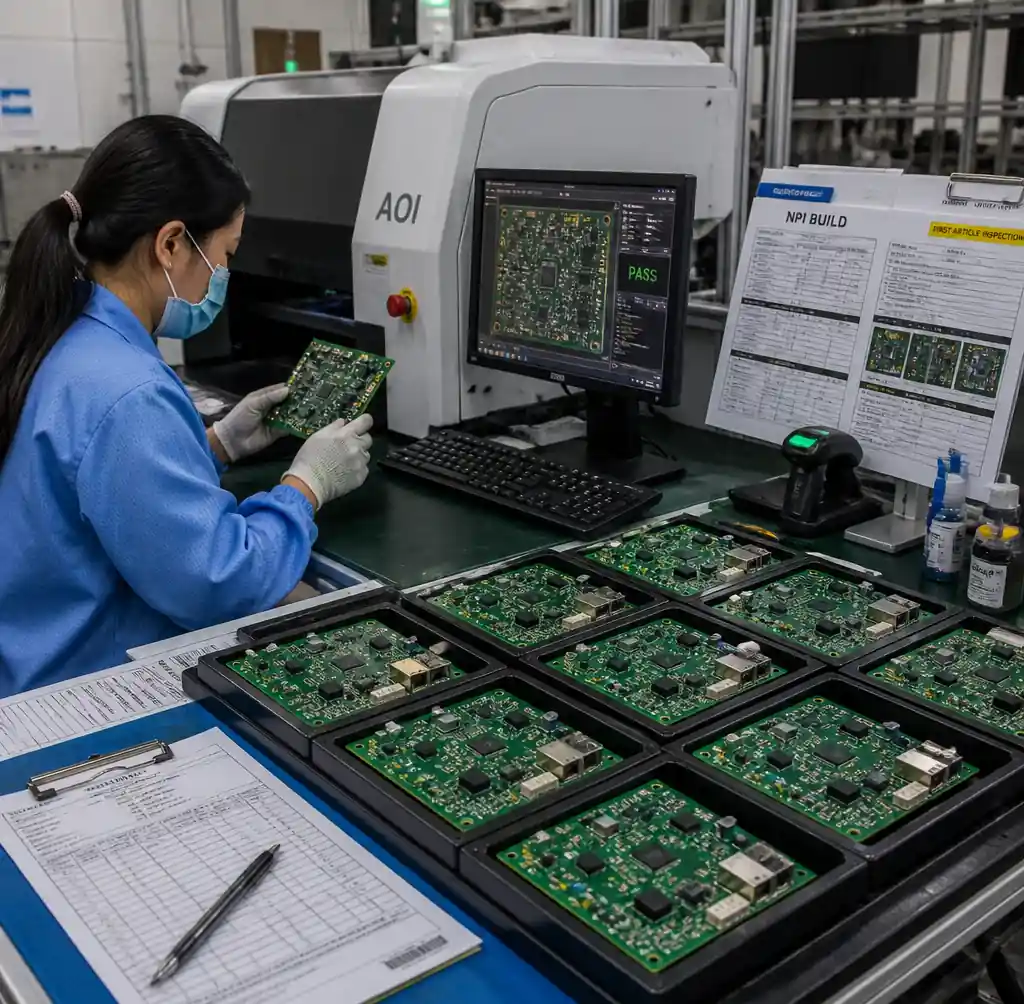
Skipping first article inspection saves $50-100 but risks propagating systematic errors across all boards. At 50 units, one systematic defect creates 50 defective boards. FAI cost per board is $1-2; rework cost is $15-30 per board.
Using marginal or counterfeit components cuts BOM cost 20-30% but introduces field reliability risk that can destroy customer relationships. For products going to real customers, counterfeit risk isn’t worth any savings.
Eliminating conformal coating in harsh environments saves $3-5 per board but creates field failure risk from moisture or chemical exposure. If your product operates in industrial or outdoor environments, coating is insurance, not overhead.
Frequently Asked Questions
What is a reasonable MOQ for low volume PCB assembly?
For prototype quantities, MOQ should be 1-5 units. For NPI and pilot production, 10-25 units is standard. Any manufacturer requiring 500+ unit MOQ for initial builds is not set up for low-volume service. Specialized providers in 2026 typically offer flexible MOQs starting at 10 units for production-quality assembly.
How much does low volume PCB assembly cost per unit?
Per-unit cost varies significantly based on complexity. For a simple 2-layer board with standard components at 50 units, expect $15-30 per board including assembly. Complex 6-8 layer boards with BGAs and fine-pitch components at the same quantity run $50-120 per board. Component costs add 1.5-3x multiplier over volume distributor pricing due to small-quantity premiums.
Should I choose turnkey or consigned assembly?
Turnkey assembly works best for most projects under 100 units. The 10-20% component price premium gets offset by eliminated procurement labor and faster execution. Choose consigned assembly only if you already have components in stock or have existing supplier contracts with favorable pricing.
How can I reduce costs without increasing order quantity?
Focus on BOM optimization: reduce unique component SKUs, use manufacturer preferred parts lists, and consolidate to standard values. Optimize board dimensions for panel utilization. Accept standard lead times instead of rush service. Bundle multiple projects with one manufacturer to increase total volume.
What lead time should I expect?
Standard lead time for low-volume assembly ranges 10-15 business days including PCB fabrication and assembly. Quick-turn services can deliver in 5-7 days at 30-50% price premium. True rush orders achieve 3-5 days but expect double standard pricing. Lead time varies based on component availability—long-lead ICs can extend timelines regardless of manufacturing capacity.
Conclusion
Low volume PCB assembly success hinges on matching sourcing strategy to actual volume requirements rather than forcing prototype approaches into production contexts. The 10-500 unit range requires specialized providers who optimize for flexibility and quick changeovers. Component procurement dominates cost structure at low volumes, making BOM engineering more impactful than assembly labor optimization. Strategic negotiation focuses on project bundling, payment terms, and growth potential rather than pure volume leverage. Understanding where cost reductions preserve quality versus where they create downstream risk separates efficient NPI execution from budget overruns and schedule delays.