
Coverlay flex pcb
Flexible PCB coverlay’s major function is to protect the circuitry on the flexible PCB.
It acts as the solder resist or solder mask for flexible printed circuit boards.
Conventional solder masks or solder resist having limited ductility or flexibility.
So for flexible printed circuits that need greater flexibility,
flexible PCB coverlay is affixed on the circuit board for the protection of the copper foils and wirings.
Flexible PCB coverlay is frequently used and the most preferred solution for enclosing layers of the external circuit of a flexible printed circuit in the PCB industry.
It provides a more durable and robust solution with excellent flexibility and high dielectric strength.
Flexible PCB Coverlay is a solid sheet of material with two parts comprising of one layer of either acrylic or epoxy-based flexible adhesives and one layer of polyimide.
The adhesive bonds the polyimide into the flexible circuit and enclosed the circuitry.
The flexible PCB coverlay is then aligned to the surface of the circuit and aligned under specific temperature and pressure.
Flexible PCB coverlay exists in various combinations of the thickness of the adhesive and film.
The most frequently used combination is in ratio 1:1 (that is 1 mil film and 1 mil adhesive).
The specific combination of the films and adhesives is dependent on these items below:
- Minimum bending requirements. Thinner coverlay might be needed to meet tougher bending requirements
- The weight of the external copper layers
- Dielectric resistance voltage (in some cases)
- Cost
The natural brown coloration of a flexible PCB coverlay is frequently seen when you take a look at a flexible printed circuit.
Since coverlay is a solid sheet of polyimide, it has similar dielectric voltage resistance as flexible cores of polyimide-approximately 3KV per 0.001 inch-and it is available in various thicknesses for various bending requirements.
What Is The Difference Between Flexible PCB Coverlay And Solder Mask Layer?
The circuitry of the exposed external layers of flexible printed circuits can be encapsulated with either a polyimide coverlay or a flexible solder resist or solder mask.
Although both materials perform the same primary function of protecting or insulating the circuitry of the outer layer of a flexible PCB,
each material has different features, capabilities, and characteristics that are suitable for certain particular design requirements.
The differences between flexible PCB coverlay and solder mask are:
- A flexible PCB coverlay is a combination of adhesive and Kapton (a polyimide) but a solder mask (solder resist) is liquid-based.
- Coverlay dam sizes should be kept at 10 mils minimum; however, solder mask dam sizes should be kept at 4 mils minimum.
The dam stops the flowing of molten, liquefied solder from one pad to another pad nearby - The trace to mask opening for coverlay can be as close as 3 mils.
However, using 3 mils for solder masks could cause undercut or non-recording issues (with respect to the imaging of solder masks).
It is advisable you maintain a minimum distance of 4 mils for a solder mask. - Coverlay is generally used on the flexible sections of flexible printed circuits.
A solder mask is made use of on the hard or rigid section of the PCB.
However, if you want to make use of coverlay on an entire rigid-flexible PCB, ensure fang opening or window opening is present. - Unlike a solder mask, coverlay cannot be used on pitch components.
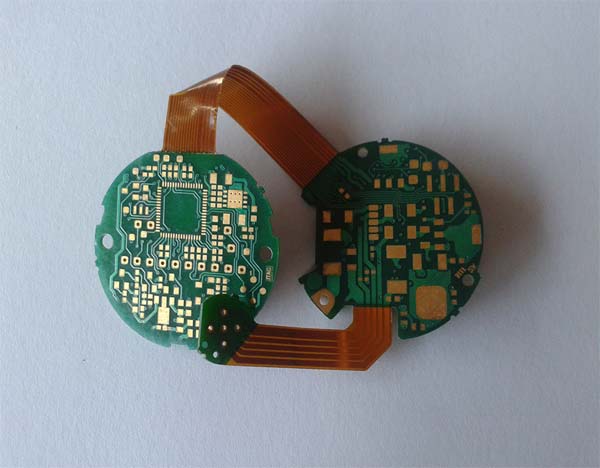
types of coverlay flex pcb
1. Adhesiveless Coverlay Flex PCB:
This type of coverlay flex PCB does not require any adhesive to bond the coverlay to the base material.
Instead, the coverlay is laminated directly onto the copper traces of the base material, which eliminates the risk of adhesive contamination.
2. Adhesive Coverlay Flex PCB:
This type of coverlay flex PCB uses an adhesive layer to bond the coverlay to the base material.
The adhesive layer is typically made of acrylic or epoxy and provides a strong bond between the coverlay and the base material.
3. Thermally Bonded Coverlay Flex PCB:
This type of coverlay flex PCB uses heat and pressure to bond the coverlay to the base material.
The coverlay is typically made of polyimide and is bonded to the base material using a thermally activated adhesive.
4. Liquid Photoimageable Coverlay Flex PCB:
This type of coverlay flex PCB uses a liquid photoimageable coverlay material that is applied to the base material using a screen printing process.
The coverlay material is then cured using UV light, which creates a strong bond between the coverlay and the base material.
5. Pre-Cut Coverlay Flex PCB:
This type of coverlay flex PCB uses a pre-cut coverlay that is applied to the base material using an adhesive layer.
The pre-cut coverlay is typically made of polyimide and is cut to the exact size and shape of the PCB, which reduces waste and improves accuracy.
Conclusion
Flexible PCB Coverlay offers effective protection and insulation to the circuitry of external layers of a flexible PCB which addresses various design requirements.
It is also important you understand the differences between a coverlay and a solder mask to facilitate your flexible PCB designs.