
Shielded flex pcb
Advantages Of Using Shielded Flex PCB In Modern Electronics
Shielded flex PCBs, or flexible printed circuit boards, have become increasingly integral in the realm of modern electronics, offering a multitude of advantages that cater to the evolving demands of contemporary technology.
One of the primary benefits of using shielded flex PCBs is their ability to provide superior electromagnetic interference (EMI) protection.
In an age where electronic devices are ubiquitous and often operate in close proximity to one another, the risk of EMI is significant. Shielded flex PCBs mitigate this risk by incorporating shielding layers that prevent unwanted electromagnetic signals from interfering with the device’s operation. This ensures that the electronic components function reliably and efficiently, which is particularly crucial in sensitive applications such as medical devices and aerospace technology.
Moreover, the inherent flexibility of these PCBs allows for innovative design possibilities that rigid PCBs simply cannot offer.
The ability to bend and fold the circuit board enables designers to create more compact and lightweight devices, which is a critical consideration in the development of portable electronics. This flexibility also facilitates easier installation in complex assemblies, reducing the need for connectors and wiring that can add bulk and potential points of failure. Consequently, shielded flex PCBs contribute to the overall durability and longevity of electronic devices, as they are less prone to mechanical stress and damage.
In addition to their flexibility and EMI protection, shielded flex PCBs offer significant space-saving advantages.
The compact nature of these PCBs allows for more efficient use of available space within a device, enabling the integration of additional features and functionalities without increasing the overall size. This is particularly beneficial in the consumer electronics industry, where there is a constant push for smaller, more powerful devices. By utilizing shielded flex PCBs, manufacturers can meet these demands while maintaining high performance and reliability.
Another notable advantage of shielded flex PCBs is their thermal management capabilities.
The materials used in these PCBs are often chosen for their excellent thermal conductivity, which helps dissipate heat more effectively than traditional rigid PCBs. This is especially important in high-performance applications where excessive heat can lead to component failure and reduced lifespan. By ensuring efficient heat dissipation, shielded flex PCBs help maintain optimal operating temperatures, thereby enhancing the overall performance and reliability of the device.
Furthermore, the use of shielded flex PCBs can lead to cost savings in the long run.
While the initial manufacturing costs may be higher compared to traditional PCBs, the benefits of reduced assembly time, fewer components, and increased reliability can result in lower overall production costs. Additionally, the enhanced durability and longevity of devices using shielded flex PCBs can lead to fewer repairs and replacements, further contributing to cost savings over the product’s lifecycle.
In conclusion, the advantages of using shielded flex PCBs in modern electronics are manifold.
From superior EMI protection and innovative design possibilities to space-saving benefits and improved thermal management, these PCBs offer a comprehensive solution to the challenges faced by contemporary electronic devices. As technology continues to advance and the demand for more compact, reliable, and high-performing devices grows, the adoption of shielded flex PCBs is likely to become even more widespread, solidifying their role as a cornerstone of modern electronics design and manufacturing.

Design Considerations For Shielded Flex PCB
When designing shielded flexible printed circuit boards (PCBs), several critical considerations must be taken into account to ensure optimal performance and reliability. Shielded flex PCBs are essential in applications where electromagnetic interference (EMI) and radio frequency interference (RFI) can compromise the functionality of electronic devices. Therefore, understanding the intricacies of their design is paramount.
To begin with, the choice of materials plays a pivotal role in the effectiveness of shielded flex PCBs.
The base material, typically polyimide, must exhibit excellent flexibility and thermal stability. Additionally, the shielding material, often a combination of copper and conductive adhesives, must provide adequate protection against EMI and RFI while maintaining the board’s flexibility. The selection of these materials directly impacts the board’s performance, durability, and manufacturability.
Another crucial aspect is the layout design.
The arrangement of traces and components on a shielded flex PCB must be meticulously planned to minimize noise and signal degradation. Designers should prioritize the placement of high-speed signal traces away from potential sources of interference. Furthermore, maintaining consistent trace widths and spacing is essential to ensure signal integrity. The use of ground planes and vias can also enhance shielding effectiveness by providing a low-impedance path for return currents, thereby reducing EMI.
Transitioning to the topic of shielding techniques, there are several methods to consider.
One common approach is the use of a solid copper layer as a shield, which can be either laminated onto the flex PCB or integrated into the board’s structure. This method offers robust protection but may add to the board’s thickness and reduce its flexibility. Alternatively, a mesh or grid pattern of copper can be employed, striking a balance between shielding effectiveness and flexibility. Additionally, conductive adhesives and tapes can be applied to specific areas of the board to provide localized shielding without compromising overall flexibility.
Thermal management is another vital consideration in the design of shielded flex PCBs.
The addition of shielding materials can impact the board’s thermal properties, potentially leading to overheating issues. Therefore, designers must incorporate adequate thermal vias and heat dissipation mechanisms to manage the heat generated by electronic components. This ensures the board operates within safe temperature limits, thereby enhancing its reliability and longevity.
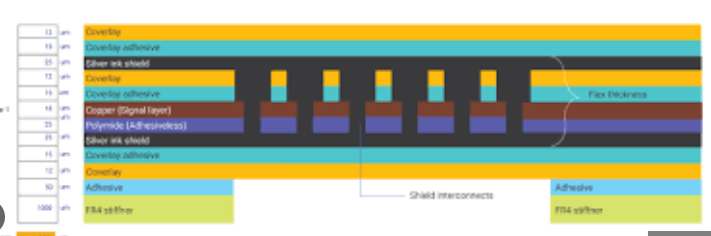
Moreover, the manufacturing process of shielded flex PCBs requires careful attention to detail.
The lamination process, in particular, must be precisely controlled to ensure proper adhesion of the shielding materials without introducing defects such as delamination or air gaps. Additionally, the etching and plating processes must be optimized to achieve the desired trace geometries and shielding patterns. Quality control measures, including rigorous testing for continuity, impedance, and shielding effectiveness, are essential to verify that the final product meets the required specifications.
In conclusion, the design of shielded flex PCBs involves a complex interplay of material selection, layout design, shielding techniques, thermal management, and manufacturing processes. Each of these factors must be carefully considered and optimized to achieve a high-performance, reliable, and flexible PCB that effectively mitigates EMI and RFI. By adhering to these design considerations, engineers can develop shielded flex PCBs that meet the stringent demands of modern electronic applications, ensuring the seamless operation of devices in increasingly challenging electromagnetic environments.
Common Applications Of Shielded Flex PCB In Industry
Shielded flexible printed circuit boards (PCBs) have become indispensable in various industrial applications due to their unique combination of flexibility, durability, and electromagnetic interference (EMI) shielding capabilities. These attributes make them particularly valuable in environments where space constraints and electronic noise are significant concerns.
One of the most prominent applications of shielded flex PCBs is in the aerospace industry.
Here, the need for lightweight and reliable components is paramount. Shielded flex PCBs are used in avionics systems, where they help to reduce the weight of the aircraft while ensuring that critical electronic systems are protected from EMI. This is crucial for maintaining the integrity of communication and navigation systems, which are essential for the safe operation of aircraft.
In the automotive industry, shielded flex PCBs are employed in various electronic control units (ECUs) and infotainment systems.
Modern vehicles are equipped with numerous electronic systems that require robust EMI shielding to function correctly. Shielded flex PCBs provide the necessary protection, ensuring that these systems operate without interference. Additionally, their flexibility allows for more efficient use of space within the vehicle, contributing to more compact and streamlined designs. This is particularly important in electric vehicles, where space and weight savings can directly impact the vehicle’s range and performance.
The medical field also benefits significantly from the use of shielded flex PCBs.
Medical devices, such as diagnostic equipment and wearable health monitors, require high levels of precision and reliability. Shielded flex PCBs help to minimize the risk of EMI, which can interfere with the accurate functioning of these devices. Moreover, their flexibility allows for the development of more ergonomic and patient-friendly designs, enhancing the overall user experience. For instance, in wearable health monitors, the use of shielded flex PCBs ensures that the device can comfortably conform to the contours of the body while maintaining its functionality.
In the telecommunications sector, shielded flex PCBs are integral to the development of high-frequency communication devices.
These devices, such as smartphones and base stations, require effective EMI shielding to maintain signal integrity and prevent data loss. Shielded flex PCBs provide the necessary protection, ensuring that these devices can operate efficiently in environments with high levels of electronic noise. Furthermore, their ability to bend and flex allows for more innovative and compact designs, which are essential in the ever-evolving telecommunications industry.
The industrial automation sector also leverages the advantages of shielded flex PCBs.
In manufacturing environments, where machinery and electronic systems are often in close proximity, EMI can pose a significant challenge. Shielded flex PCBs help to mitigate this issue, ensuring that automated systems can operate without interference. This is particularly important in precision manufacturing processes, where even minor disruptions can lead to significant defects and production delays. Additionally, the durability of shielded flex PCBs ensures that they can withstand the harsh conditions often found in industrial settings, such as exposure to chemicals and extreme temperatures.
In conclusion, shielded flex PCBs play a crucial role in a wide range of industrial applications. Their ability to provide effective EMI shielding, combined with their flexibility and durability, makes them an ideal choice for industries such as aerospace, automotive, medical, telecommunications, and industrial automation. As technology continues to advance, the demand for shielded flex PCBs is likely to grow, driven by the need for more reliable, efficient, and compact electronic systems.
How Shielded Flex PCB Enhances Signal Integrity
Shielded flex PCBs, or flexible printed circuit boards, have become increasingly vital in modern electronics due to their ability to enhance signal integrity. Signal integrity refers to the quality and reliability of electrical signals as they travel through a circuit. In an era where electronic devices are becoming more compact and complex, maintaining signal integrity is paramount. Shielded flex PCBs offer a robust solution to this challenge by incorporating shielding techniques that mitigate electromagnetic interference (EMI) and crosstalk, thereby ensuring the fidelity of the transmitted signals.
One of the primary advantages of shielded flex PCBs is their ability to reduce electromagnetic interference.
EMI is a common issue in electronic circuits, where unwanted electromagnetic waves can disrupt the normal operation of the device. This interference can originate from various sources, including other electronic components, power lines, and even external environmental factors. By integrating shielding layers within the flex PCB, these unwanted electromagnetic waves are effectively blocked or absorbed, preventing them from interfering with the signal pathways. This is particularly crucial in high-frequency applications where even minor disruptions can lead to significant performance degradation.
In addition to mitigating EMI, shielded flex PCBs also address the issue of crosstalk.
Crosstalk occurs when a signal transmitted on one circuit or channel creates an undesired effect on another adjacent circuit or channel. This phenomenon is especially problematic in densely packed electronic assemblies where multiple signal lines run in close proximity. Shielded flex PCBs employ various techniques, such as ground planes and shielding layers, to isolate signal lines from each other. This isolation minimizes the risk of crosstalk, ensuring that each signal remains distinct and uncorrupted by neighboring signals.
Furthermore, the flexibility of these PCBs offers additional benefits in terms of design and application.
Traditional rigid PCBs can be limiting in applications that require dynamic movement or complex geometries. Flex PCBs, on the other hand, can bend, twist, and fold, making them ideal for use in wearable electronics, medical devices, and other applications where space and flexibility are critical. The incorporation of shielding in these flexible circuits does not compromise their mechanical properties, allowing designers to achieve both signal integrity and physical adaptability.
Moreover, shielded flex PCBs contribute to the overall reliability and longevity of electronic devices.
By protecting the signal integrity, these PCBs help prevent data corruption and signal loss, which can lead to device malfunctions or failures. This reliability is particularly important in mission-critical applications such as aerospace, automotive, and medical industries, where the consequences of signal degradation can be severe. The enhanced durability and performance of shielded flex PCBs thus translate into more robust and dependable electronic systems.
In conclusion, shielded flex PCBs play a crucial role in enhancing signal integrity in modern electronic devices. By effectively mitigating electromagnetic interference and crosstalk, these PCBs ensure the reliable transmission of signals, which is essential for the optimal performance of electronic systems. Their flexibility further expands their applicability across various industries, providing both design versatility and mechanical resilience. As electronic devices continue to evolve, the importance of maintaining signal integrity will only grow, making shielded flex PCBs an indispensable component in the advancement of technology.