
A brief discussion on key materials for high-frequency microwave RF PCB circuit boards
The circuit materials of printed circuit boards (PCBs) are key building blocks of radio frequency (RF)/microwave circuits – essentially the starting point of these circuits. PCB materials come in many different forms, and the choice of materials depends largely on the requirements of the intended application.
For example, materials that reliably support high-frequency circuits in commercial wireless products may fail quickly when entering the extreme conditions of a military environment. A basic understanding of PCB material types and their parameters can help match materials to applications.
Like many RF/microwave components, PCB materials are classified and compared by a number of key parameters, including relative dielectric constant (Dk or εr), dissipation factor (Df), coefficient of thermal expansion (CTE), thermal coefficient of dielectric constant (TCDk), and thermal conductivity. When classifying different PCB materials, many circuit designers start with Dk. The Dk value of a PCB material refers to the capacitance or energy available between a pair of very close conductors fabricated on that material compared to the same pair of conductors in a vacuum.
A vacuum produces a reference value of 1.0, with other dielectric materials offering higher reference values.
For example, commercial PCB materials typically have Dk values ranging from about 2 to 10, depending on how they are measured and at what frequency they are tested. Conductors on materials with higher Dk values can store more energy than conductors on materials with lower Dk values.
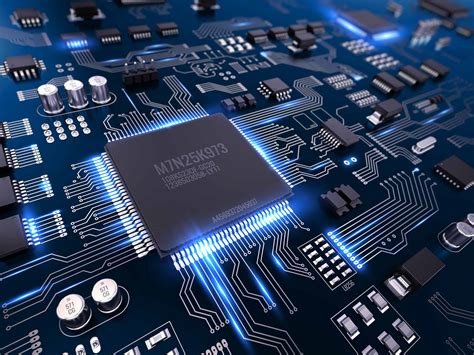
Printed Circuit Boards (PCBs)
The Dk value of a PCB material affects the size, wavelength, and characteristic impedance of a transmission line fabricated on that material.
For example, for a given characteristic impedance and wavelength, the size of a transmission line fabricated on a PCB material with a high Dk value will be much smaller than the size of a transmission line fabricated on a PCB material with a low Dk value, even though other material parameters may be different.
Designers of circuits where loss is a critical performance parameter often prefer PCB materials with lower Dk values because these materials have lower losses than materials with higher Dk values.
In practice, PCB materials can lose signal power in four ways: dielectric loss, conductor loss, leakage loss, and radiation loss, although dielectric loss and conductor loss can be better controlled by the choice of PCB material. For example, the Df parameter provides a way to compare the dielectric loss of different materials, with lower Df values indicating materials with lower dielectric loss.
For a given transmission line impedance (e.g., 50Ω), a transmission line on a low-Dk material will be physically wider than one on a high-Dk material, and wider transmission lines will also have lower conductor losses. These wider transmission lines can also translate into higher manufacturing yields (and production cost savings) than narrower transmission lines on higher-Dk materials.
However, the trade-off is that they take up more area on the PCB, which can be a problem for designs where miniaturization is critical.
The thickness of the PCB substrate, especially the thickness of its copper conductor layer, can also affect the impedance of the transmission line, with thinner dielectric materials and conductors producing narrower conductor widths to maintain the desired characteristic impedance.
PCB material conductors are often specified by copper weight, such as 1 oz. (35μm thick) copper or 2 oz. (70μm thick) copper.
The mass of these copper conductors can also affect conductor losses. Copper conductors with a rough surface will exhibit higher conductor losses than copper conductors with a smooth surface profile.
Maintaining the impedance of a transmission line is critical for many RF/microwave circuits, so controlling Dk to a narrow range across the PCB and over temperature is essential to achieving tight impedance in a design. Most PCB datasheets show the material’s Dk and its Dk tolerance, such as ±0.5.
Another important material parameter, TCDk, provides details on how much the PCB material’s Dk varies over the operating temperature range, as this also affects the impedance of the transmission line. A TCDk value of 150 ppm/°C might be considered high, while a TCDk value of 30 ppm/°C or less is considered low. For circuits that must maintain impedance over a wide operating temperature range, it is better to use a PCB material with a lower TCDk value.
In addition to the fact that temperature changes affect Dk and impedance, they can also have a mechanical effect on the PCB.
The CTE of a PCB is a parameter that attempts to show the effect of temperature on a PCB material. Essentially, it is a measure of the material’s expansion/contraction with temperature, and lower values are the goal. For example, materials such as polytetrafluoroethylene (PTFE) have long been used in high-frequency PCBs due to their excellent electrical properties, although pure PTFE has a high CTE (about 300 ppm/°C).
Some PCB material manufacturers, such as PTFE, use PTFE in their materials but add different filler materials to lower the CTE value.
It is important to note that the CTE of the PCB dielectric material should closely match the CTE of its conductors and other layers to minimize the mechanical effects of temperature changes.
PTFE Composite RT/duroid 6035HTC
This ceramic-filled PTFE composite RT/duroid 6035HTC has high thermal conductivity and can be used in high-power circuit applications
For any commercial PCB material, separate CTE values are usually listed for all three axes (x, y, and z). CTE provides some evidence of how the PCB material handles extreme temperatures, such as during the soldering process.
For example, mismatched CTE values of materials used in multilayer structures can lead to reliability issues because the dimensions of different circuit layers change with temperature. PCB materials with lower CTE values are generally considered to be more thermally stable than those with higher CTE values. In terms of use over a wide temperature range, a CTE of 70 ppm is Circuit materials that are 100 W/m/°C or higher are considered fairly rugged and should be able to handle the extreme temperatures of circuit fabrication and assembly.
The CTE of a PCB material should closely match that of copper in both the x- and y-axes to minimize changes in mechanical stress with temperature.
Additionally, the CTE of the circuit material in the z-axis provides insight into the expected reliability of plated through holes (PTHs) that will be formed through the dielectric material, since these drilled holes are plated with copper. Ideally, the dielectric material and copper will expand and contract with temperature in a similar manner to achieve high reliability for the PTHs.
Heat dissipation in RF/microwave circuits (particularly for high-power designs) is an important function that is characterized by the thermal conductivity of the PCB.
While standard PCB materials may have a thermal conductivity of 0.25 W/m/K, fillers are often added to PCB materials to increase the thermal conductivity to more favorable values (and better heat dissipation capabilities). For example, RO4350B is a hydrocarbon/ceramic PCB material from Rogers Corp. that has long been a reliable building block material for high-frequency applications, including automotive and cellular communication systems.
RO4350B is not based on PTFE, but is a 10 The z-axis Dk at GHz is relatively low at 3.48 ± 0.05, TCDk is +50 pm/°C, and the dissipation factor is 0.0037. It has a reasonably good thermal conductivity of 0.69 W/m/K. In contrast, RT/duroid 6035HTC, also from Rogers, is a ceramic-filled PTFE composite specifically formulated for high-power, high-frequency circuits with a Dk of 3.50 ± 0.05, a TCDk of +50 ppm/°C, and a low dissipation factor of 0.0013. It has excellent thermal conductivity, with a typical value of 1.44W/m/K.
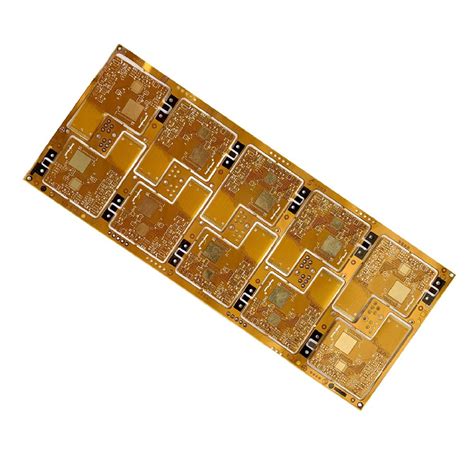
RF/Microwave PCBs
The materials used for RF/microwave PCBs range from low-cost FR-4 materials to expensive PTFE-based materials. Circuit boards composed of FR-4 materials are essentially laminates of glass-reinforced epoxy, while PTFE materials are usually reinforced with glass fiber or ceramic filler materials (although pure PTFE-based PCBs are also used). The difference in performance between these two extreme materials points to the trade-offs that must be made in PCB materials between cost and performance, and between the ease of processing of FR-4 and the difficulty of processing PTFE materials.
Excellent circuit performance often comes at a high price, although many PCB material suppliers have invested significant effort in developing a variety of composite materials with different Dk values for use in a variety of RF/microwave applications.