
Changing the Design Approach
Smart, Long-Term Solutions
Balancing good design practices with your business to protect your company’s future growth is a challenging process. In the past, electronics designers have maintained their competitive advantage by seeing when the industry is about to change and becoming smart business people before becoming developers and system architects. While technology innovations continue to push the design process forward, they must still be widely accepted by the industry before they become mainstream technologies.
What has changed is the level of complexity that all this innovation has brought. Electronic product design has become more mature, and the drive to market product technologies has increased. The pressure is not only to deal with this increasing complexity, but also to find smart, long-term solutions to maintain this competitive advantage and protect this growth.
Changing the Design Approach
Since the advent of the microprocessor, many improvements have made products smaller and faster, and the design complexity has increased accordingly. The result is that designing electronic products is no longer an easy task – it has become a question of how to innovatively manage the growing design complexity. Unfortunately, electronic design and development tools have not experienced such unprecedented rapid changes. Yesterday’s solutions no longer meet our needs, and today’s design methodologies are reaching a point of diminishing returns.
The danger we face is that managing complexity has diverted our attention from innovative design. The impact is multifaceted, as currently available device technologies and market demands are together moving us beyond the scalability of existing design methodologies and tools. Looking through existing options, we have only a few choices, most of which do not rely on any form of protection for future growth or growth potential. Improving the feature set of existing tools will only make the integration process more complex and difficult, while hiring engineers with the appropriate skills is expensive and time-consuming.
It’s too late to embark on an electronic development reassessment. Perhaps the biggest obstacle is in our minds and how we perceive the difference between hardware and software.
It all comes down to: a software problem
The solution to the complexity development problem is to raise the level of abstraction at which board-level engineers perform their design work by hiding the complexity from the designer. This allows for new ways to approach larger systems without extending the development time of the same integrated circuit, such as by reducing complexity at the board level and at the high-level programming language level that simplifies the work of software engineers. The innovation here is to shift the focus from hardware to software without increasing development time.
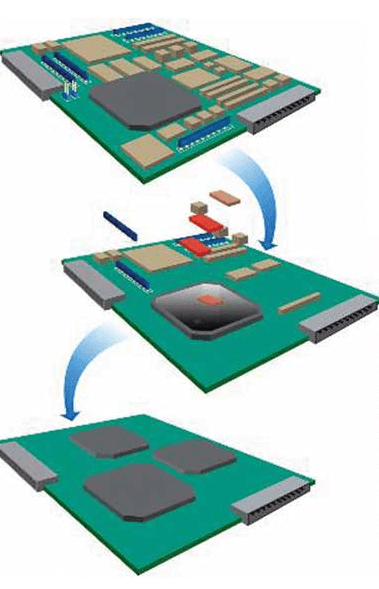
Figure 1 PCB to FPGA flow chart
As the boundary between hardware and software becomes increasingly integrated, design is no longer based solely on hardware. Low-cost, high-capacity FPGAs have the potential to change the way we design by making what was once part of the physical hardware integrated into the device now a programmable part. This “soft design” focuses attention on electronic product development, so it is logical, separates the device intelligence from the physical hardware being programmed, and avoids many of the electronic pitfalls that have long been associated with hardware-dependent solutions, such as the inability to easily make any changes at the end of development.
Software combined with hardware then becomes an inherent part of the new unified design paradigm. Many reconfigurable hardware platforms are driving a redefinition of the electronics development paradigm and illustrate the growing importance of the potential of “soft design”.
The evolution of electronics has seen discrete devices make microprocessors possible and then FPGAs possible. The recent great development of programmable hardware has the potential to extend the concept of greater integration to a wider range of electronics applications.
A new view of hardware
This approach allows us to explore many technologies beyond the existing ones, and all that is needed is a suitable design environment. Until now, the view of electronic design has been fragmented and focused on the device, and the development tools have followed this pattern. The general view of printed circuit board design is based on the choice of processor or FPGA to be configured on it. For example, using traditional hardware methods and tools, trying to improve the performance of the system without going through the inevitable and painful process of rewriting low-level code or bringing in efficient algorithms. This is time-consuming and expensive. But until now, the design of the hardware platform (that is, the incorporation of all pre-built circuits, including microprocessors and logic chips) has been a process independent of the creation of actual device intelligence.
Taking a “soft” approach brings some major advantages, such as more comprehensive design synchronization, design reuse and a unified approach. Because designers can mix their hardware and software methods without having to build hardware to support the design functionality and without having to think too much about it, a higher level of abstraction and design automation can be more effectively used. No longer is there a need to “fix” hardware platform designs before software development begins, nor is there a need to spend time and effort making minor changes within a tight development cycle. Instead, an iterative design approach allows for multiple experiments and “what if” scenarios to be developed without increasing design time. Attention, effort, and resources can be shifted to higher-level design practices, which are where the value lies. All that is needed to enable this development process is the right design environment.
Solutions that are as generic as possible
Of the solutions available, most are vendor-specific point tools that rarely reach their full potential if deployed as part of a unified, integrated design process within a company. Electronic design can really benefit from new thinking, such as integrating mutually beneficial technologies into a single design environment rather than several separate design environments. By allowing all aspects of electronic product development to be designed and managed in a single system, mainstream development efforts are greatly facilitated, thereby accelerating the transition from design to product. New innovative designs cannot be achieved using traditional point tools, and more new design processes should be considered.