
The Evolution and Design Considerations of Drone PCBs
Introduction to Drone PCB Technology
Printed Circuit Boards (PCBs) form the fundamental backbone of modern drone technology, serving as the central nervous system that integrates all electronic components into a cohesive flying machine. As drone applications have expanded from recreational use to commercial, industrial, and military applications, the demands on drone PCB technology have grown exponentially in terms of complexity, reliability, and performance.
The drone PCB market has seen remarkable growth alongside the expansion of the unmanned aerial vehicle (UAV) industry. Valued at approximately $1.2 billion in 2022, the global drone PCB market is projected to reach $3.8 billion by 2030, growing at a compound annual growth rate (CAGR) of 15.4%. This growth reflects both the increasing adoption of drone technology across sectors and the continuous innovation in PCB design that makes advanced drone capabilities possible.
Fundamental Components of Drone PCBs
Flight Controller Board
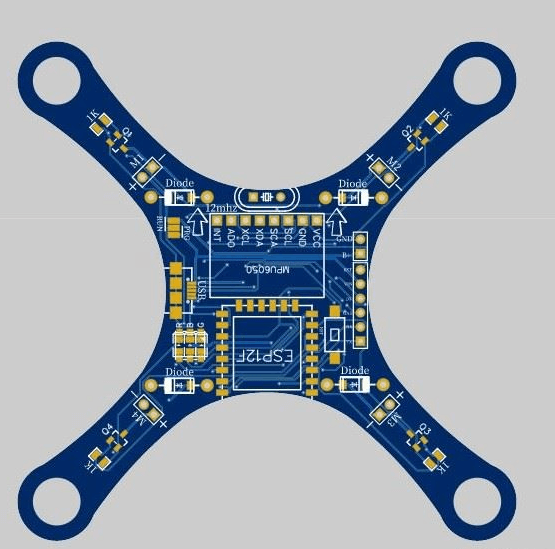
At the heart of every drone’s electronic system lies the flight controller board, essentially the “brain” of the UAV. This sophisticated PCB integrates multiple critical functions:
- Microcontroller Unit (MCU): Typically an ARM-based processor running at frequencies between 100-400MHz
- Inertial Measurement Unit (IMU): Combines accelerometers, gyroscopes, and often magnetometers
- Barometric pressure sensor for altitude maintenance
- Multiple communication interfaces (I2C, SPI, UART)
- PWM outputs for motor control
Modern flight controllers use high-density interconnect (HDI) PCBs with 6-8 layers to accommodate the complex routing requirements while maintaining minimal size and weight. The STM32 series of microcontrollers dominate this segment due to their balance of performance and power efficiency.
Power Distribution Board (PDB)
The PDB serves as the central hub for power management in a drone, responsible for:
- Distributing power from the main battery to all subsystems
- Incorporating voltage regulators for components requiring different voltage levels
- Often including battery monitoring circuitry
- Providing clean power to sensitive components like the flight controller and cameras
High-current PDBs for racing or professional drones may need to handle bursts of over 100A, requiring thick copper layers (2-4oz) and proper thermal management.
Electronic Speed Controller (ESC) Board
ESC boards have evolved significantly from simple motor drivers to sophisticated control systems:
- Modern ESCs use 32-bit processors instead of 8-bit
- Support communication protocols like DShot for faster, more reliable signal transmission
- Incorporate current sensing for telemetry and protection
- Utilize high-power MOSFETs in optimized layouts to minimize switching losses
The trend toward 4-in-1 ESC boards (combining all four motor controllers on a single PCB) has improved reliability and reduced weight but presents significant thermal management challenges.
Advanced PCB Technologies in Modern Drones
High-Density Interconnect (HDI) PCBs
As drones shrink in size while increasing in capability, HDI technology has become essential:
- Microvias with diameters as small as 50μm enable complex routing
- Sequential lamination processes allow for ultra-high component density
- Fine-pitch components (down to 0.4mm pitch) are now common
- Blind and buried vias save space and improve signal integrity
HDI PCBs are particularly crucial for compact consumer drones like those from DJI, where the entire flight controller, image processing system, and communication modules must fit in a space no larger than a credit card.
Flexible and Rigid-Flex PCBs
The unique mechanical requirements of drones have driven adoption of flexible circuit technologies:
- Flexible PCBs enable compact packaging in gimbal systems
- Rigid-flex designs combine the benefits of both technologies
- Dynamic flexing applications require careful material selection
- 3D packaging possibilities reduce overall system volume
Flexible PCBs are particularly valuable in camera systems and folding drone designs where constant movement would fatigue traditional wiring harnesses.
RF and Antenna Integration
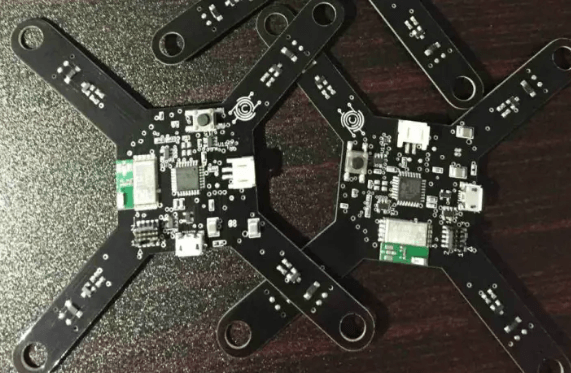
Modern drone PCBs must incorporate sophisticated RF capabilities:
- Cellular (4G/5G) connectivity for beyond visual line of sight (BVLOS) operation
- GPS/GNSS receivers with high sensitivity
- Multiple radio control links (2.4GHz, 5.8GHz)
- Often WiFi and Bluetooth for local connectivity
Advanced PCB techniques for RF include:
- Careful impedance control (typically 50Ω for RF lines)
- Ground plane optimization to prevent interference
- Antenna design directly on PCB (printed antennas)
- Shielding strategies for sensitive components
Design Considerations for Drone PCBs
Weight Optimization
Every gram matters in drone design, driving several PCB strategies:
- Use of thin core materials (down to 0.2mm)
- Minimization of PCB area through careful component placement
- Selection of lightweight components and connectors
- Elimination of unnecessary layers where possible
- Hollow via techniques to reduce weight
Thermal Management
The combination of high-power electronics in compact spaces creates thermal challenges:
- Thermal via arrays under power components
- Copper balancing to prevent warping during reflow
- Strategic placement of heat-generating components
- Consideration of thermal expansion coefficients
- Potential integration of heat spreaders or sinks
Vibration and Shock Resistance
Drones operate in high-vibration environments requiring robust designs:
- Proper component securing (corner adhesives for large components)
- Vibration-resistant solder joint design
- Mechanical reinforcement of critical areas
- Conformal coating to protect against environmental factors
- Strain relief for connectors and wiring
Electromagnetic Compatibility (EMC)
The dense electronic environment in drones requires careful EMC design:
- Proper grounding strategies (star grounding often preferred)
- Segregation of analog and digital sections
- Careful routing of high-speed signals
- Use of guard traces for sensitive analog signals
- Appropriate filtering on all I/O lines
Manufacturing and Testing Challenges
Quality Assurance
The consequences of PCB failure in flight demand rigorous quality control:
- Automated optical inspection (AOI) for all boards
- X-ray inspection for BGA components and hidden joints
- Flying probe testing for electrical verification
- Functional testing under simulated operating conditions
- Burn-in testing for critical components
Environmental Considerations
Drone PCBs must withstand various environmental conditions:
- Conformal coating for moisture protection
- Material selection for temperature extremes (-20°C to +60°C typical)
- UV-resistant materials for outdoor applications
- Corrosion-resistant finishes (ENIG or immersion silver common)
Supply Chain Factors
The drone industry’s rapid evolution presents supply chain challenges:
- Component obsolescence management
- Lead time considerations for rapid product iteration
- Dual-sourcing strategies for critical components
- Localized manufacturing for some segments
Future Trends in Drone PCB Technology
Integration and Miniaturization
The ongoing trend toward greater integration continues:
- System-in-Package (SiP) solutions combining multiple ICs
- Embedded components within PCB layers
- 3D packaging technologies
- Even higher density interconnects
Advanced Materials
New materials are enabling better drone PCBs:
- High-frequency laminates for improved RF performance
- Thermally conductive substrates for better heat dissipation
- Flexible hybrid electronics combining printed and conventional components
- Nanomaterials for enhanced reliability
Smart PCBs
The future may see more intelligence built into the PCB itself:
- Embedded sensors for structural health monitoring
- Self-diagnostic capabilities
- Adaptive circuits that can reconfigure based on conditions
- Energy harvesting integration
Conclusion
Drone PCB technology has evolved from simple boards supporting basic flight to highly sophisticated systems enabling autonomous operation, advanced imaging, and reliable communication. As drone applications continue to expand into areas like urban air mobility, advanced surveillance, and precision agriculture, the demands on PCB technology will only increase.
The successful design and manufacture of drone PCBs requires balancing often conflicting requirements: miniaturization versus thermal performance, high-speed signals versus EMC concerns, lightweight construction versus rugged reliability. Meeting these challenges requires not only advanced PCB technologies but also a deep understanding of drone operation and the specific mission requirements.
Looking ahead, we can expect drone PCBs to continue pushing the boundaries of electronics packaging, incorporating more functions into smaller spaces while improving reliability and performance. The ongoing innovation in this field will play a crucial role in enabling the next generation of drone capabilities, from swarming micro-drones to long-endurance UAVs serving as flying base stations or delivery platforms. As such, drone PCB technology remains a critical enabler for the broader UAV revolution across commercial, industrial, and consumer markets.