
What Causes White Residue or Blooming in PCB Conformal Coating?
Abstract
Conformal coating is widely used in printed circuit board (PCB) assembly to protect electronic components from moisture, dust, chemicals, and mechanical stress. However, a common issue encountered in conformal coating applications is the appearance of white residue or “blooming” on the coated surface. This phenomenon not only affects the aesthetic quality of the PCB but may also indicate underlying problems that could compromise the coating’s protective properties. This article explores the primary causes of white residue formation in PCB conformal coatings, including environmental factors, material incompatibility, improper curing, and contamination. Additionally, preventive measures and solutions are discussed to ensure optimal coating performance.
1. Introduction
Conformal coatings, such as acrylic, silicone, urethane, and epoxy-based formulations, are applied to PCBs to enhance their reliability in harsh environments. However, improper application or environmental conditions can lead to defects such as white haze, discoloration, or crystalline deposits. Understanding the root causes of these issues is essential for maintaining coating integrity and ensuring long-term PCB functionality.
2. Common Causes of White Residue in Conformal Coatings
2.1. Moisture and Humidity Exposure
One of the most frequent causes of white residue is moisture contamination during or after the coating process.
- Condensation Before Curing: If the PCB is exposed to high humidity before the coating fully cures, moisture can become trapped, leading to a milky or hazy appearance.
- Incomplete Drying: Water-based conformal coatings are particularly susceptible to white residue if not dried properly before curing.
2.2. Improper Curing Conditions
- Insufficient Cure Time or Temperature: If the coating does not cure completely due to low temperature or insufficient UV/heat exposure, uncured solvents may migrate to the surface, causing whitening.
- Rapid Curing in High Humidity: Fast curing in humid conditions can cause moisture entrapment, leading to blooming.
2.3. Contamination on the PCB Surface
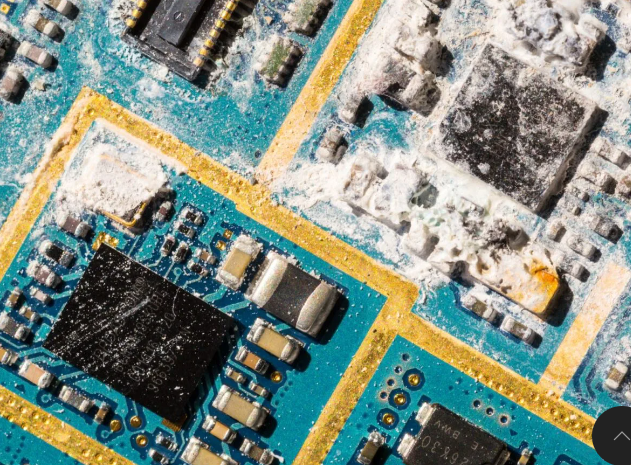
- Flux Residues: No-clean or rosin-based fluxes that are not fully removed can react with the coating, forming white crystalline deposits.
- Oils and Fingerprints: Human skin oils or machine lubricants left on the PCB can interfere with coating adhesion and cause discoloration.
- Cleaning Agent Residues: Improper rinsing of cleaning solvents (e.g., isopropyl alcohol) may leave behind residues that react with the coating.
2.4. Material Incompatibility
- Silicone Migration: If silicone-based adhesives or lubricants are present on the PCB, they can migrate into the conformal coating, causing a cloudy appearance.
- Plasticizer Leaching: Some PCB substrates or components may release plasticizers that interact negatively with the coating.
2.5. Coating Thickness and Application Issues
- Excessive Coating Thickness: Thick coatings may not cure uniformly, leading to solvent entrapment and whitening.
- Improper Spray Technique: Uneven spraying can cause pooling, which increases the risk of moisture absorption and blooming.
2.6. Thermal and Chemical Exposure
- Thermal Shock: Sudden temperature changes can cause micro-cracks, allowing moisture ingress and subsequent white residue formation.
- Chemical Exposure: Harsh chemicals (e.g., cleaning agents) may degrade the coating, leading to discoloration.
3. Preventive Measures and Solutions
3.1. Control Environmental Conditions
- Maintain a controlled humidity level (ideally below 60% RH) during coating application and curing.
- Use dehumidifiers or nitrogen blankets in high-humidity environments.
3.2. Ensure Proper Cleaning and Surface Preparation
- Remove all flux residues using appropriate cleaning methods (e.g., ultrasonic cleaning with compatible solvents).
- Avoid touching the PCB with bare hands; use gloves to prevent oil contamination.
3.3. Optimize Curing Parameters
- Follow the manufacturer’s recommended curing time and temperature.
- For UV-curable coatings, ensure sufficient UV exposure and post-curing if necessary.
3.4. Select Compatible Materials
- Verify that the conformal coating is compatible with PCB substrates, solder masks, and other materials.
- Avoid mixing silicone-based products with non-silicone coatings unless explicitly approved.
3.5. Improve Coating Application Techniques
- Apply thin, uniform layers to ensure proper curing.
- Use automated spraying or selective coating systems for consistency.
3.6. Post-Coating Inspection and Rework
- Inspect coated PCBs under UV light (for fluorescent coatings) or visual inspection for defects.
- If white residue appears, consider rework by stripping and reapplying the coating after identifying the root cause.
4. Conclusion
White residue in PCB conformal coatings is a multifactorial issue influenced by environmental conditions, material compatibility, curing processes, and contamination. By understanding these causes and implementing proper preventive measures, manufacturers can minimize defects and enhance the reliability of coated PCBs. Ensuring proper surface preparation, controlled application conditions, and optimized curing parameters are key to achieving a high-quality conformal coating finish.