
Application Scenarios and Advantages Analysis of Embedded Resistors in PCB Boards
Abstract
With the rapid development of electronic devices toward miniaturization, high-speed performance, and high reliability, traditional surface-mounted resistors face challenges in meeting the demands of high-density and high-frequency circuits. Embedded resistors, integrated within the printed circuit board (PCB) substrate, offer significant advantages in space savings, signal integrity, and manufacturing efficiency. This paper explores the application scenarios of embedded resistors in modern electronics and analyzes their key benefits compared to conventional resistor technologies.
1. Introduction
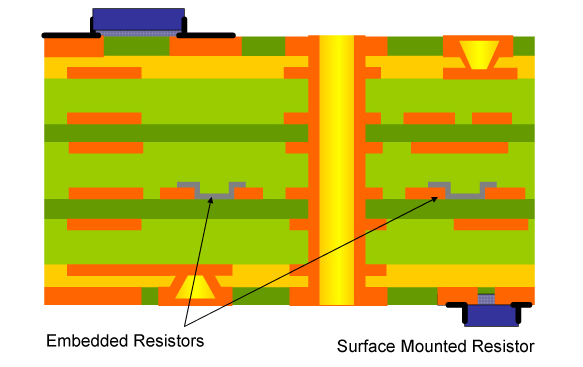
Printed circuit boards (PCBs) are fundamental components in electronic devices, providing mechanical support and electrical connections for various components. Traditional resistors are mounted on the PCB surface, occupying valuable space and introducing parasitic effects that degrade high-frequency performance. Embedded resistors, fabricated directly within the PCB layers, eliminate many of these limitations.
This article examines the primary applications of embedded resistors and their advantages in modern electronics, including consumer electronics, telecommunications, automotive systems, and aerospace.
2. Application Scenarios of Embedded Resistors
2.1 High-Density Consumer Electronics
Modern smartphones, tablets, and wearables require compact designs with minimal component footprint. Embedded resistors reduce the need for surface-mounted devices (SMDs), allowing for higher component density and thinner PCB stacks.
- Smartphones: Used in RF circuits, power management, and high-speed data lines.
- Wearables: Enable ultra-thin designs in smartwatches and health monitors.
2.2 High-Speed and High-Frequency Circuits
In high-frequency applications, parasitic inductance and capacitance from traditional resistors can degrade signal integrity. Embedded resistors minimize these effects, improving performance in:
- 5G Communication: Used in antenna matching networks and signal conditioning.
- High-Speed Digital Circuits: Reduce signal reflections in DDR memory and SerDes interfaces.
2.3 Automotive Electronics
Automotive PCBs require high reliability under harsh conditions (temperature variations, vibrations). Embedded resistors enhance durability by eliminating solder joint failures.
- Engine Control Units (ECUs): Improve signal stability in sensor networks.
- Advanced Driver Assistance Systems (ADAS): Enhance high-frequency signal processing.
2.4 Aerospace and Defense Systems
Embedded resistors are critical in aerospace due to their resistance to mechanical stress and radiation.
- Avionics: Used in flight control and communication systems.
- Satellite Electronics: Improve reliability in extreme environments.
2.5 Medical Electronics
Medical devices demand high precision and reliability. Embedded resistors contribute to:
- Implantable Devices: Reduce size and improve longevity.
- Diagnostic Equipment: Enhance signal accuracy in high-frequency circuits.
3. Advantages of Embedded Resistors
3.1 Space and Weight Reduction
By integrating resistors into PCB layers, designers save surface area, enabling more compact and lightweight devices—critical for portable electronics and aerospace applications.
3.2 Improved Signal Integrity
- Reduced Parasitic Effects: Lower inductance and capacitance compared to SMD resistors.
- Controlled Impedance: Better high-frequency performance in RF and high-speed digital circuits.
3.3 Enhanced Reliability
- No Solder Joints: Eliminates failure risks from thermal cycling and mechanical stress.
- Better Thermal Management: Heat dissipation through PCB layers improves longevity.
3.4 Simplified Assembly Process
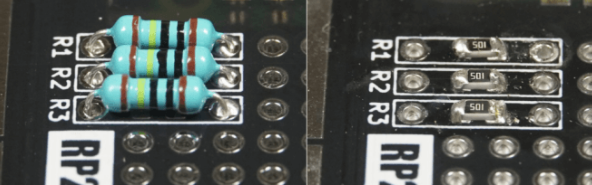
- Fewer Surface Components: Reduces pick-and-place assembly steps.
- Lower Defect Rates: Minimizes soldering-related defects.
3.5 Cost Efficiency in High-Volume Production
While initial fabrication costs may be higher, embedded resistors reduce assembly time and improve yield in mass production.
4. Challenges and Considerations
Despite their advantages, embedded resistors present some challenges:
- Design Complexity: Requires precise material selection and fabrication control.
- Limited Adjustability: Once embedded, resistance values cannot be modified.
- Higher Initial Costs: Specialized materials and processes increase upfront expenses.
5. Future Trends
Advancements in materials (e.g., thin-film and polymer-based resistors) and fabrication techniques (laser trimming, additive manufacturing) will further enhance embedded resistor performance and adoption.
6. Conclusion
Embedded resistors offer significant benefits in miniaturization, signal integrity, and reliability, making them indispensable in modern high-performance electronics. As technology evolves, their adoption will expand across industries, driving innovation in PCB design and manufacturing.